
Trigger Points Explained: What They Are and How to Treat Them
A trigger point is a tender, taut spot in a skeletal muscle, often called a “knot.” Pressing on it hurts locally, and it can also send pain to another part of the body. That second feature is what sets it apart from ordinary soreness. The International Continence Society’s terminology group defines it as a tender, taut band of muscle that can hurt on its own or when stimulated, and notes that local or referred pain may be reproduced.
Below, we cover what happens inside the muscle, why your shoulder knot can give you a headache, the difference between active and latent points, what the research supports, and when it is worth booking a hands-on visit.
TL;DR
- A trigger point is a hyperirritable spot in a taut band of muscle. It hurts when pressed and may refer pain elsewhere.
- Common drivers are acute injury, repetitive micro-trauma, poor posture and prolonged muscle stress.
- Active points refer pain and can hurt at rest. Latent points hurt only under direct pressure. The difference changes how firmly a clinician should treat them.
- Manual therapy has moderate evidence for myofascial pain. Evidence that dry needling or cupping beats sham treatment is mixed.
- Aggressive self-treatment in sensitive areas like the front of the neck can injure nerves. If a knot keeps coming back, get it assessed.
Table of Contents
- What a trigger point actually is
- Why pain shows up somewhere else
- Active vs. latent trigger points
- What causes trigger points to flare up
- How trigger points are found
- What treatment options exist, and what the evidence says
- Can trigger points be massaged out?
- A note for athletes: timing matters
- Our perspective
- When to book a hands-on visit
- How we can help in Plano
- FAQ
- Sources
What a trigger point actually is
Picture a muscle as a bundle of fibers that normally contract and relax together. In a trigger point, a small segment of that bundle stays tight. You can often feel it as a firm band with a pea-sized nodule inside, and pressing it reproduces a pain you recognize.
The idea goes back to Dr. Janet Travell, who described these “knots” in 1942. The StatPearls entry on trigger point injection says they may form after acute trauma or after repeated micro-trauma that stresses the muscle fibers.
A 2024 review of trigger point theory frames chronic muscle pain as a significant public health burden. One leading explanation is that the tight segment has poor blood flow and an energy shortfall, which keeps the fibers contracted and irritates the surrounding tissue.
Honesty matters here. Nobody fully knows how trigger points form. National Geographic’s overview of trigger point locations and symptoms says so directly. The ICS group also notes that “trigger point” is not a universally accepted diagnosis, and some medical organizations consider the underlying theory controversial. We think that is worth knowing, because it explains why different clinicians use different words for similar findings.
Why pain shows up somewhere else
Referred pain is the signature of a true trigger point. A knot in the upper trapezius, the muscle between your neck and shoulder, can produce a headache behind the eye. A tight spot in the buttock can feel like pain running down the leg, which is why people sometimes assume they have a disc problem when the muscle is the source.
The nervous system is part of the story. According to the National Geographic piece, Dr. Jennifer Hankenson explains that localized muscle stress causes chemical changes that sensitize pain receptors, so the pain can be out of proportion to the injury. She also stresses early management, because ongoing local sensitization can progress into central sensitization, where the nervous system stays chronically hyper-responsive.
That is the practical reason not to wait out a knot that has lasted for months.
Active vs. latent trigger points
Clinicians usually split trigger points into two groups, and the ICS terminology discussion draws the same line.
| Active trigger point | Latent trigger point | |
|---|---|---|
| Pain at rest | Often yes | Usually no |
| Pain on pressure | Yes, and may refer elsewhere | Yes, tender only under direct pressure |
| Reproduces your familiar complaint | Typically | Usually not |
| Treatment intensity | Often needs a careful, graded approach | May need little or just monitoring |
Latent points are common and may show up on anyone who is examined carefully. They can still limit range of motion or add stiffness, and they can become active under stress, a heavy training block or a long stretch at a desk.
Trigger points are not the same as tender points
The Delphi-style terminology work behind the ICS page makes a point many articles skip: “trigger point” is often used as a synonym for “tender point” or general muscle ache. They are different. A true trigger point refers pain when stimulated. A tender point hurts where you press and nowhere else. Getting the term right matters, because the treatment plan differs.
What causes trigger points to flare up
The research summary we work from lists acute injury, repetitive micro-trauma, poor posture and prolonged muscle stress as the usual triggers. National Geographic adds stress, anxiety and even vitamin deficiencies as possible contributors. In everyday life that tends to look like this:
- Desk and screen work. Hours with the head forward and shoulders rounded load the neck and upper back muscles continuously.
- Repetitive tasks. Keyboard and mouse work, assembly work, lifting, hair styling or carrying a toddler on one hip all stress the same fibers again and again.
- Training errors. A sudden jump in mileage, volume or intensity can overload a muscle faster than it adapts.
- Old injuries. Guarding a sore ankle or knee can overwork muscles higher up the chain.
- Stress. Many people clench the jaw and raise the shoulders without noticing.
Students hunched over laptops, parents juggling car seats and groceries, and weekend athletes all show up in this list, which is why trigger points are among the most common reasons people look for hands-on care.
How trigger points are found
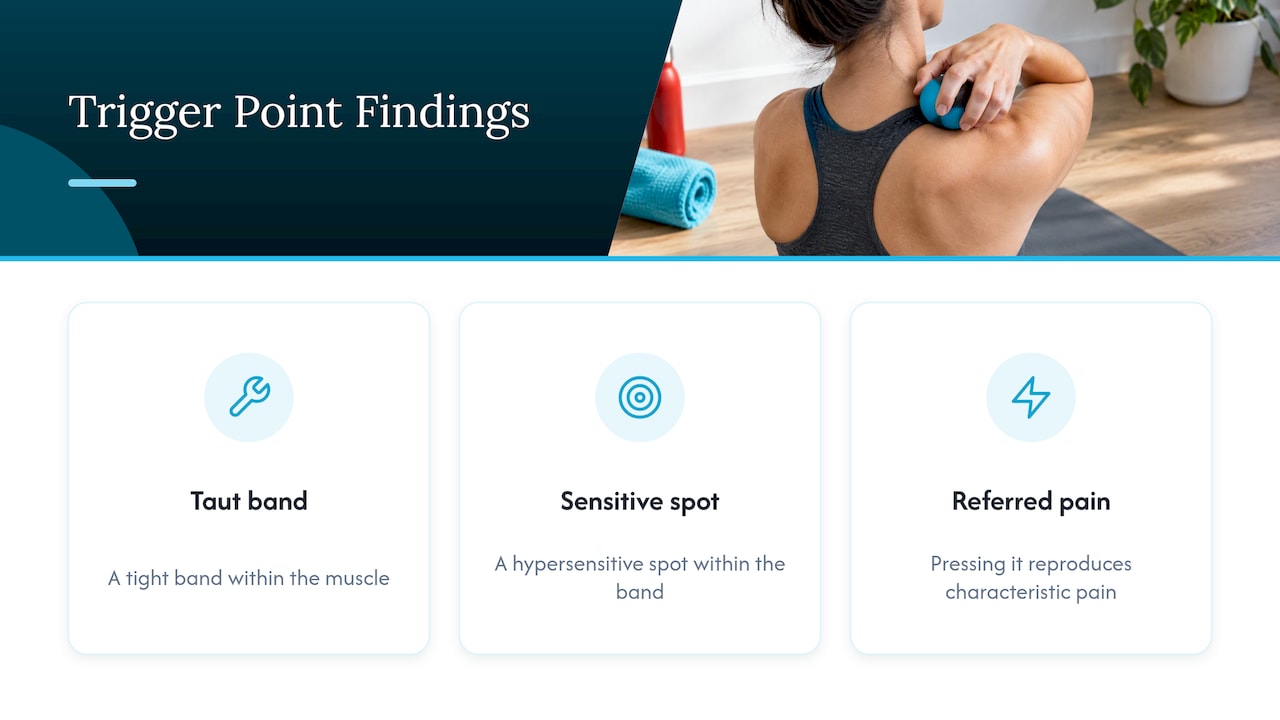
There is no scan that reliably shows a trigger point. Diagnosis rests on the hands and the history. The research summary describes three findings: a taut band, a hypersensitive spot within it, and characteristic referred pain when you press it. A good clinician also asks what you do all day, what you were doing when it started, and what makes it better or worse.
A hands-on exam also checks whether something else is going on. Referred pain from a muscle can mimic joint, disc or nerve problems, and sometimes more than one is present. For example, a cervicogenic headache can involve neck joints and muscles together, and facet joint irritation can sit alongside a tight, tender muscle band.
What treatment options exist, and what the evidence says
Here is where we try to be careful rather than promotional. The evidence is better for some approaches than others.
Manual therapy
A 2019 systematic review found moderate evidence supporting manual therapy for myofascial pain compared with other techniques. The same review found the evidence that specialized modalities such as dry needling or cupping beat placebo or sham is mixed. That does not mean they never help. It means the quality of proof is weaker, and a clinician should be upfront about it.
Manual approaches include sustained pressure on the point, soft tissue mobilization, myofascial release and myotherapy. On our site we explain what the research says about myotherapy and how myofascial release fits into a rehab plan.
Dry needling
Dry needling places a thin filament into the tight band without injecting anything. A 2026 systematic review and meta-analysis of adverse events found minor effects such as bruising or soreness in anywhere from 0% to 48.15% of treatments, while major adverse events ranged from 0% to 0.43% per treatment. Short-term trials suggest it can reduce pain intensity and improve disability scores in chronic neck or low back pain. A systematic review focused on low back pain looked at myofascial pain and dry needling specifically.
Safety depends on training. The American Physical Therapy Association supports dry needling within scope of practice when the clinician has appropriate education. Because rare but serious risks such as pneumothorax exist, it expects knowledge of anatomy, informed consent and constant communication during the procedure. Ask any provider about their training before you agree.
Instrument-assisted and shockwave approaches
Tools can reach tissue that fingers cannot, but technique matters. A commentary on instrument-assisted soft-tissue mobilization notes there is still no consensus on clinical standards such as indications, precautions and contraindications. Modern practice has moved away from treating bruising as a goal. If a provider tells you that heavy bruising is the point, that is a reason to ask more questions.
Injections
Trigger point injections are another option, typically handled by a physician. The StatPearls overview is a good neutral reference if your doctor suggests one.
Can trigger points be massaged out?
Sometimes they ease with sustained pressure, and that is why many people get relief from a foam roller or a massage ball. But there are two caveats.
Location matters. A case report in Acute cervical radiculopathy after anterior scalene muscle massage describes nerve root injury after deep massage of a muscle at the front of the neck, noting particular care for underweight patients. Delicate regions near the neck, throat and armpit are not the place for hard self-work.
Cause matters. Rubbing a knot that your desk setup or training load recreates every day gives short relief. The point returns until the load changes. That pattern is the signal that you should have it examined rather than keep pressing harder.
A reasonable at-home approach for a new, mild knot in a large, forgiving muscle such as the upper back or glute: use gentle to moderate pressure, stop if you feel tingling, numbness or sharp radiating pain, and change the habit that fed it. If the symptoms are in your neck or come with arm numbness, weakness, or a headache unlike any you have had, see a clinician rather than self-treating.

A note for athletes: timing matters
Many athletes ask whether to work on knots before competing. A systematic review of pre-performance massage of nine crossover trials, most of them low quality, found no evidence that it improves strength, sprint or jump performance in young healthy athletes. The review also suggests that long passive massage, over about nine minutes, right before performance may reduce strength, speed and jump output.
So save the deeper manual work for recovery and rehabilitation phases. Before a event, keep it short and light, or skip it.
Our perspective
At The Tx Room in Plano, we see trigger points most often in people who have already tried the obvious things: stretching, a massage, a few rounds of generic rehab. The pattern is familiar. The knot eases for a day, then returns, because the tissue around it is still restricted and the movement pattern that overloaded it has not changed.
Our approach is hands-on. We use the Fascial Distortion Model alongside myotherapy and individualized rehabilitation plans, and we focus on cases that have not improved with standard medical or physical therapy approaches. We do not claim trigger points are fully understood, and we do not think one technique fits everyone. We start with an exam, work out whether the pain is muscular, joint-related or both, and then match the treatment to what we find.
We also think patients deserve plain talk about evidence. Manual therapy has the stronger research behind it for myofascial pain. When we use other tools, we say what they are for and what the research does and does not show.
— Chris
When to book a hands-on visit
Think about an exam if any of these fit:
- The same knot has come back for more than a few weeks despite stretching or rolling.
- Pain refers into your head, arm or leg and interferes with sleep or work.
- You are training and a tight spot keeps limiting your range or output.
- A desk, repetitive task or parenting load recreates the pain every day.
- You suspect something more than a muscle, such as sciatica or a joint problem.
See an emergency provider promptly for sudden severe weakness, loss of bladder or bowel control, chest pain, or a headache that is the worst of your life. Those are not trigger point problems.
If your pain concentrates in a region, our pages on neck pain and back pain explain how we approach each, and our overview of fascia pain and self care shows what to try at home before you seek help.
How we can help in Plano
If you want a trigger point assessed and treated by hands, we offer chiropractic care and soft tissue therapy, plus dry needling and MyACT focused shockwave when they suit your case. We accept self-pay and insurance. You can start from our new patient page for Plano, and we will tell you plainly which approach we recommend and why.
FAQ
Are trigger points the same as muscle knots?
In everyday speech, yes. Clinically, a trigger point is a tender spot in a taut muscle band that may refer pain elsewhere. A spot that only hurts where you press is better described as a tender point.
What causes trigger points to flare up?
Common causes are acute injury, repetitive micro-trauma, poor posture and prolonged muscle stress. Stress and anxiety may contribute too. Flare-ups often follow a change in workload, a long stretch at a desk, or a poor night of sleep.
How do I release a trigger point safely?
For a mild knot in a large muscle, gentle to moderate sustained pressure and movement can help. Avoid hard pressure on the front of the neck, and stop if you feel tingling or numbness. If the knot keeps returning, have it examined.
Does dry needling work for trigger points?
Short-term studies show it can lower pain and improve function in chronic neck and low back pain. Evidence that it beats sham treatment is mixed. Choose a clinician with proper training in the procedure.
Should I treat a trigger point before a game?
Keep it brief and light, or skip it. Research on pre-performance massage found no strength, sprint or jump benefit, and long sessions right before competing may hurt performance. Deeper work belongs in recovery.
Sources
- ICS terminology discussion: trigger point
- National Geographic: trigger point locations, symptoms and treatments
- StatPearls: Trigger Point Injection
- Advancing musculoskeletal diagnosis and therapy: trigger point theory review
- Frequency and severity of adverse events with dry needling
- Manual therapy systematic review, 2019
- Dry needling for myofascial low back pain: systematic review
- APTA: dry needling
- Instrument assisted soft-tissue mobilization commentary
- Acute cervical radiculopathy after anterior scalene muscle massage
- Is pre-performance massage effective? A systematic review