
Glute Med Weakness: Signs, Causes and How to Fix It
Glute med weakness means the gluteus medius, the muscle on the outer side of your hip, can’t control your pelvis and thigh the way it should. You usually notice it as ache on the side of the hip, a pelvis that drops or shifts when you walk or run, knees that cave inward, or a bad back, knee or foot that never quite settles. The fix is rarely “do more clamshells.” It is working out why the muscle isn’t doing its job, then rebuilding control first and strength second.
TL;DR
- The gluteus medius stabilizes your pelvis on one leg. When it underperforms, the load lands on the low back, IT band, knee and foot.
- Weakness is often inhibition: sitting, injury or surgery can leave the muscle unable to fire fully, so more reps of the same exercise may strengthen the wrong muscles.
- Pain on the outer hip is often tendon trouble, not bursitis, and it responds to progressive loading rather than rest.
- Order matters: calm the pain, restore activation, then load with exercises like side planks and single-leg work.
- If you have tried standard care and still hurt, a hands-on assessment can show what is compensating. Our Plano clinic does that.
Table of Contents
- What the glute med actually does
- Symptoms of a weak glute med
- Why the glute med gets weak
- What a weak glute med does to the rest of you
- Rehab in the right order
- When hands-on care helps
- Our perspective
- Book an assessment in Plano
- FAQ
- Sources
What the glute med actually does
You have three gluteal muscles: the maximus, medius and minimus. Cleveland Clinic notes that they stabilize, balance and control your lower body movements and posture. The medius is the one doing quiet work every time you stand on one leg, which is every step you take.
When it works, your pelvis stays level as the opposite foot swings through. When it doesn’t, the pelvis drops or the trunk leans to cheat, and the knee tends to fall inward. A systematic review of the gluteus medius links a weak or dysfunctional muscle to several pathologies, and people with hip abductor weakness have gluteus medius weakness.
Symptoms of a weak glute med
The signs are less obvious than “my glute feels weak.” Look for patterns:
- Ache or soreness on the outer hip or upper buttock, often worse lying on that side at night or after standing on one leg.
- Pelvis drop or hip shift when you walk, run, climb stairs or squat. Our guide on hip shift in your squat shows how to spot it.
- Knees collapsing inward on a squat, step-down or landing. See our knee valgus correction plan.
- Recurring problems downstream: low back pain, runner’s knee, IT band pain, even plantar fasciitis.
- A feeling of tightness on the side of the hip that stretching never fixes.
That last one surprises people. Research on gluteus medius weakness describes patients who feel tight or sore when the muscle is really weak and inhibited, with the tensor fasciae latae (TFL) or quadratus lumborum taking over to stabilize the pelvis. Stretching the tight-feeling side can feed that compensation rather than solve it.
A simple self-check
Stand next to a mirror or have someone film you from behind. Lift one foot and hold for 30 seconds, then do five slow single-leg squats on each side. Watch for a pelvis that tilts down on the lifted side, a trunk that leans over the stance leg, or a knee that drifts inward. Differences between sides matter more than any single result. This is a screen, not a diagnosis. A clinician who watches you move can tell you much more.
Why the glute med gets weak
Sitting and the hip flexor lock
Harvard Health describes gluteal amnesia, nicknamed dead butt syndrome, as a problem caused by too much sitting that brings pain and discomfort in the buttocks. Long hours of sitting tend to leave the hip flexors short and tight at the front of the hip. A tight front can make it harder for the back of the hip to fire, even when you consciously try to use it. If you sit all day, our piece on anterior pelvic tilt covers the posture side of this.
Injury and surgery: arthrogenic muscle inhibition
A joint injury can reflexively shut a muscle down. This is arthrogenic muscle inhibition (AMI). It has been studied extensively in the quadriceps after ACL injury, and a 2025 systematic review looked at whether the gluteus medius shows the same inhibition after ACL injury. For athletes coming back from a knee, hip or ankle problem, this matters: the muscle may not contract fully no matter how hard you try, and heavy loading before activation is restored can simply train the muscles that are compensating.
Overload and tendon irritation
Not every sore lateral hip is weak. Sometimes the tendon is overloaded. Expert commentary in MSK Science and Practice holds that chronic gluteal pain is often labeled bursitis when tendinopathy is the more frequent culprit. That explains why rest and anti-inflammatories so often disappoint. Our tendinitis page explains how we think about tendon problems in general.
What a weak glute med does to the rest of you
The medius sits in the middle of the chain, so its problems show up elsewhere.
| Area | What can happen | Related guide |
|---|---|---|
| Low back | Pelvic instability, other muscles working overtime | Hip pain |
| Knee | Inward collapse, patellofemoral pain | Runner’s knee |
| Outer thigh | TFL and IT band overload | IT band syndrome |
| Foot | Extra strain on the plantar fascia | Plantar fasciitis |
| Leg | Pain that mimics nerve symptoms | Sciatic leg pain |
The plantar fascia link is backed by data. In a study of 80 participants on plantar fasciopathy and hip muscle strength, people with plantar fasciitis showed lower hip abductor and external rotator strength on the affected side than on their other side and than healthy controls.
Strengthening the muscle can make a real difference for runners. In a 6-week hip-strengthening program for injured runners, 22 of 24 subjects became pain-free and returned to running. It was a small study, so treat it as encouraging rather than a guarantee.
Pain that travels down the leg isn’t always the glute. Numbness, tingling, leg weakness or any change in bladder or bowel control needs prompt medical evaluation, not a hip exercise.
Rehab in the right order
Most people fail at this because they skip steps. Here is the sequence we would follow.
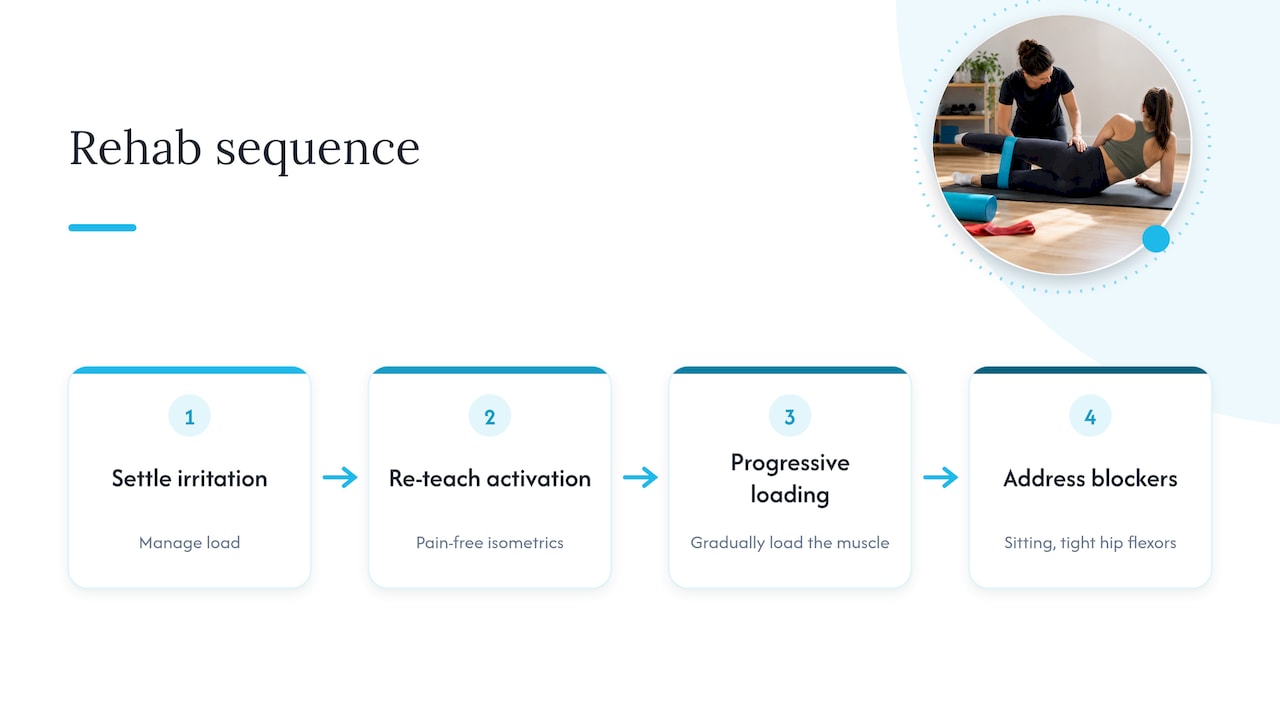
Step 1: Settle the irritation
If the outer hip is sore, reduce what provokes it. For gluteal tendon pain, that usually means avoiding compression: not crossing your legs, not sleeping on the sore side without a pillow between your knees, and not standing hanging on one hip. Physio Network’s summary of gluteal tendinopathy rehab stresses progressive load management and avoiding early compression, not complete rest.
Step 2: Re-teach the muscle to fire
Before you load it, make sure you are using it. A 2025 review on gluteus medius inhibition points to the need for motor control and neuromuscular re-education first. In practice that means gentle, pain-free isometrics: lie on your side, lift the top leg a few inches with the toes pointed slightly down, and hold 20 to 30 seconds while placing a hand on the muscle to check it, not the front of the hip, is working. If the TFL or low back takes over, the rep doesn’t count.
Step 3: Load it properly
Once you can recruit it cleanly, you need real load. An EMG-driven study of gluteal forces found that adding external resistance at a 12-repetition maximum raised peak gluteus medius forces by 28 to 150 N over bodyweight alone. The exercises that produced the highest forces included the side plank, the single-leg RDL and the single-leg squat with resistance.
A simple progression:
- Weeks 1 to 2: side-lying isometric holds, 3 sets of 30 seconds, daily.
- Weeks 2 to 4: bridge variations and standing hip abduction against a band, 3 sets of 10 to 12, every other day.
- Weeks 4 to 8: side planks, then loaded single-leg RDL and step-downs, 3 sets of 8 to 12 with a weight that makes the last reps hard.
- Ongoing: carry the control into walking, running or lifting, filming yourself to check pelvis and knee position.
These are general ranges, not a prescription. Tendon pain, a recent surgery or a labral problem all change what is safe. If you have a hip labral problem, see our stepwise conservative plan.
Step 4: Fix what keeps shutting it off
If you sit for ten hours a day, nothing you do for twenty minutes will undo it on its own. Break up sitting, open up the hip flexors, and make sure your pelvis isn’t parked in a forward tilt. This is where many exercise-only plans stall.
When hands-on care helps
Exercise is the backbone of recovery. Hands-on treatment earns its place when it makes exercise possible: easing guarded tissue, restoring motion, and reducing the competing muscles’ grip so the glute med can take its job back.
At The Tx Room in Plano we work with soft tissue and biomechanics, and several tools may fit a weak-glute case depending on what the exam finds:
- The Fascial Distortion Model, a hands-on approach to soft tissue injuries.
- Muscle activation therapy, aimed at muscles that aren’t firing, rather than endless stretching.
- Dry needling and myofascial release for overactive TFL, hip and back tissue.
- Shockwave (MyACT) for stubborn tendon and fascia areas.
Our fascia work guide is honest about the limits: short-term relief from fascia work lasts longest when paired with rehab. That is how we use it.
Our perspective
We see a lot of people who have already done the standard routine: clamshells, a foam roller, a few weeks of rest. They come in with hip, knee, foot or back pain that comes back. What we find most often is that the glute med is not simply “weak.” It is being outvoted. The TFL, the quadratus lumborum or the hamstrings have learned to do its job, and the body likes that arrangement.
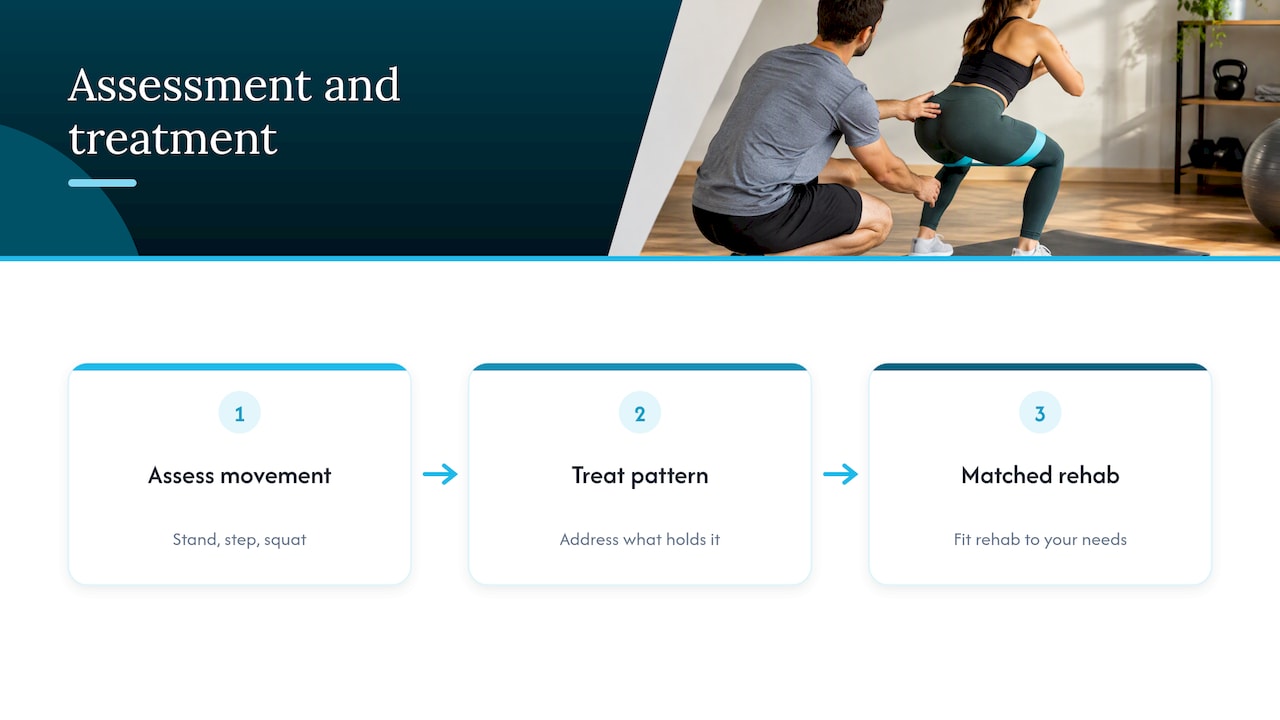
So we start with an assessment, not a protocol. We watch you stand, step and squat, and we look at the hips, the foot and the lower back together. Then we treat what’s holding the pattern in place by hand, and we give you rehab that matches where you are, not where a template says you should be. We don’t promise a number of visits. Tissue, history and consistency decide that.
If you take one thing from this article: when something feels tight and stretching doesn’t help, ask whether it is actually weak.
— Chris
Book an assessment in Plano
If you live or work around Plano and hip, knee, foot or low back pain keeps returning, book an evaluation with our chiropractors. We will find out whether your glute med is the issue and build a plan around it. We don’t publish prices online, so call or check our site for current details and insurance questions.
FAQ
Can weak glutes cause plantar fasciitis?
They can contribute. Research on plantar fasciopathy has found lower hip abductor and external rotator strength on the painful side. Weak hips may let the foot and knee collapse inward, adding strain to the plantar fascia. Foot pain also has many other causes, so get it examined rather than assuming.
Is glute med pain bursitis or tendinopathy?
Expert commentary suggests tendinopathy is the more common cause of chronic outer hip pain, though bursitis does occur. The two can feel the same. That is why a hands-on exam matters. Tendon pain generally responds to progressive loading rather than rest alone.
What are the best exercises for the gluteus medius?
Start with gentle isometric holds to learn to activate it. For real strengthening, EMG research points to the side plank, single-leg RDL and single-leg squat, especially with added resistance. Pick the level that you can do without pain or compensation.
How long does it take to fix a weak glute med?
The 6-week runner study above shows meaningful change is possible in that timeframe for some people, but the pace depends on your injury, age, training history and sitting habits. Expect to spend the first couple of weeks on pain control and activation before heavy loading.
Sources
- Gluteal Muscles (Glutes): What They Are, Anatomy & Function, Cleveland Clinic
- Understanding and Exercise of Gluteus Medius Weakness: A Systematic Review
- The end of painful sitting, Harvard Health
- Evidence for arthrogenic inhibition of the gluteus medius after ACL injury
- Evidence for arthrogenic inhibition of the gluteus medius after ACL injury, PMC
- MSK Science and Practice article on gluteal pain and tendinopathy
- The Relationship between Plantar Fasciopathy and Hip Muscles Strength Deficits
- Hip-strengthening program for injured runners, PubMed
- Gluteal Muscle Forces during Hip-Focused Injury Prevention and Rehabilitation Exercises
- From Research To Practice: The Gluteal Tendinopathy Rehab Journey, Physio Network