
Return to Running in 4–8 Weeks: Clinic Tested IT Band Treatment
Most iliotibial band syndrome resolves with nonsurgical care: rest, activity changes, and a physical therapy program built around hip and glute strengthening. Icing and short-term NSAID use help early on. Surgery is rarely necessary and only considered after roughly six months of consistent, structured conservative treatment fails. See a clinician sooner if pain worsens, function declines, or something feels mechanically off.
TL;DR:
- Conservative treatment focusing on hip and glute strengthening is effective for 50 to 90 percent of cases within four to eight weeks.
- The pain typically worsens with repetitive activity and improves with rest, especially on downhill efforts and certain knee movements.
- Surgery is only considered after about six months of unsuccessful structured conservative care, and it involves procedures like bursectomy or IT band lengthening.
- Addressing underlying weaknesses in gluteal muscles and optimizing running or cycling mechanics are key to preventing recurrence.
- Early exercises should activate and strengthen hip abductors gradually, while heavy impact or high-mileage sessions should be avoided during initial treatment phases.
Table of Contents
- What Does IT Band Syndrome Feel Like?
- Why the IT Band Gets Irritated in the First Place
- How Clinicians Diagnose IT Band Syndrome
- The Stepwise Path for IT Band Syndrome Treatment
- Exercises That Actually Help, and Ones to Skip Early On
- Getting Back to Running or Cycling Safely
- When Surgery Enters the Conversation
- Cutting Recurrence Risk After You Recover
- What the Research Actually Shows
- A Chiropractor’s Take on What Actually Moves the Needle
- How The Tx Room Treats IT Band Syndrome in Plano
- Sources
What Does IT Band Syndrome Feel Like?
The pain sits on the outside of the knee, right around where the iliotibial band crosses the femur. Runners usually notice it a mile or two into a run, worse going downhill or when the foot strikes at a certain angle. Cyclists tend to feel it during longer, steady efforts, especially if the saddle or cleats are off.
The pain builds with repetition rather than showing up from one bad step. It often eases with rest between sessions, then returns almost on cue once training resumes. That pattern alone separates IT band syndrome from an acute ligament injury, which usually hurts consistently from the moment it happens.
A clinician evaluating this will look for a few specific signs:
- Tenderness right at the lateral femoral epicondyle, about two to three centimeters above the knee joint line
- Pain reproduced with resisted knee extension around 30 degrees of flexion, the angle where the band rubs most against the bone
- Mild swelling or thickening over the same spot in longer-standing cases
- Pain that worsens with downhill walking or descending stairs
Red flags that call for urgent evaluation include a locked or blocked knee that won’t move through its full range, joint swelling that appears suddenly and dramatically, fever, or numbness and tingling down the leg. Those symptoms point toward something other than IT band syndrome: a meniscus tear, a stress fracture, or a lumbar nerve issue can all mimic lateral knee pain and need a different workup entirely.
Why the IT Band Gets Irritated in the First Place
The iliotibial band itself is a thick strip of connective tissue running from the hip to just below the knee. It doesn’t have much capacity to contract or stretch on its own. When people talk about “loosening” the IT band, what they’re actually describing is reducing tension in the muscles that pull on it: the tensor fasciae latae and the gluteal muscles.
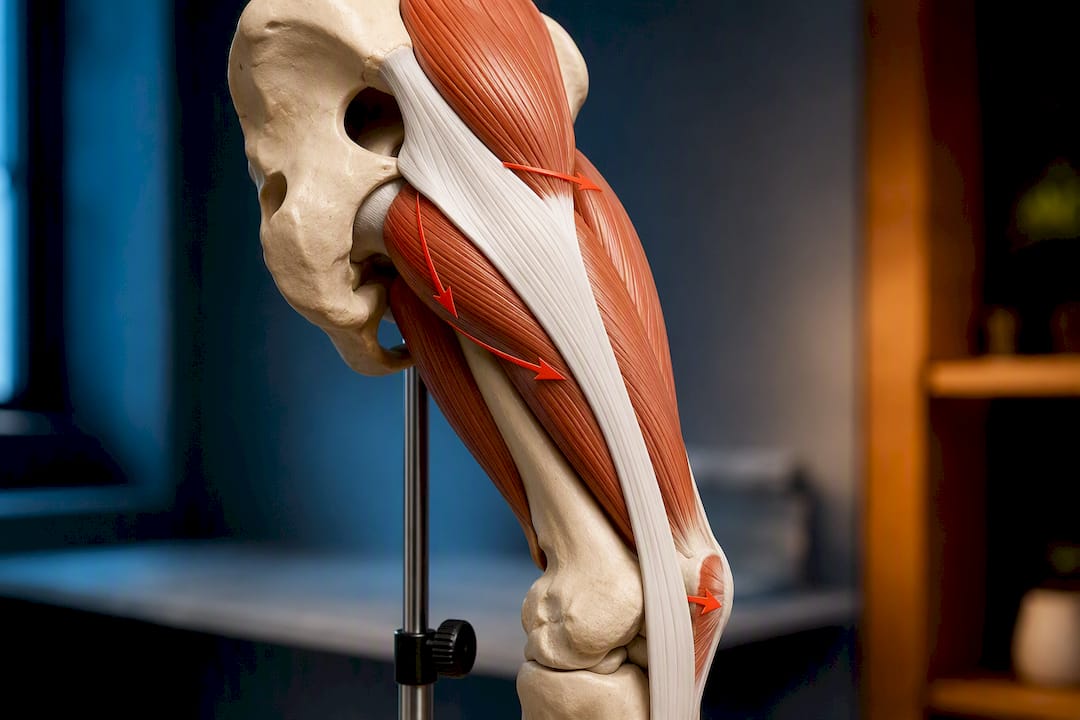
Weakness in the glute medius, glute maximus, and TFL is the most common root cause. When those muscles don’t fire properly, the femur rotates and adducts more than it should during the stance phase of running, and the band drags across the epicondyle with every stride.
Several factors tend to stack on top of that weakness:
- Sudden jumps in running mileage, especially adding hills or speed work too fast
- Worn-out running shoes that have lost cushioning and stability
- A bike fit with the saddle too high or cleats misaligned
- Leg-length discrepancies or excessive foot pronation that change how load travels up the chain
- Training almost exclusively on cambered roads or one direction on a track
None of these causes act alone most of the time. A runner with decent glute strength might tolerate a mileage jump just fine; the same jump paired with underlying hip weakness is often what tips someone into symptoms.
How Clinicians Diagnose IT Band Syndrome
Diagnosis starts with a conversation, not a scan. A clinician wants to know when the pain started, what activities trigger it, and whether it’s gotten better or worse with rest.
- History taking. Expect questions about training volume changes, footwear age, bike setup if cycling is involved, and any prior knee or hip injuries.
- Physical exam tests. The Noble compression test applies pressure over the lateral epicondyle while the knee bends and straightens; pain around 30 degrees of flexion is a positive sign. The Ober test checks for tightness in the tensor fasciae latae and hip abductors by assessing how the leg lowers from an abducted position.
- Imaging, when needed. Most cases don’t require an X-ray or MRI. Imaging gets ordered when the presentation is atypical, when a clinician suspects a meniscus tear, stress fracture, or bursitis instead, or when symptoms haven’t budged after weeks of proper treatment.
- Referral criteria. If there’s no improvement after a genuinely structured program, if the diagnosis stays unclear, or if the knee shows real functional limitation like a persistent limp, referral to a sports medicine physician or orthopedic surgeon makes sense.
Chiropractors trained in soft-tissue assessment, physical therapists, and sports medicine physicians can all run this initial exam. The tests are quick, and a clear positive finding on both the Noble and Ober tests, paired with the right history, is usually enough to move straight into treatment.
The Stepwise Path for IT Band Syndrome Treatment
The right IT band syndrome treatment plan moves through phases rather than throwing everything at the problem at once. Rushing strength work before pain calms down tends to backfire, and stalling too long in rest mode delays the muscle work that actually fixes the underlying issue.
1. Acute phase (roughly the first one to two weeks).
Cut back or pause the aggravating activity. This doesn’t mean total bed rest. Swimming or an elliptical machine often stay pain-free while running does not. Ice the lateral knee for 15 to 20 minutes a few times a day, particularly after any activity. Over-the-counter NSAIDs like ibuprofen can help with pain and swelling for short stretches, but they’re a bridge, not a fix, and should be used per a clinician’s or pharmacist’s guidance rather than indefinitely.
2. Pain-control and soft-tissue phase.
Once the sharpest pain has settled, hands-on work targeting the TFL and gluteal muscles, rather than the band itself, can reduce tension around the hip and knee. Modalities like targeted heat, soft-tissue mobilization, or myofascial techniques fit here as short-term aids, not standalone cures.
3. Motor-control and strengthening phase.
This is where lasting change happens. The evidence consistently points to hip abductor strengthening as the backbone of long-term recovery, not stretching the band itself. A typical progression adds load or difficulty roughly once a week, only after the current exercise level is pain-free.
4. Adjuncts.
Foam rolling and myofascial release aimed at the TFL and glutes can offer short-term relief and fit reasonably into early rehab as a low-risk addition, though reviews note their long-term contribution is uncertain on their own. A shoe and orthotic check matters here too, especially for anyone running on shoes older than 300 to 400 miles. Corticosteroid injections sometimes come into play for cases with significant inflammation, used both as a therapeutic step and, in some cases, to help confirm the diagnosis when the response to injection is telling.
5. Monitoring.
Track pain levels and function weekly rather than day to day, since single bad days don’t tell you much. Many people see real progress within four to eight weeks of consistent, well-structured care, per both Harvard Health and clinical reviews on the topic. If four to six weeks pass without meaningful change, that’s the signal to revisit the diagnosis or escalate care rather than keep repeating the same plan.
Pro Tip: Keep a simple pain log rating your knee zero to ten before and after each session. Patterns show up faster in numbers than in memory, and it gives your physical therapist or chiropractor something concrete to adjust the plan around.
Exercises That Actually Help, and Ones to Skip Early On
Effective IT band syndrome exercises follow the same logic as the treatment phases: activate first, then load, then add speed and impact last.
Early phase, activation-focused:
- Glute bridges with a resistance band around the knees
- Clamshells, lying on your side with knees bent and feet together
- Quadruped hip extensions, keeping the knee bent to isolate the glute
- Short-arc quad isometrics for general knee stability
- Lacrosse ball or foam roller work along the TFL and glutes, never directly grinding on the sore spot at the knee
Mid to late phase, load-focused:
- Single-leg Romanian deadlifts
- Lateral step-downs off a small box, controlling the descent
- Loaded standing hip abduction with a cable or band
- Resisted lateral band walks, sometimes called the “monster walk”
- Progressive single-leg hops, added only once strength work is pain-free
The progression rule that matters most: increase load before you increase volume, and hold off on high-impact drills like running intervals or plyometrics until strength and control are solid. A little post-exercise soreness is normal; sharp or lingering knee pain means you jumped a phase too soon.
Skip heavy walking lunges, repeated downhill running, and high-mileage sessions during the acute phase. These load the exact pattern that caused the irritation in the first place, and doing them early is one of the most common reasons people stay stuck for months instead of weeks.
Pro Tip: If a lateral step-down causes your hip to drop or your knee to cave inward, that’s a motor-control problem, not a strength problem yet. Slow the movement down and film yourself from the front before adding weight.

Getting Back to Running or Cycling Safely
Return to activity should follow a clear, gradual sequence rather than jumping straight back into old mileage.
- Confirm pain-free walking, including stairs and hills, for several consecutive days.
- Start with short, pain-free run intervals, something like one to two minutes of running mixed with walking breaks.
- Increase total running time by 10 to 20 percent per week only if the prior week stayed pain-free.
- Reintroduce hills, speed work, and longer distances last, one variable at a time.
Timelines vary, but many people following a structured program see solid improvement in four to eight weeks. Chronic cases, especially ones that went untreated for months before starting rehab, can take considerably longer.
If pain returns during this process, don’t push through it. Drop back to walking, reassess your training load or footwear, and return to the strengthening phase you were in before symptoms flared. Repeated relapses, meaning the same pain returning two or three times despite backing off appropriately, is a clear cue to check back in with a clinician rather than keep restarting the cycle alone.
When Surgery Enters the Conversation
Surgery for IT band syndrome is uncommon, and it’s reserved for people whose symptoms genuinely limit daily function after a real attempt at conservative care, generally defined as about six months of guideline-based treatment that hasn’t worked.
When it does happen, a few procedures come up most often:
- Bursectomy, removing an inflamed bursa near the lateral epicondyle if that’s driving the pain
- IT band lengthening or partial resection, releasing a portion of the band to reduce friction over the bone
- Arthroscopic debridement, cleaning out irritated tissue through small incisions
Recovery from these procedures typically runs several weeks to a few months, with a graded return to activity similar in structure to the conservative rehab timeline. Surgical case series generally report good outcomes, though direct comparisons between techniques remain limited, so the decision usually comes down to a conversation between patient and surgeon about goals, risk tolerance, and how much conservative care has actually been tried.
Cutting Recurrence Risk After You Recover
Getting better once doesn’t guarantee it stays that way. Preventing IT band syndrome from coming back means treating your training load and your body’s weak links as ongoing maintenance, not a one-time fix.
- Increase weekly mileage or cycling volume gradually, sticking to roughly a 10 percent bump rather than sudden jumps
- Build in scheduled rest days and cross-training instead of running the same pattern every day
- Replace running shoes every 300 to 500 miles, sooner if you notice uneven wear
- Limit repeated downhill running and heavily cambered roads when possible, or at least alternate directions on tracks
- Keep a standing glute-strength and hip-mobility routine going year-round, not just during flare-ups
A gait or bike-fit analysis with a physical therapist or running coach is worth scheduling if symptoms have recurred more than once, or if you’ve made all the obvious equipment changes and pain still shows up. Sometimes the issue is a stride pattern or cleat position that’s invisible without a trained eye watching you move.
What the Research Actually Shows
The clinical picture on IT band syndrome treatment is fairly consistent across major sources. StatPearls reports that roughly 50 to 90 percent of patients improve within four to eight weeks of nonoperative treatment, a wide range that reflects differences in how consistently people follow through on strengthening work versus just resting and hoping.
Johns Hopkins Medicine, the American Academy of Orthopaedic Surgeons, and PMC-published reviews all describe the same hierarchy: activity modification and pain control first, structured hip and glute strengthening as the core long-term intervention, and surgery held in reserve for the small minority who don’t respond after months of genuine effort. That consistency across independent sources is one reason the conservative-first approach carries real weight rather than being a default answer given because it’s easy.
Referral to a specialist becomes appropriate when a structured program hasn’t produced improvement, when the diagnosis stays genuinely unclear despite a proper exam, or when function keeps declining, especially alongside any neurologic signs like numbness or weakness down the leg.
A Chiropractor’s Take on What Actually Moves the Needle
Most patients who walk in with lateral knee pain have already tried foam rolling the IT band itself for weeks, and they’re confused about why it hasn’t helped. It hasn’t helped because the band isn’t the problem; the hip is. At The Tx Room, we pair Fascial Distortion Model work on the TFL and glutes with progressive strengthening from day one, rather than treating those as separate phases. That combination tends to shorten the time it takes people to get back to running compared to strength work alone.
The most common mistake is stopping rehab the moment pain disappears, before the strength gains that prevent relapse actually stick…
— Chris
How The Tx Room Treats IT Band Syndrome in Plano
If you’ve been cycling through rest, ice, and stretching without lasting relief, a hands-on approach that actually addresses the hip and glute mechanics behind your pain is the more direct route. The Tx Room uses the Fascial Distortion Model alongside individualized rehab plans, so treatment targets the TFL and gluteal tension driving your symptoms rather than just icing the sore spot on your knee.
A first visit includes a full movement assessment to identify where your kinetic chain is breaking down, followed by hands-on fascia work paired with a strengthening plan you can start immediately. Many patients report noticeable improvement within their first three to five sessions, with a guided return-to-sport plan mapped out from there. If lateral knee pain has been sidelining your runs, book a visit with The Tx Room to get a plan built around your specific mechanics instead of another round of generic stretches.
Sources
For readers who want to dig deeper, Johns Hopkins Medicine lays out the standard management hierarchy and surgical thresholds. AAOS OrthoInfo covers return-to-activity pacing in plain language. The PMC review on athletic treatment approaches and the StatPearls entry both detail the evidence behind hip strengthening and realistic recovery timelines, while Harvard Health offers accessible prevention guidance for everyday runners.
This article is general information, not a substitute for advice from a qualified doctor. Consult a qualified healthcare professional about your own circumstances before acting on anything here.
- Iliotibial Band Syndrome | Johns Hopkins Medicine
- A Review of Treatments for Iliotibial Band Syndrome in the Athletic Population – PMC
- IT Band Pain Relief: What to Skip and What Will Help – Runner’s World