
Short Term Pain Relief From Fascia Work When Paired With Rehab
Fascia work refers to hands-on techniques and self-care methods that target the connective tissue web wrapping every muscle, nerve, and organ in your body. Done well, it produces short-term pain relief and better range of motion, especially when paired with active rehab. The evidence supports quick, real gains. It does not support fascia work as a standalone fix for chronic structural problems.
TL;DR:
- Fascia work provides short-term relief mainly through nerve stimulation and improved tissue glide, without evidence of permanent structural changes.
- Referred pain patterns and poor response to stretching indicate fascial restrictions, especially after immobilization or repetitive strain.
- Techniques should feel like sustained pressure, avoiding sharp or worsening discomfort, with contraindications including severe osteoporosis and active malignancy.
- Self-care with foam rollers benefits from sustained, moderate pressure sessions, while clinical fascia work combines manual therapy with active rehabilitation for lasting results.
- Combining fascia techniques with active movement and strengthening in the same week enhances long-term benefits and functional recovery.
Table of Contents
- What Fascia Is and Why It Matters for Movement
- Recognizing the Signs Fascia Might Be the Cause
- Common Causes of Unhealthy Fascia
- What the Research Actually Shows About Fascia Work
- Self-Care Tools vs. Clinician-Delivered Fascia Work
- A Simple At-Home Routine That Complements Clinical Care
- How The Tx Room Approaches Fascia Work Clinically
- The Gap Between What Fascia Work Promises and What It Delivers
- Getting Hands-On Fascia Care at The Tx Room
- Where This Information Comes From
- Sources
What Fascia Is and Why It Matters for Movement
Fascia isn’t a single sheet of tissue. It’s a continuous network with superficial and deep layers, lubricated by hyaluronan, a slippery compound that lets muscle layers glide past each other without friction. When that gliding mechanism works, you don’t notice it. When it doesn’t, you feel stuck, stiff, or oddly restricted in a joint that seems otherwise fine.
Fascia does three jobs that matter for how you move and feel:
- Transmits force between muscles, so a tight hip can change how your ankle loads during a run
- Holds posture by distributing tension across the body rather than isolating it to one spot
- Carries sensory information through mechanoreceptors and nociceptors, the nerve endings responsible for both proprioception and pain signaling
That third point explains something patients find confusing: a restriction in your shoulder blade can produce pain down your arm, because fascia’s continuity lets tension travel far from its source.
Recognizing the Signs Fascia Might Be the Cause
Muscle soreness and fascial dysfunction don’t always feel the same, and telling them apart changes what kind of care actually helps.
- Diffuse, hard-to-pinpoint stiffness rather than a sharp, localized ache tends to point toward fascia rather than a single muscle strain.
- Palpable tight bands or “knots” that don’t loosen with basic stretching often indicate restricted fascial glide, not just muscle tightness.
- Symptoms that started after a period of immobilization (a cast, a desk job, a long flight) or repetitive loading (running, typing, throwing) suggest fascia has adapted poorly to disuse or overuse.
- Referred pain patterns, where discomfort shows up somewhere other than the tissue causing it, are a classic fascial signature.
- Poor response to stretching alone is a useful self-check. If static stretching doesn’t budge the stiffness after a few honest attempts, the problem may sit in the connective tissue rather than the muscle belly.
If you notice two or more of these, it’s worth mentioning them specifically to a clinician rather than just saying “my back is tight.”
Common Causes of Unhealthy Fascia
Fascia doesn’t get “unhealthy” randomly. A handful of specific stressors change how it behaves mechanically.
- Trauma and scar formation from injury or surgery can leave fascia thickened and less pliable at the repair site.
- Repetitive strain from sport, work, or posture habits creates localized densification, essentially the tissue thickening in response to repeated load.
- Prolonged sitting or immobility reduces the natural gliding motion fascia needs to stay lubricated.
- Dehydration lowers hyaluronan’s lubricating capacity, making adjacent tissue layers stick rather than slide.
- Chronic inflammation and metabolic stress can prime the nervous system toward heightened pain sensitivity, amplifying how restrictions feel.
These factors compound. Someone recovering from an old ankle sprain who also sits for nine hours a day is stacking two separate mechanisms working against fascial glide at once.
What the Research Actually Shows About Fascia Work
The most encouraging data comes from a small pilot study on chronic low back pain, where nine sessions of interdisciplinary fascia therapy over several weeks produced a reported 83% reduction in pain intensity and an 87% reduction in disability, with participants also reporting better mood and sleep. That’s a striking result, but it comes from a small cohort, not a large randomized trial, so treat it as a strong signal rather than a guarantee.
Broader evidence tells a more measured story. A scoping review of fascia manipulation found neuromuscular benefits like improved movement efficiency and faster reaction time, with effects lasting roughly a week after treatment. The mechanisms behind this include mechanoreceptor stimulation, transient anti-inflammatory activity, and improved tissue glide, not permanent restructuring of the tissue itself.
Myofascial release interventions commonly produce short-term pain and range-of-motion improvements, but evidence for long-term structural remodeling of fascia remains inconsistent across studies.
That’s the core finding of a narrative review on fascial-targeted mechanical interventions, and it’s the honest bottom line: fascia work reliably changes how you feel in the short term. Whether it permanently changes the tissue is still an open question, complicated by inconsistent study protocols and heavy dependence on practitioner skill.
Self-Care Tools vs. Clinician-Delivered Fascia Work
You have real options at both ends of the spectrum, from a foam roller in your living room to a hands-on session with a trained provider.

Self-myofascial release covers foam rollers, lacrosse balls, and percussive devices. The technique matters more than the tool: sustained, moderate pressure held over a tender spot for 30 to 90 seconds tends to outperform aggressive, fast rolling. This is the “time under tension” idea clinicians rely on.
Clinician-delivered options include:
- Manual myofascial release, hands-on pressure and stretching guided by feel and patient feedback
- Instrument-assisted soft tissue mobilization (IASTM), using tools to apply targeted pressure along fascial lines
- The Fascial Distortion Model (FDM), a diagnostic and treatment framework that categorizes fascial distortions into specific types and treats each differently
- Myofascial Acoustic Compression Therapy, a device-based approach combining acoustic pressure waves with compression
Pro Tip: If a technique produces sharp, shooting, or worsening pain rather than a dull “good hurt,” stop. Fascia work should feel like sustained pressure easing, not escalating discomfort.
Aggressive techniques aren’t right for everyone. Clinical guidance flags contraindications including advanced diabetes complications, severe osteoporosis, healing fractures, and active malignancy. If any of those apply to you, get clearance from a provider before starting anything beyond gentle self-care.
A Simple At-Home Routine That Complements Clinical Care
Here’s a routine grounded in what actually holds up in practice, not a random sequence of stretches.
- Warm up first. Five minutes of light cardio or dynamic movement increases blood flow before you apply pressure to tight tissue.
- Foam roll the target area. Hold sustained, moderate pressure on tender spots for 30 to 90 seconds each rather than rolling quickly back and forth.
- Move through mobility drills. Follow rolling with active range-of-motion work, hip circles, shoulder rolls, ankle pumps, so the tissue moves through its new range rather than just sitting loose.
- Add brief strengthening. A few sets of a relevant strength movement help lock in the mobility gain instead of losing it within the hour.
- Hydrate and move often. Frequent short movement breaks throughout the day matter more than one long session, since hyaluronan lubrication responds to regular use.
Pro Tip: Favor light, sustained pressure over deep, painful digging. Clinical sources consistently note that fascia responds better to time under tension than to force. Stretching guidance from a Plano chiropractor covers how to sequence mobility work around your existing routine.
Improved range of motion and less guarding during movement are good signs the routine is working. Sharp pain, numbness, or symptoms that get worse instead of better mean it’s time to stop and see a clinician.
How The Tx Room Approaches Fascia Work Clinically
The Tx Room in Plano treats fascia dysfunction through the Fascial Distortion Model, a hands-on framework that identifies specific patterns of fascial distortion and matches each to a targeted manual technique, alongside Myofascial Acoustic Compression Therapy for cases where a device-based approach fits better.
Treatment typically follows a pattern consistent with the research: manual work paired with active rehab rather than manual work alone.
- Initial assessment identifies movement compensations, not just the painful spot itself
- Treatment plans combine hands-on fascia work with progressive exercise and range-of-motion rebuilding
- Follow-up frequency adjusts based on how quickly a patient responds, rather than a fixed number of visits for everyone
When a case involves red flags outside the clinic’s scope, such as a suspected fracture or a condition needing imaging, The Tx Room coordinates with primary care or specialist providers rather than treating in isolation.
The Gap Between What Fascia Work Promises and What It Delivers
Most fascia content online oversells the mechanism. You’ll read claims about “breaking up adhesions” or “releasing toxins,” language that sounds mechanical and permanent. The research doesn’t back that framing. What the evidence actually supports is a nervous-system story: fascia work stimulates mechanoreceptors, calms nociceptive signaling, and temporarily improves tissue glide. That’s not a lesser outcome. It’s just a different, more honest one than the “your fascia was stuck and now it’s fixed” narrative.
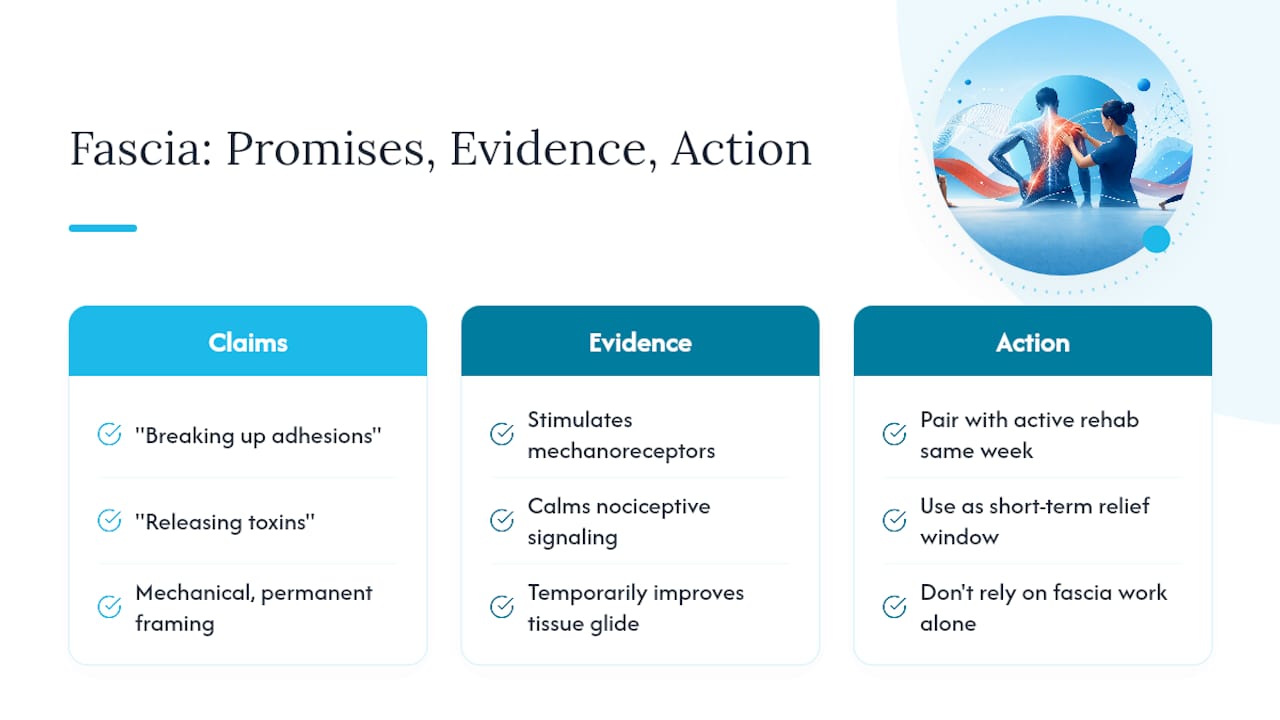
The conventional advice fails in two directions. Some people treat foam rolling as a complete solution and wonder why stiffness returns within days. Others dismiss fascia work entirely because it doesn’t restructure tissue permanently, missing that short-term relief has real value, especially when it opens a window for better movement and strength work.
Here’s what I’d prioritize first: pair any fascia technique, self-administered or clinical, with active rehab in the same week. The pilot study showing dramatic pain reduction didn’t use fascia work alone. It combined manual therapy with a broader interdisciplinary approach. That’s the model worth copying, not the idea that one roller session fixes a movement pattern years in the making.
— Chris
Getting Hands-On Fascia Care at The Tx Room
If you’ve tried foam rolling and stretching without lasting relief, that’s usually the signal to bring in a clinician who can assess the whole movement chain instead of just the sore spot. The Tx Room in Plano works with athletes managing overuse injuries, people with chronic stiffness that hasn’t responded to home care, and patients dealing with conditions like sciatica or plantar fasciitis where fascial restriction plays a direct role.

A first visit typically includes a movement assessment to identify where restrictions are actually originating, not just where the pain shows up, followed by a treatment plan built around the Fascial Distortion Model and, when appropriate, Myofascial Acoustic Compression Therapy. Most patients return for a short series of follow-up visits rather than a single session, since durable change comes from combining manual work with progressive rehab. If you’re dealing with ongoing back pain that hasn’t responded to rest or generic stretching, book an assessment and find out whether fascia work fits your case.
Where This Information Comes From
The clinical claims here draw on a mix of pilot research, scoping and narrative reviews, and major health-system explainers. For deeper reading: the interdisciplinary fascia therapy pilot study on chronic low back pain, the scoping review on fascia manipulation mechanisms, and practical overviews from HSS and Cleveland Clinic on myofascial release basics and safety.
This article is general information, not a substitute for advice from a qualified doctor. Consult a qualified healthcare professional about your own circumstances before acting on anything here.
Sources
- Interdisciplinary Fascia Therapy: A Proof-of-Concept Pilot Study for a New Myofascial Approach for Chronic Low Back Pain
- Therapeutic mechanisms of fascia manipulation: A scoping review
- Myofascial release and fascial-targeted mechanical interventions in musculoskeletal rehabilitation: mechanisms, modalities, and integrative physiology
- Myofascial Release (MFR): An Overview – HSS
- Myofascial release therapy – Cleveland Clinic