
IT Band Pain Causes: What Actually Irritates the Outer Knee
IT band pain usually comes from repeated load on the outer knee (or, less often, the outer hip) that the body can’t tolerate yet. The common drivers are a sudden jump in running or cycling volume, weak hip abductor muscles, worn shoes or banked running surfaces, and a few structural traits like bowed legs. The old idea that a tight band simply rubs over bone has lost ground. Current research points to compression of a pain-sensitive fat pad under the band, and that changes how you should think about stretching and foam rolling.
This guide explains each cause in plain terms, how to tell which ones apply to you, and when it’s time to have someone look at how you move.
TL;DR
- IT band syndrome is an overuse injury. AAOS lists it as a common cause of pain in the thigh, knee, and outside of the hip in athletes and runners.
- Newer research describes it as compression of a fat pad under the band near the knee, not simple friction.
- The biggest fixable causes are training errors, weak hip abductors, worn footwear, and movement mechanics.
- Aggressive foam rolling of the band can backfire. Strength and load management usually do more.
- If pain hasn’t improved after about 6 weeks of sensible care, get a hands-on evaluation.
Table of Contents
- What the IT band is and where it hurts
- Why the friction explanation fell out of favor
- The main causes of IT band pain
- Which cause is yours? A quick self-check
- What makes it worse
- What recovery usually looks like
- When to get it looked at
- Our perspective
- Getting help in Plano
- FAQ
- Sources
What the IT band is and where it hurts
The iliotibial band (ITB) is a thick strip of fascia that runs down the outside of your thigh. It is the distal extension of fascia from the tensor fasciae latae, gluteus medius, and gluteus maximus. It crosses the knee and attaches just below it.
That anatomy matters. The band is fed by your hip and glute muscles, so what those muscles do (or fail to do) changes how the band loads at the knee. Most people feel IT band pain in one of two places:
- Outer knee, a few centimeters above the joint line. This is the classic runner’s or cyclist’s pain, often sharp, and often showing up at a predictable point in a run.
- Outer hip, over the bony point of the hip. This version is less common and often gets mistaken for trochanteric bursitis or a gluteal tendon problem.
It’s also common. ITBS is the leading cause of lateral knee pain in endurance runners, affecting roughly 7% to 14% of that group, according to a 2025 review.
Why the friction explanation fell out of favor
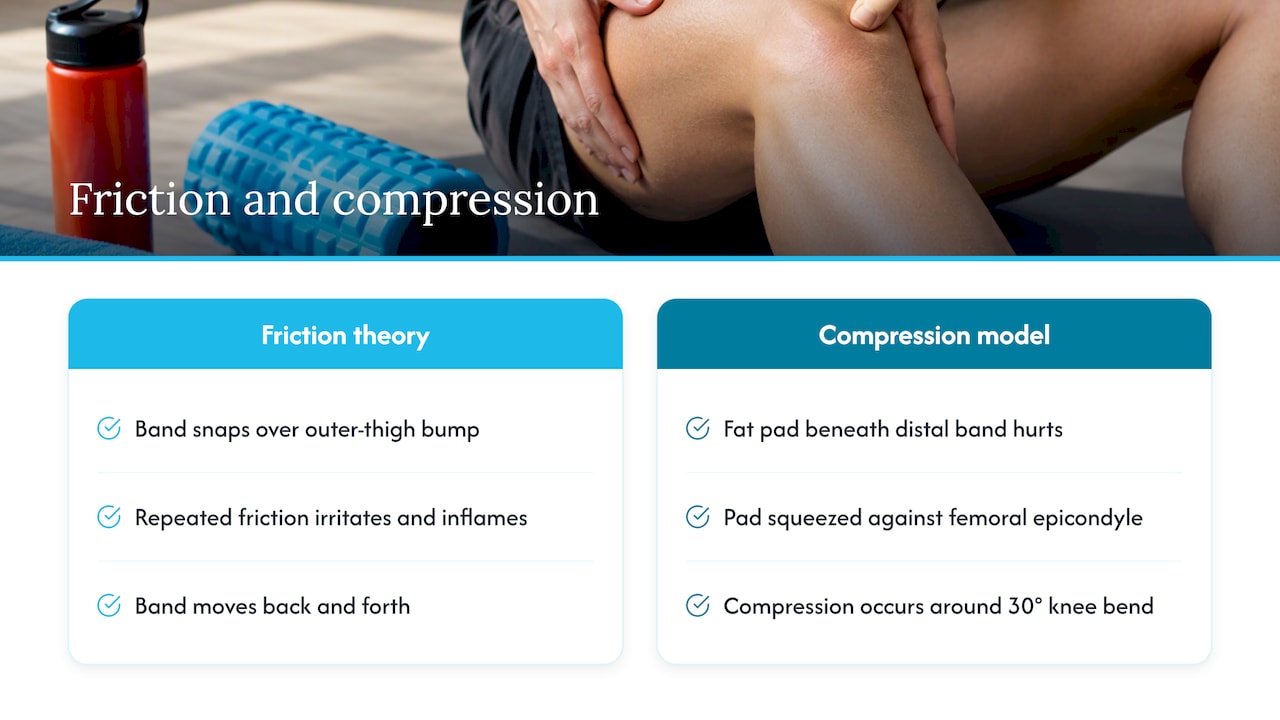
For decades the story was simple: the band snaps back and forth over the bump on the outer thigh bone, gets irritated, and inflames. Some major patient pages still describe it this way. The AAOS page, for example, calls it an overuse injury from repetitive friction.
But recent anatomical and biomechanical work challenges that. A 2024 review in Current Physical Medicine and Rehabilitation Reports notes the original friction theory is being questioned, and it describes ITBS as closer to an impingement or compression problem. The tissue that hurts is a richly innervated fat pad beneath the distal band. It gets squeezed against the lateral femoral epicondyle, especially when the knee is bent around 30 degrees. That’s the angle your knee passes through on every running stride and every pedal stroke.
A 2026 review in the same vein explains the practical consequence: because the problem is compression of deep tissue.2026.5582), hammering the band itself is aimed at the wrong target, and the better question is why the band is compressing that pad in the first place.
The StatPearls entry is a fair summary of the field: the cause is controversial and likely multifactorial. So the honest answer to “what causes it” is a stack of factors, not one villain.
The main causes of IT band pain
1. Training errors
This is the most common trigger and the easiest to fix. Clinical guidance in BMJ Best Practice lists these modifiable risk factors:
- Abrupt increases in training volume or intensity
- Running on cambered or banked surfaces
- Worn-out footwear
Typical real-life versions: signing up for a spring half marathon and going from 10 to 25 miles a week in a month. Running the same side of a sloped road every morning. Adding hill repeats and a new group ride in the same week. Tissue adapts slowly, and the outer knee is not forgiving when you outrun that adaptation.
2. Weak hip abductors
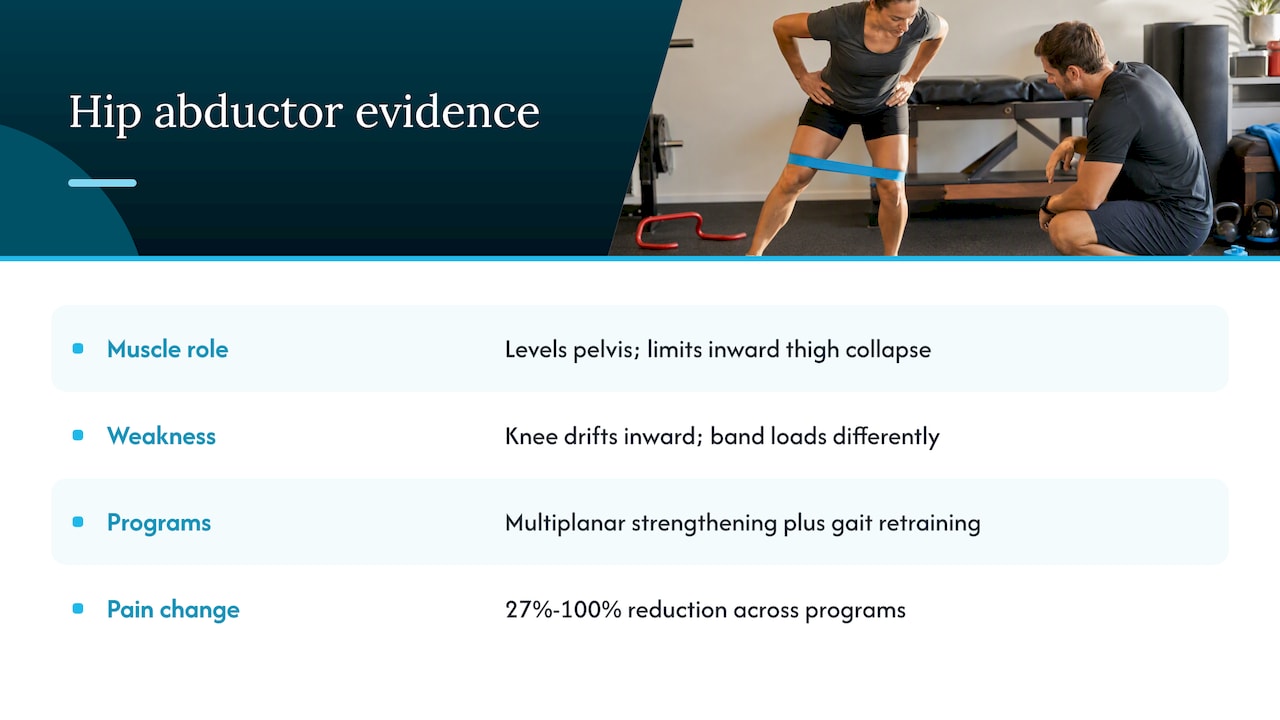
The gluteus medius and related muscles hold your pelvis level and keep the thigh from collapsing inward when you land on one leg. When they’re weak or tire early, the knee tends to drift inward and the band loads differently.
This is the cause clinicians cite most. One hip-focused clinic guide says weakness in the hip abductors is the primary cause for the majority of people it sees with the hip version. The research on treatment points the same way: a 2026 comprehensive review says leading programs now emphasize multiplanar hip abductor strengthening.2026.5582) and gait retraining, with pain reduction ranging from 27% to 100% across programs. That is a wide range, which tells you results depend heavily on how well the program is matched to the person.
3. Movement mechanics and running form
How you land matters as much as how strong you are. Two patterns come up repeatedly:
- Knee collapsing inward (dynamic valgus) on landing, squatting, or stepping down.
- A long, slow stride that keeps the knee in the painful zone for more of each step.
On the second one, the same 2026 review says raising step cadence by 5% to 10% is a primary way to reduce time spent in the impingement zone.2026.5582) around 30 degrees of knee flexion. It is a small change you can test on an ordinary run with a metronome or watch.
If inward knee collapse sounds like you, our guide to correcting knee valgus walks through the ankle and hip checks that usually come first.
4. Structural and anatomical traits
Some people start with a slightly worse hand. BMJ Best Practice names bowed legs (genu varum), leg length differences, and inward-twisted shinbones (internal tibial torsion) as anatomical risk factors. You can’t change bone shape, but you can build around it: stronger hips, more careful progression, and sometimes shoe or surface changes.
5. Repetitive position, not just running
IT band pain isn’t only a runner’s problem. Cyclists get it because the pedal stroke repeats that same 30-degree knee angle thousands of times per ride. Hikers get it on long descents. Weekend soccer players, rowers, and people who suddenly start a stair-climber habit see it too. If you sit all day and then train hard, that adds a layer: sitting leaves the glutes underused, and our lower cross syndrome rehab plan covers that pattern.
6. Surgery, joint replacement, and other special cases
People often ask about IT band pain after a knee replacement. It does happen. A case report with literature review describes ITB traction syndrome after total knee arthroplasty, and a separate review lists reported causes of isolated outer knee pain after replacement, including extruded cement, an overhanging tibial tray, and remnant osteophytes rubbing against the band. That is a surgical-hardware question. If it applies to you, go back to your orthopedic surgeon rather than trying to self-manage.
Which cause is yours? A quick self-check
This can’t diagnose you, but it helps you decide where to look first.
| What you notice | Likely contributor | First thing to examine |
|---|---|---|
| Pain started after a mileage or intensity jump | Training load | Weekly volume, rest days, hills |
| Pain begins at the same point in every run, then eases when you stop | Compression at about 30 degrees of knee flexion | Cadence, stride length, downhill running |
| One hip drops or the knee dives inward on a single-leg squat | Hip abductor weakness | Glute strength and control |
| Pain is worse on one side and you always run the same road edge | Surface camber | Route and direction |
| Shoes have well over a few hundred miles on them | Worn footwear | Replace and compare |
| Pain predates any change, and you’ve always been bowlegged | Anatomy | Strength base and progression |
Most people have two or three of these at once, which is why one-fix advice like “just stretch” so often disappoints.
What makes it worse
Two habits keep people stuck.
Aggressive foam rolling. Because the pain source is deep tissue under the band, grinding on the band itself may not help and can irritate things. The 2024 Springer review notes the friction model’s persistence often leads to counterproductive self-treatment, including hard rolling of the band. Rolling the quads and glutes gently for comfort is fine. Pressing hard on the outer thigh until it hurts is not a plan.
Stretching alone. The band is fibrous and has very little give. What recovers people is strengthening the hip abductors and addressing biomechanics, not isolated band stretching, according to AAOS.
What recovery usually looks like
For most people, conservative care works. AAOS says most patients return to baseline activity within about 6 weeks with treatment. Surgery is rarely needed and is considered only after extensive non-surgical care has failed.
A sensible sequence looks like this:
- Cut the trigger, not all movement. Reduce the volume or hills that provoke pain to a level that doesn’t flare it. Cross-train on things that don’t irritate the knee.
- Load the hips. Side-lying and standing hip abduction, step-downs, single-leg work, and lateral band walks. Heavy, slow resistance training is the loading style the Springer review highlights for building tissue tolerance.
- Adjust mechanics. Try a 5% to 10% cadence increase and check for inward knee collapse.
- Return gradually. Reintroduce running in short, flat, even-surface sessions, with a rest day between.
For a fuller rehab outline, see our IT band syndrome treatment guide.
When to get it looked at
ITBS is a clinical diagnosis. Per AAOS and the clinical guidance in our research, it’s usually made by a primary care sports medicine physician, a physical therapist, or a chiropractor who focuses on musculoskeletal biomechanics. Imaging such as MRI is generally unnecessary at first.
Book an evaluation if:
- Pain hasn’t meaningfully improved after about 6 weeks of sensible care
- Symptoms are atypical: swelling, locking, giving way, or night pain
- You can’t rule out other problems such as a meniscus tear or a stress fracture
- You’ve had a knee replacement and the outer knee is painful
If you have sudden severe pain after a fall or twist, can’t bear weight, or the knee looks deformed, seek urgent medical care instead.
Our perspective
We see a lot of people who arrive having done everything the internet said: stretching the band, rolling it until it bruised, resting for two weeks, then relapsing on the first run back. The band was rarely the real story.
What we look for is the chain above the pain. How does the pelvis behave on one leg? Does the knee drift inward? Is the foot and ankle contributing? Are there tender, restricted areas of fascia in the thigh and hip that change how the leg moves? Our approach is hands-on, and we use the Fascial Distortion Model alongside individualized rehab, then test whether the change holds when you load it. Hands-on work is a way to open a window, not a finish line. Strength and better movement are what keep the window open. Our own page on fascia work paired with rehab says as much.
We also focus on cases that haven’t improved with standard medical or physical therapy approaches. If that’s you, the issue is often that the program treated the site of pain and never changed the load or the movement.
— Chris
Getting help in Plano
If your outer knee or hip pain has lingered, we can assess your movement and build a plan around what’s driving it. The Tx Room is a chiropractic center in Plano, Texas, treating musculoskeletal and soft tissue injuries with hands-on care. Depending on what we find, options include the Fascial Distortion Model, dry needling, and myofascial release, all paired with exercises you can do on your own. Visit The Tx Room to get started.
FAQ
Is IT band syndrome a form of tendonitis?
Not exactly. It is often mistaken for tendonitis, but current research describes it as more of an impingement or compression problem involving a fat pad under the band. The band is fascia, not a tendon.
What type of doctor should I see for IT band pain?
A primary care sports medicine physician, a physical therapist, or a chiropractor who focuses on musculoskeletal biomechanics can diagnose it, per AAOS. It is diagnosed from your history and exam, and scans are usually not needed at first.
Can IT band pain happen after a knee replacement?
Yes. Reports describe it as a recognized but easily missed cause of outer knee pain, often tied to hardware or bone spurs rubbing the band. Talk with your orthopedic surgeon, since the fix may differ from standard IT band rehab.
Is a tight IT band the cause of the pain?
Tightness alone is not the best explanation. The band is hard to stretch, and research now points to hip weakness and mechanics.2026.5582) as the deeper drivers. Strength work and load management usually matter more than stretching.
Sources
- Knee pain in runners: the most common causes, symptoms, and treatment review
- Iliotibial Band Syndrome Current Evidence, Current Physical Medicine and Rehabilitation Reports
- The evolution of etiopathogenesis and conservative management of iliotibial band syndrome in long-distance runners.2026.5582)
- Iliotibial Band (IT Band) Syndrome, OrthoInfo, AAOS
- Iliotibial band syndrome, BMJ Best Practice US
- Iliotibial Band Syndrome, StatPearls, NCBI Bookshelf
- Selective Iliotibial Band Release for Iliotibial Band Traction Syndrome After Total Knee Arthroplasty
- Isolated lateral-sided knee pain in total knee arthroplasty: a review