
Fascia Pain Causes: What Triggers It and When to Get Help
Fascia pain usually comes from a few things: overuse, repeated strain, long hours in one posture, an old injury that never fully settled, or fascia that has lost its ability to glide. It often feels like tightness, pulling or a deep ache that does not match any single muscle. It can also show up away from the real source. Below we explain each cause, how fascia pain differs from muscle pain, what “fascia inflammation” can mean, and when it is time to stop waiting and get it examined.
TL;DR
- Fascia is a continuous, nerve-rich connective tissue. When it dries out, thickens or is overloaded, it can hurt and restrict movement.
- The most common triggers are repetitive motion, sedentary habits, poor posture, and trauma from injury or surgery.
- Fascia pain tends to be a deep, tight, referred ache. Ordinary muscle soreness usually fades in a few days.
- Rapid swelling, hard or woody skin, or heel pain with sharp first steps are different problems and need a medical evaluation.
- If self-care has not helped in two to three weeks, hands-on assessment is the sensible next step.
Table of Contents
- What fascia is and why it can hurt
- The main causes of fascia pain
- Why the pain often shows up somewhere else
- Fascia pain vs. muscle pain
- Fascia inflammation symptoms: what they can and can’t mean
- Fascia pain, myofascial pain and fibromyalgia
- Our perspective at The Tx Room
- What to do first: a sensible self-care window
- When hands-on care makes sense
- How we treat fascia pain in Plano
- Preventing fascia pain from coming back
- FAQ
- Sources
What fascia is and why it can hurt
Fascia is the web of connective tissue that wraps your muscles, joints, nerves and organs. It is not packing material. Researchers describe it as highly innervated, a tissue that can generate pain itself, and because it forms one continuous network, strain in one region can be felt somewhere else.
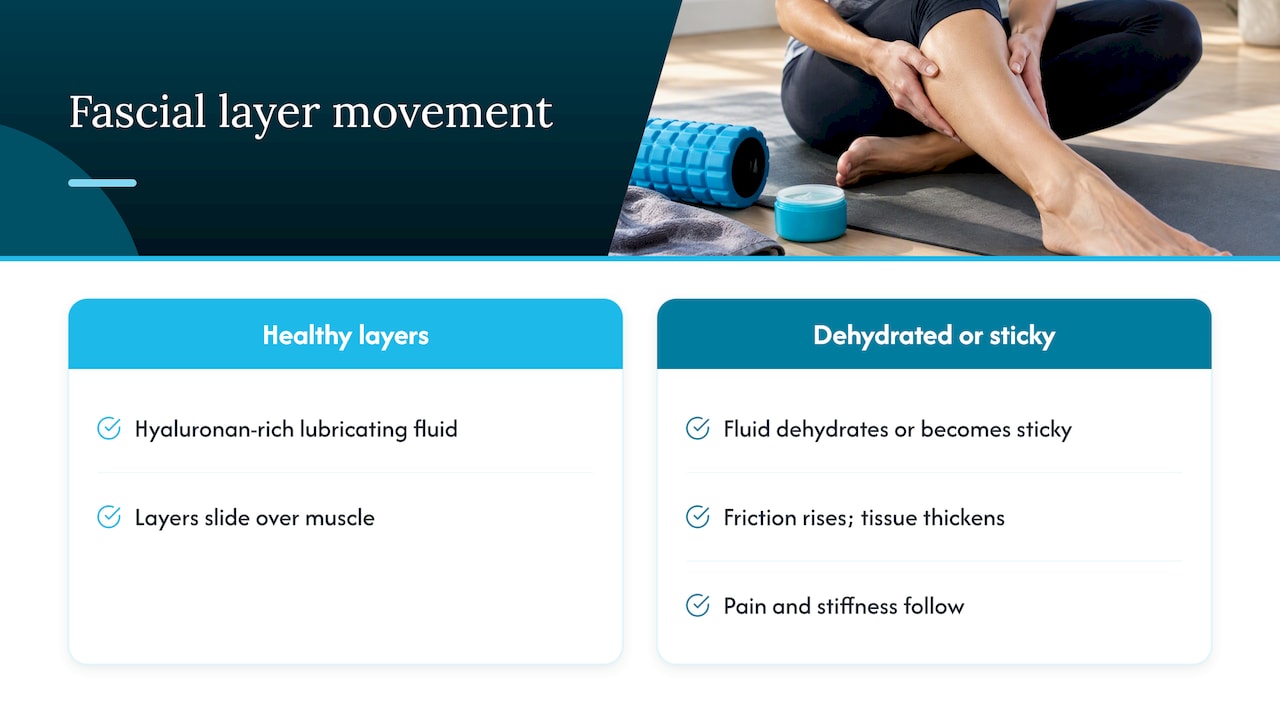
For healthy movement, the layers of fascia need to slide over one another and over the muscle beneath. A 2023 review of fascial mechanics explains that a lubricating fluid rich in hyaluronan sits between the layers. When it dehydrates or becomes sticky, friction rises, the tissue thickens, and pain and stiffness follow.
That is why fascia problems are rarely “just a knot.” The same review describes densification of collagen fibers from dehydration and micro-trauma. Stretching a muscle that is bound down by stuck fascial layers often brings only brief relief.
The main causes of fascia pain
Repetitive motion and overuse
Running the same route, swinging the same racket, or lifting the same way for years loads the same fascial lines again and again. The fascial mechanics review notes that repetitive micro-damage can accumulate and make tissue denser before it has recovered.
Plantar fasciitis is the best-known example. Cleveland Clinic explains that it happens when the plantar fascia under your foot is overused or stretched too far.
Sitting still for hours
Fascia needs movement to stay hydrated and mobile. Long stretches at a desk, in a car or at a school desk keep tissue in one shape. The same review lists sedentary behavior as a common contributor.
Office workers often feel it as neck and shoulder tightness that refers into the mid-back. We see the same pattern with phone use, which we cover in our piece on text neck and neck pain.
Poor posture
Posture is a low-grade load that never switches off. Rounded shoulders, a forward head and a collapsed lower back all keep certain fascial lines under constant tension. Poor posture is also a recognized predisposing factor for myofascial pain, alongside muscle strain and habits.
If this sounds like you, our guide to rounded shoulders and a six-week exercise plan shows what to do and when manual care helps.
Injury and surgery
A sprain, strain, fall or operation can leave fascia scarred, thickened or distorted. Injury and surgery are both named among the common causes in the fascial mechanics review. Many people feel the original injury healed, yet the area still pulls, catches or aches months later.
This is the case the Fascial Distortion Model (FDM) was built for. We explain it further below.
Pushing through pain
Athletes and manual workers often treat pain as something to ignore. Training or holding static postures before tissue has recovered lets micro-damage stack up. Rest, good mechanics and regular movement are what the research points to for preventing it. If you are unsure whether soreness is normal, read our five red flags that soreness is a strain, not DOMS.
Trigger points and myofascial pain syndrome
Myofascial pain syndrome (MPS) is a chronic condition built around trigger points: tender, taut bands in muscle and fascia that cause local or referred pain. A 2025 mechanisms paper cites prevalence estimates of 10% to 20% in the general population and up to 50% in specialized pain clinics, while noting that its diagnostic criteria and mechanisms are still debated.
The cause is complex and not fully understood. That honesty matters: anyone promising a single cure for trigger points is overselling.
Why the pain often shows up somewhere else
One of the most confusing features of fascia and trigger point pain is referral. Research on MPS describes referred pain in predictable patterns, so a shoulder ache can come from a trigger point in the neck or upper back.
This is also why people chase the wrong spot for months. They stretch the sore shoulder, massage the painful hip, ice the heel, and nothing changes because the driver is elsewhere along the chain. A good assessment looks above and below the site of pain.
Fascia pain vs. muscle pain
The two overlap, and fascia and muscle often hurt together. Still, certain patterns help you tell them apart.
| Ordinary muscle soreness or strain | Fascia-related pain | |
|---|---|---|
| Typical feel | Achy, sore to touch, worse when the muscle works | Tight, pulling, stiff or restricted, sometimes burning |
| Location | At the muscle that was worked | Often spread along a line or referred to another area |
| Timing | Peaks within a day or two after hard effort, then fades | Lingers, returns with the same posture or activity |
| Response to stretching | Often feels better | Relief is brief or the stiffness comes back |
| Movement | Limited by pain | Limited by a sense of restriction or “stuckness” |
This table is a rough guide, not a diagnosis. A true muscle strain, a joint problem and a nerve problem can all feel similar, and the only way to sort them out is a hands-on exam.
Fascia inflammation symptoms: what they can and can’t mean
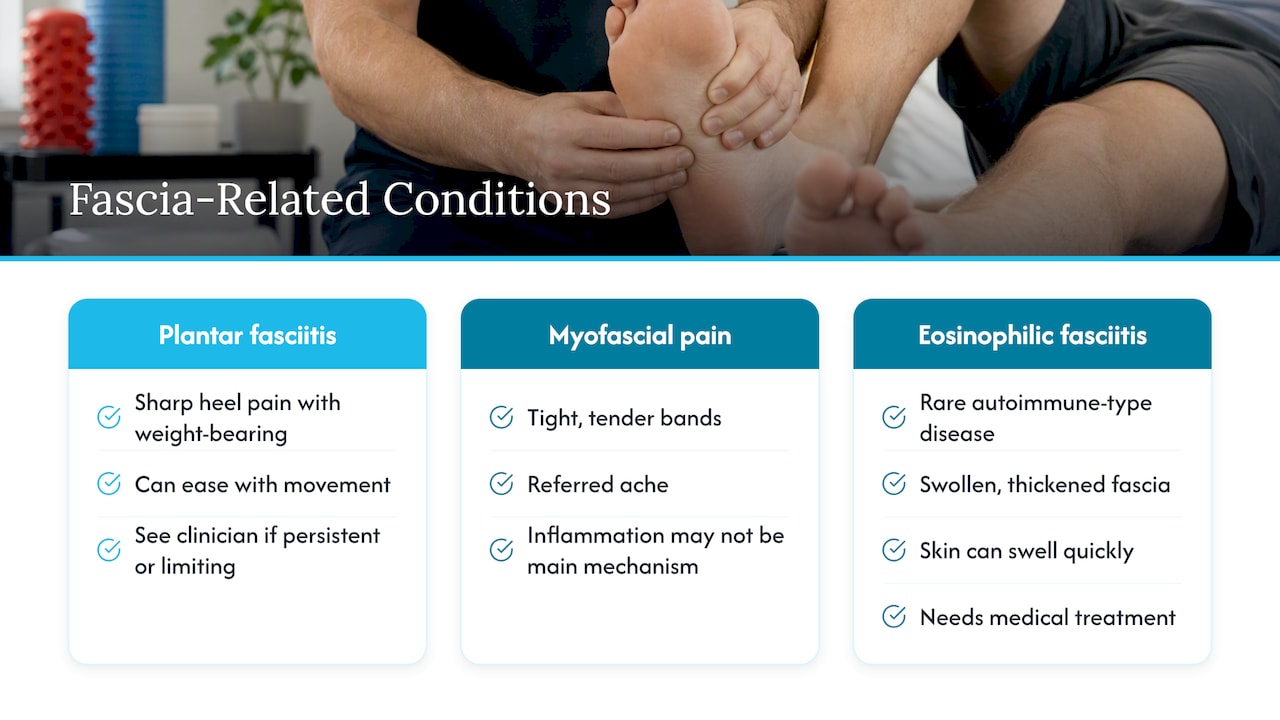
People searching for fascia inflammation are usually describing one of three situations.
Plantar fasciitis. This is the common one. Cleveland Clinic describes sharp or stabbing heel pain when you put weight on the foot, which can ease with movement and return when you stop. If this is you, see a clinician if it persists or limits walking.
Myofascial pain. Tight, tender bands and referred ache. This is often called fascia pain, though classic inflammation is not necessarily the main mechanism.
Eosinophilic fasciitis. This is rare, and different in kind. MedlinePlus describes swollen, inflamed, thickened fascia, with skin on the arms, legs, neck, abdomen or feet that can swell quickly. JAMA Dermatology patient information (January 2026) explains it is an autoimmune-type disease that needs medical treatment.
If your skin turns hard, tight or woody, or swelling in an arm or leg appears over days to weeks, do not wait on self-care. See your primary care physician promptly, and ask about a referral to a rheumatologist or dermatologist.
Fascia pain, myofascial pain and fibromyalgia
People often lump these together. In short, MPS is typically focal and episodic, tied to specific regions and trigger points, while fibromyalgia is widespread across the body. A fascia and fibromyalgia paper puts fibromyalgia at roughly 2% to 6% of the population.
If your pain is everywhere, comes with heavy fatigue and poor sleep, or has been brushed off as “in your head,” ask your physician about fibromyalgia as well. Both conditions can coexist with local fascial problems.
Our perspective at The Tx Room
We work with a lot of people who arrive after the usual route has not worked: rest, a round of anti-inflammatories, maybe physical therapy. Their scans are often unremarkable, and they are still in pain.
Our view is that the problem is frequently a tissue that is not gliding properly, or an injury that left a distortion behind. We think of fascia as a map. The sore spot is often just where the map is crumpled, not where the crease began.
So we start by listening to how the pain began and how the patient points to it. In the Fascial Distortion Model, the hand gestures and descriptions people use carry real information about the type of distortion. Then we treat with our hands, test what changed, and pair the work with movement so the result holds.
We are honest about limits. Not every ache is fascial, and some need imaging, bloodwork or a physician. If something falls outside what we treat, we say so.
— Chris
What to do first: a sensible self-care window
Most mild fascia-type tightness deserves a fair two to three weeks of self-care before you escalate. Our Plano fascia pain guide lays out the same timeline.
- Move more often. Break up long sitting every 30 to 45 minutes. Walk, change position, roll the shoulders.
- Reduce the trigger. Adjust your workstation, shoes, bag, training volume or technique rather than ignoring the pattern.
- Use gentle, regular movement instead of aggressive stretching of the sore spot.
- Rest from the specific aggravator, not from all activity.
- Stay hydrated and sleep well. These support normal tissue recovery, though they will not fix a stuck area on their own.
If the pain is no better after two to three weeks, keeps returning, wakes you at night, or limits sport or work, move on to a hands-on assessment.
When hands-on care makes sense
See a physician first or urgently for fever with pain, numbness or weakness that is worsening, loss of bladder or bowel control, pain after significant trauma, swelling and skin hardening, or chest pain. These are not chiropractic-first problems.
For persistent soft tissue pain without those warning signs, manual therapy is a reasonable option. A meta-analysis of myofascial release for chronic low back pain describes it as an approach aimed at restoring fascial sliding. You can read how we use it in myofascial release in Plano and how fascia work pairs with rehab.
How we treat fascia pain in Plano
The Tx Room is a chiropractic center in Plano, Texas, focused on musculoskeletal injuries and biomechanical imbalances. Our core method is the Fascial Distortion Model, a hands-on approach for soft tissue injuries. We also offer:
- Dry needling for trigger points
- MyACT, focused shockwave for myofascial tissue
- Deep tissue therapy laser
- Chiropractic care and soft tissue therapy, with individualized rehab plans
We see athletes, parents, desk workers with repetitive strain, and students with posture problems, including people who have not improved with standard medical or physical therapy approaches. We accept self-pay and insurance. To start, book a visit at The Tx Room and tell us where it hurts and how it began.
Preventing fascia pain from coming back
Prevention is mostly boring and effective.
- Vary your load. Change positions, routes and tasks. Fascia reacts to sameness.
- Build up gradually. Increase training volume in steps, and let tissue adapt before the next jump.
- Fix the mechanics. A form check on lifting, running or desk setup removes the repeating stress.
- Strengthen the weak link. Pain that returns in the same place often points to a muscle that is not doing its job.
- Treat small problems early. An old ankle sprain or a sore hip can reshape how the whole chain moves.
FAQ
What causes fascia pain?
Common causes include repetitive motion, long periods of sitting, poor posture, and trauma from injury or surgery, according to a review of fascial mechanics. These can dry out and thicken the fascia so its layers no longer glide. Trigger points can add referred pain.
How do I know if it’s fascia pain or muscle pain?
Muscle soreness is usually local, peaks a day or two after hard effort and fades. Fascia pain tends to feel tight or pulling, spreads along a line or refers elsewhere, and keeps coming back. A hands-on exam is the reliable way to tell, since the two often coexist.
What are the symptoms of fascia inflammation?
The most common form is plantar fasciitis, with sharp heel pain when you stand on the foot. Rapid swelling and hard, tight skin on the arms or legs point to a rare condition called eosinophilic fasciitis, which needs prompt medical care.
Is fascia pain the same as fibromyalgia?
No. Myofascial pain is usually focal and tied to trigger points, while fibromyalgia is widespread. Both can occur together, so tell your physician if your pain is body-wide or comes with severe fatigue.
How long should I try self-care before getting help?
Give it two to three weeks of movement, load changes and posture fixes. If you are not clearly better, or the pain is getting worse or interfering with work and sport, get it assessed.
Sources
- Mechanical Properties and Physiological Challenges of Fascia (PMC, 2023)
- Fascia Mobility, Proprioception, and Myofascial Pain (PMC)
- Trends in management of myofascial pain (PMC)
- Exploring fascia in myofascial pain syndrome (PMC)
- Fascia and fibromyalgia mechanism paper (PMC)
- Myofascial Release for Chronic Low Back Pain: Meta-Analysis (PMC)
- Plantar Fasciitis (Cleveland Clinic)
- Eosinophilic fasciitis (MedlinePlus)
- Eosinophilic Fasciitis (JAMA Dermatology)