
Why ACL Often Needs 8–9 Months: Clinician Return to Sport Timeline
There is no single date that tells you when it’s safe to play again. Return to sport depends on meeting specific criteria, not just time on a calendar, which means a minor strain can clear in days while an ACL reconstruction commonly takes 8 to 9 months. The real marker of readiness is pain-free, sport-specific function paired with objective clearance tests, and the CDC’s 6-step concussion progression is one of the clearest examples of what that looks like in practice.
TL;DR:
- Return to sport usually requires meeting pain-free, sport-specific function, with concussion recovery typically taking over a week at minimum with the CDC’s protocol.
- ACL reconstruction generally takes 8 to 9 months for competitive play, with earlier return increasing the risk of reinjury if benchmarks are not met.
- Functional testing, including limb symmetry and movement quality, alongside psychological readiness, guides safe clearance rather than relying solely on elapsed time.
- Muscle strains and ligament injuries follow a gradual, criterion-based progression, often lasting from a few weeks to several months depending on injury severity.
- Hands-on treatments support rehab but do not replace the necessity of meeting objective testing criteria before returning to sport.
Table of Contents
- Quick timeline snapshot by injury category
- Criterion-based progression and decision frameworks clinicians use
- Detailed evidence-based timelines and checkpoints for common injuries
- How to personalize the timeline: tests, benchmarks, and a sample progression
- Load management, monitoring, and red flags during return-to-sport
- Clinic-tested protocols and proof points from The Tx Room
- What realistic return to sport actually looks like
- How we help you get back to your sport safely
- FAQ
- Sources
Quick timeline snapshot by injury category
Every range below assumes criteria are met, not just that the calendar has turned. Surgery, concomitant procedures, and individual healing speed all shift these numbers, sometimes by months.
- Muscle strain, grade I: 1 to 3 weeks with progressive loading and pain-free movement at each stage.
- Muscle strain, grade II to III: 4 to 8 weeks or more, depending on depth of tissue damage and whether surgical repair is needed.
- Ankle or ligament sprain: 1 to 2 weeks for mild sprains, 6 to 12 weeks for more significant ligament injuries requiring functional bracing and balance retraining.
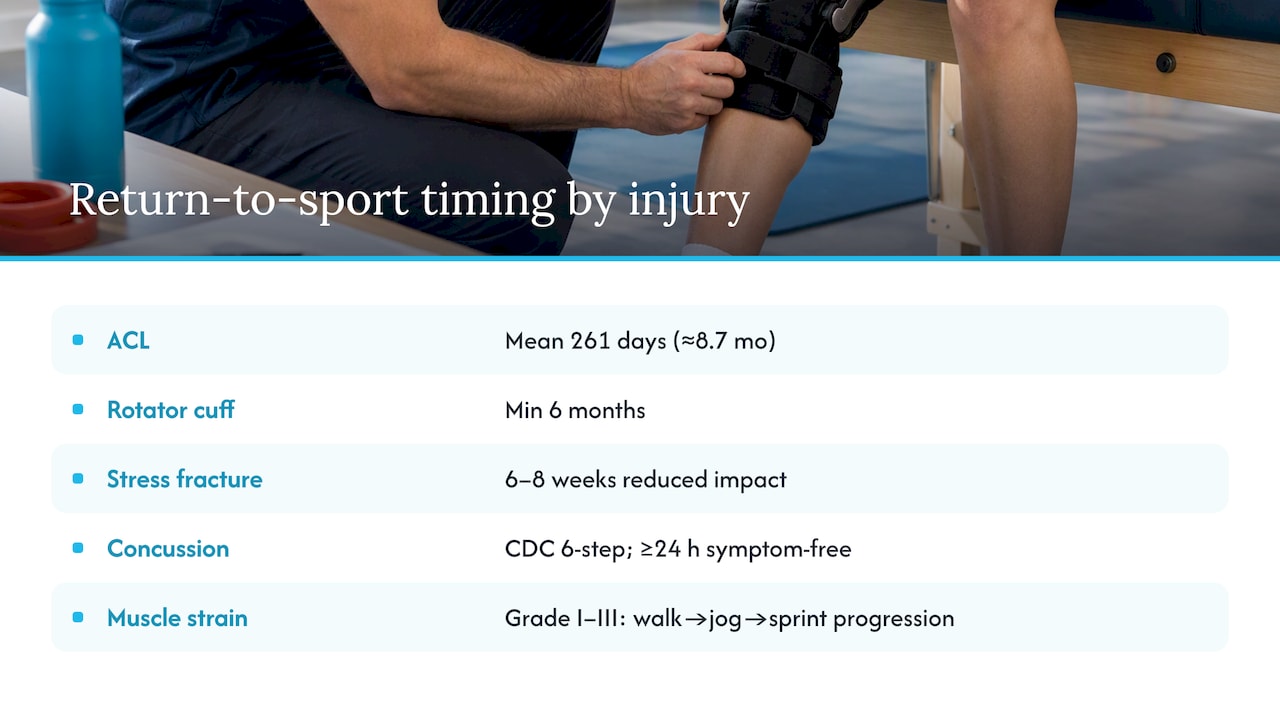
- Rotator cuff repair: surgical cases typically cite a minimum of 6 months, with some studies reporting up to 12 months before full sport clearance.
- Achilles tendon injury: 4 to 6 months for surgical repair, shorter for partial tears managed conservatively, with weightbearing progression carefully staged.
- Stress fracture: 6 to 8 weeks of reduced impact loading, extended if imaging shows incomplete healing.
- Concussion: no fixed timeline, but the structured 6-step progression typically takes a week or more when symptom-free at each stage, extending longer if symptoms recur.
These are starting points for conversation with a clinician, not a substitute for individualized testing.
Criterion-based progression and decision frameworks clinicians use
Clinicians increasingly rely on structured decision frameworks like StAART and StARRT models instead of rigid timetables. These approaches break the return-to-sport decision into three layers: current health status (tissue healing, pain, swelling), participation risk (sport demands, position, contact level), and risk tolerance modifiers (season timing, scholarship pressure, prior injury history, athlete and family preference). A 2016 consensus statement from sports physical therapy experts frames return to sport as a continuum, not a single clearance date, and recommends shared decision-making among athlete, clinician, and coach.
Objective criteria anchor each stage of that continuum:
- Pain-free range of motion matching the uninjured side.
- Limb symmetry index of 90% or higher on strength and hop testing before high-risk drills.
- Movement quality during cutting, landing, and deceleration, not just raw numbers.
- Successful completion of sport-specific drills at game speed without compensation.
Psychological readiness matters just as much as physical testing. Tools like the ACL-RSI scale measure confidence and fear of reinjury, and research shows multimodal rehab that includes psychological readiness assessments predicts return-to-sport success better than strength testing alone. An athlete can pass every physical test and still hesitate on the field, and that hesitation is itself a clinical signal worth addressing.
Pro Tip: Ask your clinician to track your psychological readiness score alongside your strength and hop test numbers. Lagging confidence often shows up weeks before a physical setback does.
Detailed evidence-based timelines and checkpoints for common injuries
ACL reconstruction separates into two checkpoints: return to training and return to match play. Pooled data across professional football players show a mean time to return to sport around 261 days, roughly 8.7 months, with match play consistently taking longer than training. Returning before strength and hop test symmetry reach target thresholds is linked to higher reinjury risk, which is why many criterion-based programs average closer to 10.5 months in some cohorts rather than the often-cited 6-month mark.
Muscle strains follow a grade-based path. Grade I strains need pain-free walking, then jogging, then sprinting before sport-specific drills. Grade II and III strains require the same progression but with longer holds at each stage and sometimes imaging before clearance. Clinic-tested calf strain protocols follow this same graded loading approach.
Ligament sprains, especially at the ankle, hinge on functional testing: single-leg balance, hop-for-distance, and cutting drills, often paired with bracing during the return-to-sport window to reduce reinjury risk while proprioception rebuilds.
Rotator cuff and shoulder injuries progress through load tolerance and scapular control before throwing or overhead athletes resume full activity. Surgical repairs commonly cite a minimum of 6 months before sport clearance, and a structured throwing progression is standard for overhead athletes regardless of whether surgery was involved.
Achilles injuries and stress fractures both depend on staged weightbearing. Achilles repairs move from protected weightbearing to walking to light jogging over several months, while stress fractures typically require 6 to 8 weeks of reduced impact with imaging confirming healing before higher-load activity resumes.
Concussion management follows the CDC’s structured 6-step return-to-play progression: light aerobic activity, moderate activity, non-contact drills, full-contact practice, and finally return to competition. Each step requires at least 24 hours symptom-free before advancing, and any return of symptoms means dropping back to the previous step. Academic and cognitive demands typically resume before contact sports do, and the full progression can take anywhere from a week to several months depending on symptom recovery.
How to personalize the timeline: tests, benchmarks, and a sample progression
Testing turns a generic timeline into one specific to you. Baseline strength, hop distance, and range of motion should be measured early, then retested every 2 to 4 weeks during mid and late-stage rehab, with sport-specific skill tests added weekly as tolerance improves. A limb symmetry index of 90% or higher on strength and hop testing is a commonly used benchmark before clearing high-risk drills, though research shows this threshold alone doesn’t guarantee reinjury protection, which is why movement quality checks matter too.
A sample progression, with clinician oversight at each step:
- Pain-free range of motion and basic strength work.
- Progressive loading: walking to jogging to running.
- Non-contact, sport-specific drills at low intensity.
- Full-speed, sport-specific drills with contact if applicable.
- Return to competition with continued monitoring.
Pro Tip: Don’t skip step three just because step two feels easy. Non-contact drills at full speed reveal compensations that walking and jogging never will.
Load management, monitoring, and red flags during return-to-sport
Progressive overload works best in small increments rather than big jumps, especially in the weeks right after you resume training. Session RPE (rated perceived exertion) and daily pain scores help you and your clinician catch problems before they become setbacks, and periodic strength or hop testing confirms you’re actually progressing rather than just feeling better.
Watch for these red flags, which mean pausing or stepping back a stage:
- Return of pain at rest or with activity that had resolved.
- New or increased swelling around the injured joint.
- Numbness, tingling, or other neurologic symptoms.
- Persistent weakness or asymmetry that doesn’t improve with rest.
A safe, evidence-based return-to-running plan follows this same logic: small increments, frequent check-ins, and a willingness to regress a stage rather than push through warning signs.
Clinic-tested protocols and proof points from The Tx Room
In our clinic, we’ve seen IT band syndrome resolve with a structured 4 to 8 week return-to-run protocol, and calf strains follow a similar graded timeline. We use the Fascial Distortion Model and focused shockwave therapy as adjuncts within that criterion-based rehab, never as a shortcut around the testing and progression stages above.
What realistic return to sport actually looks like
Athletes want a date. We’d rather give you a target you can actually hit safely. Testing tells us more than the calendar ever will, and the athletes who recover fastest are usually the ones who stay patient through the boring middle stages. Work with your clinician and coach together: the best outcomes come from all three of you reading the same signals.
— Chris
How we help you get back to your sport safely
We build return-to-sport plans around the same criteria-based testing this article describes, using hands-on treatment to support the rehab work, not replace it.
- Fascial Distortion Model for soft tissue and biomechanical imbalances.
- Dry needling for muscle tension and trigger point relief.
- MyACT focused shockwave for stubborn soft tissue injuries.
Booking starts with an evaluation where we assess your current function against the benchmarks that matter for your sport. Visit The Tx Room to schedule your first visit.
FAQ
How long does it take to return to sport after an ACL tear?
Most athletes return to training around 6 to 7 months and to competitive match play closer to 8 to 9 months after ACL reconstruction. Timing depends heavily on whether meniscus or cartilage procedures were done at the same time.
What is the CDC’s 6-step return-to-play protocol for concussions?
The CDC’s concussion guidance moves athletes through light aerobic activity, moderate activity, non-contact drills, full-contact practice, and competition. Each step requires at least 24 hours symptom-free before advancing, and symptoms returning mean dropping back a step.
What tests determine if I’m ready to return to sport?
Clinicians commonly use limb symmetry index on strength and hop testing, targeting 90% or higher compared to the uninjured side, alongside pain-free range of motion and sport-specific drill performance. Psychological readiness scales like ACL-RSI are also used because confidence and fear of reinjury predict outcomes independent of physical testing.
Does returning to sport too early increase reinjury risk?
Evidence on ACL recovery suggests athletes who return before meeting strength and hop test benchmarks face higher reinjury rates than those who wait for criteria-based clearance. This is part of why many structured rehab programs average longer timelines than the commonly cited 6-month mark.
Can hands-on treatment speed up my return-to-sport timeline?
Hands-on treatments such as the Fascial Distortion Model or focused shockwave therapy may support tissue recovery and reduce pain, but they work alongside criterion-based rehab testing rather than replacing it. Your actual clearance still depends on meeting the strength, movement, and sport-specific benchmarks described above.
Sources
- Returning to sports | HEADS UP | CDC
- Return-to-play rate and time to return to play after anterior cruciate ligament reconstruction in professional football players: a systematic review and meta-analysis | BMC Musculoskeletal Disorders
- Rotator cuff repair return-to-play evidence (systematic review) | PMC
- Psychological readiness and multimodal rehabilitation improve return-to-sport outcomes | PMC