

2–6 Weeks to Relief: Clinic Backed Shoulder Impingement Care in Plano
Most people with shoulder impingement should start with a structured, shoulder-specific exercise program paired with activity changes, not rest or imaging. Expect early relief within 2 to 6 weeks and more complete improvement by around 12 weeks, inside a 3 to 6 month conservative trial. See a specialist sooner if you have progressive weakness, night pain that wakes you up, or symptoms getting worse despite consistent home effort.
TL;DR:
- Shoulder-specific exercises paired with activity modifications typically lead to pain relief within 2 to 6 weeks and full improvement by 12 weeks, within a 3 to 6 month period.
- Manual therapy, such as soft-tissue work and dry needling, can accelerate early gains and improve movement, especially when combined with a structured exercise program.
- Rehabbing through progressive, staged exercises targeting pain-free motion, scapular stabilization, and rotator cuff strengthening is essential for safe recovery.
- Injections, including NSAIDs and cortisone, serve as short-term pain bridges and should be timed to support exercise, not replace it, with repeated injections risking tissue weakening.
- Seek specialist care sooner if symptoms worsen, such as progressive weakness, night pain, or loss of shoulder motion, especially after several weeks of home efforts.
Table of Contents
- Why Exercise Comes Before Everything Else in Shoulder Impingement Treatment
- How Do You Progress Through Shoulder Impingement Exercises Safely?
- Do Manual Therapy and Clinic Treatments Actually Help?
- What About Medications and Cortisone Shots?
- What’s a Realistic Recovery Timeline, and When Should You Escalate Care?
- What Can You Do Today to Calm an Angry Shoulder?
- How Hands-On Care and Exercise Work Together
- Getting Hands-On Help for Shoulder Impingement in Plano
- Sources
- FAQ
Why Exercise Comes Before Everything Else in Shoulder Impingement Treatment
The evidence here is unusually consistent for an orthopedic condition. Exercise beats doing nothing, and it isn’t close. One systematic review found a standardized mean difference of −0.94 for exercise versus non-exercise controls on pain, a large effect by clinical research standards. Specific, shoulder-targeted programs also outperform generic stretching routines, and adding manual therapy to exercise gives a further short-term bump (SMD −0.32).
That’s the backbone of shoulder impingement treatment. Everything else is support:
- Manual therapy speeds up early gains and gets people moving comfortably sooner.
- NSAIDs and corticosteroid injections calm pain enough to participate in rehab, but the relief is short-term.
- Surgery stays on the table mainly for confirmed structural tears or when conservative care genuinely fails.
A large meta-analysis published in the British Journal of Sports Medicine reinforces this hierarchy: exercise is the core treatment, while injections, shockwave therapy, laser, and taping are reasonable add-ons with generally low-quality supporting evidence. That’s not a knock on those tools. It just means they work best alongside a real exercise plan, not instead of one. The 3 to 6 month window matters because shoulder tissue needs that long to remodel and strengthen under load, and surgeons generally want to see a genuine rehab attempt before considering surgical options.
How Do You Progress Through Shoulder Impingement Exercises Safely?
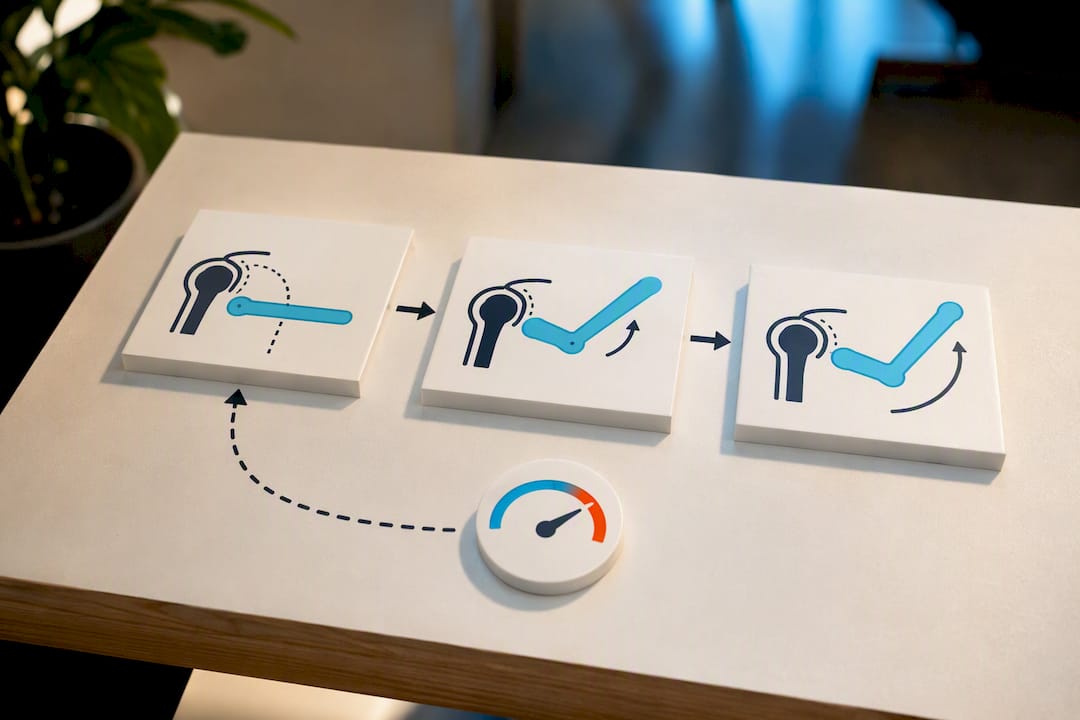
Rehab works in stages, and skipping ahead usually backfires. Here’s the order clinics actually use.
- Stage 1 (Days 1 to 10): Restore pain-free motion. Do pendulum swings and a doorway stretch for the front of the shoulder, 2 to 3 times daily. Stay below the point where pain sharpens, and avoid overhead reaching until motion feels smoother.
- Stage 2 (Weeks 1 to 4): Wake up the scapula. Scapular squeezes (10 reps, 3 sets) and prone I, T, and Y raises with light or no weight rebuild the muscles that stabilize your shoulder blade. Harvard Health notes that correcting scapular control and posture is often the missing piece people skip when they only chase the painful spot.
- Stage 3 (Weeks 3 to 8): Load the rotator cuff. Band-resisted external and internal rotation, plus scaption raises to shoulder height, in 2 to 3 sets of 10 to 15 reps. The HSS shoulder exercise guide uses these same movements, along with side-lying external rotation, as standard early strengthening work.
- Stage 4 (Week 6 onward): Return to function. Add sport or work-specific movement patterns gradually, tracking whether pain stays flat or climbs as load increases.
Increase reps or resistance only when the current level feels genuinely easy, not just tolerable.
Pro Tip: Keep a one-line daily log: exercise done, pain score out of 10, and how the shoulder felt afterward. A pattern of rising pain over 2 to 3 days is your cue to back off a stage, not push through it.
Do Manual Therapy and Clinic Treatments Actually Help?
Manual therapy isn’t a replacement for exercise, but it earns its place. Research shows hands-on treatment paired with exercise produces faster short-term gains than exercise alone, largely because reducing pain and stiffness first lets people engage more fully in strengthening work. That’s the real function of manual care: it’s a runway, not a landing strip.
Several clinic-based tools fall into this adjunct category:
- The Fascial Distortion Model (FDM) targets soft-tissue restrictions that limit shoulder mechanics using focused manual technique.
- Dry needling addresses trigger points and muscle tightness contributing to impingement patterns.
- MyACT (focused shockwave) and laser therapy are used for tendon-related pain that hasn’t responded well to exercise alone.
At Thetxroom, treatment plans are built around this same principle: hands-on work clears the path so a progressive exercise program can actually do its job. Chiropractic and manual-therapy approaches to shoulder conditions are also explored in more detail by Enhanced Chiropractic, which covers similar hands-on reasoning for frozen shoulder.
Clinics that pair targeted manual work with progressive rotator cuff loading tend to see faster functional return than generic home programs alone, particularly for patients whose shoulder problem stems from broader kinetic-chain imbalances rather than an isolated tendon issue.
See a clinician if your home program stalls after several weeks, if you notice real functional weakness (not just discomfort), or if you need a faster return to sport or physically demanding work.
What About Medications and Cortisone Shots?
Short courses of NSAIDs or topical diclofenac reduce pain enough to keep moving, but they’re a bridge, not a fix. Long, unsupervised use isn’t a good long-term plan for chronic joint pain.
Corticosteroid injections work similarly; they’re a bridge to rehab, not a substitute for it.
- Injections often relieve pain enough to participate meaningfully in physical therapy.
- Ultrasound-guided injections place the medication more accurately than blind injections.
- Repeated injections carry a real risk: they can weaken tendon tissue over time, so most clinicians limit how often they’re used.
The smartest use of an injection is timed right before a rehab push, not as a repeated crutch. If pain is blocking your ability to do the exercises in Stage 2 or 3 above, one well-placed injection can unlock progress you couldn’t make otherwise.
What’s a Realistic Recovery Timeline, and When Should You Escalate Care?
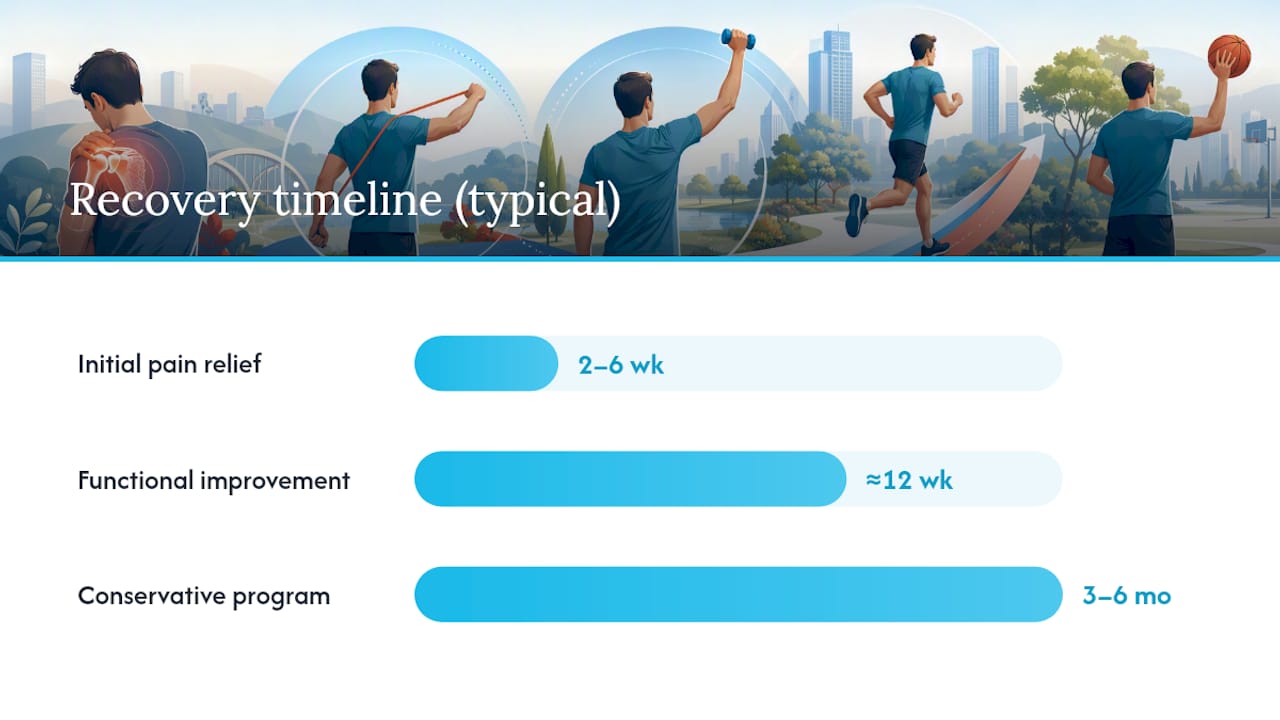
Recovery follows a fairly predictable arc for most people. Initial pain relief typically shows up within 2 to 6 weeks of consistent exercise and activity changes, with more complete functional improvement by around 12 weeks. Most conservative programs run the full 3 to 6 months before anyone seriously discusses surgery.
Certain symptoms should move up your timeline for seeing a specialist:
- Progressive weakness, especially trouble lifting the arm against resistance
- Night pain severe enough to disrupt sleep
- Rapid, unexplained loss of shoulder motion
- Signs suggesting a larger rotator cuff tear rather than simple impingement
Track your pain on a 0 to 10 scale, note your range of motion weekly, and record what daily tasks you can and can’t do. That record makes any conversation with a provider far more productive than “it still hurts.”
What Can You Do Today to Calm an Angry Shoulder?
Small changes reduce daily aggravation while your exercise program does the real work.
- Skip repetitive overhead reaching and lifting with your arm away from your body.
- Use ice for the first 48 to 72 hours after a flare, then switch to heat for ongoing stiffness.
- Sleep on your back or the unaffected side, with a pillow supporting the affected arm.
- Adjust your desk or workstation so your elbow stays close to your body during typing or lifting tasks.
Stick to these basics daily rather than only after pain spikes.
How Hands-On Care and Exercise Work Together
Manual techniques and progressive loading aren’t competing philosophies. Hands-on work resets mechanics that block good movement, then exercise builds the strength that keeps the shoulder there. Recovery timelines vary by case, and clinic care is meant to support your exercise plan, not replace it…
— Chris
Getting Hands-On Help for Shoulder Impingement in Plano
Home exercises solve most shoulder impingement cases, but not every case. When pain blocks progress or a deadline for sport or work is closing in, some clinics offer a faster path: hands-on treatment built specifically to unlock stalled rehab, not replace it.
The clinic combines Fascial Distortion Model work, dry needling, MyACT focused shockwave, and soft-tissue therapy with individualized rehab plans, rather than a one-size-fits-all protocol handed to every patient. That combination suits athletes chasing a fast return to sport, workers whose job demands overhead reaching, and anyone whose home exercise program has plateaued despite real effort.
A first visit typically includes a hands-on evaluation of shoulder and scapular mechanics, identification of potential causes of the impingement, and a treatment plan tailored to that finding rather than a generic handout. If your shoulder pain has stuck around longer than a few weeks, book a visit at Thetxroom and get a plan built around your specific shoulder, not a template.
Sources
- Shoulder Impingement Syndrome – StatPearls – NCBI Bookshelf
- Systematic review: exercise and manual therapy in shoulder impingement (PubMed entry)
- Effectiveness of conservative interventions including exercise, manual therapy and medical management in adults with shoulder impingement: a systematic review and meta-analysis
- How to treat shoulder impingement – Harvard Health
- Exercises for Shoulder Impingement – HSS
FAQ
What Aggravates Shoulder Impingement?
Repetitive overhead motion, poor posture that rounds the shoulders forward, and sleeping on the affected side all tend to make impingement worse. Lifting with your arm away from your body, rather than close to it, also loads the shoulder in a way that reproduces pinching pain.
What Is the Fastest Way to Heal a Shoulder Impingement?
There’s no true shortcut, but the fastest reliable path combines a structured, shoulder-specific exercise program with activity modification starting immediately. Many people notice meaningful relief within 2 to 6 weeks, and pairing exercise with manual therapy or clinic-based hands-on care can accelerate that early progress.
How Do You Unpinch a Shoulder Impingement?
You reduce impingement by improving scapular positioning and rotator cuff strength, which opens up space in the joint during arm movement. Gentle mobility work first, followed by scapular stabilization and rotator cuff strengthening, addresses the mechanical pinching rather than just masking the pain.
How Long Does It Take for a Shoulder Impingement to Heal?
Most people feel initial improvement within 2 to 6 weeks of consistent treatment, with more complete functional recovery by around 12 weeks. A full conservative trial typically runs 3 to 6 months before surgery enters the conversation for most patients.