
Calf Strain Treatment: Safe Steps to Recover Fast
Start protected rest and PRICE immediately, control pain safely, then begin progressive, supervised loading as pain allows. That single sequence covers the first two weeks of calf strain treatment for most people. The quicker a person can schedule an appointment at The TxRoom, the faster the injured calf will heal.
First 72-hour action plan:
-
Stop the activity that caused the injury and avoid putting full weight on the leg until you can do so without limping.
-
Apply ice wrapped in a cloth for 15–20 minutes every 2 hours for the first 48 hours.
-
Compress the calf with an elastic bandage from the foot upward to limit swelling.
-
Elevate the leg above heart level whenever you are resting.
-
Take acetaminophen for pain if needed. Avoid ibuprofen and naproxen in the first 24–72 hours.
Seek out an appointment with The TxRoom: The quicker we can start treating the injured area, the quicker we will recover. We use an array of treatments to fix the damaged tissue.
Pro Tip: Keep the leg elevated and compressed even while sleeping for the first two nights. Gravity works against you the moment you put the foot down, and early swelling control is the single biggest factor in how quickly you move to rehab.
Table of Contents
Symptoms to expect and what causes a calf strain
How clinicians diagnose a calf strain
The clinical exam
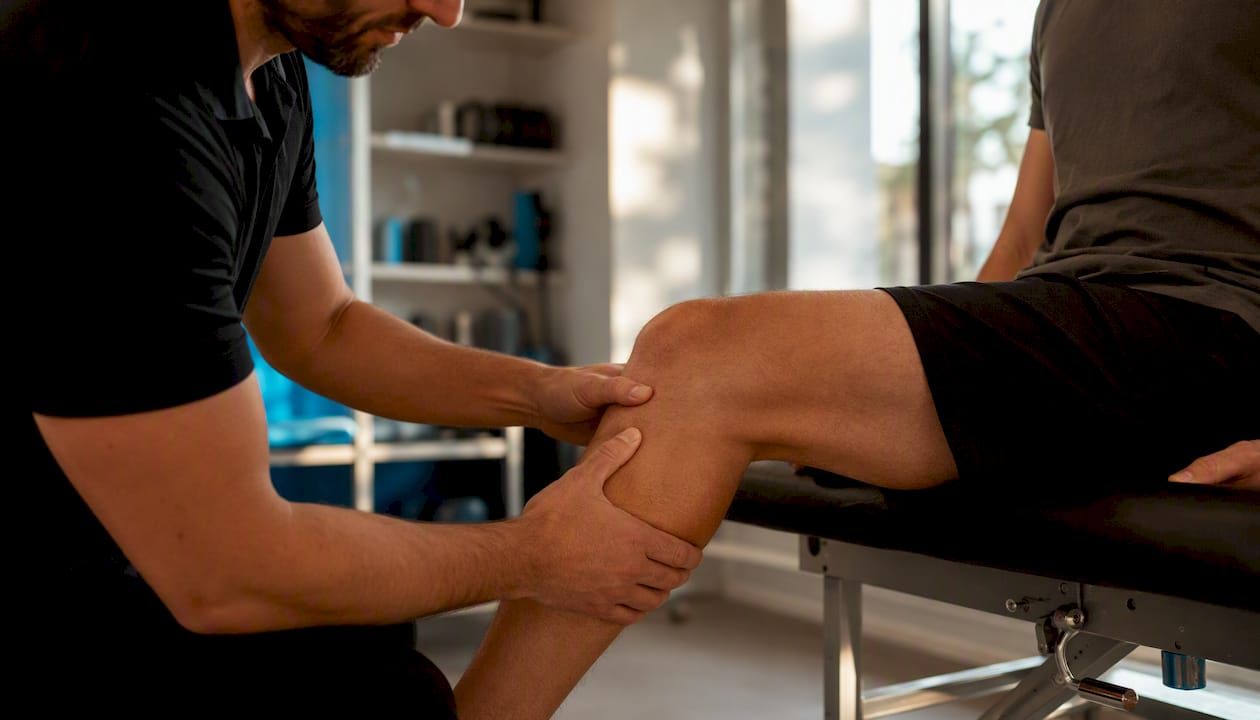
Diagnosis is primarily clinical. A provider will ask about the mechanism of injury, then assess the leg through:
- Single-leg heel raise: — The ability to perform this movement, and how many repetitions are possible, gives a quick functional read on severity.
When imaging helps
Clinical assessment remains the gold standard, but imaging is useful in specific situations:
-
No meaningful improvement after 1–2 weeks of appropriate care.
-
Suspected high-grade (Grade II–III) tear where knowing the extent of damage changes management.
-
Large intramuscular hematoma that may need aspiration.
-
Unclear diagnosis where DVT or a partial Achilles tear needs to be excluded.
Ultrasound is fast, inexpensive, and good for identifying hematoma and fiber disruption. MRI provides more detail on the full extent of a tear and is preferred when surgical planning is on the table.
Referral logic
Most Grade I and mild Grade II strains are managed by a primary care physician, sports medicine clinician, or chiropractor with soft-tissue expertise. Severe Grade II and Grade III injuries, or any case where compartment syndrome or DVT is suspected, warrant urgent evaluation. A surgical consult is appropriate when conservative care has failed or when a complete rupture significantly impairs function in an active patient.
What to do in the first 48–72 hours
The PRICE framework (Protect, Rest, Ice, Compression, Elevation) is the standard starting point for acute calf strain care. It builds on the older RICE model by adding an explicit protection step, which matters most in the first 24 hours when continued loading can extend the tear.
Step-by-step first 72-hour care:
- Rest: — Relative rest, not complete immobilization. Gentle, pain-free movement of the ankle is fine and prevents stiffness.
The No H.A.R.M. rule from Sports Medicine Australia is worth memorizing: avoid Heat, Alcohol, Running, and Massage in the first 72 hours. Each of these increases blood flow to the injured area and can worsen intramuscular bleeding.
Pain control: Acetaminophen (Tylenol) is the safest first-line oral option. Avoid non-selective NSAIDs like ibuprofen and naproxen for the first 24–72 hours. If an anti-inflammatory is needed, a selective COX-2 inhibitor such as celecoxib is a better choice during this window. For pain management options that avoid early NSAID use, the approach used for knee and shoulder soft-tissue injuries applies here as well.
Days 4–14: Once acute pain begins to settle, introduce pain-free ankle range-of-motion exercises and gentle isometric calf contractions. The goal is to start loading the healing tissue without provoking it. A heel lift inside your shoe during this phase reduces the stretch on the calf during walking and improves comfort significantly.
Pro Tip: Compression plus elevation together are more effective than either alone. If you can only do one thing consistently, keep the leg elevated with the bandage on. Swelling that is controlled in the first 48 hours translates directly into a shorter rehab window.
What to expect: recovery timeline by grade
Recovery time varies considerably by severity, and the ranges below reflect typical clinical experience rather than guarantees:
-
Grade I (mild): Days to 2 weeks. Pain with activity but preserved strength and near-normal walking. Most people return to sport within 1–2 weeks with appropriate care.
-
Grade II (moderate): 2–6 weeks. Partial tear with measurable weakness. Return to running typically requires 3–4 weeks minimum; return to explosive sport may take 6 weeks or longer.
-
Grade III (severe): 3–6 months, sometimes longer. Complete rupture with significant functional loss. Surgical repair is considered in active patients with major functional deficits.
Milestone checklist for return to activity:
-
Pain-free walking on flat ground without a limp.
-
Pain-free single-leg heel raise (full range, at least 20–25 repetitions matching the uninjured side).
-
Pain-free jogging on flat ground.
-
Pain-free running at increasing speeds.
-
Ability to perform sport-specific cutting, jumping, or acceleration drills without symptoms.
Reinjury risk is highest within the first two months after returning to full activity. Rushing through the milestone checklist is the most common reason people end up back at square one.
Progressive rehab: exercises and return-to-play criteria
A phased approach to calf strain rehab reduces deconditioning, promotes organized tissue healing, and shortens the overall recovery window compared to prolonged rest.
Phase overview
Phase 1 (Days 1–5): Acute protection. Pain-free ankle pumps and gentle range-of-motion circles. No loading beyond comfortable walking.
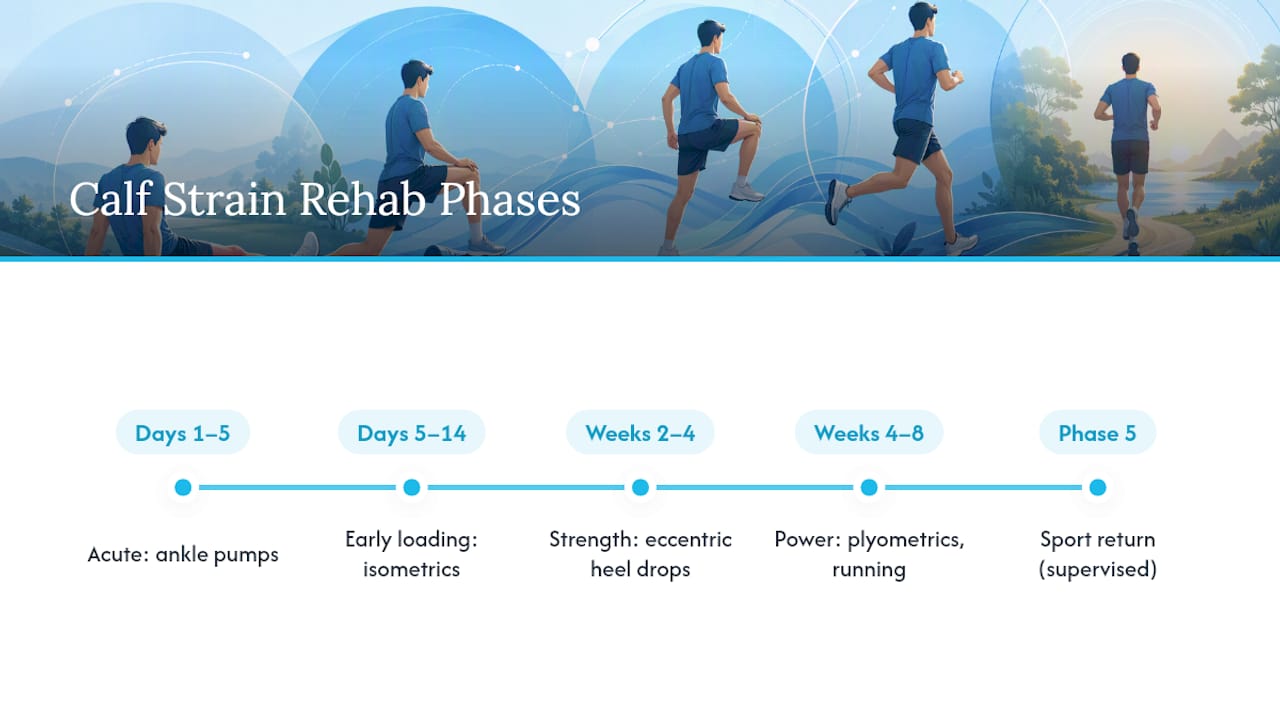
Phase 2 (Days 5–14): Early loading. Isometric calf contractions (press the ball of the foot into the floor without moving the ankle), seated calf raises targeting the soleus with the knee bent, and pain-free walking progression.
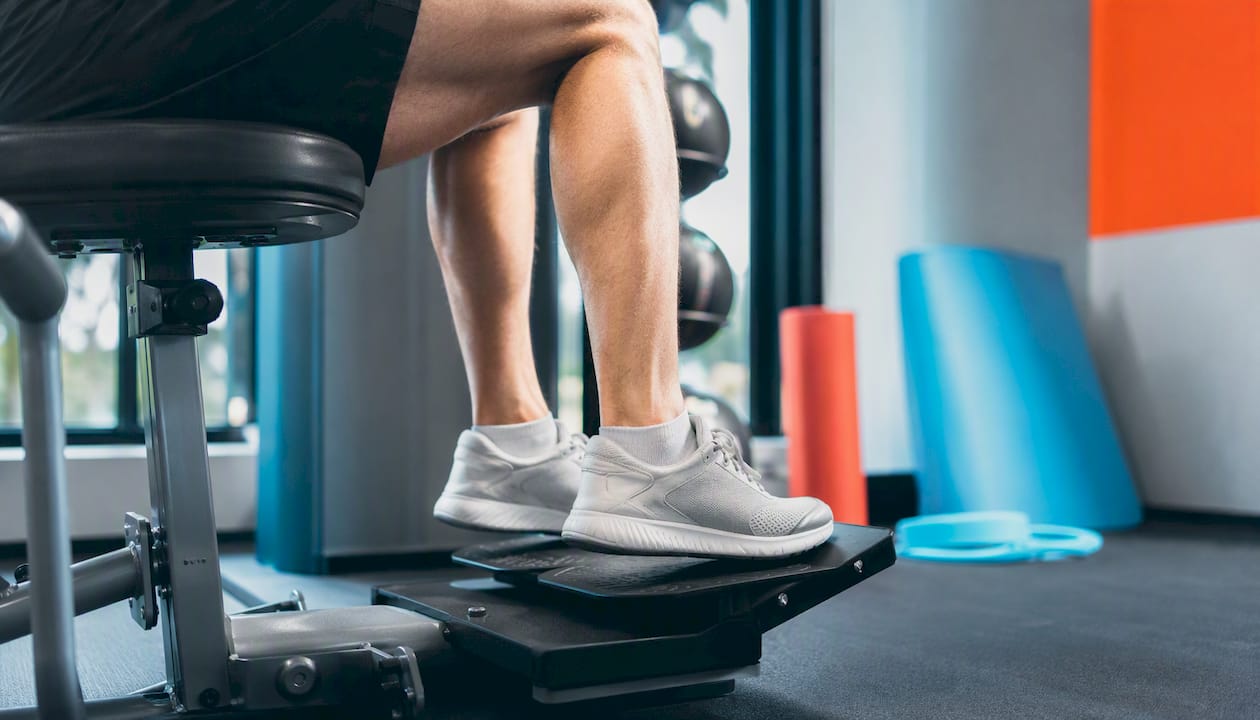
Phase 3 (Weeks 2–4): Strength building. Standing double-leg calf raises progressing to single-leg. Eccentric heel drops off a step (lower slowly over 3–4 seconds) are the cornerstone of this phase and directly address the tissue’s vulnerability to re-tear.
Phase 4 (Weeks 4–8): Power and plyometrics. Skipping, bounding, and progressive running reintroduction. Begin sport-specific drills only when single-leg heel raise quality matches the uninjured side.
Phase 5: Sport-specific reintroduction. Cutting, acceleration, deceleration, and reactive drills at full speed. This phase is supervised.
Sequential home program
-
Ankle pumps: 3 sets of 20 repetitions, 3 times daily (Phase 1).
-
Seated calf raises (knee bent, targeting soleus): 3 sets of 15, twice daily (Phase 2).
-
Standing double-leg calf raises: 3 sets of 15–20, once daily (Phase 3).
-
Single-leg standing calf raises: 3 sets of 15, once daily (Phase 3–4).
-
Eccentric heel drops off a step: 3 sets of 12–15, once daily (Phase 3–4).
-
Skipping and light jogging: progress by 10% per session when pain-free (Phase 4).
For a broader mobility restoration framework that complements this program, athletes returning from lower-limb injuries can use structured checklists to track readiness across multiple movement patterns.
Progression rules: Pain during or after exercise should not exceed a 3/10 on a numeric rating scale. If soreness persists more than 24 hours after a session, reduce load and frequency. Phases 4 and 5 should be supervised by a clinician or physical therapist.
Objective test: The single-leg heel rise test, comparing repetition count and quality side-to-side, is the most practical field measure of readiness. Asymmetry greater than 20% suggests the calf is not ready for full return to sport.
Red flags and when to see a provider
Seek urgent evaluation for these signs
-
Sudden severe deformity or a visible gap in the calf muscle.
-
Complete loss of plantarflexion (inability to point the foot downward).
-
Signs of compartment syndrome: severe, disproportionate pain, tightness, numbness, or tingling in the lower leg that worsens with passive stretch.
-
Signs of DVT: increasing calf swelling, warmth, redness, and pain that does not follow the expected recovery pattern.
-
Rapidly expanding hematoma or severe uncontrollable pain.
Non-urgent reasons to book an appointment
-
No meaningful improvement after 1–2 weeks of home care.
-
Inability to bear weight without a significant limp.
-
Persistent weakness or a feeling of instability in the calf.
-
Recurrent calf strains in the same location.
What to tell your clinician
Bring this information to your visit to speed diagnosis and avoid repeat questioning:
-
Exact mechanism of injury (what you were doing, what you felt).
-
Prior calf injuries and how they were managed.
-
Any new or worsening symptoms since the injury.
-
Current medications, especially anticoagulants (warfarin, apixaban) or antiplatelets (aspirin, clopidogrel), which affect bleeding risk and management decisions.
This guide provides general health information, not medical advice. Confirm current treatment recommendations with a qualified healthcare provider or primary source.
Key Takeaways
Effective calf strain treatment starts with PRICE in the first 72 hours, safe pain control without early NSAIDs, and a progressive loading program that begins as soon as pain allows.
| Point | Details |
|---|---|
| Start PRICE immediately | Protect, rest, ice, compress, and elevate within the first 72 hours to limit swelling and re-bleeding. |
| Avoid NSAIDs early | Skip ibuprofen and naproxen for the first 24–72 hours; use acetaminophen or celecoxib instead to reduce bleeding risk. |
| Recovery varies by grade | Mild strains resolve in days to 2 weeks; moderate tears take 2–6 weeks; severe injuries may need 3–6 months. |
| Progressive loading beats rest | Phase-based rehab with eccentric heel drops and single-leg calf raises shortens recovery and cuts reinjury risk. |
| Thetxroom for hands-on care | Thetxroom in Plano uses FDM and individualized rehab plans to manage calf strains and guide safe return to activity. |
A clinician’s perspective on calf strains
The part most guides underplay is the reinjury window. People feel better, they go back to their sport, and two weeks later they are back in the clinic with the same injury. The tissue heals faster than it strengthens, and that gap is where most recurrences happen.
What actually works is treating the return-to-sport milestone as a test, not a calendar date. The single-leg heel raise is the most honest measure available. When you can match your uninjured side in both count and quality, and you can do it without compensating through the hip or trunk, you are close to ready. When you cannot, you are not, regardless of how many weeks have passed.
The other thing worth saying plainly: prolonged rest is not neutral. Muscle atrophies faster than most people expect, and a calf that has been immobilized for three weeks without any loading stimulus will be weaker and stiffer than one that was gently loaded from day five onward. The modern approach, controlled early loading under supervision, is not aggressive. It is protective. The tissue needs mechanical input to organize properly, and the clinician’s job is to calibrate how much input is appropriate at each stage.
At Thetxroom, the assessment starts with identifying which structure is involved, how the fascial system around it is responding, and where the kinetic chain is compensating. That picture changes the treatment plan considerably, and it is why two patients with the same grade of injury can have very different recovery timelines.
Thetxroom can help you recover from a calf strain
If you are past the acute phase and still limping, still weak, or unsure whether you are ready to return to your sport, hands-on clinical assessment changes the picture fast.
At Thetxroom in Plano, Texas, calf strain care starts with a thorough hands-on evaluation using the Fascial Distortion Model, which identifies not just the torn fibers but the fascial restrictions and compensatory patterns that develop around them. Treatment integrates myofascial therapy, targeted progressive loading, and gait assessment so that your rehab plan matches your actual movement patterns, not a generic protocol. For patients dealing with sprains and strains, the clinic also offers adjunctive soft-tissue therapies that support tissue recovery between sessions.
First visits include a full assessment and a clear plan for what comes next, whether that is a short course of hands-on treatment, a supervised home program, or both. Book your appointment at Thetxroom and get a specific answer about where you are in recovery and what it takes to get back to full activity.
Useful sources and further reading
The following sources informed this guide and are worth reviewing for deeper clinical detail:
-
Calf Strain (Pulled Calf Muscle): Treatment & Recovery – Cleveland Clinic
-
Calf Strain Rehab: From Research To Practice — Physio Network
-
How to Safely Speed Up Calf Strain Recovery – Verywell Health