
Fix Knee Valgus: 3 Phase Plan With Visual Retraining & Ankle Tests
Most functional knee valgus can be improved without surgery through a focused exercise and movement-retraining program. Measurable change typically shows up within 6 to 12 weeks of consistent work, though progress that stalls despite good effort is a sign to get assessed. Start right now: do a bodyweight squat in front of a mirror to check your knee tracking, then perform one glute activation drill, like a side-lying clamshell, for 15 reps per side.
TL;DR:
- Improvements are most likely within 6 to 12 weeks of consistent exercise and movement retraining, with signs of progress visible on video or photos.
- Heel-lift squat tests help identify whether ankle mobility limitations or hip control issues are driving knee valgus.
- Strengthening weak hip abductors, external rotators, and improving pelvic control are key goals, especially when combined with visual feedback during movement training.
- Structural joint issues or visible asymmetries require medical assessment before relying solely on home exercise programs.
- When progress stalls despite 8 to 12 weeks of effort, professional evaluation and targeted manual therapy may be necessary.
Table of Contents
- How to check your knee alignment at home
- Practical biomechanics: the muscle and mobility drivers you must fix
- A prioritized 3-phase corrective program
- How to retrain movement: mirrors, video, and cueing that work
- Simple ankle mobility and foot-strength work that supports knee correction
- When home exercises aren’t enough and what a clinician will do
- Author perspective: why we favor active rehab then selective hands-on care
- How to start with The Tx Room
- FAQ
- Sources
How to check your knee alignment at home
Before picking exercises, you need to know what you’re dealing with. Dynamic knee valgus means your knees cave inward during movement, even though they may look straight when you’re standing still. That distinction matters because the fix depends on when and how the collapse happens.
Three home checks give you a working picture:
- Standing alignment check: stand relaxed and look at your kneecaps. If they point inward even at rest, with a visible bowing of the lower leg, that leans toward a structural pattern rather than a purely movement-based one.
- Bodyweight squat test: squat to a comfortable depth while someone films you from the front, or use a tripod. Watch whether your knees drift inward as you descend. Then repeat the squat with a small heel lift, a folded towel or a 1-inch board under your heels. If the valgus noticeably improves with the heel lift, limited ankle dorsiflexion is likely a driver, a pattern confirmed in a directed exercise study that used heel-lift testing to isolate ankle restriction.
- Single-leg squat test: stand on one leg and lower into a shallow squat. Knee collapse that’s far worse on one leg than the other, or that only appears under single-leg load, points more toward hip and pelvic control than ankle mobility.
Recording video of each test matters more than people expect. Your brain is bad at judging your own knee position in real time, and a phone clip lets you compare week to week instead of guessing whether the program is working.
Practical biomechanics: the muscle and mobility drivers you must fix
Knee valgus rarely has one cause. It’s usually a chain reaction that starts above or below the knee and shows up at the joint in between.
- Weak hip abductors and external rotators: when the gluteus medius and gluteus maximus can’t control the thigh bone, the femur rotates and adducts during loading, pulling the knee inward.
- Poor core and pelvic control: a pelvis that drops or rotates during a step or squat changes the angle the femur sits at, which cascades down to the knee.
- Limited ankle dorsiflexion: when your shin can’t tilt forward enough over your foot, your body finds range somewhere else, often by letting the knee drift inward, a mechanism supported by directed corrective exercise research.
- Excessive foot pronation: a foot that rolls in too much changes the position of the shin and knee above it.
Pro Tip: Test your ankle before you blame your hip. The heel-lift squat check takes 30 seconds and tells you which direction to prioritize first.
Functional valgus, the kind driven by weakness, tightness, and motor control, is the kind this article addresses, and it responds well to training. Structural valgus, caused by bone shape or alignment set at the joint itself, doesn’t correct with exercise alone. If your knees cave inward even standing still, if one leg is visibly different in bony shape from the other, or if you have a history of growth plate issues or prior fracture near the knee, imaging and a clinical evaluation should come before you invest months in a home program.
A prioritized 3-phase corrective program
A good corrective program isn’t a random exercise list. It’s a sequence: first you teach the muscles to fire, then you load them, then you ask them to control real movement under speed and fatigue.
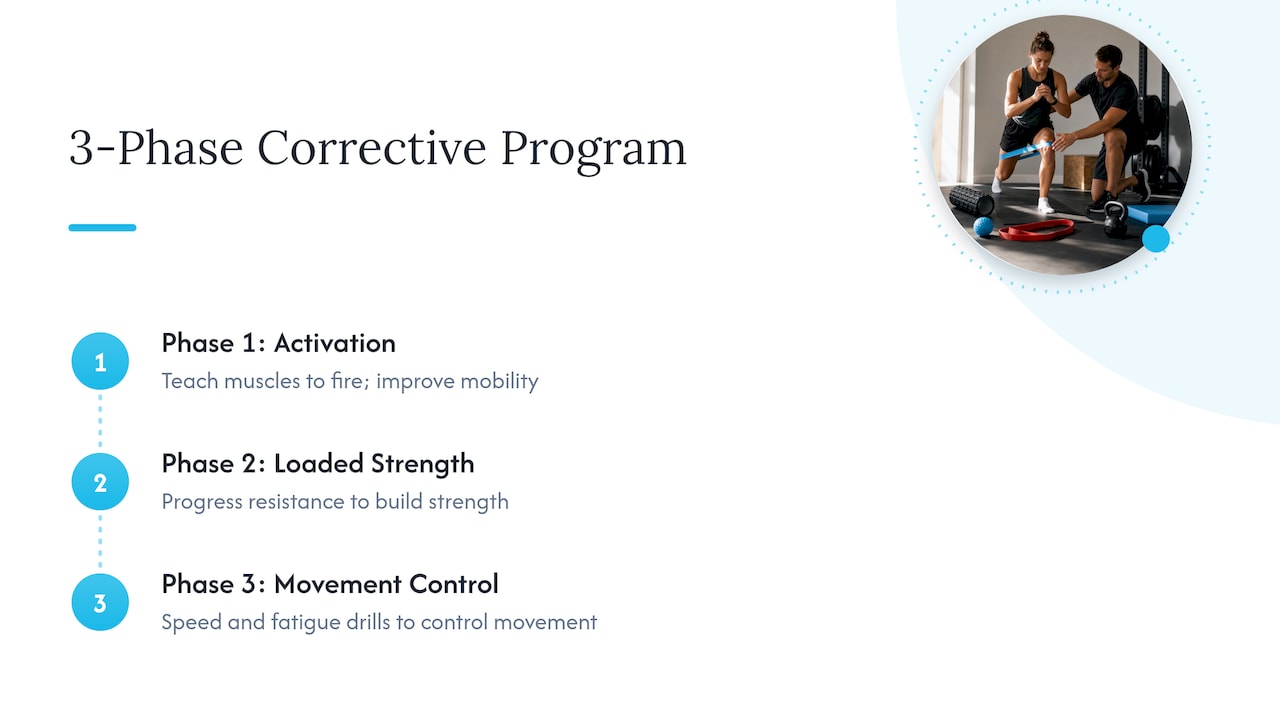
Phase 1: activation and mobility (weeks 0 to 2)
The goal here is waking up the muscles that aren’t pulling their weight and opening up the ankle range that’s forcing compensation elsewhere. Keep sessions short, 10 to 15 minutes, and do them most days of the week rather than three hard sessions.
- Banded glute bridges: loop a resistance band above the knees, bridge up while pressing the knees outward against the band, 3 sets of 15.
- Ankle dorsiflexion mobilizations: kneeling or in a half-kneeling lunge, rock your weight forward over the front foot without the heel lifting, 3 sets of 10 per side.
- Short-core bracing drills: dead bugs or bird dogs focused on keeping the low back and pelvis still, 2 sets of 8 per side.
Phase 2: strength and integration (weeks 3 to 6)
Now you add load and start connecting single-joint strength to multi-joint movement. Train 3 times per week with at least one rest day between sessions.
- Lateral band walks: band around the ankles or just above the knees, step sideways while keeping tension and avoiding knee cave, 3 sets of 10 steps each direction.
- Single-leg Romanian deadlifts: light dumbbells, controlled tempo, focus on a level pelvis, 3 sets of 8 per side.
- Step-ups: a box or sturdy step at knee height, drive through the heel, watch the knee track over the middle toes, 3 sets of 10 per side.
- Controlled squats with a band above the knees: same cue as the bridges, now standing and loaded, 3 sets of 12.
A 12-week combined program using sessions like these, performed three times a week at about 60 minutes each, showed substantial reductions in the gap between the knees and reported pain in women with inward-collapsing knee alignment, a useful benchmark for what consistent strength work over several months can do.
Phase 3: function and transfer (weeks 7 to 12)
This phase asks the knee to behave under conditions closer to real life: speed, single-leg landing, and less conscious thought.
- Loaded single-leg squats: holding dumbbells, slow eccentric phase, 3 sets of 8 per side.
- Low-amplitude plyometrics: small pogo hops or low box step-downs, focusing on a quiet, controlled landing, 3 sets of 10.
- Jump-landing drills with external feedback: jump and land in front of a mirror or recorded on video, aiming the knees at the second toe on landing, 4 sets of 5.
Pro Tip: Quality beats quantity in every phase. If your knee caves on rep 8 of 12, stop at 7. Training the collapse pattern under fatigue reinforces exactly what you’re trying to undo.
A sample week might look like: Monday, full Phase 2 or 3 session; Wednesday, a shorter session emphasizing the drills that are hardest for you; Friday, a full session plus the jump-landing work; with ankle mobility and core bracing from Phase 1 kept in as a daily five-minute warm-up throughout all three phases.
Progress is measured, not guessed. Re-film your bodyweight and single-leg squats every two weeks and compare the knee path side by side with the earlier clips. Pelvic stabilization training over six weeks has been shown to reduce dynamic knee valgus while increasing glute and quad activation measured by EMG, which lines up with what you should expect: the knee path visibly straightens before you necessarily feel stronger. A single-leg hop for distance, compared left to right, is another simple checkpoint, large asymmetries are worth tracking as you progress.
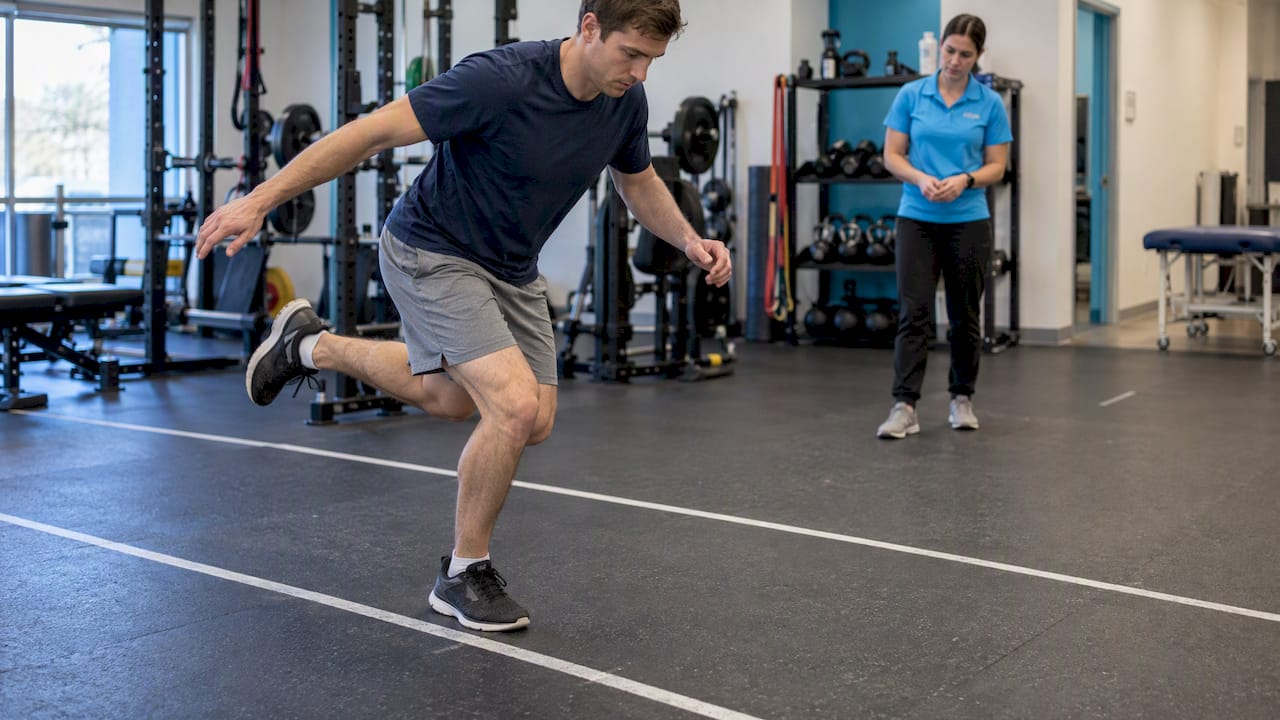
If you’re dealing with hip instability that shows up specifically during squatting, a targeted assessment approach for hip shift in the squat pattern covers some of the same ground from a slightly different angle and is worth a look if Phase 2 feels harder on one side than the other.
How to retrain movement: mirrors, video, and cueing that work
Strength alone doesn’t fix valgus. You can have strong glutes and still cave your knees inward out of habit, because the nervous system learned that movement pattern long before you started training. Retraining the pattern itself is the part most home programs skip.
- Visual feedback beats verbal cues: watching your own knee position in a mirror or on video during a squat produces better motor learning than being told “push your knees out” without seeing it happen, according to a clinical commentary on movement retraining.
- External-focus cues outperform internal ones: cueing “push the band apart” or “spread the floor” works better than cueing a specific muscle to contract, because it directs attention to the outcome rather than the mechanism.
- Mirror squat practice: 3 sets of 10 slow squats, eyes on your own knee path, correcting in real time rather than after the fact.
- Band-resisted squat retraining: light band above the knees during bodyweight squats, used specifically as a cue rather than a strength load.
- Valgus control instruction sessions: structured practice combining feedback, cueing, and the strength drills above produced a roughly 59% reduction in dynamic knee valgus angle over six weeks in active women with knee pain, alongside improved pain and hop-test scores.
Structure feedback like training wheels: heavy in the first two to three weeks, then gradually faded. Start every new drill with a mirror or video in front of you, then once the pattern feels automatic, remove the visual cue and test yourself without it. That fade-out step is what separates a drill you can do from a pattern that holds up on a basketball court or a trail run.
Simple ankle mobility and foot-strength work that supports knee correction
If your heel-lift squat test showed improvement, your ankle is part of the problem, and no amount of hip strengthening will fully fix a knee that’s compensating for a stiff ankle.
- Calf mobility stretching: wall-facing lunge stretch, knee tracking over the toes, 3 sets of 30 seconds per side, daily.
- Ankle rocker drills: half-kneeling position, rock the shin forward over the foot without the heel lifting, 3 sets of 10 per side.
- Short-foot exercises: standing or seated, draw the ball of the foot toward the heel without curling the toes, building the foot’s arch control, 2 sets of 10 holds.
- Toe yoga: practice lifting the big toe while keeping the smaller toes down, then reversing it, to build independent toe control that supports arch stability.
Footwear matters more than most people think. A shoe with a worn-out medial edge, or one that lets your foot roll inward excessively, works against everything you’re doing in the gym. Orthotics can help when pronation is significant and persistent, but they’re worth discussing with a clinician rather than guessing at over the counter, since the wrong support can mask a problem instead of fixing it. If your squat only cleans up with a heel lift in place, that’s a reasonable cue to trial a small permanent heel lift or a shoe with more structured heel support while you continue the ankle mobility work, rather than relying on the towel under your heel indefinitely. For a deeper look at foot-specific progressions, targeted foot-strengthening exercises build on the short-foot and toe drills above. An evidence-based protocol for overpronation-related knee pain is also worth reading if pronation looks like your main driver.
When home exercises aren’t enough and what a clinician will do
A structured program fails for a few predictable reasons: pain that doesn’t settle, a plateau despite real consistency, or a driver that exercise alone can’t reach.
- Red flags: sharp or worsening pain, a knee that gives way or feels unstable, locking or catching sensations, or swelling that doesn’t resolve.
- No progress despite 8 to 12 weeks of consistent, well-executed work is a sign something besides weakness or motor control is driving the pattern.
- Visible structural asymmetry or a history of prior knee injury warrants a professional look before you push further on your own.
A clinic visit typically starts with a movement analysis, similar to the squat and single-leg tests above but done with trained eyes and sometimes basic tools to measure angles. From there, hands-on work can loosen tissue that’s limiting motion, while exercise progression continues in parallel rather than stopping. At our clinic, treatment for knee pain often pairs manual therapy built on the Fascial Distortion Model with soft tissue work, dry needling, or MyACT, used to address restrictions that a stretching routine alone hasn’t resolved, alongside continued corrective exercise. If imaging is warranted, that referral happens before any hands-on work begins.
Author perspective: why we favor active rehab then selective hands-on care
The exercise and movement-retraining approach outlined above is the right first move for nearly everyone with functional knee valgus. It’s cheap, it’s supported by a growing body of small trials, and it puts the work in your hands rather than someone else’s.
That said, I think people underestimate how long motor retraining takes to stick. Six weeks changes a pattern on video. It takes longer to hold under real fatigue, speed, or distraction. Expect a plateau around week 6 or 7, and don’t read it as failure.
When a plateau turns into months of no change despite real consistency, that’s not a sign to add more exercises. It’s a sign to get a second set of eyes on what’s actually restricting the movement.
— Chris
How to start with The Tx Room
If your corrective program has stalled, or you’d rather have a trained eye on your squat pattern from the start, hands-on assessment can shorten the guesswork. We offer chiropractic care built around the Fascial Distortion Model, along with soft tissue therapy, dry needling, and MyACT focused shockwave therapy, each aimed at loosening restrictions that a home program alone hasn’t been able to reach.
A first visit typically includes a movement assessment similar to the squat and single-leg checks described earlier, followed by a hands-on session targeting whatever is found, with an exercise progression plan to continue between visits. Most patients notice a shift in symptoms within a handful of sessions rather than months. If you’re in the Plano, Texas area and your knee alignment work has plateaued, visit our main clinic page to learn more or book an evaluation.
FAQ
Can a valgus knee be corrected?
Functional knee valgus, the kind driven by weak hips, tight calves, or poor movement patterns, generally responds well to a structured exercise and retraining program, with measurable reductions in knee collapse documented in as little as six weeks. Structural valgus caused by bone alignment needs a clinical evaluation rather than exercise alone.
Is it too late to fix knock knees as an adult?
Adult movement patterns respond to the same corrective exercise principles as younger populations, since a 12-week combined exercise program in middle-aged women reduced the gap between the knees and cut pain scores substantially. Age itself isn’t the limiting factor; consistency and addressing the right driver, hip, ankle, or both, matters more.
How much does it cost to correct knock knees?
Cost depends entirely on the path you take: a home exercise program costs nothing beyond a resistance band, while hands-on clinical care is billed per visit and varies by clinic and insurance coverage. We don’t publish a fixed price for evaluation or treatment, so reach out directly for current session rates.
Can I fix knock knees naturally?
Yes, for the functional type, a combination of targeted strengthening, ankle mobility work, and movement retraining with visual feedback has reduced dynamic knee valgus in multiple small trials without surgery or devices. Progress typically takes 6 to 12 weeks of consistent effort to show up clearly on video.
Sources
- Effect of Combined Exercise Program on Lower Extremity Alignment and Knee Pain in Patients with Genu Varum
- Two- and 3-Dimensional Knee Valgus Are Reduced After an Exercise Intervention in Young Adults With Demonstrable Valgus During Squatting
- The Effect of Valgus Control Instruction Exercises on Pain, Strength, and Functionality in Active Females With Patellofemoral Pain Syndrome
- Clinical commentary on movement retraining and neuromuscular control for knee valgus