

Evidence Backed Clinic Steps for Overpronation Knee Pain in 4–8 Weeks
Overpronation can contribute to knee pain, but it is rarely the only cause. If your feet roll inward excessively during walking or running, that motion can twist the shin-bone and pull your kneecap off its normal track. Try supportive shoes or a prefabricated insole for a week or two, and cut back on painful activity. If pain persists, worsens, or comes with swelling or instability, get a clinical assessment rather than guessing.
TL;DR:
- Overpronation causes shin bone internal rotation that can lead to altered patellar tracking and knee pain, especially when foot pronates excessively during walking or running.
- Clinicians assess for overpronation through gait analysis, foot posture measurement, strength screening, and movement tests, reserving imaging for persistent or severe cases.
- Custom orthotics and gait retraining show moderate, variable success, but strengthening exercises and manual therapy are crucial components of an effective, long-term approach.
- Self-care includes cutting back on aggravating activities, performing foot arch lifts, calf raises, and hip stabilization exercises, with prompt medical attention if swelling, locking, or worsening pain occurs.
- Ignoring overpronation-driven knee pain risks structural damage, secondary joint issues, and activity decline, emphasizing early assessment and comprehensive treatment for lasting recovery.
Table of Contents
- What Overpronation Actually Does to Your Knee
- How Clinicians Assess Whether Your Foot Is the Culprit
- Conservative Treatments: What Works, What Helps Temporarily, and What the Evidence Shows
- Safe Self-Care Steps and Exercises You Can Start Now
- When to See a Clinician and What That Visit Looks Like
- How Hands-On Care Fits Into a Recovery Plan
- What Happens if You Ignore Overpronation Knee Pain
- Other Conditions That Mimic Overpronation Knee Pain
- Author Perspective: What Actually Moves the Needle
- Get a Biomechanical Assessment at a Specialized Clinic
- Sources
- FAQ
What Overpronation Actually Does to Your Knee
Every foot pronates some amount during a normal gait cycle. It’s how your arch absorbs shock when your heel strikes the ground. Overpronation happens when the rearfoot rolls inward too far or too long, collapsing the medial arch beyond what your leg can absorb without a compensation somewhere upstream.
That compensation usually shows up at the knee. Excess pronation drags the shinbone into internal rotation, and because the thigh bone doesn’t always follow at the same rate, the kneecap gets pulled slightly off its groove. Clinicians call this altered patellar tracking, and it’s a recognized mechanism behind patellofemoral pain syndrome, often described as a dull ache behind or around the kneecap.
A few things determine whether that mechanical chain actually causes pain:
- How much your foot pronates and for how long during each step
- Whether your hip and glute muscles can control that rotation before it reaches the knee
- Your available range of motion at the ankle and midfoot
- Training load, especially sudden increases in running volume or hard surfaces
This is why some people walk around with visibly flat, overpronated feet for decades and never develop knee pain from flat feet. Good proximal control at the hip can absorb what the foot fails to control.
How Clinicians Assess Whether Your Foot Is the Culprit
A clinician won’t diagnose overpronation as the cause of your knee pain just by glancing at your arches. It takes a sequence of tests that connect what your foot does to what your knee feels.
- Gait observation, often on video. Slow-motion playback reveals rearfoot eversion timing and how long the foot stays pronated during stance phase.
- Static foot posture measurement, commonly using the Foot Posture Index, a six-item scale that scores arch height, heel position, and midfoot bulge.
- Single-leg squat and step-down tests, which expose whether your hip and knee collapse inward under load, a strong visual clue for biomechanical dysfunction.
- Hip, glute, and quadriceps strength screening, since weak proximal muscles let foot-driven rotation travel straight up to the knee.
- Neuromuscular control tests, checking how quickly and accurately you can correct your position when balance is challenged.
Imaging or a specialist referral usually only enters the picture when there’s swelling, mechanical locking, or symptoms that don’t respond to a few weeks of targeted conservative care.
Conservative Treatments: What Works, What Helps Temporarily, and What the Evidence Shows
The honest answer is that no single fix works for everyone, and the research reflects that nuance rather than a clean winner.
Orthotics for overpronation have the strongest controlled evidence of the bunch. A randomized trial found that 39.3% of adults with pronated feet who used prefabricated foot orthoses reached neutral foot posture within six months, compared with just 8.5% of a control group. That’s a meaningful gap, but the same trial noted the effect varied by metatarsal anatomy. Not every foot responds the same way to the same insert.
Gait retraining is where the more recent evidence has gotten interesting. A 2024 meta-analysis pooling 15 studies and 295 participants found that specific retraining techniques, particularly lateralizing the center of pressure and adjusting foot progression angle, produced measurable reductions in pronation. A separate systematic review reached a similar conclusion, though it flagged that the ideal dose and method still aren’t standardized across clinics.
Other tools fill in the gaps:
- Motion-control or stability running shoes reduce excess rearfoot motion for some runners, though the effect is modest without other changes.
- Kinesiology taping and knee braces can offer short-term symptom relief during flare-ups.
- Foot and hip strengthening exercises address the neuromuscular side of the equation, not just the structural side
Clinical summaries caution that orthoses and inserts work best as an adjunct, not a permanent crutch. Relying on a device without ever retraining your muscles can leave you dependent on it, since long-term evidence for insoles alone is mixed when they aren’t paired with strength work.
Safe Self-Care Steps and Exercises You Can Start Now
You don’t need a referral to start reducing load on an irritated knee today. Cut back on the specific movements that spike your pain, whether that’s running, stairs, or deep squats, but keep gentle activity going. Complete rest tends to slow recovery rather than speed it.
- Foot doming. Sit with your foot flat, then lift the arch without curling your toes. Hold two seconds, repeat 10 times per foot.
- Calf raises. Rise onto your toes slowly, pause, lower with control. Start with two feet, progress to one foot as strength improves.
- Glute bridges. Lie on your back, squeeze your glutes, lift your hips. This builds the hip strength that keeps knee rotation in check.
- Single-leg balance with a resistance band. Stand on one leg while a partner or anchored band pulls gently at your hip, forcing your stabilizers to react.
Pro Tip: Do foot doming barefoot in front of a mirror for the first few sessions. Most people cheat by curling their toes instead of lifting the arch, and watching your own foot fixes that habit fast.
Stop and call a clinician if you notice swelling that doesn’t go down overnight, a locking or catching sensation, or pain that wakes you up at night.
When to See a Clinician and What That Visit Looks Like
Home care handles a lot of mild, activity-related knee pain. But certain signs mean it’s time to get looked at rather than wait it out.
- Swelling that persists more than a couple of days
- A knee that locks, gives way, or feels unstable when you walk
- Pain that wakes you at night or steadily worsens over a week
- Noticeable decline in your ability to walk, climb stairs, or bear weight
A proper visit covers more than the knee itself. Expect a full kinetic-chain exam checking your feet, ankles, hips, and gait pattern, sometimes paired with the gait analysis tools described earlier. Many clinicians start with a trial of temporary orthoses or basic gait cues alongside a progressive strengthening plan, then reassess in a few weeks.
Most people see meaningful improvement within four to eight weeks of consistent conservative care. Imaging or referral to a specialist usually only comes up if symptoms plateau or red flags appear early.
How Hands-On Care Fits Into a Recovery Plan
Strengthening and gait work address the muscles and movement patterns behind overpronation, but tight or restricted soft tissue can limit how well those changes actually hold. This is where hands-on techniques, including the Fascial Distortion Model used at a specialized clinic, complement rather than replace rehab exercise.
FDM-style treatment targets specific fascial restrictions that can quietly limit ankle and hip mobility, the same mobility your muscles need to correct pronation on their own. Addressing restricted tissue alongside strengthening tends to work better than either approach in isolation:
- An individualized assessment identifies which joints and tissues are actually restricted, rather than treating the knee alone
- Treatment goals are measurable: reduced pain, improved single-leg control, better range of motion
- Progress gets tracked against a functional baseline, not just how the knee “feels” that day
Readers dealing with related flat feet and overpronation issues often benefit from combining this kind of manual work with the strength progressions covered earlier.
What Happens if You Ignore Overpronation Knee Pain
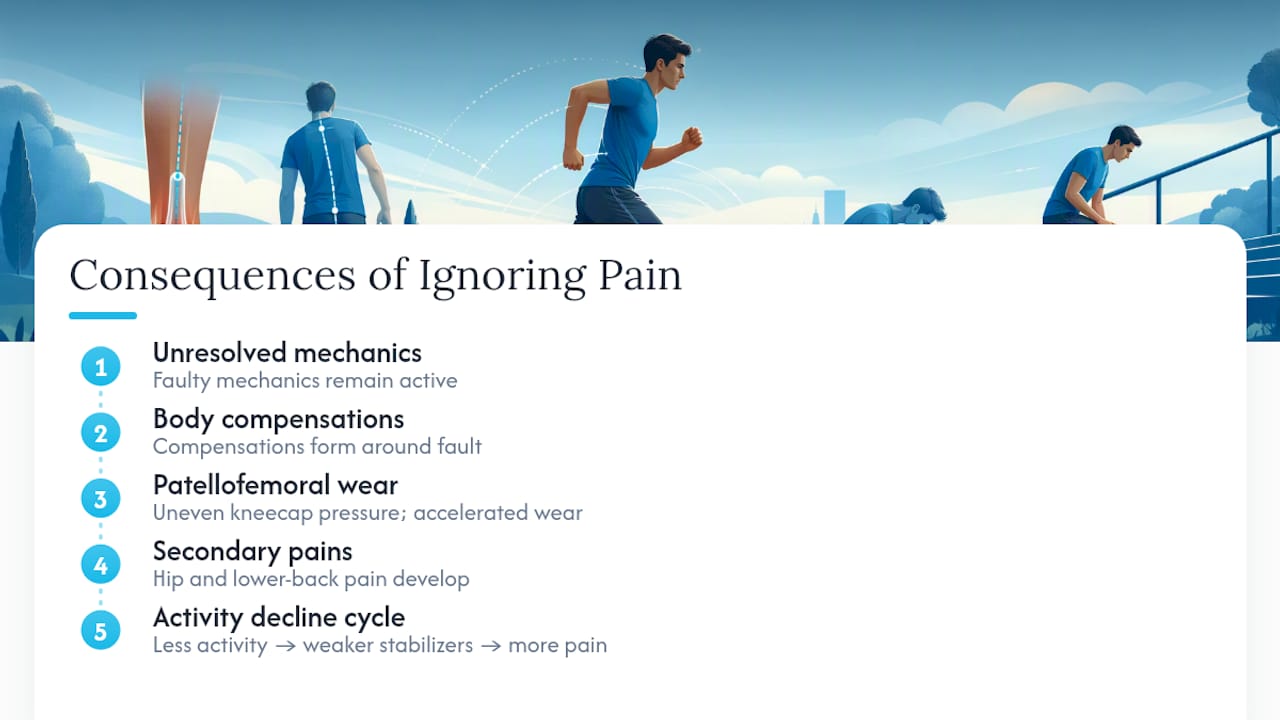
Letting overpronation-driven knee pain run its course rarely resolves the underlying mechanics, it just gives your body more time to build compensations around them. Those compensations are the real problem.
When your knee keeps absorbing rotational stress it wasn’t built to handle, the patellofemoral joint takes the brunt of it. Cartilage under the kneecap experiences uneven pressure with every step, and over months to years that repetitive mismatch is associated with accelerated wear behind the kneecap. This doesn’t mean everyone with overpronation ends up with arthritis, but the mechanical setup increases the odds compared to a knee tracking normally.
The compensations don’t stop at the knee, either. People with unaddressed overpronation frequently develop secondary hip pain, since the glutes and external rotators work overtime trying to control a rotation that starts at the foot. Lower back discomfort can follow the same chain, especially in people who spend hours standing or walking for work.
There’s also a behavioral cost that’s easy to underestimate. Chronic knee pain pushes people away from the activities that would actually help; the walking, running, or strength training that builds the hip and glute control needed to fix the pronation in the first place. That creates a slow decline: less activity, weaker stabilizers, more pronation-driven stress, more pain. Breaking that cycle gets harder the longer it runs, which is the real argument for early conservative treatment rather than waiting to see if it goes away on its own.
Other Conditions That Mimic Overpronation Knee Pain
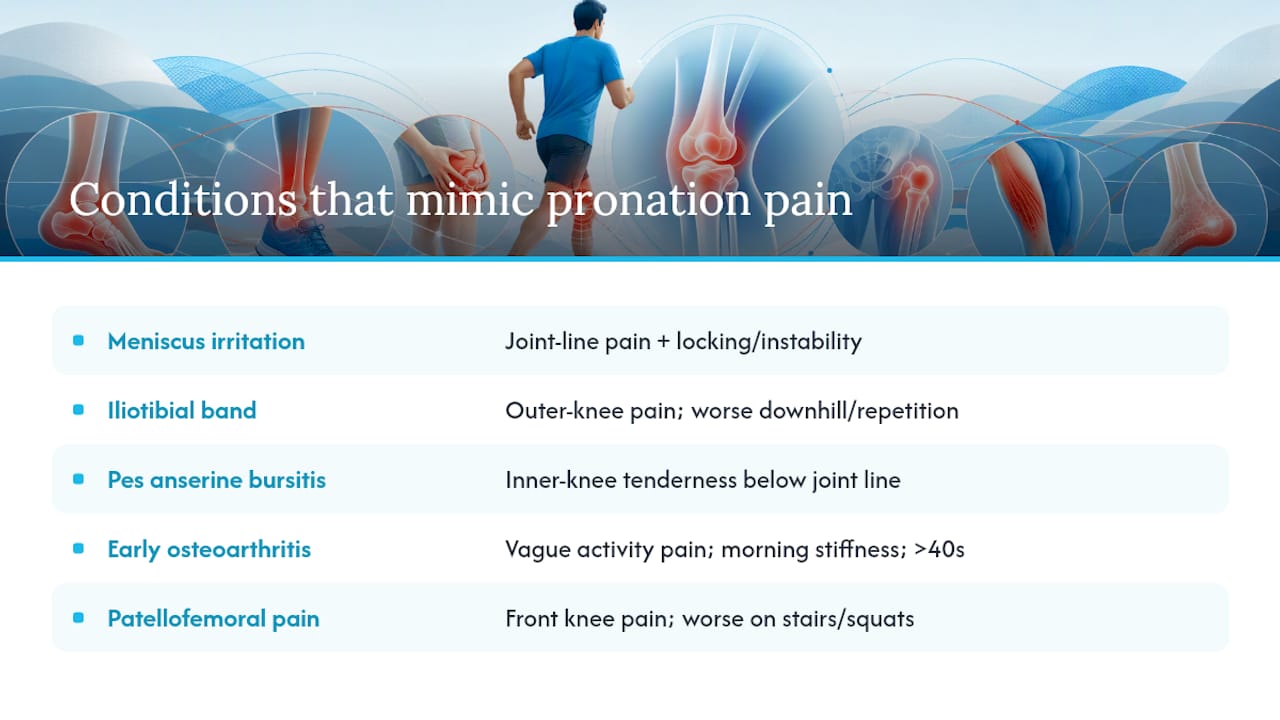
Not every ache near the knee traces back to your feet, and treating the wrong cause wastes time. A few common mimics deserve a second look before you assume pronation is the culprit.
Meniscus irritation produces pain along the joint line, often with catching or locking that overpronation-related patellofemoral pain doesn’t typically cause. If your knee gives way or gets physically stuck, that points more toward a meniscal or ligamentous issue than a tracking problem.
Iliotibial band syndrome causes pain on the outer side of the knee, usually worse with running downhill or repetitive bending. It shares some risk factors with pronation but responds to a different rehab approach, focused on hip abductor strength and IT band mobility rather than foot control.
Pes anserine bursitis creates tenderness on the inner side of the knee, just below the joint line, and can feel similar to the medial knee ache some overpronators describe. The location is close enough that people confuse the two, but bursitis usually responds to rest and targeted anti-inflammatory care rather than gait changes.
Early-stage osteoarthritis can also produce vague, activity-related knee pain that overlaps with pronation symptoms, particularly in people over 40. A clinician can usually distinguish the two through joint line tenderness patterns, morning stiffness duration, and how the pain responds to a short trial of activity modification.
If your pain sits squarely at the front of the knee, worsens with stairs or squatting, and improves somewhat with supportive footwear, pronation-driven patellar tracking is a reasonable working theory. If it’s sharper, localized to one side, or comes with locking or instability, it’s worth ruling out these other causes first.
Author Perspective: What Actually Moves the Needle
Fixing overpronation knee pain works better as a sequence than a single fix: assess the whole kinetic chain first, then retrain movement patterns, then build strength, and use orthoses as a bridge, not a permanent solution. The trap most people fall into is grabbing an insert and stopping there. Give any combined plan six to eight weeks before judging whether it’s working. Bodies compensate slowly, and they correct just as slowly.
— Chris
Get a Biomechanical Assessment at a Specialized Clinic
A specialized clinic offers a direct path to answers when a chiropractor visit or generic insole hasn’t fixed the problem, because the assessment starts at the foot and works up through the hip, not just at the sore knee. Using the Fascial Distortion Model alongside individualized rehab planning, the clinic evaluates gait, foot posture, and proximal strength together instead of treating the kneecap in isolation.
A first visit typically includes a movement screen, a look at your footwear and daily loading patterns, and hands-on treatment for any restricted tissue found along the way. Follow-up visits build out a progressive strengthening plan, similar to the runner’s knee approaches that pair manual therapy with targeted exercise. If you’re in Plano and dealing with knee pain that hasn’t responded to rest or a store-bought insole, book an evaluation and get a plan built around how your specific foot and knee actually move.
This article is general information, not a substitute for advice from a qualified doctor. Consult a qualified healthcare professional about your own circumstances before acting on anything here.
Sources
- Cleveland Clinic — Overpronation
- PubMed: Meta-analysis on gait retraining (2024)
- Randomized trial of prefabricated orthoses (PMC11765314)
- NCBI Bookshelf — overview of interventions for knee pain and pronation
- PLOS ONE — Systematic review on gait retraining (2024)
FAQ
What Happens if Overpronation Goes Untreated?
Untreated overpronation can lead to ongoing patellofemoral pain, secondary hip or lower back discomfort, and, over time, uneven cartilage wear behind the kneecap from repeated abnormal loading.
Why Does the Back of My Knee Hurt When I Bend or Straighten It?
Pain behind the knee during bending is more often linked to hamstring tendon irritation, a Baker’s cyst, or meniscus involvement than to overpronation, which typically causes pain at the front or inner side of the knee.
Why Does My Knee Feel Like It Needs to Pop but Won’t?
That sensation usually points to soft tissue tightness or a mild tracking issue rather than a joint problem, and it can appear alongside overpronation-driven patellar maltracking when surrounding muscles are overly tense.
What Could Be Causing Inner Knee Pain When I Walk?
Inner knee pain during walking commonly comes from patellofemoral tracking issues tied to foot pronation, though pes anserine bursitis and early medial compartment changes can produce a similar ache and are worth ruling out.