
6 Sports Chiropractor Benefits, Without the Performance Hype
Yes, sports chiropractic can help athletes. The best-supported benefits are faster symptom relief, better joint mobility, and support during injury recovery. Spinal manipulation, soft-tissue therapy, and the team-physician guidance from ACSM all point to the same practical rule: it works best alongside rehab. Evidence for direct performance gains is mixed, so treat it as a recovery and movement tool, not a shortcut.
TL;DR:
- A small Australian Rules football trial found fewer lower limb strains and less back pain, but hamstring and noncontact knee results were not significant.
- Reviews find immediate mobility or neuromuscular changes after manipulation, but no reliable sports performance gains; the practical value of small effects remains uncertain.
- ACSM guidance places chiropractic within multidisciplinary care, with return to play based on function and the full medical picture rather than pain relief alone.
- Seek medical evaluation first for numbness, severe night pain, or significant recent trauma; otherwise, bring training schedules and symptom records to tailor care around competition.
- For chronic soft tissue problems, manual treatment should ease symptoms enough to support progressive loading, while exercise rebuilds capacity and persistent problems need physician review.
Table of Contents
- 1. What are the main benefits for you as an athlete?
- 2. What do the research and major guidelines say?
- 3. When should you see a sports chiropractor, and what happens at a visit?
- 4. What are the long-term benefits beyond injury recovery?
- 5. How can sports chiropractic help with chronic musculoskeletal conditions?
- 6. Our perspective: hands-on, FDM-led care for athletes
- 7. Ready to get started with sports chiropractic?
- FAQ
- Sources
1. What are the main benefits for you as an athlete?
Most athletes come to a sports chiropractor with a specific problem: a tight hamstring, a stiff lower back, a joint that will not move the way it used to. Here is what the hands-on approach typically offers, and what you might notice in training.
- Faster symptom control. Manual therapy and soft-tissue work can ease pain and guarding, so you often move more freely after a session. A runner with a tight calf might find the next run less restricted.
- Better joint range of motion. Adjustments and fascial work target stiff segments and restricted tissue. A swimmer or overhead athlete may notice a smoother, fuller reach.
- Quicker recovery between sessions. Easing stiffness and improving tissue mobility can help you feel ready sooner after hard training blocks or tournament weekends.
- Injury prevention through better mechanics. A good assessment spots movement flaws and imbalances, such as a hip that does not rotate well or a stiff thoracic spine, before they turn into strains.
- Support for sport-specific function. Some studies report small, immediate changes in neuromuscular measures after manipulation. These changes are modest, so think of them as a window to move better, not a performance boost.
- Coordination with rehab and return-to-play. A sports chiropractor can handle the hands-on side while a physical therapist, coach, or physician handles loading and progression. Athletes surveyed in a qualitative study were generally satisfied with their care, expected symptom improvement and a sport-specific assessment, and wanted clinicians to communicate better with each other.
Range of motion is a good place to see the practical payoff. If you want a closer look at how mobility work translates to your sport, our piece on how chiropractors help range of motion walks through it. Soft-tissue techniques are covered in more depth in our article on myotherapy benefits.
Shockwave is another tool athletes ask about, especially for stubborn foot and ankle problems. Podiatry practices such as the sports medicine team at Lakewood Family Foot use it for conservative care of those injuries, which shows how widely hands-on, non-surgical options are used in sports health.
Pro Tip: Bring your training schedule and a recent record of your symptoms to your first visit. A sport-specific history lets the clinician time treatment around competition, not just around pain.
2. What do the research and major guidelines say?
The evidence supports a useful adjunct role. It does not support miracle claims. Here is where the strongest sources land.
- Injury prevention trial. A randomized trial in semi-elite Australian Rules footballers found that adding sports chiropractic manual therapy to existing care appeared beneficial for preventing primary lower-limb muscle strains and reducing low-back pain. The hamstring and non-contact knee findings were not statistically significant, and the authors flagged the small sample and called for larger replication.
- Performance outcomes. A systematic review of spinal manipulation in healthy adults found that manipulation often produces immediate mobility or neuromuscular changes but does not reliably improve sport performance. Where small gains appeared, their practical importance was uncertain.
- Team-based care. ACSM team-physician guidance treats sports chiropractic as one component of multidisciplinary sports-health care and says return-to-play decisions should rest on function and the full medical picture. Related ACSM guidance on early musculoskeletal injury management stresses screening, rehab milestones, and coordination among clinicians.
The takeaway: the footballer trial suggests fewer lower-limb muscle strains and less back pain, but its small size means it is a promising signal, not proof that routine chiropractic prevents all sports injuries.
In practice, that means measuring your progress, pairing hands-on care with rehab, and expecting more high-quality performance research to come.
3. When should you see a sports chiropractor, and what happens at a visit?
Consider booking when you have an acute strain, stiffness that will not clear, reduced range of motion, soft-tissue pain that keeps coming back, or an upcoming event where you want a pre-competition tune-up. Red flags such as numbness, severe night pain, or a recent significant trauma call for medical evaluation first.
A typical pathway looks like this:
- History and goals. You describe the injury, your sport, and your training load.
- Movement screen and red-flag check. The clinician tests how you move and rules out anything that needs a physician.
- Sport-specific assessment. Your sport’s demands shape what gets examined, from throwing mechanics to running gait.
- Hands-on treatment. Depending on the findings, this may include spinal manipulation, fascial distortion techniques, soft-tissue therapy, dry needling, or focused shockwave, plus rehab exercises to do at home.
- Coordination and follow-up. A plan is set with your therapist, coach, or physician, with reassessment tied to the injury type.
Timelines vary by tissue. Ligament injuries, for example, move through distinct healing phases, which we lay out in our guide to ligament sprain recovery milestones. For bigger injuries, our explanation of ACL recovery shows why function-based milestones beat the calendar.
4. What are the long-term benefits beyond injury recovery?
Acute care gets you back on the field. The longer-term value comes from what you learn and maintain afterward.
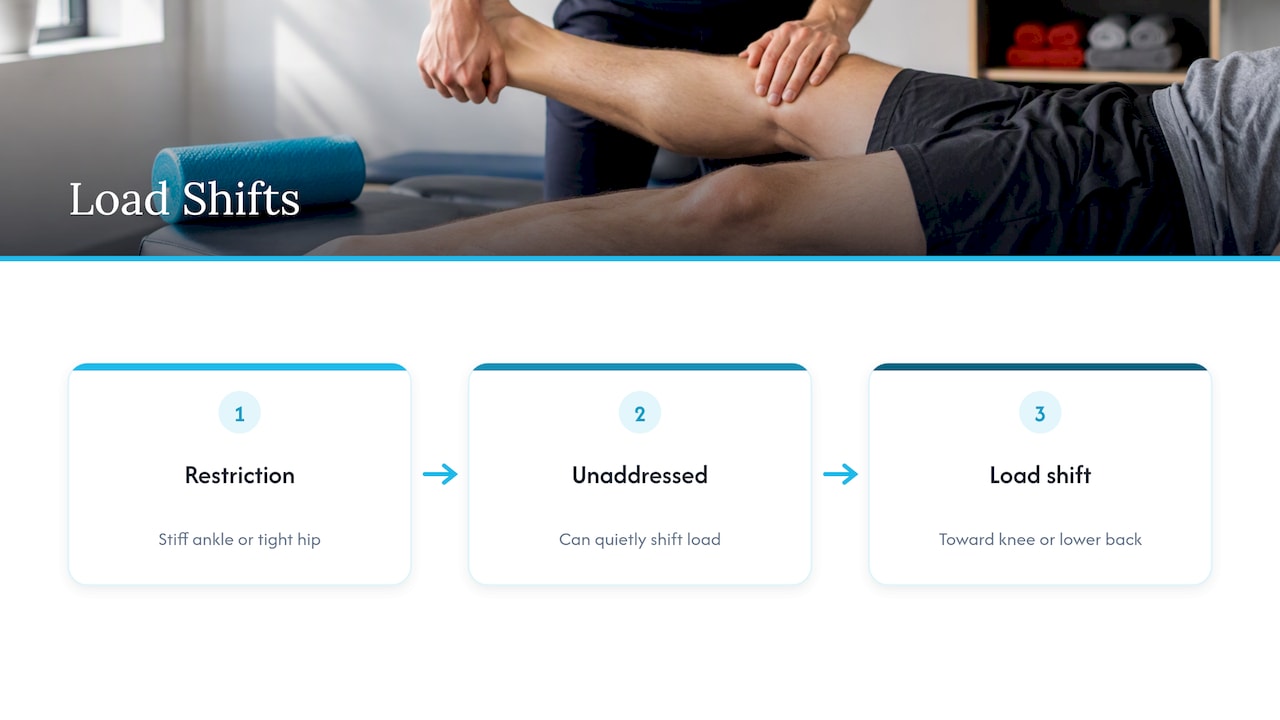
Regular movement assessments help you catch small restrictions before they compound. A stiff ankle or a tight hip flexor that goes unaddressed can quietly shift load to your knee or lower back over a season, so spotting it early protects the rest of the chain.
There is also an education benefit. Athletes who work with a hands-on clinician often leave knowing which movements to monitor, which drills to keep in their warm-up, and how to tell normal soreness from a warning sign. That awareness lasts long after the last visit.
Maintenance visits can also fit around your calendar, for example during heavy training blocks or just before peak competition, when small restrictions cost the most. The evidence here is thinner than for acute care, and the footballer trial’s authors called for larger replication, so we frame this as a reasonable strategy rather than a guarantee. The consistent finding across the sources is that outcomes improve when manual therapy sits inside a broader plan with progressive exercise and clear communication between clinicians.
Finally, athletes tend to stay engaged when care is collaborative. The qualitative research points to satisfaction rising when clinicians explain what they find and coordinate with the rest of the team.
5. How can sports chiropractic help with chronic musculoskeletal conditions?
Athletes carry chronic issues too: recurring tendon irritation, persistent low-back tightness, plantar fascia pain, and repetitive strain that flares with volume. These rarely resolve with a single fix, which is where a steady, hands-on approach earns its place.
For low-back pain, the evidence is the most developed. The pragmatic-studies review places chiropractic care in the same range as physical therapy and medical care for many outcomes, which supports it as one reasonable option among several. Broader pain-care guidance, including the CDC clinical practice guideline, emphasizes maximizing nonpharmacologic and nonopioid therapies and using integrated, team-based approaches, which is the same model good sports chiropractic follows.
For chronic soft-tissue problems, the usual strategy combines manual therapy to calm irritated tissue with progressive loading to rebuild capacity. Soft tissue work, fascial techniques, and shockwave can reduce symptoms enough to let you train, while the exercise program does the lasting work. If a condition is not responding after a reasonable trial, that is the signal to loop in your physician for imaging or a different plan.
6. Our perspective: hands-on, FDM-led care for athletes
We specialize in hands-on manual therapy built around the Fascial Distortion Model, and our focus is getting you back to activity quickly and safely. FDM treats specific patterns of distorted fascia, which we find helpful for the sprains, strains, and nagging overuse problems athletes bring in.
Here is how a typical athlete pathway looks. We assess how you move and what your sport demands. We start hands-on sessions to restore motion and settle symptoms. Then we layer in progressive rehab, coordinating with your therapist, coach, or physician as needed. Return to activity follows function, not just the absence of pain. Our write-up on athletes who excel with chiropractic care shows what that looks like in practice.
The mistake I see most often is treating the sore spot and ignoring the pattern behind it. Pain is usually the last place a problem shows up, so the best outcomes come from chasing the cause while you keep training smartly.
— Chris
7. Ready to get started with sports chiropractic?
If you want sport-focused, hands-on care, we would like to evaluate how you move and build a plan around your goals. Whether you are rehabbing an injury or tuning up before a season, you can start with a conversation.
Our services for athletes include:
- Chiropractic care and soft-tissue therapy
- Fascial Distortion Model
- Dry needling
- MyACT focused shockwave
- Deep tissue therapy laser
Book an evaluation through our main services page or call us, and we will find a time that fits your training week.
This article is general information, not a substitute for advice from a qualified doctor. Consult a qualified healthcare professional about your own circumstances before acting on anything here.
FAQ
What are the benefits of being a chiropractor?
Chiropractors gain the satisfaction of helping people move and feel better through hands-on care, plus the chance to work closely with patients over time. For athletes, a sports-focused practice also means working alongside coaches and other clinicians on return-to-play.
Can a chiropractor prescribe GLP-1?
No. Chiropractors focus on musculoskeletal care and do not prescribe medications such as GLP-1 drugs. Questions about prescriptions belong with your physician or another licensed prescriber.
Is a Doctor of Chiropractic degree a real doctor?
A Doctor of Chiropractic is a professional doctoral degree for a licensed healthcare provider who diagnoses and treats musculoskeletal conditions. It is not a medical degree, so chiropractors do not practice as medical physicians or prescribe drugs.
What should you avoid after a chiropractic adjustment?
Skip intense training, heavy lifting, and prolonged static positions right after a session unless your clinician says otherwise. Mild soreness is common, so follow your provider’s guidance and report anything unusual.
Sources
- The effect of a sports chiropractic manual therapy intervention on the prevention of back pain, hamstring and lower limb injuries in semi-elite Australian Rules footballers: a randomized controlled trial | BMC Musculoskeletal Disorders | Springer Nature Link
- The effects of spinal manipulation on performance-related outcomes in healthy asymptomatic adult population: a systematic review of best evidence | Chiropractic & Manual Therapies | Springer Nature Link
- Team Physician Consensus Statements – ACSM
- Effectiveness and Economic Evaluation of Chiropractic Care for the Treatment of Low Back Pain: A Systematic Review of Pragmatic Studies
- Springermedicine