
Is Chiropractic Safe for Plano Patients? Check Training Before You Go
Chiropractic care is generally considered safe when a licensed, trained practitioner performs spinal manipulation for spine-related musculoskeletal pain. NCCIH notes that serious events are very rare, while active surveillance found that 21% of patients reported a mild event within days. Screening and honest conversation about risk make the difference.
TL;DR:
- NCCIH reports that up to 21% of patients may experience mild symptoms within 2–7 days after treatment, including soreness, stiffness, or headache.
- Published estimates of serious complications range from one per 2 million manipulations to 13 per 10,000 patients, reflecting differences in study design and reporting.
- MedlinePlus lists severe osteoporosis, spinal cancer, bone or joint infection, and severely pinched nerves with numbness, tingling, or weakness as reasons to avoid manipulation.
- Sudden severe neck pain with slurred speech, dizziness, vision changes, new limb weakness, or bowel or bladder changes warrants emergency care, not an adjustment.
- Before booking, verify the license, ask how the clinician screens for contraindications and explains risks and alternatives, and reject cure promises or prepaid maintenance plans.
Table of Contents
- What do major health bodies say about chiropractic safety?
- What side effects are normal after an adjustment?
- How serious can complications get, and how rare are they?
- Who should avoid spinal manipulation?
- Why do training and practice style affect your risk?
- How do you choose a safe chiropractor?
- What happens at a visit, and what should informed consent cover?
- What does the evidence say overall?
- What is our view on safe chiropractic care?
- Where can you get safety-focused chiropractic care in Plano?
- FAQ
- Sources
What do major health bodies say about chiropractic safety?
The mainstream medical view is cautiously positive. A 50-year review of chiropractic research found that clinical practice guideline recommendations have evolved to favor spinal manipulative therapy for many spine-related disorders. An AHRQ review of noninvasive treatments for low back pain concluded that spinal manipulation, exercise and acupuncture offer small-to-moderate short-term benefits, and that serious harms appeared rare, although harms were not assessed as well as they should have been.
For context, different treatments for chronic pain have different potential benefits and harms. Discuss the options with a clinician.
The honest limit is this: trials are rarely large enough to detect very rare events, so screening and reporting carry much of the safety load.
What side effects are normal after an adjustment?
Most reactions are mild and short-lived. You may notice:
- Localized soreness near the treated area
- Stiffness in the neck or back
- A mild headache
- A temporary increase in the pain you came in with
NCCIH reports that up to 21% of patients may have mild, transient events in the 2–7 days after treatment, and the surveillance study above lists discomfort, stiffness and numbness as the most common. Older work, such as Ernst’s risk–benefit analysis, reported mild effects in about 50% of patients in some studies, though methods varied widely.
For severe or worsening symptoms, or numbness that spreads, seek immediate emergency care.
How serious can complications get, and how rare are they?
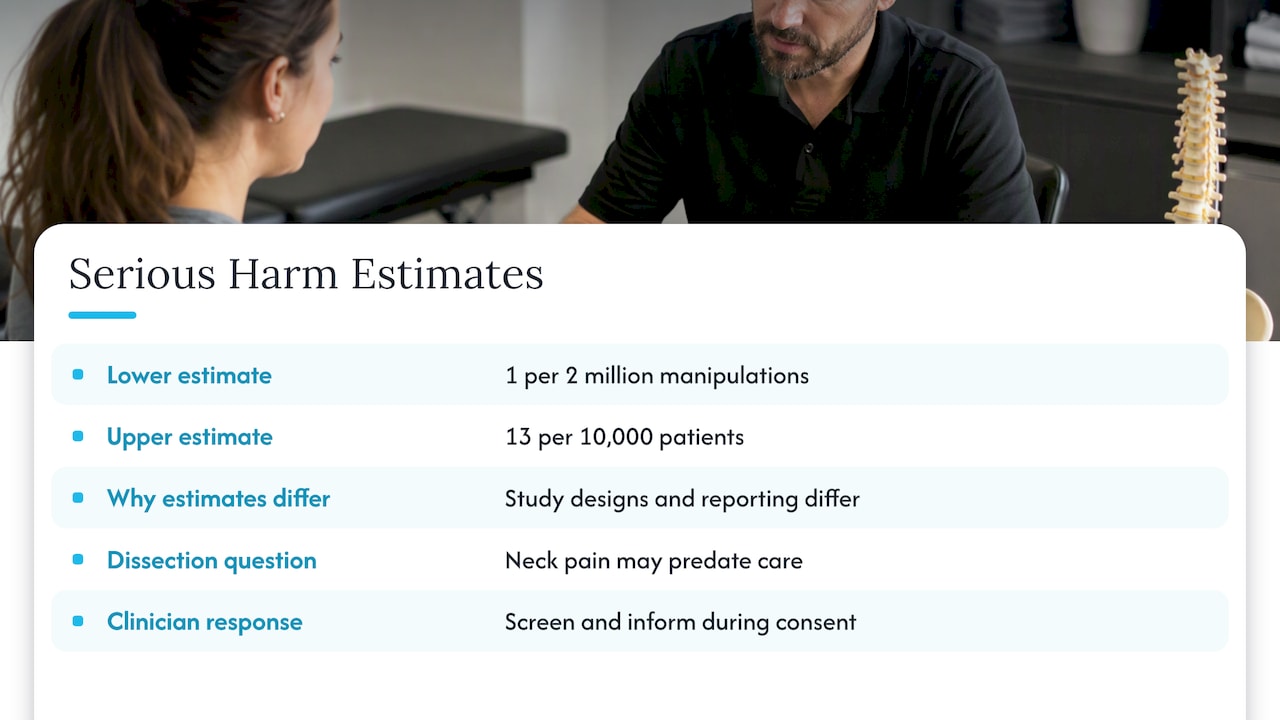
Serious harms are rare, but you deserve the full picture. The literature describes fractures, neurological injury and vascular events. A review of chiropractic care reports estimates ranging from 1 per 2 million manipulations up to 13 per 10,000 patients. The gap is wide because study designs and reporting differ, which is exactly why no single number should be treated as final.
Cervical artery dissection is the hardest question. People with an early dissection often have neck pain and may seek care for it, so a manipulation can appear to cause an event that was already underway. Researchers call this protopathic bias. It means case reports alone cannot establish that manipulation caused the injury, and it also means the possibility cannot be dismissed. A scoping review for clinicians concludes that serious events are rare and that clinicians should screen for pre-existing pathology and inform patients during consent.
Who should avoid spinal manipulation?
Some conditions rule manipulation out. MedlinePlus lists severe osteoporosis, spinal cancer, bone or joint infections, and severely pinched nerves with numbness, tingling or weakness. Ask a clinician whether other conditions make spinal manipulation inappropriate.
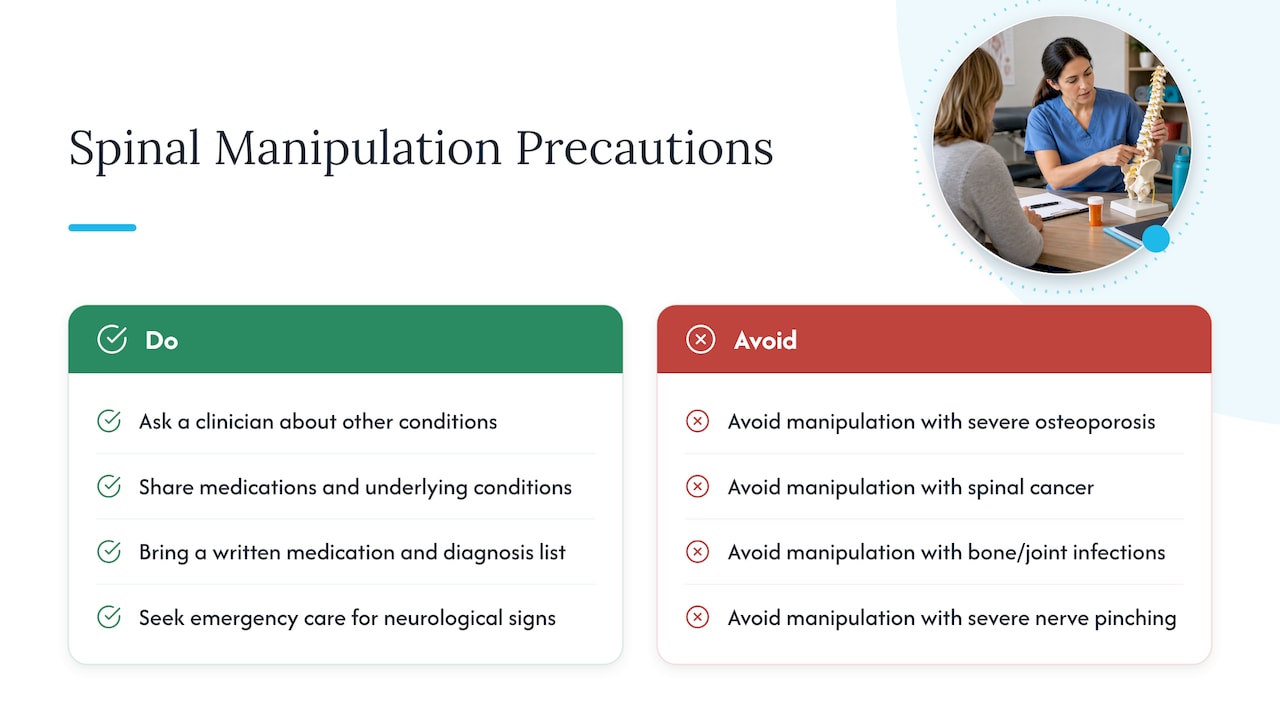
Seek immediate emergency care rather than an adjustment if you have sudden severe neck pain with neurological signs such as slurred speech, dizziness or vision changes, new weakness in an arm or leg, or bowel or bladder changes.
Share your medical history, including any medications and underlying conditions, with the clinician before treatment.
Pro Tip: Bring a written list of your medications and diagnoses to the first visit, including blood thinners and any bone or joint conditions.
Why do training and practice style affect your risk?
Ask about a chiropractor’s training, licensing and approach to screening before choosing a provider. You can read about what that training involves on our page on the education of a Plano chiropractor.
Practice style matters just as much. Ask what evidence supports the proposed care, how progress will be assessed, and whether the plan includes screening and informed consent.
Culture counts too. A qualitative study of providers who perform spinal manipulation found mixed attitudes toward patient safety and called for shared understanding and reporting across professions. A literature synthesis proposed structured safety training so clinicians learn from adverse events.
How do you choose a safe chiropractor?
Before booking, check these:
- Verify the state license on the licensing board’s website
- Confirm the scope of practice is clear
- Ask whether the clinician coordinates with your medical providers
At the first visit, ask these in order:
- How will you screen me for conditions that rule out manipulation?
- What is the expected course of care, and when will we reassess?
- What are the risks and alternatives to what you propose?
Walk away from promises to cure unrelated conditions, or pressure to prepay long-term maintenance bundles with no stated outcomes.
What happens at a visit, and what should informed consent cover?
A visit may include a discussion of your history, an examination and a conversation about possible treatment and aftercare. Ask what to expect before agreeing to care.
Before treatment, ask the clinician to explain the risks, expected benefits and alternatives in language you understand. Ask questions, discuss follow-up, and tell the clinician if you do not want a technique.
What does the evidence say overall?
Guidelines increasingly favor spinal manipulation for selected low back and neck pain, as the research trends review shows. Active surveillance shows mild, brief reactions are fairly common. Passive reporting systems capture far less, since voluntary reporting undercounts events. A VA evidence summary adds that trials are underpowered to detect very rare serious events.
The gaps are real: precise incidence of serious harm, and the role of causation in vascular events. For you, that means risk communication should be candid, screening should be thorough and consent should never be skipped.
What is our view on safe chiropractic care?
Safety starts before any adjustment. We screen, explain risks and alternatives, and build time-limited plans around hands-on work. For many soft tissue problems we use techniques from the Fascial Distortion Model. If you want an individualized risk assessment before deciding, reach out and we will talk it through.
— Chris
Where can you get safety-focused chiropractic care in Plano?
We offer care built around screening, informed consent and a plan that fits you:
- Hands-on chiropractic care
- The Fascial Distortion Model for soft tissue injuries
- Soft tissue therapy for pain that has not responded elsewhere
Book your individualized assessment at The Tx Room and we will start with your history, not an adjustment.
This article is general information, not a substitute for advice from a qualified doctor. Consult a qualified healthcare professional about your own circumstances before acting on anything here.
FAQ
What are the risks of going to a chiropractor?
Most risks are mild: soreness, stiffness or a headache that fades within days. Serious events are very rare, but screening matters. NCCIH says up to 21% of patients may have mild, transient events in the 2–7 days after treatment.
Is chiropractic safe for children?
Our sources here address adults and spinal manipulation generally, so they do not settle the question for children. Ask any clinician about screening, technique choice and why care is needed. We explain our approach on our page on chiropractic care for kids.
Who should avoid chiropractic adjustments?
People with severe osteoporosis, spinal cancer, bone or joint infection, or a severely pinched nerve with weakness should not have spinal manipulation, according to MedlinePlus. Sudden severe neck pain with neurological symptoms calls for urgent medical evaluation.
Why do some doctors discourage chiropractors?
Potential concerns include training, ongoing care without a clear rationale, and the difficulty of measuring very rare serious events. Ask a clinician about their training, screening and proposed plan of care.
Sources
- Spinal Manipulation: What You Need To Know | NCCIH
- Chiropractic care for back pain: MedlinePlus Medical Encyclopedia
- What’s the harm? Results of an active surveillance adverse event reporting system for chiropractors and physiotherapists. | PSNet