
Pregnancy Sciatica Relief: What Helps and What to Avoid
Sciatica in pregnancy usually responds best to a combination of small daily changes: side-sleeping with pillow support, regular position changes, gentle walking if your obstetric clinician approves, heat or cold, and hands-on care from a trained professional. Most of these are low-risk and you can begin them today. The part that needs a professional is the line between ordinary pregnancy pain and pain that needs a medical look. This guide covers both, so you know what to try, what to skip, and when to pick up the phone.
TL;DR
- Pregnancy sciatica is pain that runs from the low back down the back of one leg. It is thought to come from the uterus pressing on the sciatic nerve.
- Start with side-sleeping and pillows, frequent position changes, good lifting posture, and heat or cold packs.
- Exercise should never cause pain. If it hurts, stop, and check with your obstetric clinician before you change your routine.
- Skip deep-tissue massage while pregnant. Chiropractic care from a trained professional is a reasonable option for pregnancy-related low back and pelvic pain.
- Call your prenatal clinician if the pain is severe, lasts more than two weeks, follows a fall, or comes with fever, bleeding, or a swollen, red, warm leg.
Table of Contents
- What pregnancy sciatica actually feels like
- Home relief you can start today
- What to avoid when sciatica flares
- Can prenatal massage help?
- Chiropractic care for pregnancy sciatica
- How we help pregnant patients in Plano
- When to call your prenatal clinician
- A simple first-week plan
- Other options you may hear about
- FAQ
- Sources
What pregnancy sciatica actually feels like
Most people describe it as a line of pain, not a general ache. It starts in the low back or buttock and travels down the back of one leg, sometimes to the knee and sometimes all the way to the foot. Women’s health guidance from the U.S. government describes it as pain from the lower back down the back of one leg, and says it is thought to happen when the uterus puts pressure on the sciatic nerve.
The sensation can be sharp, burning, electric, or dull and heavy. Some women also notice numbness or weakness in one leg, which Boston Medical Center’s pregnancy resource lists alongside sciatica.
How it differs from other pregnancy aches
Pregnancy brings plenty of back, hip, and glute discomfort that is not sciatica. A few clues help you tell them apart:
- Direction. Sciatica travels. Pain that stays in one spot, such as the center of the low back or a sore muscle in the hip, is more likely general strain.
- One side. Sciatica usually follows one leg rather than both.
- Nerve-type sensations. Tingling, numbness, or a shooting quality point toward the nerve. A tight, achy, or cramping quality points toward muscle.
- Leg swelling, warmth, or redness. This is not a sciatica pattern at all and needs prompt medical attention (more on that below).
You cannot diagnose yourself from a list, and a hands-on exam is what separates nerve irritation from muscle, joint, or fascial pain. If you are unsure, that uncertainty is a good reason to get examined rather than guess.
Home relief you can start today
The goal at home is to calm the irritated area, reduce the sustained positions that load it, and keep moving within comfort. A UT Southwestern medical blog notes that at-home care can include pregnancy-safe exercises, tips for posture, daily movements, and sleep positions, and that a heating pad or cold packs may help.
Sleep positioning
Night is when many women feel it most. The Mayo Clinic recommends sleeping on your side with a pillow between your knees, under your belly, or behind your back for support. Try these adjustments:
- Lie on the side that hurts less first, and keep your knees bent with a pillow between them so your hips stay level.
- Add a second pillow under the belly if the weight pulls on your low back.
- If a pillow behind your back keeps you from rolling flat, keep it. It is a cheap way to protect your position at 3 a.m.
- If one side is clearly worse, alternate sides through the night rather than staying on the painful one for hours.
We wrote a longer guide on why sciatica flares at night and how to sleep better if this is your biggest problem.
Lifting, standing, and sitting
The same Mayo Clinic guidance advises bending at the knees rather than the waist when you lift, taking frequent breaks if you stand for a long time, and sitting with good posture. For sciatica specifically, UT Southwestern adds that you should avoid lifting or moving heavy objects, sitting on hard surfaces, and staying in one position, sitting or standing, for more than a few minutes once you can move more freely again.
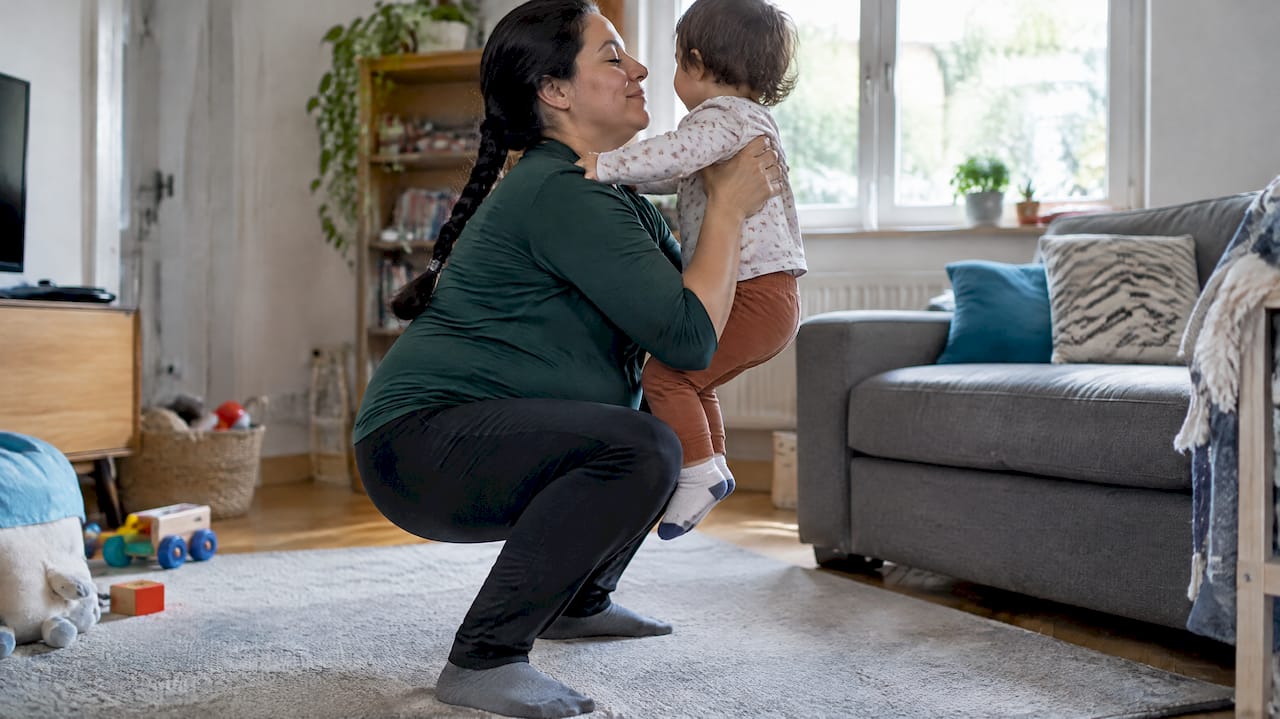
A practical way to use that: set a quiet timer for every 20 to 30 minutes at your desk or on the couch, stand up, shift your weight, and walk to the kitchen. Parents of toddlers have the hardest version of this problem, because lifting a child is unavoidable. Squat to the child’s level, hold them close to your body, and bring them to you rather than twisting and reaching.
Heat, cold, and walking
A heating pad on the low back or buttock, or a cold pack wrapped in a cloth, are both reasonable. Use whichever feels better and keep sessions short. Do not apply heat directly over the belly.
Walking is the easiest movement to add. ACOG says walking is generally safe during pregnancy when no complication prevents it, and that activity should be individualized with the advice of your obstetric clinician. If walking sets off the leg pain, shorten the distance, slow down, and try again later in the day rather than pushing through.
Guided exercise
UT Southwestern notes that a licensed physical therapist can guide pregnancy-safe exercises to stretch and strengthen the core. A review in the journal PMC makes a related point: exercise helps chronic musculoskeletal pain, and it works best as part of a supervised program that includes manual therapy and postural correction. In plain terms, the combination of hands-on care and guided movement tends to beat either one alone.
What to avoid when sciatica flares
Avoidance matters as much as treatment, because a flare often comes from a single awkward afternoon.
- Pushing through pain. ACOG says exercise should not cause pain and that you should stop if it does. Pain is a stop signal, not something to override.
- Changing your routine without checking. Ask your obstetric clinician before you start or change an exercise routine.
- Heavy lifting and carrying on one hip. Both load the pelvis unevenly.
- Long stretches in one position. Sitting for a two-hour meeting or standing at a counter through a whole meal prep are classic triggers.
- Hard seats. A firm bench or stadium seat compresses the buttock area. Bring a cushion.
- Aggressive stretching. Deep hamstring and piriformis stretches that pull hard on an irritated nerve can make symptoms worse. Gentle, pain-free movement is the rule. Our page on sciatica stretches and red flags explains how to tell a good stretch from one that irritates the nerve, and you should still clear any new movement with your obstetric clinician first.
Videos and social posts often present a stretching routine as universal. Your body, your trimester, and your pregnancy history all change what is appropriate, so treat online routines as ideas to run past your care team.
Can prenatal massage help?
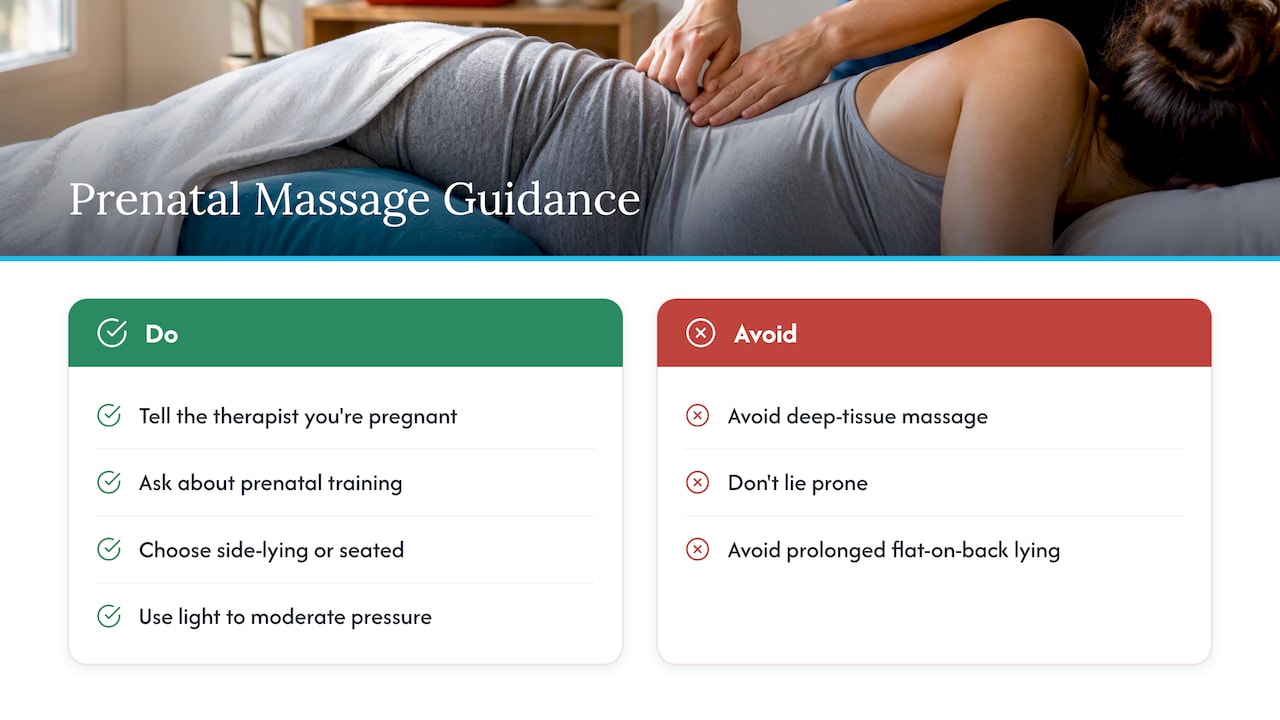
Massage is one of the most searched ideas for this problem, and the answer is a careful yes for gentle work and a no for deep pressure. A 2021 systematic review advises avoiding deep-tissue massage during pregnancy because of concerns about dislodging blood clots, and suggests gentle superficial touch instead. The same review says pregnancy massage should generally be done side-lying or seated, not prone, and that lying flat on your back for long periods should be avoided.
So if you book a massage, tell the therapist you are pregnant, ask whether they are trained in prenatal work, and expect a side-lying setup with light to moderate pressure. If a provider wants to work deeply on the sciatic area while you lie face down, that is the moment to say no.
Chiropractic care for pregnancy sciatica
Chiropractic care is one of the most common questions women ask about this, and the research offers a measured but encouraging picture. The PMC review states that chiropractic care and massage therapy can be effective options for pregnancy-related low back and pelvic pain, with limited reports of adverse side effects when performed by trained professionals.
The same review is also clear about where the evidence is still developing: the effectiveness of these therapies specifically for pregnancy sciatica caused by nerve root irritation needs larger clinical studies. That is true of many conditions in pregnancy, because large trials on pregnant women are hard to run. What it means in practice is that the quality of the exam and the experience of the provider matter a great deal.
Questions to ask before your first visit
A good chiropractor will welcome these, and your obstetric clinician should be part of the conversation:
- Do you have experience treating pregnant patients, and how do you adjust your positioning and techniques at my stage of pregnancy?
- What will you examine to work out whether this is nerve irritation, a joint problem, or muscle and fascial pain?
- What would make you stop treatment and refer me back to my obstetric clinician?
- How will we know within a few visits whether this approach is working?
- Which home changes should I be making between appointments?
Tell your prenatal clinician you are considering chiropractic care, mention any complications or restrictions you have been given, and bring that information to the first appointment. Our page on whether chiropractic care is safe during pregnancy walks through what to expect.
Our perspective on pregnancy sciatica
Pregnant patients are often told to wait it out, and for a lot of women that advice means weeks of poor sleep and a shrinking list of things they can comfortably do. We think there is a better path for many of them. When we look at pain that travels down a leg, we want to know what is actually driving it: a nerve under pressure, a stiff joint, or tight, distorted fascia that is mimicking nerve pain. Those three look similar to the person living with them and need different handling.
Our approach is hands-on and individualized. We use the Fascial Distortion Model, a manual approach to soft tissue injuries, and we focus on cases that have not improved with standard approaches. We do not apply one routine to everyone. Pregnancy changes which positions, pressures, and techniques make sense, so we plan around your stage of pregnancy and what your obstetric clinician has told you.
We also believe in pairing treatment with simple habits, because the hour on the table is not the hour that decides your recovery. Sleep position, how you lift your toddler, and how long you sit all matter. Our goal is to get you moving comfortably again and to tell you plainly when something belongs with your obstetrician instead.
Chris
How we help pregnant patients in Plano
If you are in the Plano area and the home measures above are not enough, we offer hands-on chiropractic and soft tissue care built around the Fascial Distortion Model and individualized treatment plans. For expectant mothers, our chiropractic care for pregnancy page explains how we approach visits, and you can read more about pregnancy and chiropractic care in Plano.
Want to know whether your leg pain is a good fit for hands-on care? Contact us through our Plano chiropractic and soft tissue care page and tell us your stage of pregnancy and where the pain travels. We accept self-pay and insurance, and we will let you know what we would examine first. For background on leg pain specifically, see our guides to sciatica in Plano and sciatic leg pain.
When to call your prenatal clinician
Most pregnancy sciatica is uncomfortable but not dangerous. A few patterns are different, and these are the ones to act on without waiting for the next appointment.
Call your obstetric provider
ACOG says to consult an obstetric care provider if back or leg pain is severe, lasts more than two weeks, or follows an injury or a fall. Two weeks is a useful marker: if your plan at home is not making a visible difference by then, get examined.
Get help right away
ACOG’s safety resources list a fever of 100.4°F (38°C) or higher, vaginal bleeding, and swelling, pain, or tenderness in a leg, which may come with redness and warmth, as reasons to seek help immediately. A swollen, red, warm calf is not sciatica, and it should never be treated as something to stretch out.
New numbness or weakness in a leg also deserves a prompt call to your clinician. The PMC review notes that surgery is typically avoided in pregnancy but may be considered in severe cases with progressive neurologic deficits. That is rare, and it is the reason worsening weakness should always be reported rather than watched.
A simple first-week plan
If you want a starting point, this is a low-risk sequence. Adjust it with your obstetric clinician.
| Day | Focus | What to do |
|---|---|---|
| 1 | Sleep | Set up side-sleeping with pillows between the knees and under the belly |
| 2 | Daily positions | Change position every 20 to 30 minutes; use a cushion on hard seats |
| 3 | Lifting | Squat with a straight back, keep loads close, avoid twisting |
| 4 | Heat or cold | Try each for a short session and keep whichever eases the pain |
| 5 | Walking | Short, easy walks if cleared, stopping if the leg pain starts |
| 6 | Questions | Write down when the pain is worst and where it travels |
| 7 | Review | If no better, book an exam; if worse, call your obstetric provider |
Keeping notes helps any provider. Bring the log of where the pain travels, which positions help, and what you have already tried. It saves time at the first visit and gives a clearer picture than memory.
Other options you may hear about
Acupuncture is sometimes used for pregnancy-related pelvic pain, although the PMC review says evidence specifically for sciatica needs more evaluation. Over-the-counter medication comes up often too, and whether any medicine is appropriate is a question only your obstetric clinician can answer for your pregnancy. Do not start anything because a friend or forum recommends it.
The common thread is that the best-supported steps are the simple ones, and that every new treatment should be disclosed to your prenatal team. A good provider of any kind will ask who else is caring for you.
FAQ
Does pregnancy sciatica go away after delivery?
For many women it eases once the pressure on the nerve is gone, although the timing varies and no source we reviewed gives a guaranteed timeline. If leg pain, numbness, or weakness continues after birth, ask your clinician for an exam rather than assuming it will fade.
Is it safe to see a chiropractor while pregnant?
A review in PMC reports that chiropractic care can be an effective option for pregnancy-related low back and pelvic pain, with limited reports of adverse effects when done by trained professionals. Choose a provider with prenatal experience and tell your obstetric clinician about the plan.
Can a prenatal massage help sciatica?
Gentle, side-lying or seated massage may ease surrounding muscle tension. A 2021 systematic review advises avoiding deep-tissue massage during pregnancy and avoiding prone and prolonged back-lying positions, so confirm your therapist is trained in prenatal work.
What is the best sleeping position for sciatica in pregnancy?
Mayo Clinic recommends sleeping on your side with a pillow between your knees, and extra support under the belly or behind your back. Alternating sides and keeping your hips level can help reduce pressure on the painful leg.
When is sciatica pain an emergency during pregnancy?
Get help right away for fever of 100.4°F (38°C) or higher, vaginal bleeding, or a leg that is swollen, painful, tender, red, or warm. Also call your obstetric provider if pain is severe, lasts over two weeks, or follows a fall.
Sources
- Body changes and discomforts, Office on Women’s Health
- Back Pain and Sciatica in Pregnancy, Boston Medical Center
- Sciatica in pregnancy, UT Southwestern Medical Center
- Back pain during pregnancy: 7 tips for relief, Mayo Clinic
- Back Pain During Pregnancy, ACOG
- The Main Changes in Pregnancy: Therapeutic Approach, PMC
- Effects, Side Effects and Contraindications of Relaxation Massage During Pregnancy, PMC