
Tight Calves and Heel Pain: Causes, Stretches and Next Steps
Yes, tight calves can cause heel pain. The calf muscles feed into the Achilles tendon, which attaches at the heel and is continuous with the plantar fascia under your foot, so a stiff calf raises the load on the heel with every step. Where the pain sits (bottom of the heel or back of the heel) points to the likely culprit, and a few weeks of consistent calf and foot care is the standard first step. This guide explains the connection, how to tell the common causes apart, what to do at home, and when it is time to have someone examine you.
TL;DR
- Tight calf muscles and a tight Achilles tendon pull on the heel and add strain to the plantar fascia, which is why they are a recognized risk factor for plantar fasciitis.
- Pain under the heel usually points to the plantar fascia. Pain at the back of the heel usually points to the Achilles tendon or the structures around it.
- Calf and plantar fascia stretching, supportive shoes and activity changes are the usual first-line steps, held for 15 to 30 seconds per stretch.
- Swelling, a pop or snap during an injury, trouble walking, or pain that has not improved after about two weeks of home care means it is time to get examined.
- If heel pain keeps returning despite stretching, the problem may be in how the tissue moves and loads, not only in how long the muscle is.
Table of Contents
- How the calf, Achilles tendon and heel are connected
- Which heel pain goes with tight calves?
- Who tends to get heel pain from tight calves
- What to do at home first
- Is it the heel or the calf itself?
- When to get it checked
- Our perspective on tight calves and stubborn heel pain
- Hands-on help for heel pain in Plano
- FAQ
- Sources
How the calf, Achilles tendon and heel are connected
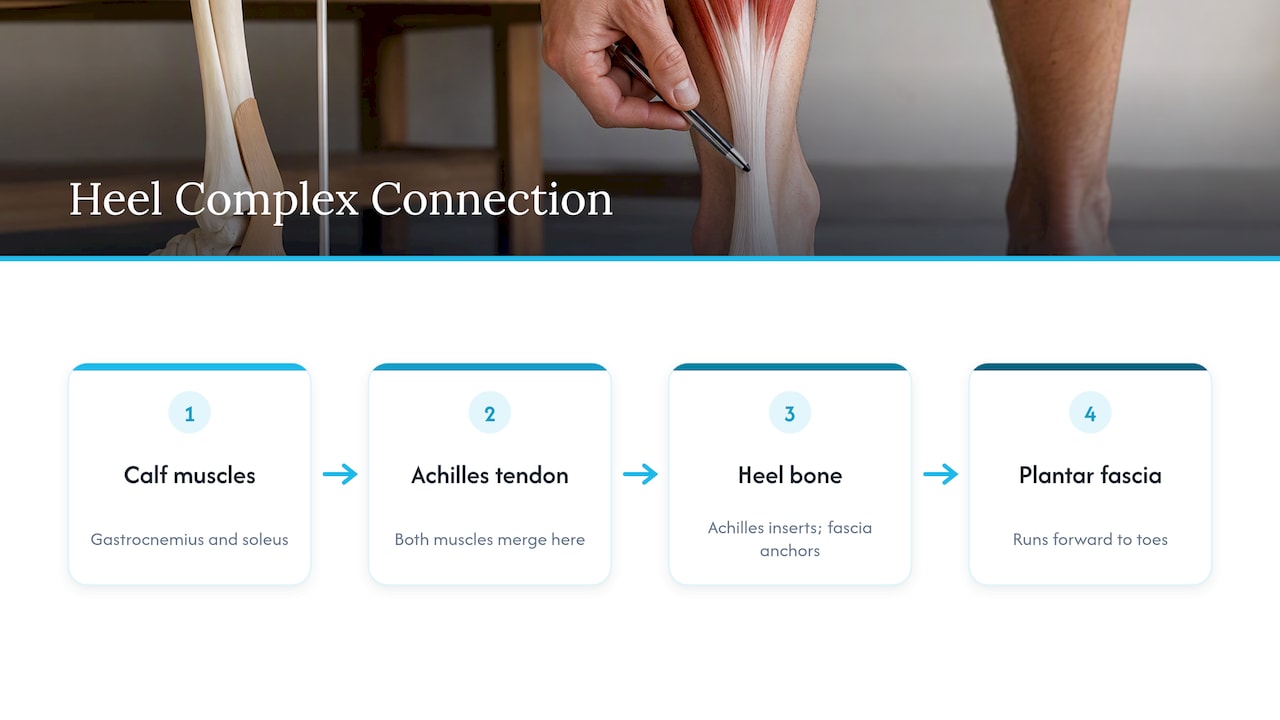
The calf is two muscles, the gastrocnemius and the soleus. Both merge into the Achilles tendon, and the Achilles inserts on the heel bone. Under the foot, the plantar fascia, a thick band of tissue, anchors to the same bone and runs forward to the toes.
That chain is not just a drawing in an anatomy book. Yale Medicine notes that tight calf muscles and a tight Achilles tendon pull excessively on the heel with each step, which increases strain on the plantar fascia. A radiology review of the heel complex describes the Achilles tendon, the covering of the heel bone and the plantar fascia as a structural continuum, and reports that biomechanical studies show more load on the Achilles tendon increases tension in the plantar fascia.
In plain terms: when your calf cannot lengthen enough, your ankle cannot bend upward as far as it should when you step over your foot. Your body finds the motion somewhere else. Often that means the arch flattens more, the foot rolls, or the heel takes a harder hit. Over hundreds of steps a day, a small restriction becomes a lot of repeated stress.
A quick home clue: knee straight versus knee bent
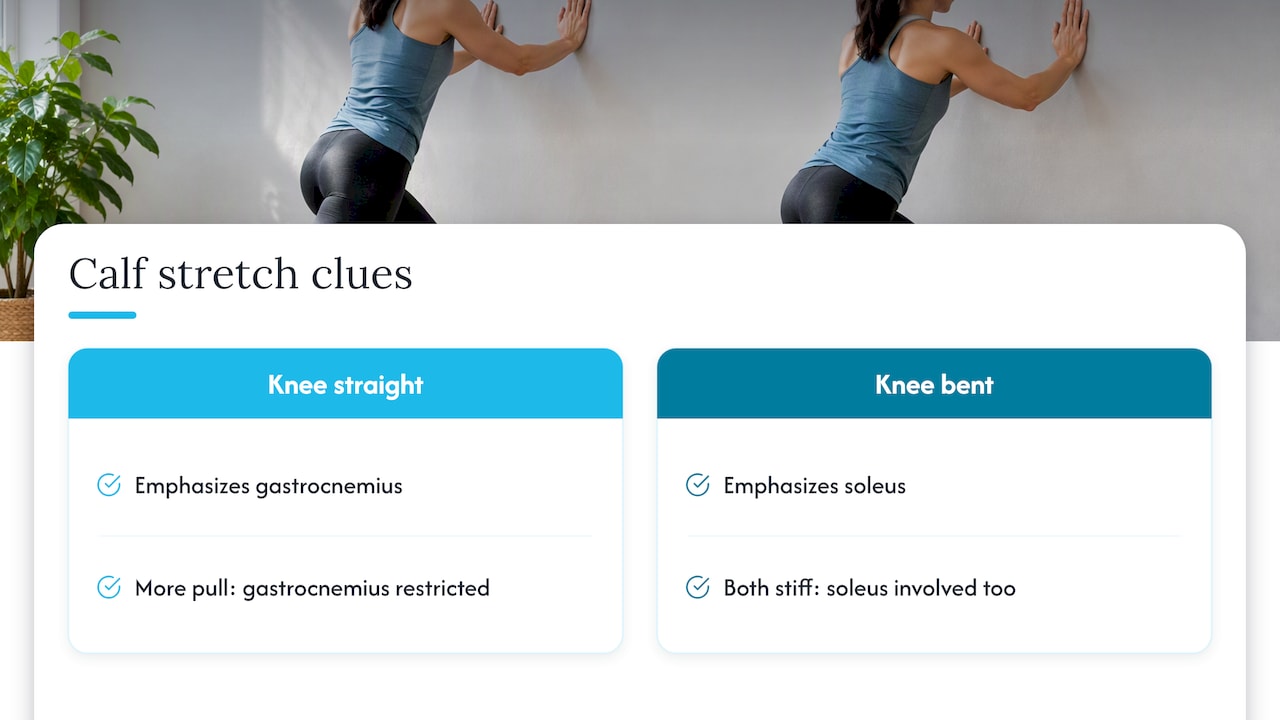
The two calf muscles behave differently. The gastrocnemius crosses the knee, so it is stretched most when your knee is straight. The soleus sits below the knee and is stretched most when your knee is bent. If you feel a pull at the back of the leg in a straight-knee wall stretch but much less with a bent knee, the gastrocnemius is the more restricted part. If both feel stiff, the soleus is involved too. This is a way to decide which stretch to prioritize, not a diagnosis.
Which heel pain goes with tight calves?
Heel pain is not one condition. The American Academy of Family Physicians classifies mechanical heel pain by location: pain at the back is often related to Achilles tendinopathy, Haglund deformity or bursitis, while pain on the bottom is often related to plantar fasciitis or nerve entrapment. That split is the best first sorting tool you have.
| Where it hurts | What it often feels like | Common causes linked to calf tightness |
|---|---|---|
| Bottom of the heel, toward the arch | Sharp or stabbing pain with the first steps in the morning or after sitting, easing as you warm up | Plantar fasciitis |
| Back of the heel, where the Achilles attaches | Aching, stiffness or tenderness, often worse after activity or when pressing the tendon | Achilles tendinitis, bursitis, Haglund deformity |
| Inside of the heel with burning or tingling | Burning or pins and needles rather than a deep ache | Nerve entrapment |
| Sudden pain with swelling or a pop | Immediate, hard to put weight through | Needs prompt exam, see the red flags below |
Two of these deserve more detail.
Plantar fasciitis
The Merck Manual lists tight calf muscles or a tight Achilles tendon among the risk factors for plantar fasciitis, along with high or low arches, a sudden jump in activity, and jobs that involve long periods of standing or walking on hard surfaces. If your bottom-of-heel pain is worst at the first steps of the day, our page on plantar fasciitis in Plano explains what we look at and how we approach it.
Achilles tendinitis
The American Academy of Orthopaedic Surgeons notes that Achilles tendinitis is frequently caused by tight calf muscles, which put more stress on the point where the tendon attaches to the heel bone. If your pain is behind the heel and tendon-related, see our overview of tendinitis care.
When the burning is nerve-related
Not every heel ache is a tight-calf problem. The UK’s NICE guidance on plantar heel pain says burning over the inner heel or pins and needles may point to nerve entrapment. Stretching harder will not solve that, and it is one reason a hands-on exam is worth having when symptoms do not fit the typical pattern.
Who tends to get heel pain from tight calves
The pattern shows up in a few groups we hear from regularly in Plano:
- Runners and recreational athletes who add mileage, speed work or hills quickly. The Merck Manual names a sudden increase in activity as a trigger, including in people who were sedentary before.
- Workers on their feet, such as teachers, nurses, retail and warehouse staff, who spend hours on hard floors.
- Busy parents who chase kids, carry loads and rarely have time to stretch or replace worn shoes.
- Desk workers and students who sit for long stretches, then stand up and walk on a stiff, shortened calf. Calf stiffness from sitting still adds up.
- People with high or low arches. Both foot types are listed among the risk factors, and either can change how the calf and heel share load. If you have flat feet, our guide to flat feet pain relief covers the support side. If your foot rolls outward, read about supination treatment.
What to do at home first
For most people with typical heel pain and tight calves, a short, consistent routine is the right starting point. Yale Medicine’s Dr. Peden describes stretching the calf, Achilles and plantar fascia as one of the most effective ways to treat and prevent plantar fasciitis, because it increases elasticity and reduces pressure on the tissue. Clinical practice guidelines from the Orthopaedic Section of the American Physical Therapy Association suggest that specific plantar fascia and gastrocnemius/soleus stretching can bring short-term relief, in the range of one week to four months.
Three stretches
- Wall calf stretch (straight knee). Stand facing a wall with your hands on it. Step one foot back, keep that leg straight and the heel down, and lean forward until you feel a pull in the upper calf. Hold 15 to 30 seconds, as Yale Medicine suggests.
- Bent-knee version (soleus). From the same position, bend the back knee slightly while keeping the heel down. The pull moves lower, closer to the Achilles. Hold for the same 15 to 30 seconds.
- Seated plantar fascia stretch. Sit, cross the sore foot over the opposite knee, and gently pull the toes back toward your shin. Hold 15 to 30 seconds. You should feel a stretch along the arch, not a sharp pain.
The Cleveland Clinic also recommends a stair stretch: hold a railing and let the heel hang off the edge of a step to relieve tension in the calf and Achilles tendon. Go slowly, keep a firm grip, and stop if you feel pinching in the front of the ankle.
How to stretch without making it worse
- Stretch to a firm pull, never to sharp or burning pain.
- Do a few rounds, a few times a day, rather than one long, aggressive session.
- Warm up first with a short walk, or stretch after a shower.
- Skip bouncing. Steady holds are what the guidance describes.
- If stretching the Achilles area makes the back of the heel more sore, back off. An irritated tendon often needs a gentler approach, and a clinician can set the right load.
Other home measures
Stretching is only part of the plan. The American College of Foot and Ankle Surgeons lists supportive shoes with arch cushioning, heel cups or pads that raise the heel, avoiding walking barefoot on hard surfaces, and ice, taping or arch-supporting wraps as ways to get short-term relief from pain and inflammation. The same consensus emphasizes biomechanical support, such as arch-supporting insoles or taping, to reduce stress on the plantar fascia in the acute phase.
A practical way to apply that:
- Swap flat, worn-out shoes for ones with real arch support, and wear them indoors on hard floors.
- Try a heel cup or an over-the-counter arch insert for a couple of weeks and see whether the first steps of the morning improve.
- Reduce running or jumping volume a little instead of stopping everything, so the tissue is loaded but not overloaded.
- Add foot and calf strength once the pain settles. Our guide to foot strengthening exercises shows how to build on it.
One caution from the Merck Manual: repeated steroid injections around the heel can backfire, since they may thin the fat pad under the heel and lead to further damage to the fascia. If someone suggests injections, ask about the number and the alternatives.
Is it the heel or the calf itself?
Sometimes the calf is the injured part, not just the tight one. A pulling pain mid-calf after a sprint or a sudden push-off is a different problem from a heel that hurts at first steps. If the calf is where it hurts, read about calf strain treatment. When both the calf and heel are involved, treating only the heel often leaves the cause in place, and treating only the calf can miss a fascia or tendon problem that has already developed.
When to get it checked
Home care is reasonable for typical, gradual heel pain. Some signs mean you should not wait it out:
- Swelling, a pop or snap at the time of injury, or trouble walking. The UK’s NHS heel pain guidance says these can indicate a heel fracture or a ruptured Achilles tendon and need medical attention. See an urgent care clinic, an orthopedic provider or your primary care doctor.
- Pain that has not improved after about two weeks of home treatment. The same NHS page uses two weeks as the point to get seen. That is a sensible checkpoint for anyone in Texas too.
- Burning, tingling or numbness in the heel or foot. This can point toward a nerve problem, not a tendon or fascia one.
- Pain that wakes you at night or keeps getting worse despite rest and supportive shoes.
If stretching and orthoses do not give enough relief, the Merck Manual notes that physical therapy, casting or, rarely, surgery may be considered. Most people never reach that stage, and getting an accurate diagnosis early is the best way to stay out of it.
Our perspective on tight calves and stubborn heel pain
We see the same story often. Someone stretches their calf for weeks, rolls their foot on a ball, buys new insoles, and the heel still hurts. The advice was not wrong, but it assumed the only problem was a short muscle.
Our view is that tight calves and heel pain are usually a load problem across the whole chain, from the foot and ankle up through the calf, and sometimes the hip and low back. Stretching a muscle that is guarding against something else can feel like pulling on a knot. That is why we start with a hands-on exam of how your tissue actually moves and where it is restricted, instead of assuming the diagnosis from the symptom.
Our approach is hands-on and built around the Fascial Distortion Model, which treats specific soft tissue distortions, along with myotherapy and individualized rehab plans. We focus on cases that have not improved with standard medical or physical therapy approaches. We do not promise a number of visits or a guaranteed result, because every foot, job and training history is different. What we promise is a clear explanation of what we find, a plan you can follow, and honest guidance if you need to see someone else, such as a podiatrist or orthopedic provider.
If you take one thing away: use the home routine above consistently for a couple of weeks, and do not let heel pain drift for months because it “isn’t that bad.”
— Chris
Hands-on help for heel pain in Plano
If home care has stalled, or your heel pain keeps returning, we can examine the whole chain: foot, ankle, calf and beyond. Depending on what we find, treatment may include the Fascial Distortion Model, dry needling, or focused shockwave, alongside rehab you can do between visits. Our page on chiropractic for plantar fasciitis shows how a typical plan combines hands-on care with home loading. To book an exam, start at The Tx Room.
We accept insurance and self-pay. Ask us about your situation when you contact the clinic.
FAQ
Can tight calves really cause heel pain?
Yes. The calf muscles feed into the Achilles tendon, which connects to the heel bone and is continuous with the plantar fascia. A tight calf and Achilles increase the pull on the heel with each step and raise strain on the fascia. Tightness is a risk factor, not the only cause, so the rest of your foot mechanics matter too.
What do tight calves indicate?
Often they reflect activity, work or footwear: a sudden jump in training, long hours on hard floors, or lots of sitting. They can also go with high or low arches. Tight calves alone are not a disease, but when they come with heel pain they are worth addressing, because they are a recognized risk factor for plantar fasciitis and Achilles tendinitis.
How long should I stretch before seeing someone?
Give a consistent home routine about two weeks. Hold each calf and plantar fascia stretch for 15 to 30 seconds and pair it with supportive shoes. If there is no improvement by then, or you have swelling, a pop, numbness or trouble walking, get examined sooner rather than later.
Should I stretch if the back of my heel hurts?
Gently, and stop if it irritates the area. Pain at the back of the heel often relates to the Achilles tendon, which can be sensitive to aggressive stretching. Start with a mild bent-knee calf stretch and cut back if it flares. Persistent pain there should be examined so the load can be set correctly.
Can a chiropractor help with tight calves and heel pain?
Hands-on care can address restricted soft tissue in the calf, foot and ankle, and a good plan pairs it with exercises you do at home. At our Plano clinic we use the Fascial Distortion Model and related techniques, and we refer out when your symptoms need a different kind of provider.
Sources
- 3 Simple Steps to Beat Plantar Fasciitis Heel Pain, Yale Medicine
- The Heel Complex: Anatomy, Imaging, Pathologic Conditions, RadioGraphics
- Heel Pain: Diagnosis and Management, American Family Physician
- Plantar Fasciitis, Merck Manual Consumer Version
- Achilles Tendinitis, OrthoInfo, AAOS
- Differential diagnosis of plantar fasciitis, NICE CKS
- Heel Pain: Plantar Fasciitis Revision 2023, Orthopaedic Section, APTA
- 5 Plantar Fasciitis Stretches and Exercises, Cleveland Clinic
- Heel Pain Clinical Consensus Statement, American College of Foot and Ankle Surgeons
- Heel pain, NHS