
Thoracic Outlet Syndrome and Chiropractic Care: What to Expect
Chiropractic care can be a reasonable first step for thoracic outlet syndrome (TOS) when it is built around careful assessment, gentle soft tissue work, posture and movement retraining, and a clear plan for when to refer you on. It works best as part of conservative care, which is the standard starting point for the most common type, neurogenic TOS. Below you will find what TOS is, how it is sorted from look-alike conditions, which hands-on methods are used, which signs mean you need a physician right away, and what a first visit with us in Plano looks like.
TL;DR
- TOS is compression of nerves or blood vessels in the narrow space between the neck, collarbone and first rib. About 95% of cases are neurogenic, meaning nerve-related.
- Conservative care comes first: posture correction, scapular stabilization, stretching of tight neck and chest muscles, and nerve mobilization, alongside hands-on soft tissue treatment.
- Forceful high-velocity thrusts and first-rib work call for caution. A thorough assessment should come before any technique.
- A sudden swollen arm, a cold pale hand, or a painful, warm, red arm needs urgent medical care, not a chiropractic appointment.
- We build individualized plans at The Tx Room in Plano, using the Fascial Distortion Model, dry needling, and other hands-on options.
Table of Contents
- What thoracic outlet syndrome is
- Why TOS is hard to pin down
- What the conservative care standard looks like
- How chiropractic care can help
- Safe use: which techniques call for caution
- Red flags: when to seek medical care first
- Perspective
- What a first visit looks like
- Daily habits that support your care
- Ready to have it looked at?
- FAQ
- Sources
What thoracic outlet syndrome is
The thoracic outlet is the passage just below your neck, between the collarbone and the first rib, where nerves and blood vessels travel from the neck toward the arm. MedlinePlus explains that TOS occurs when those nerves or vessels are squeezed, either between the neck and shoulder muscles or between the first rib and the collarbone.
The symptoms depend on what is being compressed:
- Shoulder, neck and arm pain
- Burning, tingling or numbness in the arm, hand and fingers
- Hand weakness when a nerve is involved
- Arm swelling when a vein is involved
The three types
Mayo Clinic describes three forms. Neurogenic TOS accounts for roughly 95% of cases and involves the nerves. Venous TOS (about 4%) and arterial TOS (about 1%) involve blood vessels. Neurogenic TOS often shows up as numbness, tingling or a weak grip. Vascular forms can bring swelling, skin color changes or a cold hand, and severe cases can involve blood clots.
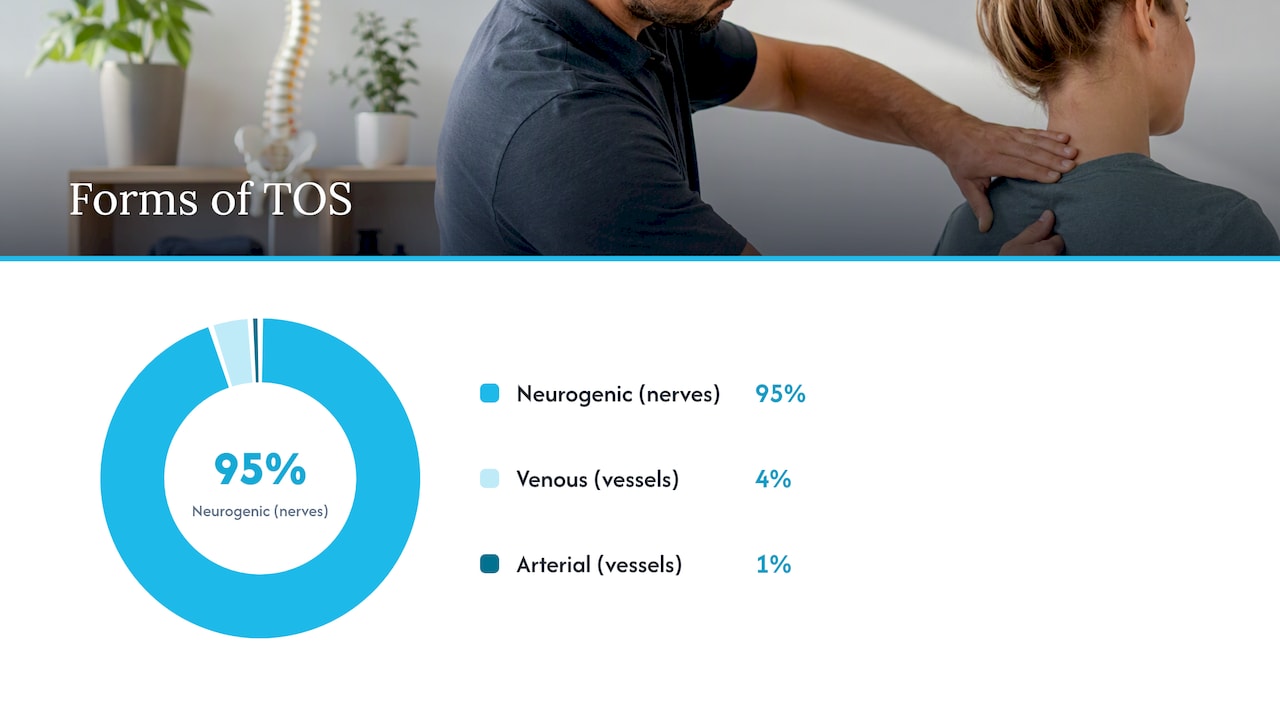
That split matters for you as a patient. Neurogenic TOS is the type most often managed with conservative, hands-on and rehabilitation-based care. The vascular types need a physician’s eyes first.
Who tends to get it
The people who come to us with upper-body nerve symptoms are rarely a single type. Desk workers with a forward head and rounded shoulders, parents who spend hours lifting and carrying children, swimmers and overhead throwers, and people with repetitive strain from keyboards or tools all load the neck, chest and shoulder in similar ways. If this sounds like you, our pages on forward head posture and rounded shoulders cover the postural side in more depth.
Why TOS is hard to pin down
TOS is one of the trickiest conditions in the upper body to diagnose. A recent academic review of recognizing and managing TOS notes there are no universally accepted diagnostic criteria, and that it is largely a diagnosis of exclusion. In practice, a clinician takes a detailed history, examines the neck, shoulder and arm, may order targeted imaging, and checks for conditions that can imitate TOS.
The usual look-alikes are:
- Cervical radiculopathy (a pinched nerve root in the neck)
- Carpal tunnel syndrome at the wrist
- Cubital tunnel syndrome at the elbow
This is why a general “arm tingling” label is not enough. Numbness in the ring and little fingers could come from the elbow, the neck, or the thoracic outlet, and sometimes from more than one place at once. If your symptoms involve the wrist, our page on carpal tunnel care in Plano explains how that differs. For the elbow, see our guide to cubital tunnel syndrome treatment, and for forearm symptoms, radial tunnel syndrome.
Why a careful exam comes first
A good chiropractic exam does more than check your spine. It looks at how your neck, upper ribs, collarbone, shoulder blade and chest muscles move together, which postures bring on your symptoms, and whether your pulses, color and temperature are normal in both hands. If anything points toward a vascular problem or a structural cause that needs imaging, you should be sent to a physician before treatment starts.
What the conservative care standard looks like
The same academic review lists the first-line approach for neurogenic TOS: posture correction, scapular stabilization, stretching of the scalene and pectoralis minor muscles, and neural mobilization exercises, along with patient education and changes to activities and posture. It describes structured, posture- and muscle-balance-focused rehabilitation as the standard first-line route.
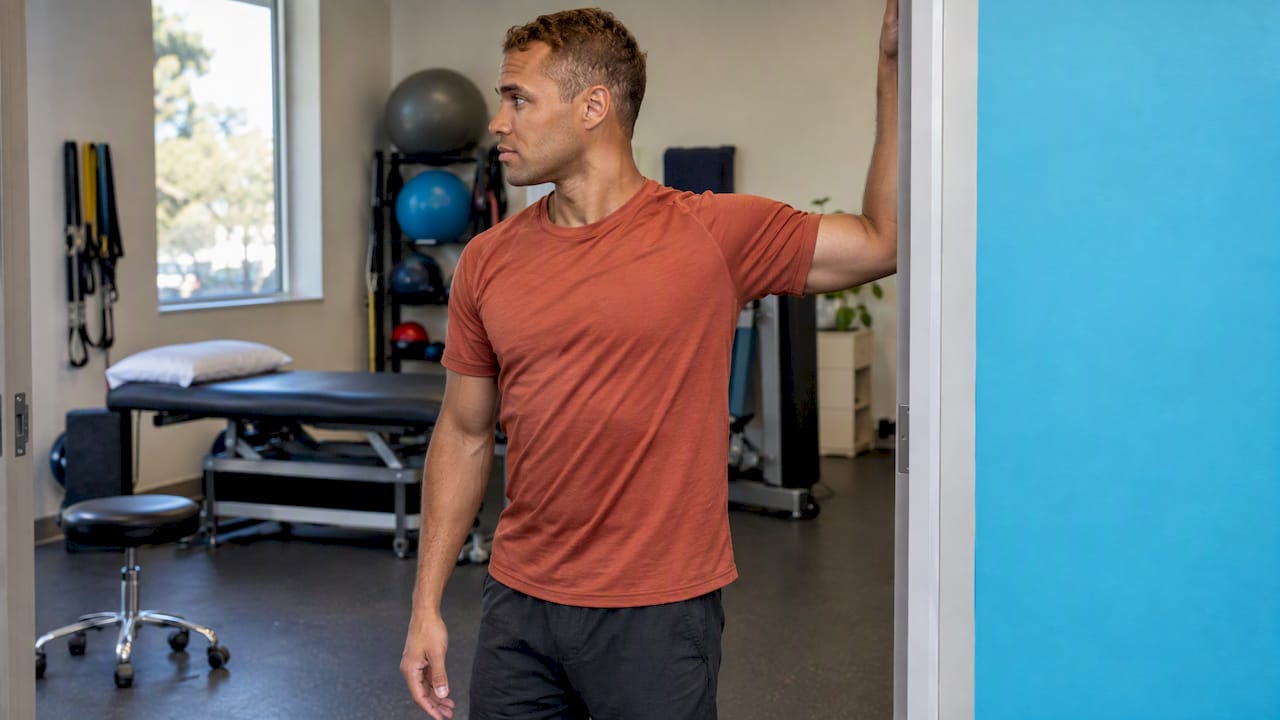
That is the frame we work within. Hands-on care is not a replacement for that rehabilitation. It is a way to make the tight, irritated tissue around the outlet more ready to move, so the exercises can actually take hold.
What the key muscles do
- Scalenes: neck muscles that attach to the first rib. When they are tight or overworked, they can crowd the space the nerves pass through.
- Pectoralis minor: a small chest muscle that pulls the shoulder blade forward and down. Tightness here narrows the space under the collarbone.
- Scapular stabilizers: the muscles around your shoulder blade that hold it in a good position. When they are weak, the shoulder drifts forward and down.
This pattern of tight front muscles and weak back muscles is the same one we see in upper crossed syndrome. Our guide to an upper crossed syndrome treatment sequence lays out how we approach it, and if your mid-back feels locked, thoracic spine stiffness is worth reading.
How chiropractic care can help
Chiropractic care for TOS is not one technique. It is a plan. A published case report in the academic literature describes a patient whose paresthesia improved after chiropractic treatment that combined soft tissue therapy and manipulation. That fits what we see as a reasonable model: address the soft tissue and the joints together, then retrain movement.
Here is how the pieces can fit together.
| Goal | Hands-on or clinic method | Home or rehab piece |
|---|---|---|
| Ease tight neck and chest tissue | Soft tissue therapy, myofascial work | Gentle scalene and pec minor stretches |
| Reduce local pain and trigger points | Dry needling, focused shockwave | Activity and posture changes |
| Improve shoulder blade control | Muscle activation work | Scapular stabilization exercises |
| Restore nerve glide | Mobilization of surrounding tissue | Neural mobilization exercises |
| Reduce repeated strain | Ergonomic and posture coaching | Workstation and carrying changes |
Methods we use
Our services are hands-on by design. Depending on what your exam shows, a plan may include:
- The Fascial Distortion Model, a hands-on approach to soft tissue injuries.
- Dry needling for stubborn muscle knots.
- MyACT focused shockwave for tight, restricted tissue.
- Deep tissue therapy laser.
- Myofascial release, muscle activation therapy and active release treatment.
Not every patient needs every method. We pick the ones your exam supports, and we change the plan as you respond.
Safe use: which techniques call for caution
Part of choosing a chiropractor well is knowing which techniques deserve extra care around the neck, chest and upper ribs.
First-rib work. A 2024 academic review of TOS diagnosis and treatment says physical therapy may include massage, and that first-rib mobilization is not usually recommended. If it is indicated, it should be done carefully after a thorough assessment, since it might cause irritation and pain. In plain terms: gentle, specific and well-justified, never routine.
High-velocity thrusts. A published case report describes a serious complication, a hematothorax, after thoracic spinal manipulation. Its lesson is that clinicians and patients should understand the risks of individual techniques, high-velocity thrusts in particular. You can use that to guide your questions:
- Ask what technique will be used on your upper back and ribs, and why.
- Ask what the alternatives are, such as soft tissue work or low-force methods.
- Tell the clinician about anything that changes during or after a visit, especially chest pain, trouble breathing or new arm symptoms.
Our page on whether chiropractic is safe for Plano patients explains what to check about a provider’s training before you book.
Red flags: when to seek medical care first
Some signs mean you should not wait for a chiropractic visit.
- Sudden arm swelling with a bluish color, or a cold, pale hand with weak pulses. The academic review says these vascular signs warrant immediate referral to a vascular surgeon. In the US, go to an emergency department.
- Throbbing or cramping pain, swelling, redness and warmth in one arm. The NHS lists these as possible signs of a blood clot and advises urgent medical attention.
- Chest pain or shortness of breath. Treat these as emergencies and call 911.
For progressive weakness, muscle wasting in the hand, or symptoms that keep getting worse despite a few weeks of good conservative care, ask your physician about further testing and a specialist referral.
Where surgery fits
Surgery is reserved for a small group of patients. The CDC’s NIOSH document on work-related neurogenic TOS describes it as being for severe, persistent symptoms or significant vascular compromise that do not resolve with conservative management, and notes that outcomes for neurogenic TOS surgery vary, so careful patient selection matters. For most people with neurogenic TOS, giving a structured conservative plan a fair trial comes first.
Perspective
Most people who reach us with thoracic outlet symptoms have already been told to rest, stretch, or wait. Many have had a normal scan and still have a hand that goes numb when they drive, type, or carry a child.
Our view is that the tissue around the neck, collarbone and first rib deserves a hands-on look. We use the Fascial Distortion Model and other manual methods to find what is restricted, treat it with care, and then pair that work with the posture and shoulder blade training that keeps the relief going.
We also think a good plan is honest about its limits. If your exam points to a vascular problem or something that needs imaging, we send you to the right physician first. If it points to a soft tissue and movement problem, we build an individualized plan and track how you respond visit by visit.
Chris
What a first visit looks like
We describe the full process on our page about thoracic outlet syndrome treatment. In short, expect this:
- History. When the symptoms began, what brings them on (overhead reach, driving, sleeping position, typing), which fingers are involved, and what you have already tried.
- Exam. Neck and shoulder motion, posture, muscle tension in the scalenes and chest, shoulder blade control, nerve and circulation checks, and a look at the wrist and elbow to rule out other sites.
- Plan. An individualized plan with the hands-on methods your exam supports, simple movements to do at home, and changes to work and sleep habits.
- Review. We reassess at each visit. If you are not improving as expected, or new signs appear, we say so and coordinate referral.
A realistic example
Take a hypothetical office worker with tingling in the ring and little fingers that gets worse by late afternoon. Her shoulders sit forward, her chest feels tight, and her neck is stiff on one side. A plan might start with soft tissue work over the scalenes and chest, a short set of pec minor stretches, and one or two back-of-shoulder strengthening moves done daily. We would also adjust her monitor height and look at how she carries her bag. She would be asked to report any change in color, temperature or swelling right away. This is an illustration of how a plan is structured, not a promise of results.
Daily habits that support your care
Small changes matter because the outlet is sensitive to sustained positions.
- Break up long stretches at a desk with a brief posture reset every 30 to 45 minutes.
- Switch which shoulder carries a bag, or use a backpack with both straps.
- Avoid sleeping with your arm overhead if that wakes you with tingling.
- Do your prescribed stretches gently. Nerve-related symptoms should not spike during them.
The Fascia care guide and our piece on what stretching can and cannot do can help you decide what to do at home and when to bring in hands-on help.
Ready to have it looked at?
If you live or work in Plano and your arm, hand or neck symptoms have not eased, we can examine you, work out whether thoracic outlet involvement is likely, and start a hands-on plan built around you. We see athletes, parents, desk workers and students, including people who have not improved with standard medical or physical therapy approaches.

You can see our full range of services on The Tx Room’s main page and book an exam from there.
FAQ
Can a chiropractor treat thoracic outlet syndrome?
Yes, chiropractors can assess and manage neurogenic TOS as part of a conservative plan. That plan typically combines soft tissue treatment, posture and shoulder blade work, and home exercises. A chiropractor should also recognize vascular warning signs and refer you to a physician when needed.
Is it safe to have my neck or upper back adjusted with TOS?
It depends on the technique and your exam findings. Published case reports show that serious complications are possible after high-velocity thoracic manipulation, and first-rib mobilization is not usually recommended unless carefully indicated. Ask your provider which techniques they plan to use, and ask for gentler soft tissue options if you prefer them.
How is TOS different from carpal tunnel syndrome?
Carpal tunnel compresses the median nerve at the wrist, while TOS involves nerves or vessels near the neck and collarbone. Because the symptoms overlap, clinicians have to rule out carpal tunnel, cubital tunnel and cervical radiculopathy before settling on TOS. A thorough exam can separate them, and sometimes more than one is present.
When should I see a doctor instead of a chiropractor?
Go straight to a physician or emergency department for sudden arm swelling, a cold or pale hand, or a painful, red, warm arm, because these can signal a blood clot. Also seek medical care for chest pain, trouble breathing, or fast-progressing weakness.
Will I need surgery?
Most people with neurogenic TOS start with conservative care, and surgery is reserved for severe, persistent symptoms or significant vascular compromise that do not resolve. A physician or surgeon decides that after a full evaluation.
Sources
- MedlinePlus: Thoracic Outlet Syndrome
- Mayo Clinic: Thoracic outlet syndrome, symptoms and causes
- Recognising and managing thoracic outlet syndrome (PMC)
- Differentially diagnosing chronic upper limb paresthesia (PMC)
- Diagnostic and Therapeutic Approach to Thoracic Outlet Syndrome (PMC)
- Massive Hematothorax after Thoracic Spinal Manipulation (PMC)
- CDC: Work-Related Neurogenic Thoracic Outlet Syndrome
- NHS: Thoracic outlet syndrome