
Hip Drop When Running: Causes, Tests and What Helps
Hip drop is when the pelvis on the side of your swinging leg sinks lower than the side you are standing on. It happens on every stride to some degree. It becomes a problem when the drop is large, one-sided, or comes with pain. The cause is often weak or poorly timed hip muscles, but the research is less tidy than most running articles suggest, and that changes what you should do about it.
Below: what hip drop actually is, why it happens, what the studies say about injury risk, how a clinician assesses it, a progression of exercises that has been tested in runners, and when to stop self-managing and get examined.
TL;DR
- Hip drop (also called contralateral pelvic drop) is the swing-side pelvis dropping during single-leg stance. A small amount is normal.
- It is often blamed on weak hip abductors, but studies have not consistently found a simple link between measured weakness and pelvic motion. Motor control and fatigue matter too.
- Whether hip drop causes running injuries is not settled. Training errors show up more often in the distance-running research.
- A static single-leg test can miss what happens at running speed, so a running-specific assessment is more informative.
- Pain, limping, or a gait change that does not settle is a reason to get examined rather than keep running through it.
Table of Contents
- What hip drop is, and how it relates to Trendelenburg gait
- Why one hip drops more than the other
- Does hip drop cause running injuries?
- How hip drop is assessed
- Exercises and training changes that may help
- When to get examined
- Our perspective: assess the movement, then treat what you find
- Getting help in Plano
- FAQ
- Sources
What hip drop is, and how it relates to Trendelenburg gait
When you run, you spend each stride on one leg. The muscles on the outside of the stance hip, mainly the gluteus medius and tensor fasciae latae, have to keep the pelvis level. A running study describes them as controlling hip adduction eccentrically after foot strike and then contributing to propulsion. If they cannot hold the pelvis, the opposite side dips.
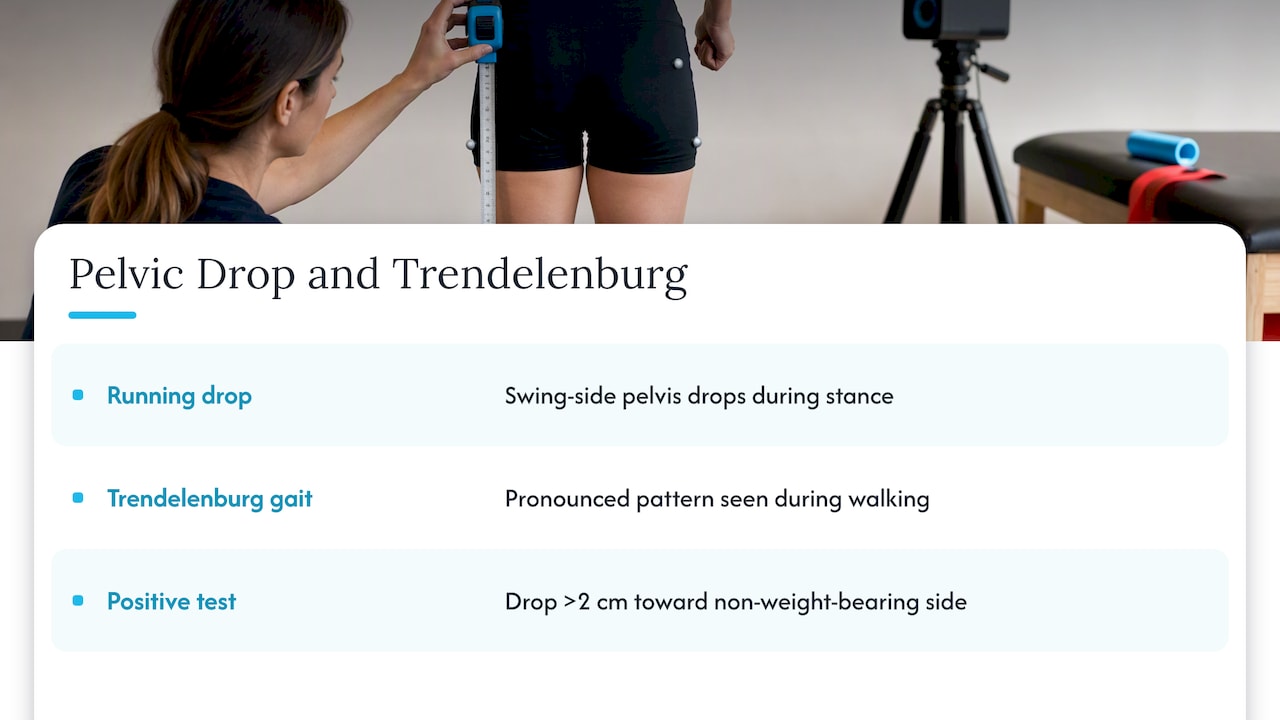
Researchers define running pelvic drop as downward obliquity of the swing-side pelvis relative to horizontal during stance. A 2021 study describes the same pattern in walking: the non-stance side of the pelvis drops during single-limb stance.
Trendelenburg gait is the clinical name for the pronounced version of this pattern, seen in walking when the hip abductors cannot do their job. In the hip examination, a pelvic drop of more than 2 cm toward the non-weight-bearing side counts as a positive Trendelenburg test, pointing to insufficient gluteal abductor function. Running hip drop is the same idea at higher speed and with much shorter ground contact. Most runners with visible hip drop are nowhere near a clinical Trendelenburg gait, so do not read the label as a diagnosis.
What it looks like
Filmed from behind, you will see the belt line or the dimples above the glutes tilt so the swing side sits lower at mid-stance. Often the trunk leans toward the stance side at the same time, and the knee on the stance leg may collapse inward. A phone video at 120 frames per second or higher from directly behind, on a treadmill, is enough to spot it. One clip at one speed is a snapshot only, because the same study found that running speed increased the observed pelvic drop.
Why one hip drops more than the other
The popular answer is “weak glute medius.” It is sometimes right and often incomplete. Here is what the evidence supports.
Weakness, but not as a simple relationship. Pelvic drop is commonly attributed to reduced hip-abductor activity, yet studies have not consistently found a simple relationship between measured weakness and pelvic or hip motion. In 21 recreational runners, static gluteus medius torque did not correlate with frontal-plane pelvic drop. The authors suggested dynamic strength, activation patterns and fatigue may matter more.
Motor control. The same 2021 paper says pelvic drop can reflect a motor-control adaptation or a combination of strength and motor-control deficits. Strengthening alone does not always change how you move. In practice: you can have a strong glute on a machine and still let the pelvis sag when you are tired at mile six.
Not every rotational or structural difference drops the pelvis. A 2023 study of children with increased femoral anteversion found no significant difference in abductor strength or contralateral pelvic drop versus controls, even though hip and pelvic rotation were greater. Bone shape alone does not predict the pattern.
Things worth checking in your own case:
- Side-to-side differences in single-leg strength and balance
- Leg-length or pelvic-height differences
- Hip range of motion, especially limited internal rotation
- Foot and ankle mechanics on the dropping side
- Low-back or trunk control, since the trunk and pelvis move together
- Fatigue: does the pattern appear only late in a run?
- Stride width and cadence, since crossover running narrows the base and amplifies the demand on the hip
That list is why a one-sided drop should not automatically be labeled simple muscle weakness. It is a movement pattern with several possible drivers, and finding yours is the point of an assessment.
Does hip drop cause running injuries?
Honest answer: it may contribute, but the evidence does not prove it.
The case for concern: in walking research, pelvic drop has been associated in different populations with gluteal tendinopathy, early hip osteoarthritis and patellofemoral pain, and may increase hip and knee joint stress. In runners with medial tibial stress syndrome (shin splints), a 2024 trial notes that weak hip abductors can contribute to poor dynamic limb alignment and control, alongside hard surfaces, footwear, limited flexibility and foot pronation.
The case for caution: a university review of the running literature found no conclusive answer on whether a gait deviation causes injury or follows it, because long-term gait-analysis studies are lacking. The same review reported that asymmetry was not established as a major overuse-injury risk factor, and training errors were implicated more often in the distance-running research it cited.
What that means for you:
- If you have hip drop and no pain, you do not need to panic. Look at your training load first: sudden mileage jumps, too many hard days, no recovery weeks.
- If you have hip drop and a recurring injury on the same side (outer hip, knee, shin, IT band), the pattern is a reasonable suspect and worth addressing.
- If you have pain and your drop is getting worse, treat that as a symptom to get examined.
If your outer knee is the complaint, our page on IT band treatment and return to running covers the hip-to-knee chain in more detail. If your knee tracks inward during squats or landings, the knee valgus correction plan is a close relative of this problem.
How hip drop is assessed
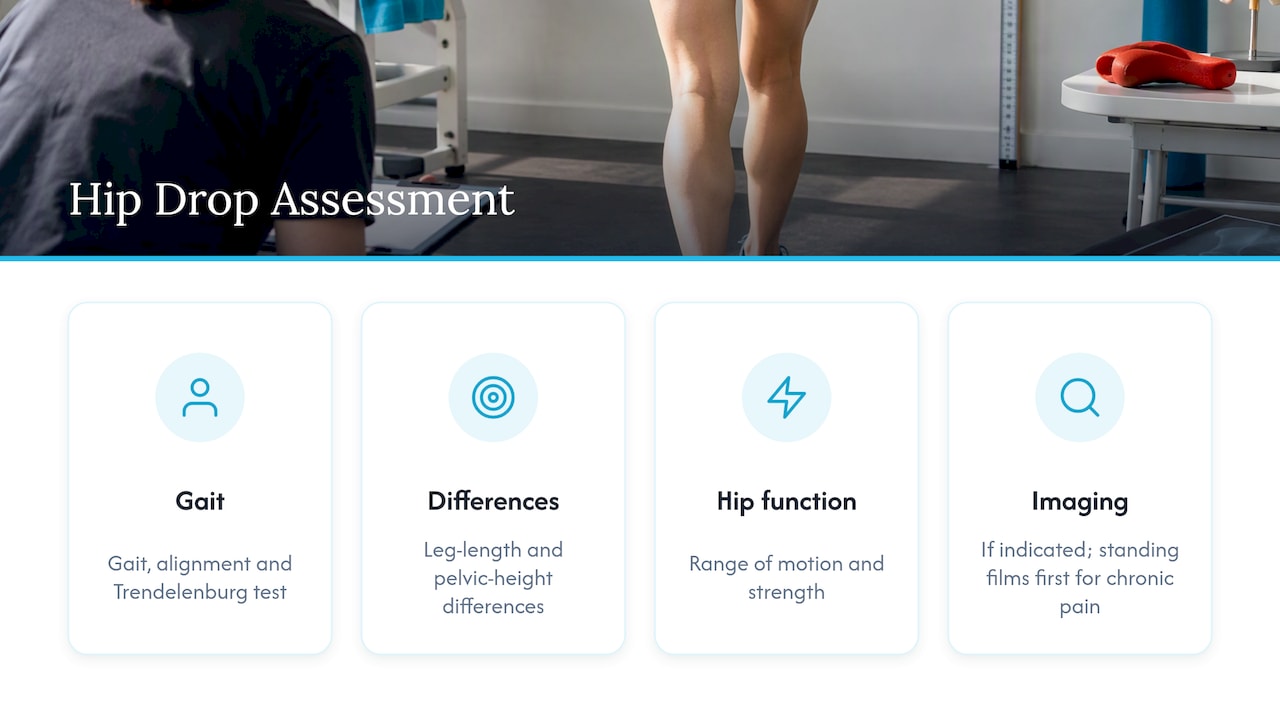
A proper assessment is more than watching you stand on one leg. A 2021 review says a clinician should assess gait, leg-length or pelvic-height differences, hip range of motion, strength, alignment, and the Trendelenburg test. For pain, the American Academy of Family Physicians advises gait analysis for antalgic or Trendelenburg gait, range of motion, strength, and targeted imaging when indicated, with standing hip and pelvic radiographs typically the first study for undifferentiated chronic hip pain.
Why the single-leg test is not enough
The static Trendelenburg test is quick and useful, but a 2025 study found it did not significantly predict dynamic pelvic motion during walking or running. Average pelvic drop during running was 4.2 degrees below horizontal, while the static task produced a mean position of 15.9 degrees above horizontal. The two tasks are simply different. A passing standing test does not clear your running, and a failing one does not prove your running is the problem.
A useful assessment therefore combines:
- A static screen (single-leg stance, single-leg squat, step-down)
- Strength and endurance testing of the hip abductors, side to side
- Range of motion and tissue findings around the hip, thigh and trunk
- Video of you running, ideally late in a run when fatigue shows
Exercises and training changes that may help
The best-described program for runners comes from a 2024 randomized trial in runners with shin splints. Its hip-abductor exercises were pelvic drops, single-leg bridges, side-lying hip abduction with internal rotation, lateral step-ups and resisted standing hip abduction, with resistance progressed individually using a 10-repetition-maximum method. The general program was done three times a week for eight weeks, three sets of 15 repetitions. Participants in that trial stopped running for three weeks and returned gradually at less than 50% of their previous level. That is a research protocol for a specific injury, not a prescription for you, but it shows the shape of a sensible plan: consistent frequency, progressive load, and a controlled return.
A broader review supports non-weight-bearing, controlled weight-bearing and functional exercises, and to a lesser extent dynamic exercises for lower-extremity movement control. Read that as an order of operations.
A simple progression
| Stage | Goal | Examples |
|---|---|---|
| 1. Isolate | Wake up the outer hip | Side-lying abduction, single-leg bridge |
| 2. Load | Build strength and endurance | Resisted standing abduction, lateral step-ups |
| 3. Control | Hold the pelvis level under load | Step-downs in front of a mirror, single-leg stance with reach |
| 4. Transfer | Carry it into running | Short run-walk intervals, then easy runs on flat ground |
Move on when the pelvis stays level through the whole set, not when the calendar says so. Because fatigue is one suspected driver, finish a few sets at the end of a workout rather than only when fresh.
Running changes that cost nothing
- Cut back volume briefly if the hip or knee is sore, then rebuild gradually.
- Run a little slower while retraining. Pelvic drop increased with speed in the 2025 study.
- Avoid crossover steps and run with your feet landing under your hips, not on a tightrope line.
- Alternate surfaces if every run is on hard concrete.
- Do the strength work on non-running days or after easy runs, not before intervals.
If you work on a different pattern at the same time, our hip shift squat guide shows how we assess a lopsided pelvis before choosing what to fix first.
When to get examined
Self-managing is reasonable for a painless asymmetry you just noticed on video. It stops being reasonable when:
- You limp, in walking or running, or your stride has visibly changed.
- Pain sits deep in the groin or hip, or hurts when you walk, climb stairs or get out of a car.
- Pain gets worse during a run, or wakes you at night.
- The same side keeps breaking down (outer hip, knee, shin, foot) despite rest.
- You have had eight weeks or so of consistent strengthening with no change.
- You have numbness, weakness or pain radiating down the leg, or any pain after a fall or impact.
In those situations, see a clinician who can examine gait, the hip joint and strength, and order imaging when it is indicated. Sudden severe pain, an inability to bear weight, or pain with fever or unexplained illness needs urgent medical attention, not a clinic booking and a wait.
Our perspective: assess the movement, then treat what you find
Most of the runners who come to us with hip drop have already been told “strengthen your glutes” and have already tried it. Some improve. Others do not, and the reason is usually that the drop was one piece of a larger pattern: a stiff or irritated tissue region, a limited hip, a foot that is not doing its job, or a trunk that is not stabilizing.
That is why we do not start with a protocol. We start by watching you move and finding where the chain breaks. Our work is hands-on. We use the Fascial Distortion Model to treat soft tissue restrictions that can limit how a hip or leg moves, and we pair it with an individualized rehabilitation plan so the new range turns into control. The research above backs the second half of that: movement-control training works best when it is progressive and specific, and the manual work is there to remove what is blocking it.
We are also direct about what hip drop is not. It is not always the cause of your pain, and it is not always weakness. If your video looks fine and your hip tests are normal, we will tell you to look at training load instead of chasing a number. Our focus is on cases that have not improved with standard approaches, but we would rather say “this is not your problem” than treat a finding that does not matter.
— Chris
Getting help in Plano
If you live near Plano, Texas and your hip drop comes with pain, recurring injuries or a plateau despite exercise, the Tx Room offers hands-on care for musculoskeletal and soft tissue problems in athletes and non-athletes. Depending on what the exam shows, that can include chiropractic care and soft tissue therapy, dry needling or focused shockwave (MyACT), along with a rehab plan you can keep doing between visits. To start, book through our new patient page.
FAQ
Is hip drop when running bad?
Not necessarily. Some pelvic drop on the swing side is a normal part of running. Research has not conclusively shown that it causes injuries, and training errors were implicated more often in the distance-running literature reviewed. It deserves attention when it is large, one-sided, getting worse, or accompanied by pain.
Does hip drop always mean weak glutes?
No. Weak hip abductors are a common suspect, but studies have not consistently found a simple link between measured weakness and pelvic motion. Motor control, fatigue and a combination of factors can all play a part, so strengthening alone does not always change how you run.
Can I test myself at home?
You can film yourself from behind on a treadmill and compare sides, and try a single-leg stance or step-down in front of a mirror. Keep in mind that a standing test does not reliably predict what your pelvis does while running. If you find a clear difference or any pain, have a clinician examine you.
How long does it take to fix hip drop?
There is no guaranteed timeline. The best-described running program in the research was eight weeks, three sessions a week, but it was for runners with a specific injury. Your timeline depends on what is driving the pattern, which is why the assessment comes first.
Is a Trendelenburg gait the same as hip drop?
They describe the same movement at different degrees. Trendelenburg gait is the clinical term for a pronounced pelvic drop in walking from insufficient hip-abductor function. Hip drop in running is usually subtler and measured differently.
Sources
- Frontal Plane Pelvic Drop in Runners: Causes and Clinical Implications
- Hip and Trunk Muscle Activity and Mechanics During Walking
- Does Increased Femoral Anteversion Cause Hip Abductor Weakness?
- Isometric Gluteus Medius Muscle Torque and Frontal Plane Pelvic Drop
- Physical Examination of the Hip
- Trendelenburg Test as a Predictor of Pelvic Drop
- Hip Pain in Adults: Evaluation and Differential Diagnosis (AAFP)
- Effect of hip abductors training on pelvic drop and knee valgus
- An evidence-based review of hip-focused neuromuscular exercise