
Heel Bursitis vs. Plantar Fasciitis: How to Tell Them Apart
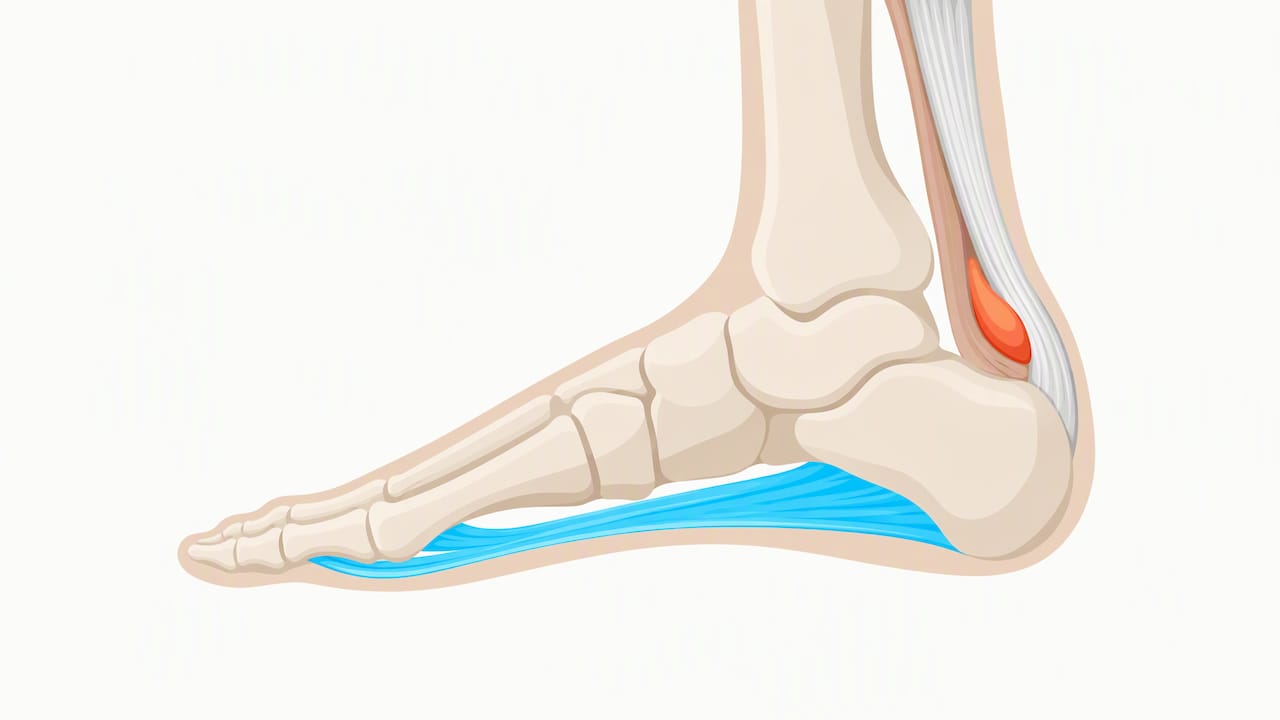
Heel bursitis and plantar fasciitis both hurt in the heel, but they are different problems in different places. Plantar fasciitis hurts under the heel, usually on the first steps after rest. Heel bursitis hurts at the back of the heel, where the Achilles tendon meets the bone, and it often looks swollen or red. Here is how to sort out which one you probably have, what else it could be, and when to get a hands-on exam.
TL;DR
- Pain under the heel that is worst with the first steps of the morning points to plantar fasciitis. Pain behind the heel, often with swelling, points to heel bursitis.
- Bursitis is inflammation of a fluid-filled sac. Plantar fasciitis involves the thick band of tissue along the sole of the foot.
- Pain at the ball of the foot, especially with a toe drifting out of line, suggests a plantar plate problem instead.
- Redness, warmth, fever, or being unable to rise on your toes needs prompt medical care, not a wait-and-see approach.
- Heel pain that has not improved after a few weeks deserves a hands-on exam, because the right treatment depends on the right diagnosis.
Table of Contents
- The quick difference: where it hurts
- What plantar fasciitis feels like
- What heel bursitis feels like
- Red, swollen heel: what else could it be?
- Where the plantar plate fits in
- How each one is diagnosed
- Treatment: what usually helps each condition
- A self-check you can do today
- When to get it checked
- What we do about it at The Tx Room
- Our perspective
- FAQ
- Sources
The quick difference: where it hurts
Location is the fastest clue. The American Academy of Orthopaedic Surgeons separates pain beneath the heel, commonly plantar fasciitis, from pain behind the heel, which may come from retrocalcaneal bursitis or a problem in the Achilles tendon.
| Plantar fasciitis | Heel bursitis | |
|---|---|---|
| Typical pain spot | Bottom of the heel, often toward the inside | Back of the heel, behind or just above the bone |
| Classic timing | First steps in the morning or after sitting | Builds with activity, worse on tiptoes |
| Visible signs | Usually none | Swelling, warmth, sometimes redness |
| What is irritated | The plantar fascia along the sole | A bursa near the Achilles tendon |
| Usual diagnosis | History and exam | History, exam, sometimes imaging |
If your symptoms do not fit either column cleanly, that is common. Several heel problems overlap, and a few of them can exist at the same time.
What plantar fasciitis feels like
The plantar fascia is the connective tissue running along the bottom of the foot. Cleveland Clinic describes plantar fasciitis as that tissue stretching or tearing and becoming inflamed. The pain is commonly at the inner part of the underside of the heel, and the American College of Foot and Ankle Surgeons notes it often shows up on the first few steps in the morning or after periods of inactivity.
A typical story: you get out of bed and the first steps feel like a bruise or a stab. It eases as you warm up, then returns after a long drive, a day at a desk, or the end of a run. Many people also notice it after a jump in mileage, a new job on hard floors, or a change in shoes.
Is plantar fasciitis the same as plantar heel pain?
Not exactly. Plantar heel pain is the umbrella term. The 2023 clinical practice guideline from the Academy of Orthopaedic Physical Therapy describes plantar heel pain as covering several diagnoses, including plantar fasciitis and other causes such as heel fat pad syndrome. Plantar fasciitis is the most common one, which is why the two terms get swapped so often.
What about heel spurs?
Heel spurs are bony growths, not a separate source of the morning pain most people feel. OrthoInfo notes that spurs may accompany long-standing plantar fasciitis but are often a result of the condition rather than the cause. You can have a spur and no pain, or pain and no spur.
What heel bursitis feels like
A bursa is a small fluid-filled sac that cushions and lubricates where tendons or muscles slide over bone. MedlinePlus explains that heel bursitis is swelling and inflammation of that sac at the back of the heel bone, and that too much ankle use, such as walking, running or jumping, can irritate it.
Cleveland Clinic lists two main types:
- Retrocalcaneal bursitis: the bursa between the heel bone and the Achilles tendon. This is the one most people mean.
- Subcutaneous calcaneal bursitis: the bursa between the skin and the Achilles tendon, which sits closer to the surface, often where shoe backs rub.
The same source lists pain and swelling in or behind the heel, tenderness, more pain when standing on the toes, warmth around the heel, and a change in skin color. That visible swelling is the biggest practical difference from plantar fasciitis, which rarely changes how the heel looks.
So, can bursitis happen in the heel? Yes. It just lives behind the heel, not under it, which is why “bursitis or plantar fasciitis” is partly answered by pointing at the spot that hurts.
Red, swollen heel: what else could it be?
Not every sore, swollen heel is bursitis. Mayo Clinic lists a long set of causes for heel pain: bursitis, Achilles tendon disorders, heel spur conditions, nerve problems, stress fractures, fractures, infection, and inflammatory or systemic diseases, in addition to plantar fasciitis.
That list matters for a few reasons:
- Achilles tendon problems also hurt behind the heel. The tendon pain tends to sit in the cord itself, while bursitis feels deeper and more tender at the bone. Our page on tendinitis explains how those overlap.
- Stress fractures cause pain that worsens with impact and does not warm up.
- Infection or inflammatory disease can cause a hot, red, swollen heel, sometimes with fever.
Mayo advises immediate care for serious heel pain after an injury, serious pain and swelling, being unable to bend the foot downward, rise on your toes or walk normally, or heel pain with fever and numbness or tingling. If that is you, do not book a routine appointment. Go to urgent care or an emergency department.
Where the plantar plate fits in
The plantar plate is a thick pad of ligament-like tissue under the base of the toe joints. It is not in the heel at all, which is why people who search “plantar plate vs plantar fasciitis” are often mixing up two foot zones.
According to the American College of Foot and Ankle Surgeons, plantar plate rupture may be associated with pain at the ball of the foot and changes in toe position. The same source says pain typically appears when the head of the metatarsal or the flexor crease of the affected joint is pressed, and may worsen at the end range of joint motion.
In plain terms:
- Pain under the heel, worst after rest: think plantar fasciitis.
- Pain behind the heel with swelling: think bursitis.
- Pain under the ball of the foot, often near the second toe, with a toe that drifts or lifts: think plantar plate.
Forefoot pain is also tricky. The ACFAS points out that stress fractures, capsulitis and several kinds of arthritis can look similar there, so it takes a proper exam to separate them. If that sounds like you, read our guide to plantar plate tear treatment and what clinicians try before surgery.
How each one is diagnosed
For plantar fasciitis, the diagnosis usually does not need a scan. The ACFAS consensus is that it is diagnosed in most cases by history and physical examination alone, and routine X-rays are not necessary for nontraumatic cases.
For heel bursitis, a provider may ask about activity and footwear, look for swelling and tender spots, check range of motion, and have you stand on your toes or flex your feet. Imaging such as X-ray, MRI or ultrasound may be added when the picture is unclear.
A good exam also looks above and below the sore spot. Stiff ankles, tight calves, weak hips, a high arch, or a flat arch can all load the heel. If your arches are a factor, see our page on high arch pain. If you roll to the outside of your foot, supination treatment is relevant.
Treatment: what usually helps each condition
The two conditions share a starting point. Cleveland Clinic lists nonsurgical heel pain treatments including pain relievers with ice, stretching, taping, physical therapy, orthotics, supportive shoes and rest. The details differ.
Plantar fasciitis
Load management and targeted strengthening are the backbone. The physical therapy guideline above gives an A grade to manual therapy directed at joints and soft tissue to reduce pain and improve function in plantar heel pain, along with plantar fascia and calf stretching. The ACFAS adds that treatment should be tailored to the patient’s activity, job demands and how long symptoms have lasted rather than following a rigid protocol.
For a full walk-through, see our guide to chiropractic for plantar fasciitis with home loading and our plantar fasciitis page.
Heel bursitis
The aim is to calm the irritated sac and remove what keeps provoking it. That often means easing off the aggravating activity, checking shoe backs that press on the heel, and addressing calf and Achilles tightness. Because the bursa sits next to the Achilles tendon, heel lifts, taping and gradual loading are common conversation points with a clinician. If you have visible swelling, warmth or redness, get it examined before you start stretching it hard.
The mistake that costs people months
Pushing through. The AAOS notes that continued impact on a sore heel, whatever the cause, is likely to worsen the pain and may lead to other complications. Stretching a bursa that is inflamed can make it angrier. Resting a plantar fascia completely can leave it stiff. That is why knowing which one you have comes first.
A self-check you can do today
This does not replace an exam, but it gives you something specific to report.
- Point with one finger. Under the heel, toward the inside? Behind the heel? Under the ball of the foot?
- Note the timing. Worst on the first steps after rest suggests plantar fasciitis. Worse with activity and tiptoes suggests bursitis.
- Look at both heels in good light. Swelling, a lump, warmth or redness on one side is a bursitis-type sign.
- Try a tiptoe rise. Pain at the back of the heel with a rise is typical of bursitis or an Achilles problem. If you cannot rise at all, that falls under the urgent signs above.
- Check your shoes. A stiff heel counter rubbing the back of the heel, or worn-out cushioning under it, are both common triggers.
When to get it checked
Cleveland Clinic advises calling a provider for heel pain that does not improve after a few weeks of rest or pain relievers, makes walking or movement difficult, or brings severe swelling, inflammation or stiffness. Mayo adds that heel pain at rest, or lasting more than a few weeks despite home care, calls for an office visit.
For a hot, red, swollen heel with fever, numbness or tingling, or any injury with severe pain, skip the office visit and seek urgent care.
What we do about it at The Tx Room
If your heel pain has hung around, the next step is a hands-on exam that finds the actual tissue involved. At our Plano clinic we treat soft tissue and biomechanical causes of heel pain with the Fascial Distortion Model, a hands-on approach, along with soft tissue therapy and chiropractic care. Depending on what the exam shows, we may also use dry needling, MyACT focused shockwave or deep tissue laser therapy.

We work with athletes, parents, desk workers and students, and we focus on cases that have not improved with standard medical or physical therapy approaches. Treatment plans are individualized. If your heel is red, hot, or you have a fever, we will send you to medical care first.
Our perspective
Most of the heel pain that walks into a clinic has been mislabeled at least once. People tell us they were told it was plantar fasciitis, stretched for two months, and got worse, when the real trouble was behind the heel. Others were told it was bursitis when the foot was simply overloaded by weak hips or a stiff ankle.
We think the heel is rarely the whole story. The tissue that hurts is often the tissue that is paying for a problem somewhere else: a stiff big toe, a tight calf, a foot that rolls out. So we start with where it hurts, then look up the chain, then pick the least aggressive treatment that moves the tissue. Hands-on work is meant to open a window, and exercise is what keeps it open.
Our firm rule is to avoid guessing when red flags are present. A hot, swollen heel is a medical question first.
— Chris
FAQ
Can bursitis be in the heel?
Yes. Heel bursitis most often affects the bursa between the heel bone and the Achilles tendon, called retrocalcaneal bursitis. It causes pain, swelling and tenderness at the back of the heel, often worse when you stand on your toes.
Is plantar fasciitis the same as plantar heel pain?
Plantar heel pain is a broader label that includes plantar fasciitis and other causes, such as heel fat pad problems. Plantar fasciitis is the most common cause, so the terms are often used interchangeably.
What could cause a red, swollen heel?
Bursitis is one possibility, but infection, a fracture, an Achilles tendon problem or an inflammatory condition can look similar. Redness and warmth, especially with fever or trouble walking, should be seen promptly by a medical provider.
Is walking good for plantar fasciitis?
Gentle, short walks in supportive shoes are often tolerated, but pushing through sharp pain tends to prolong the problem. Because treatment should fit your activity level and how long you have had symptoms, a clinician can tell you how much walking is right for you.
How is plantar plate pain different from plantar fasciitis?
Plantar plate pain is in the ball of the foot under the toe joints, sometimes with a toe that drifts out of line. Plantar fasciitis pain is under the heel and is typically worst on first steps after rest.
Sources
- Heel Pain: OrthoInfo, American Academy of Orthopaedic Surgeons
- Heel Pain: Causes, Diagnosis and Treatment, Cleveland Clinic
- Heel Bursitis: What It Is, Types, Symptoms and Treatment, Cleveland Clinic
- Bursitis of the heel, MedlinePlus
- Heel Pain Clinical Consensus Statement, American College of Foot and Ankle Surgeons
- Digital Deformities, forefoot disorders, American College of Foot and Ankle Surgeons
- Heel pain causes, Mayo Clinic
- Heel pain, when to see a doctor, Mayo Clinic
- Heel Pain and Plantar Fasciitis Clinical Practice Guideline, 2023 revision