
Heal an Ankle Sprain Faster: Start Rehab in the First 48–72 Hours
An ankle sprain happens when a ligament that stabilizes the joint gets stretched, partially torn, or fully torn, usually from rolling the foot inward. Most people recover fully with conservative care, though healing time depends on how badly the ligament is damaged. Right now, protect the joint, keep it elevated to control swelling, and get evaluated if you can’t put any weight on it or if pain is getting worse instead of better.
TL;DR:
- Most ankle sprains involve lateral ligaments, especially the anterior talofibular ligament, caused mainly by inward rolling, with risk factors including previous sprains and uneven surfaces.
- Healing time varies by severity: Grade 1 takes about 1-2 weeks, Grade 2 around several weeks, and Grade 3 can last several months, sometimes requiring surgery.
- Proper diagnosis relies on clinical exam and Ottawa ankle rules, with imaging only necessary if fractures or severe instability are suspected.
- Initial treatment should focus on protection, ice, compression, and elevation, avoiding prolonged immobilization to promote faster recovery.
- Active, phased rehabilitation emphasizing early movement, strength, balance, and proprioception reduces the chance of recurrence and speeds return to sports.
Table of Contents
- Sprained Ankle Symptoms and When to Seek Urgent Care
- What Causes an Ankle Sprain, and Which Type Do You Have?
- How Bad Is My Sprain, and How Long Will It Take to Heal?
- How Do Doctors Diagnose an Ankle Sprain?
- First Aid for a Sprained Ankle in the First 48 to 72 Hours
- Ankle Sprain Rehabilitation: A Phase-by-Phase Exercise Plan
- Preventing Another Sprain and Knowing When You’re Ready
- The Tx Room’s Take: Hands-On Care Meets Structured Rehab
- Why Most People Get Ankle Sprain Recovery Backward
- Sources
Sprained Ankle Symptoms and When to Seek Urgent Care
The telltale signs show up fast: pain that spikes when you put weight on the foot, tenderness right over the ligament, swelling that can balloon within an hour, bruising that spreads over the next day or two, and a joint that feels stiff or unstable when you try to move it.
- Pain concentrated on the outside or inside of the ankle, worse with movement
- Swelling and bruising, sometimes extending into the foot or lower leg
- A feeling of looseness or the ankle “giving way”
- Difficulty or inability to bear weight on the affected side
A complete inability to walk on the foot, numbness or tingling, or visible deformity are red flags that need same-day medical attention. Short of that, MedlinePlus recommends seeing a professional if pain hasn’t improved after 48 to 72 hours of home care. Emergency clinicians also lean on the Ottawa ankle rules, a quick set of exam checkpoints that catch fractures with strong reliability, to decide who actually needs an X-ray instead of just rest.
What Causes an Ankle Sprain, and Which Type Do You Have?
Roughly four out of five ankle sprains happen the same way: the foot rolls inward (inversion), stretching or tearing the ligaments on the outside of the ankle. The anterior talofibular ligament, or ATFL, takes the brunt of it almost every time, which is why lateral sprains dominate emergency room visits and sports sideline treatment alike.
- Lateral (inversion) sprain: foot rolls in, outer ligaments (ATFL, calcaneofibular) stretch or tear
- Medial (eversion) sprain: foot rolls outward, straining the deltoid ligament on the inner ankle, less common but often more painful
- Syndesmotic (high ankle) sprain: the ligaments connecting the shin bones above the ankle joint get twisted, typically from a forceful outward rotation
Risk climbs sharply if you’ve sprained the same ankle before, play or work on uneven surfaces, or wear worn-out or poorly fitted shoes.
How Bad Is My Sprain, and How Long Will It Take to Heal?
Clinicians grade sprains one through three based on how much ligament fiber is actually torn, and the grade drives the timeline more than anything else.
- Grade 1: ligament stretched, minimal tearing, mild swelling, still able to bear some weight
- Grade 2: partial tear, moderate swelling and bruising, noticeable instability
- Grade 3: complete tear, significant swelling, joint feels unstable or “loose”
MedlinePlus data puts Grade 1 healing at about 1 to 2 weeks, with most patients across all grades functional again somewhere in the 8 to 12 week range. Grade 2 sprains generally take several weeks before full activity feels normal again. Grade 3 tears, including syndesmotic sprains, typically require a longer recovery period, potentially several months, and some cases may need surgical repair. Yale Medicine notes that even most severe sprains are managed without surgery, with the emphasis on restoring motion and strength rather than immobilizing the joint.
How Do Doctors Diagnose an Ankle Sprain?
A clinician starts with a hands-on exam: pressing along each ligament to find the tender spot, checking swelling patterns, and running stress tests like the anterior drawer test to see how much the joint shifts when nudged in specific directions.
- Palpation of the ATFL, deltoid ligament, and syndesmosis
- Range-of-motion and weight-bearing assessment
- Stress testing to gauge ligament laxity
- Ottawa ankle rules applied to decide if an X-ray is warranted
X-rays get ordered when the Ottawa criteria flag possible fracture, not for every sprain. MRI or ultrasound usually only comes into play when a syndesmotic injury is suspected, when instability persists past the expected healing window, or when a tendon tear is on the differential instead of a ligament sprain. Persistent giving-way after several weeks is the usual trigger for a referral to orthopedics or sports medicine.
First Aid for a Sprained Ankle in the First 48 to 72 Hours
The classic RICE protocol (rest, ice, compression, elevation) still holds up, with one modern tweak: “protection” now often replaces strict rest, since total immobility slows healing more than it helps.
- Protect the joint from further injury with an elastic wrap, semi-rigid brace, or, if walking is painful, crutches.
- Ice for 15 to 20 minutes at a time, always with a towel between the pack and your skin, with at least 30 minutes between sessions to protect the skin.
- Compress gently with an elastic bandage to limit swelling without cutting off circulation.
- Elevate the foot above heart level whenever you’re sitting or lying down.
Over-the-counter anti-inflammatories like ibuprofen can take the edge off pain and swelling for most people, though check with a pharmacist or doctor if you have kidney issues or take blood thinners. A walking boot may help for the first few days if bearing weight is too painful, but don’t stay in it longer than necessary.
Pro Tip: Never place ice directly on skin, and don’t let a brace or boot turn into a crutch for weeks. Stiff, over-immobilized ankles heal slower and stay weaker longer than joints that get moving as soon as pain allows.
Ankle Sprain Rehabilitation: A Phase-by-Phase Exercise Plan
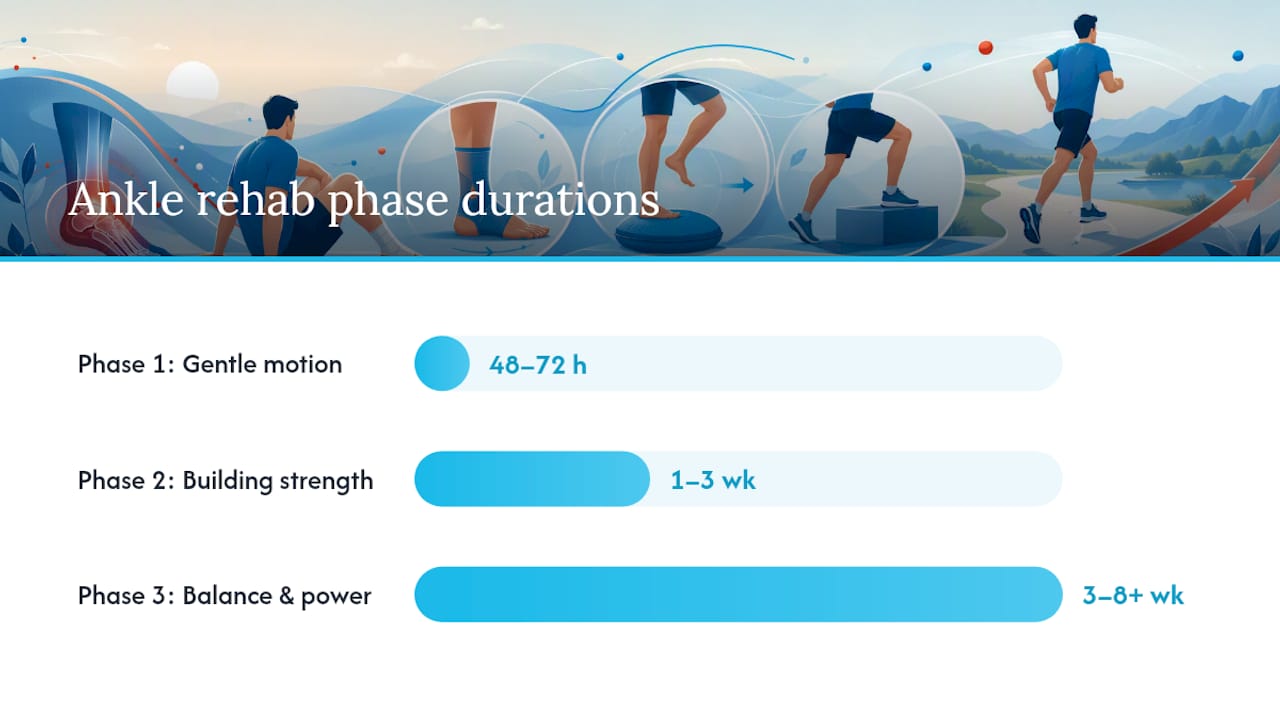
Clinical evidence reviewed in StatPearls is blunt about this: early functional rehab, meaning gentle guided movement started as soon as pain allows, beats prolonged immobilization for getting people back to full activity. Sitting in a boot for three weeks feels safer. It usually isn’t.
Phase 1 (first 48 to 72 hours): Gentle motion
- Trace the alphabet with your big toe while seated, letter by letter.
- Rotate the ankle in slow circles, both directions, staying inside a pain-free range.
Phase 2 (roughly week 1 through 3): Building strength
- Resistance-band inversion and eversion, about 30 repetitions per direction, done slowly
- Dorsiflexion and plantarflexion presses against light band resistance
- Double-leg calf raises, progressing toward single-leg as tolerance improves
Phase 3 (week 3 through 8 and beyond): Balance and power
- Single-leg standing balance, eyes open, then eyes closed
- Wobble board or foam pad drills for proprioception
- Single-leg heel raises, then lateral hops, then sport-specific cutting and sprinting drills
Harvard Health’s rehab guidance backs this same progression, from basic range of motion through balance and agility work. If swelling or instability hasn’t meaningfully improved by the two to three week mark, that’s the point to bring in a physical therapist rather than keep guessing at home. Return-to-sport benchmarks generally include pain-free full range of motion, strength that matches your other ankle, and a single-leg hop test you can pass without wobbling.
Pro Tip: Strength training alone won’t stop a repeat sprain. Balance drills retrain the nerve signals between your ankle and brain, and skipping that step is the single biggest reason sprains come back.
Readers building a home strengthening routine can pair these phases with broader foot strengthening exercises or lean on guidance for restoring ankle range of motion if progress stalls.
Preventing Another Sprain and Knowing When You’re Ready
An ankle that’s healed on paper isn’t automatically ready for a pickup basketball game or a 5K. Lace-up ankle braces or athletic taping measurably cut re-injury risk during higher-demand sports, especially in the months right after a sprain when the joint is still relearning stability. Supportive, well-fitted shoes matter more than most people assume, particularly on trails or uneven ground.
- Keep doing balance and proprioception drills two to three times a week, even after symptoms disappear
- Rotate athletic shoes before the tread and support break down
- Warm up ankle mobility before running or jumping activities
- Retest strength and balance if you feel any lingering looseness
Before returning to running or cutting sports, you should have pain-free range of motion, strength that roughly matches your uninjured side, and the ability to complete a single-leg hop without pain or instability. Restoring proprioception matters just as much as rebuilding raw strength here. If a calf strain complicates the picture during your return to running, safe recovery steps for calf strains cover similar ground.
The Tx Room’s Take: Hands-On Care Meets Structured Rehab
Sprained ankles can be treated with a combination of hands-on manual therapy using the Fascial Distortion Model and a structured exercise plan tailored to how the injury is actually presenting, not a generic handout. A typical visit may involve a physical assessment of the ligament and surrounding soft tissue, targeted hands-on treatment to address restricted movement, and a specific set of exercises to take home before the next follow-up.
Patients dealing with lingering stiffness or instability after a sprain may find that manual therapy paired with a phased exercise progression helps recovery more than exercise alone.
If you’re still limping weeks after a sprain, Thetxroom’s sprains and strains care is built around exactly that kind of stalled recovery, combining assessment, hands-on treatment, and rehab exercises under one roof.
Why Most People Get Ankle Sprain Recovery Backward
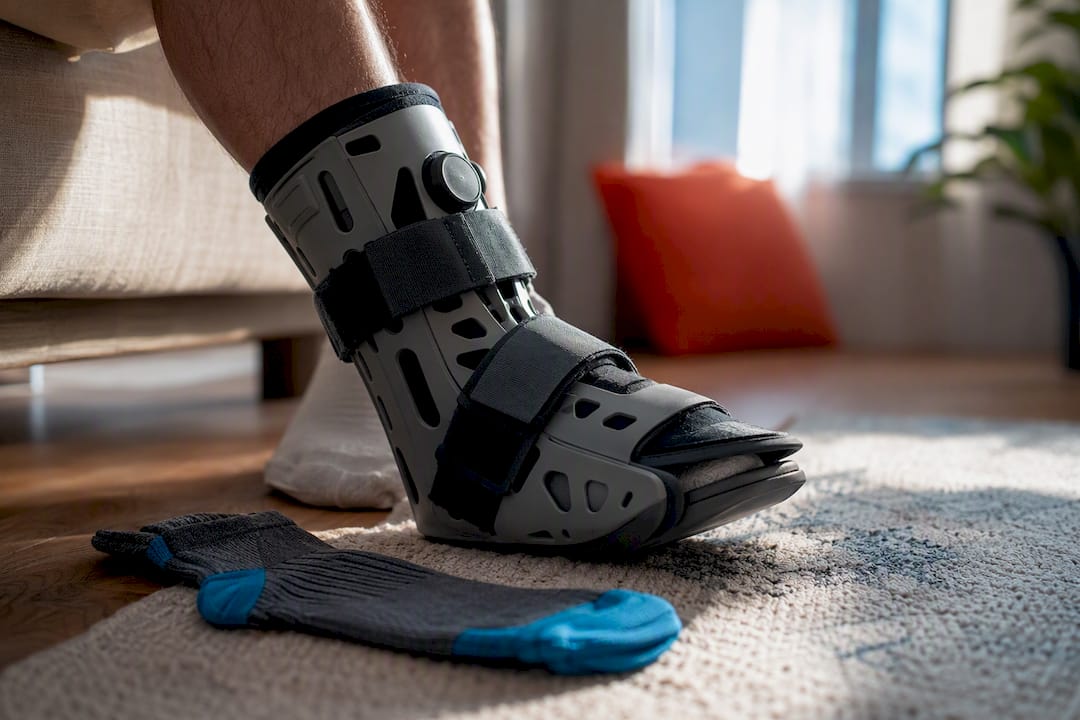
Here’s the thing almost nobody tells you when you first roll an ankle: the instinct to protect it by not moving it is exactly what slows you down. The medical evidence has been pointing the same direction for years, and it still hasn’t fully caught up with common practice. People buy a boot, wear it for three weeks straight, and wonder why the joint feels stiff and weak a month later. Immobility isn’t safety. It’s just a different kind of injury, one you gave yourself.
The other blind spot is proprioception. Most people who “do their rehab” mean they did calf raises and called it done. Strength matters, but a strong ankle that can’t sense its own position in space is still a sprain waiting to happen again. That’s the piece that gets skipped, and it’s the piece that explains why so many people sprain the same ankle two or three times.
If there’s one thing worth taking from this whole guide, it’s that recovery isn’t a straight line from rest to ready. It’s a series of small, deliberate stress tests, applied earlier than feels comfortable, that teach the joint to trust itself again.
— Chris
This article is general information, not a substitute for advice from a qualified doctor. Consult a qualified healthcare professional about your own circumstances before acting on anything here.
Sources
- Acute Ankle Sprain – StatPearls (NCBI Bookshelf)
- Ankle sprain — patient instructions – MedlinePlus
- Recovering from an ankle sprain – Harvard Health