
Plantar Fasciitis Treatment: What Works and When to Get Hands-On Help
Most plantar fasciitis improves with a consistent plan: stretching and strengthening, supportive shoes, load management and, for stubborn cases, hands-on therapy. If your heel still hurts with the first steps each morning after a few weeks of trying the basics, that is the point to bring in a clinician who treats the tissue directly. At The Tx Room in Plano, Texas, we use the Fascial Distortion Model (FDM), myotherapy, dry needling and individualized rehab plans for exactly those cases.
This guide walks through what the medical guidelines recommend, how to do each step well, and how to tell when it is time to stop going it alone.
TL;DR
- Plantar fasciitis is irritation of the thick band of tissue under your foot. The classic sign is heel pain with the first steps after rest.
- Calf and plantar fascia stretching, foot and ankle strengthening, supportive footwear and ice are the foundation of care.
- Manual therapy and dry needling have published evidence for pain relief, and they are where hands-on care adds the most.
- If you have not improved after several weeks of consistent home care, a hands-on evaluation can save you months.
- We treat plantar fasciitis in Plano with FDM, myotherapy, dry needling and individualized rehab plans.
Table of Contents
- What plantar fasciitis is, and why it hurts
- Step 1: Calm the heel and cut the load
- Step 2: Stretch the right tissue, the right way
- Step 3: Strengthen the foot and ankle
- Step 4: Footwear, habits and daily load
- Step 5: Hands-on care for pain that will not budge
- When to see a doctor first
- A realistic plan by reader
- Our perspective
- Get your heel looked at in Plano
- FAQ
- Sources
What plantar fasciitis is, and why it hurts
The plantar fascia is the thick tissue along the bottom of your foot that connects the heel bone to the toes and forms the arch. According to MedlinePlus, plantar fasciitis happens when that tissue is overstretched or overused. The most common symptom is a dull or sharp pain at the bottom of the heel that is worst with the first steps in the morning, and that can also flare after long periods of standing or sitting, on stairs, and after hard activity.
It is common. UAMS reports that more than 2 million people in the U.S. are treated for it each year and about 1 in 10 people will develop it at some point. The American Academy of Physical Medicine and Rehabilitation calls it the third most common injury among runners, and says obesity and jobs that keep you on your feet can also lead to tearing, swelling and pain.
Who tends to get it
MedlinePlus lists these risk factors: flat feet or high arches, long-distance running (especially downhill or on uneven ground), a tight Achilles tendon, shoes with poor arch support or soft soles, sudden weight gain and sudden changes in activity. That list explains why the diagnosis shows up across very different people:
- Athletes who add mileage, speed work or jumping too fast.
- Parents who spend long days on hard floors, often in flat shoes or barefoot.
- Workers in retail, healthcare, construction or classrooms who stand for most of a shift.
- Students who go from sitting all day to a new walking commute, a new job or a new sport.
Aging plays a part too. UAMS notes the fascia becomes less stretchy and the heel fat pad thins over time, so repeated impact can damage and swell the tissue.
What about heel spurs?
A heel spur on an x-ray is not the cause of your pain. MedlinePlus states that x-rays show spurs in people with and without plantar fasciitis, and an American Academy of Family Physicians review found about half of patients have spurs that are usually incidental and do not track with symptoms. Treatment is aimed at the tissue and the load on it, not the spur.
Step 1: Calm the heel and cut the load
The first job is to stop re-irritating the tissue while still staying active.
Rest from the aggravating activity, not from everything. Pain usually follows an increase in activity amount or intensity, or a change in surface or footwear, per the AAPMR. Cut back the run or the long standing blocks, then build up again gradually. Swap in cycling or swimming if you are an athlete trying to keep fitness.
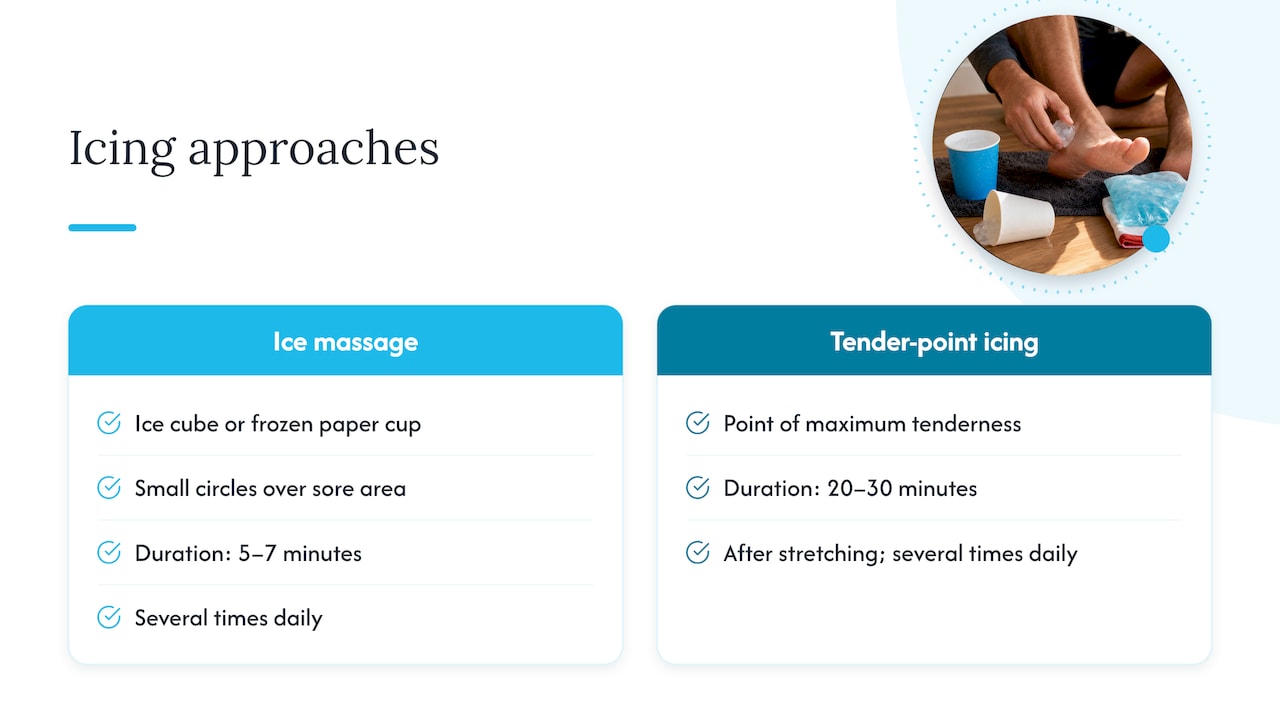
Ice. The Veterans Affairs patient guide describes ice massage: rub an ice cube or a frozen paper cup in small circles over the sore area for 5 to 7 minutes, several times a day. The American Orthopaedic Society for Sports Medicine suggests icing the point of maximum tenderness for 20 to 30 minutes after stretching and several times a day. Use a thin cloth between ice and skin, and stop if the skin turns numb or very red.
Pain relievers. The VA and the American College of Foot and Ankle Surgeons both list anti-inflammatory medication as part of initial care. If you have kidney, stomach or heart conditions, or take blood thinners, check with your doctor or pharmacist before using them.
Step 2: Stretch the right tissue, the right way
Stretching has the strongest guideline support for plantar fasciitis. The American Physical Therapy Association’s 2023 clinical practice guideline recommends both plantar fascia-specific stretching and calf (gastrocnemius and soleus) stretching for short- and long-term pain reduction and better function. In the guideline’s pooled data on 8 randomized trials with 681 participants, plantar fascia stretching did better than calf stretching in the short term, and no serious side effects were reported, only mild to moderate discomfort during the stretch that stopped when it ended.
A simple routine
- Plantar fascia stretch. Sit, cross the affected foot over the opposite knee, and pull your toes back toward your shin until you feel a stretch along the arch. The guideline’s evidence base uses holds of 10 to 30 seconds for this stretch. Repeat several times, a few times a day.
- Calf stretch. Stand facing a wall with the painful leg back, heel down and knee straight, and lean forward. Repeat with the knee slightly bent to reach the deeper calf muscle.
- Before your first steps. Do the plantar fascia stretch before you get out of bed. That targets the morning spike.
If you also have tightness through the back of the leg, our guide on tight calves and heel pain goes deeper on that link.
Where stretching goes wrong
- Bouncing instead of holding steady.
- Stretching into sharp pain rather than a firm pull.
- Doing it for three days, feeling a bit better, and stopping. The guideline’s trials ran from days to 8 weeks, so give it weeks, not days.
Step 3: Strengthen the foot and ankle
Stretching alone is rarely the whole answer. The 2023 guideline recommends therapeutic exercise including resistance training for the muscles of the foot and ankle. An AFP summary of the guideline reports that strengthening the toe flexors, ankle evertors and invertors and the gastrocnemius improved pain and function more than stretching alone.
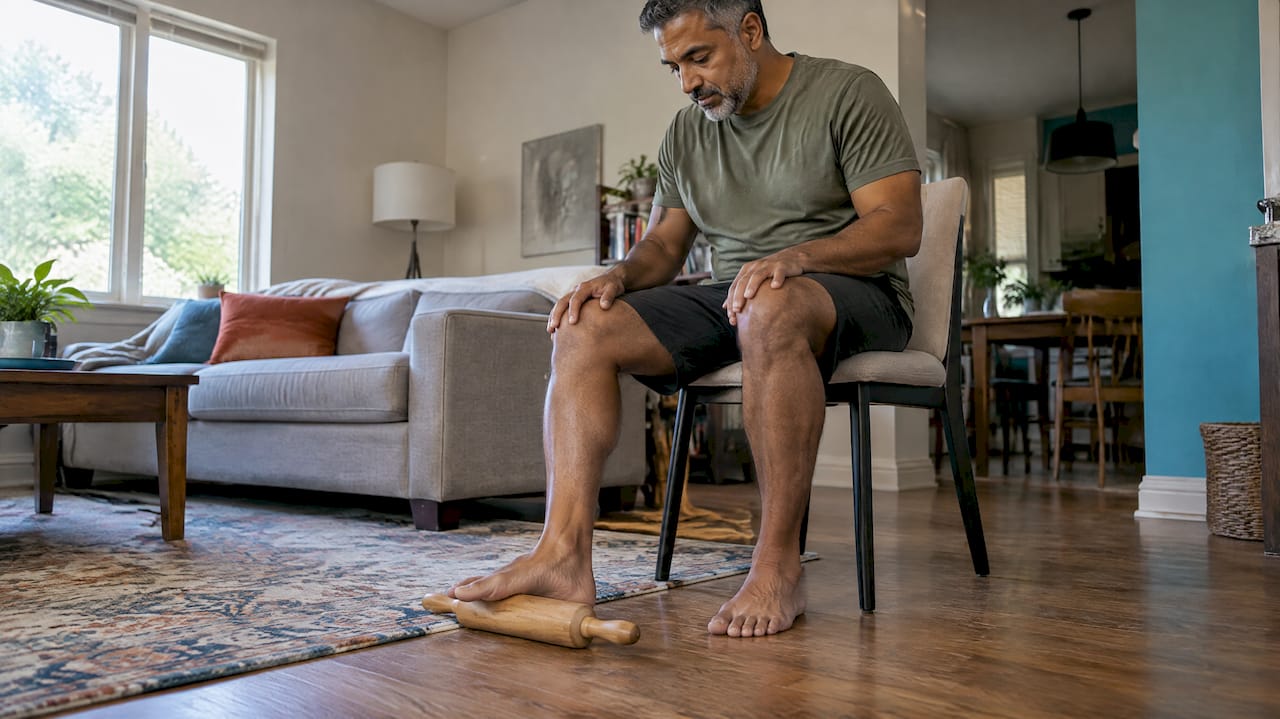
Two starting points from the AOSSM tip sheet: strengthen the arch with towel scrunches, and roll the sole of the foot over a 3- to 4-inch tube (a rolling pin works) for self-massage.
For a fuller progression, see our page on foot strengthening exercises. Movement more broadly also supports healthy joints, and this piece on non-surgical options for stiff joints is a good companion read when your knees or hips feel stiff too.
Step 4: Footwear, habits and daily load
This is the step most people underestimate, because it works all day rather than for ten minutes.
- Choose shoes with arch support and cushioning. MedlinePlus lists poor arch support and soft soles as risk factors, and the AOSSM tip sheet recommends supportive footwear with good cushioning.
- Do not walk barefoot on hard floors. ACFAS advises avoiding flat shoes and walking barefoot as part of initial care, and recommends arch supports and heel cushions. That includes the house, which matters for parents on tile and hardwood all day.
- Add heel pads when you stretch. The 2023 guideline notes heel pads may increase the benefit of stretching.
- Replace worn running shoes. A change in footwear is one of the triggers the AAPMR names, so swap gradually rather than switching to a very different shoe overnight.
- Build mileage slowly. Sudden increases in activity are a listed risk factor.
- Break up long standing. If your job keeps you on your feet, use an anti-fatigue mat where possible, sit briefly when you can, and stretch your calves during breaks.
Night splints for morning pain
If the first steps of the day are consistently the worst, the guideline recommends a night splint program of 1 to 3 months. The AOSSM sheet describes a physician-prescribed splint that holds the foot at 90 degrees to lessen that first-step pain. Ask your doctor about one if morning pain dominates.
Step 5: Hands-on care for pain that will not budge
Many people do everything above and still limp out of bed at week six. That is not a failure of effort. Plantar fasciitis usually has more than one cause. The AFP review notes that it often has several, and that it may be as much a degenerative process as an inflammatory one. That is why tissue that stays stiff, tender or guarded can need direct treatment.
The AFP’s 2025 guideline summary lists manual therapies with published benefit:
- Trigger point release combined with calf stretching improved pain for up to 2 weeks.
- Subtalar joint mobilization improved pain for up to 3 weeks.
- Deep posterior-calf massage and neural mobilization improved pain for up to 6 weeks.
- Instrument-assisted soft-tissue mobilization of the calf and plantar fascia showed measurable improvement for up to 90 days.
- Dry needling of the calf, sole and plantar muscles improved pain and reduced disability for up to 6 months.
The pattern is clear: hands-on work buys you a window of less pain, and you use that window to load the foot and calf properly. Our own approach is built the same way: treat the tissue, then pair it with a rehab plan so the result lasts. You can read about chiropractic for plantar fasciitis with home loading and what a typical recovery timeline looks like.
What we do at The Tx Room
We are a specialized chiropractic center in Plano focused on musculoskeletal injuries and biomechanical imbalances. For heel pain, our toolkit includes:
- The Fascial Distortion Model, a hands-on approach to soft tissue injuries.
- Dry needling.
- Myofascial release and fascia work.
- MyACT focused shockwave and deep tissue laser therapy.
- Individualized rehabilitation plans built around your sport, job or routine.
When to see a doctor first
Most heel pain is plantar fasciitis, but not all of it. See a physician promptly if you have:
- Heel pain after a fall or injury, or you cannot put weight on the foot.
- Significant swelling, redness or warmth, or fever.
- Numbness, tingling or burning in the foot.
- Diabetes or poor circulation along with new foot pain.
- Pain that is severe at night or at rest, rather than tied to first steps and activity.
Heel pain can also come from other structures. Our article on heel bursitis versus plantar fasciitis explains how the two differ. Injections and surgery sit at the far end of the treatment ladder: ACFAS lists corticosteroid injections among initial options, while the AOSSM notes surgery is rarely necessary.
A realistic plan by reader
Athletes. Keep training volume to what the foot tolerates, add calf and foot strengthening, and work through your hands-on care early rather than waiting for the season to end. We design rehab around your sport so you return on a plan, not a guess.
Busy parents. You do not have time for a long program. Focus on three things: supportive shoes at home, the two-minute morning stretch, and a short strengthening set. If that has not changed things in a few weeks, shorter, focused visits beat months of low-grade pain.
Workers on their feet or with repetitive strain. Change what you can about load (mats, shoes, breaks), and treat the calf as part of the problem. Tissue that is stuck after a long shift responds to hands-on care followed by loading.
Students and desk-heavy routines. Posture and sudden changes in walking or exercise are common triggers. Build walking or running gradually and strengthen the feet before ramping up.
Chronic pain. If heel pain has lingered for months, the problem is often more than one tissue. A whole-leg evaluation of calf, ankle and foot mechanics is worth more than another round of the same stretch.
Our perspective
Heel pain is rarely just a heel problem. When someone arrives after weeks of stretching and new shoes with no change, the answer is usually in how the fascia, calf and ankle are working together.
We built our approach around hands-on treatment of soft tissue: the Fascial Distortion Model, myotherapy, dry needling and individualized rehab. We focus on cases that have not improved with standard medical or physical therapy approaches, and we aim to get you back to your active life sooner.
The best results come from pairing treatment with the loading work the guidelines recommend. Treatment opens the window, and the plan keeps it open.
Chris
Get your heel looked at in Plano
If you have given the basics a few weeks and the first steps of the day still hurt, our team at The Tx Room can examine your foot, calf and movement and build a plan around your routine. We accept both self-pay and insurance. Start with our Plano plantar fasciitis page or book through our main site.
FAQ
How long does plantar fasciitis take to go away?
It varies with how long you have had it and how consistently you treat it. The research trials on stretching ran from days to several weeks, and benefits were documented from 1 week to 12 months. Our week-by-week recovery guide lays out what to expect.
Does icing help plantar fasciitis?
Yes, it is a standard part of home care. The VA recommends ice massage for 5 to 7 minutes several times a day, and the AOSSM suggests 20 to 30 minutes at the most tender spot after stretching. Always keep a cloth between ice and skin.
Should I stretch or strengthen?
Do both. The 2023 guideline recommends plantar fascia and calf stretching, along with resistance exercise for the foot and ankle muscles. Stretch first thing in the morning and add strengthening several days a week.
Do I need surgery?
Unlikely. The AOSSM notes that surgery is rarely necessary, and most people are managed with the steps above. If pain has not responded to a consistent program, a hands-on evaluation is the next step.
Sources
- Plantar fasciitis: MedlinePlus Medical Encyclopedia
- Plantar Fasciitis, UAMS News
- Plantar Fasciitis, American Academy of Physical Medicine and Rehabilitation
- Diagnosis of Heel Pain, American Family Physician
- Understanding Plantar Fasciitis, Veterans Affairs
- Heel Pain, Plantar Fasciitis: Revision 2023, JOSPT
- Plantar Fasciitis tip sheet, American Orthopaedic Society for Sports Medicine
- Plantar Fasciitis: Guidelines From the American Physical Therapy Association, American Family Physician
- Protecting Joint Health Through Movement