
Soft Tissue Injury Treatment: What to Do and When to Get Hands-On Care
Most soft tissue injuries start the same way: rest, ice, compression and elevation for the first days. If the pain, swelling or stiffness is still there after that window, or it keeps coming back, the next step is a hands-on exam and a plan built around the tissue that is actually involved. At The Tx Room in Plano, Texas, we treat sprains, strains, bruises, tendon irritation and fascial restrictions with the Fascial Distortion Model and other manual therapies, for athletes and non-athletes alike.
This guide covers what to do in the first 48 hours, which symptoms mean you should be seen promptly, how the main treatment options differ, and how to decide when home care has done what it can.
TL;DR
- Soft tissue means muscles, tendons, ligaments and fascia. Sprains, strains and bruises are the most common injuries.
- For the first day or two, stop the activity that hurt you and use rest, ice, compression and elevation (RICE). Skip heat at first.
- Get examined if you cannot put weight on the area, see a deformity, have severe pain or swelling, or the pain and swelling last beyond a few days.
- Injuries that linger, repeat or keep returning are where hands-on care such as FDM, myotherapy, dry needling and shockwave is used.
- We accept self-pay and insurance, and each plan is built individually.
Table of Contents
- What counts as a soft tissue injury
- The first 48 hours: what to do right away
- When you should be seen, not just rest
- What treatment options exist
- Where hands-on care comes in
- Who this fits: five common situations
- Timelines: what recovery really looks like
- Perspective
- Booking a visit in Plano
- FAQ
- Sources
What counts as a soft tissue injury
Soft tissue is everything that is not bone: muscles, tendons (which attach muscle to bone), ligaments (which connect bone to bone) and the connective tissue called fascia that wraps around them. The American Academy of Orthopaedic Surgeons describes sprains, strains and contusions (bruises) as the typical acute soft-tissue injuries on its OrthoInfo patient page.
In plain terms:
- Sprain: a stretched or torn ligament, like a rolled ankle.
- Strain: a stretched or torn muscle or tendon, like a pulled hamstring or calf.
- Contusion: a deep bruise from a direct blow.
- Overuse injury: irritation that builds from repetition, such as tendinitis, plantar fasciitis or a repetitive strain problem from desk or job work.
The cause varies by person. A weekend runner, a parent who lifted a toddler wrong, a warehouse worker repeating the same motion and a student hunched over a laptop can all end up with a soft tissue problem. The first response is similar. What comes after depends on how the tissue behaves over the following week or two.
The first 48 hours: what to do right away
The National Institute of Arthritis and Musculoskeletal and Skin Diseases (NIAMS) says that when an activity causes injury pain, you should stop immediately rather than work through it, because continuing can cause further harm. That one decision matters more than any product you buy afterward.
Then use RICE:
- Rest. Limit use of the area for at least a day or two. For a leg injury, AAOS notes crutches may be needed to avoid putting weight on it.
- Ice. Apply a cold pack for about 20 minutes at a time, several times a day. NIAMS gives a range of four to eight times daily. Never put ice directly on bare skin.
- Compression. Wrap the area with an elastic bandage. It should be snug but must not cut off circulation. Numbness, tingling or a bluish color beyond the wrap means loosen it.
- Elevation. Keep the injury above heart level while you rest.
The skin side of this matters more than people expect. A practical walkthrough of icing safely with skin care covers keeping a barrier between cold and skin and timing your sessions.
Why heat waits
Heat feels good, which is why people reach for it. NIAMS advises against it right after an injury because it can increase inflammation and swelling. Heat can be used later, no earlier than 72 hours in, for muscle tension and relaxation.
Bruises need a little extra care
For a deep muscle bruise, AAOS adds two details on its muscle contusion page: keep the muscle in a gentle stretch position, and do not massage the injured area early on. During the first 24 to 48 hours, keep exercising the parts of your body that are not injured to maintain fitness. After a few days, once swelling decreases, activity can be rebuilt gradually. Going back too hard too soon risks excess scar tissue.
When you should be seen, not just rest
Home care is for injuries without serious warning signs. NIAMS lists the reasons to get medical care: severe pain, swelling or bruising; pain and swelling that do not go away after a few days; not being able to tolerate weight on the area; or an obvious deformity. If symptoms persist or worsen, check with a health care provider, as NIAMS advises.
If you cannot bear weight, see a deformity or have severe pain right after a fall or collision, go to urgent care or an emergency room first, because a fracture has to be ruled out. Once that is done, or when the problem is a nagging one rather than an acute one, a hands-on assessment is the logical next stop.
Some situations that do not look dramatic still deserve an exam:
- A sprain that still hurts or feels unstable after a week.
- A calf, hamstring or shoulder that “tightens up” every time you return to training.
- Pain that wakes you at night or shows up in the same place every workday.
- Foot pain with the first steps each morning that never fully clears.
- Pain that spreads, such as leg symptoms with low back pain.
What treatment options exist
The options below are the ones that come up most often for soft tissue problems. Which one fits depends on the tissue, how long the problem has been there and what you need to get back to.
| Approach | What it is used for | Where it fits |
|---|---|---|
| RICE and activity limits | The first days after an acute sprain, strain or bruise | Everyone, at the start |
| Over-the-counter or topical pain relief | Short-term pain control | Ask a doctor or pharmacist what suits you |
| Fascial Distortion Model (FDM) | Hands-on treatment of soft tissue injuries and biomechanical imbalances | Acute injuries and cases that have not improved |
| Myotherapy and myofascial release | Muscle and fascia tension, trigger points, overuse patterns | Strains, chronic tightness, repetitive strain |
| Dry needling | Muscle trigger points and persistent tightness | Muscle-driven pain |
| Shockwave (MyACT) and laser | Stubborn tendon and tissue problems | Injuries that linger beyond the acute phase |
| Rehab exercises | Restoring mobility, strength and return to activity | Every injury, in stages |
AAOS notes that strains follow the same RICE approach as sprains, followed by simple exercises to relieve pain and restore mobility, and that surgery is reserved for more severe tears. Most contusions are mild and respond well to RICE. The same page adds that persistent symptoms should prompt medical care to prevent permanent soft tissue damage. That last point is the gap many people fall into: the injury is not bad enough for the ER, but not good enough to ignore.
Where hands-on care comes in
At The Tx Room, we focus on hands-on treatment of musculoskeletal injuries, soft tissue injuries and biomechanical imbalances. Our positioning is simple: we aim to resolve cases that have not improved with standard medical or physical therapy approaches, using individualized treatment plans built to get you back to your activity sooner.
Here is how the main tools line up with common problems.
Fascial Distortion Model for acute and stubborn injuries
FDM is a hands-on approach to soft tissue injuries. It is the center of our clinic, and you can read how it works on our Fascial Distortion Model page. We use it for athletes and non-athletes with sprains, strains and conditions such as sciatica and plantar fasciitis.
Myotherapy and myofascial release
Myotherapy is manual treatment aimed at muscle and fascia. Our write-up on myotherapy benefits explains what it addresses, and myofascial release covers how it supports rehab. Desk workers and people with repetitive strain often fit here, since the problem is usually accumulated tension rather than one dramatic event.
Dry needling, laser and shockwave
We also offer dry needling, deep tissue therapy laser and MyACT focused shockwave. These are the tools we reach for when an injury has outlasted the early phase. For active patients, our page on shockwave treatment lays out what to expect over an 8 to 12 week window.
Scar tissue and tendon irritation
Old injuries can leave restricted tissue behind. If that sounds like your history, read about chiropractic for scar tissue. For tendon pain that builds with repetition, see our tendinitis page.
Who this fits: five common situations
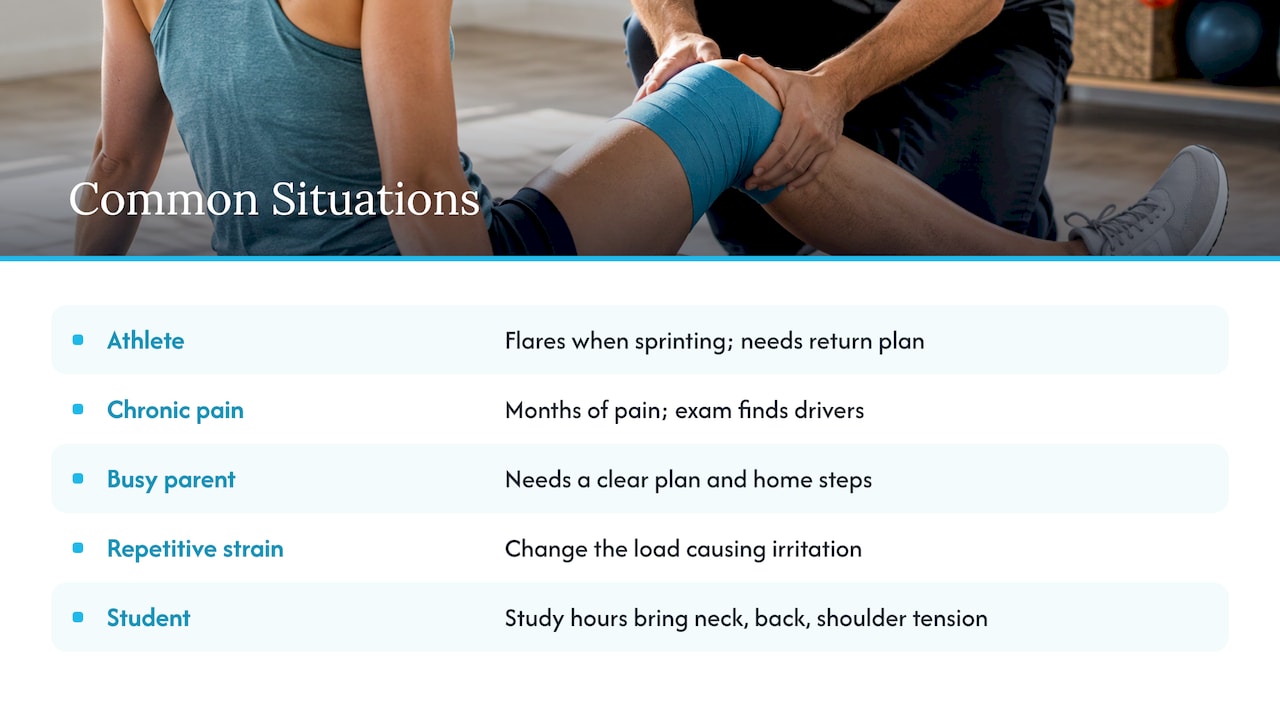
The athlete. A pulled calf or rolled ankle that gets better and then flares up the minute you sprint. You need treatment and a return plan, not just rest. Our guides to calf strain treatment and ankle sprain rehab show how recovery is staged.
The person with chronic pain. Pain that has been around for months usually involves more than one tissue and more than one habit. A hands-on exam helps find what is driving it.
The busy parent. You do not have time for a long, drawn-out process. Soft tissue problems from lifting, carrying and bending respond best to a clear plan with a defined number of visits and home steps you can actually do.
The worker with repetitive strain. The same motion all day irritates the same tissue. Treatment helps, and so does changing the load that caused it.
The student with posture pain. Neck, upper back and shoulder tension from long hours of studying is a soft tissue pattern as much as a posture one.
Timelines: what recovery really looks like
Healing is not one number. A mild bruise may settle in days. A ligament sprain moves through phases over weeks. Our ligament sprain recovery milestones break that into 1 to 2, 3 to 6 and 6 to 12 week stages, and our clinician-led 72 hour plan covers the first three days in more detail. Bigger structural injuries take longer: see why an ACL often needs 8 to 9 months in our return to sport timeline.
Two practical rules apply to all of them:
- Increase activity gradually. AAOS warns that stressing tissue too soon can create excess scar tissue.
- Track your training load. Tools that log workouts and rest days make it easier to see when soreness is normal and when you should hold back.
Perspective
Most people come to us after the same story: they rested, they iced, they waited, and the injury never fully let go. That is not a failure of RICE. RICE is the right start. It just is not built to resolve every injury.
What we see as a hands-on clinic is that soft tissue problems respond best when someone examines the tissue directly and treats what is found. That is why we use the Fascial Distortion Model, myotherapy, dry needling, laser and focused shockwave, and why each plan is built around the person in front of us instead of a template.
Our aim is to get you back to your sport, your job or your kids without the pain that has been following you around. If your injury has stalled, you do not need to keep waiting for it to change by itself.
Chris
Booking a visit in Plano
If your injury is past the first few days and not improving, or it keeps coming back, we can examine it and build a plan. The Tx Room is a specialized chiropractic center in Plano, Texas, and we accept self-pay and insurance. Learn more about our chiropractic and soft tissue care and book your first visit.
Bring a short history: when the injury happened, what you were doing, what you have already tried, and what you want to get back to. That tells us where to start.
FAQ
How long does a soft tissue injury take to heal?
It depends on the tissue and the severity. A mild bruise can settle within days, while sprains and strains typically move through stages over several weeks. If pain and swelling last beyond a few days, NIAMS recommends checking with a health care provider.
Should I use ice or heat?
Use ice first. NIAMS advises against heat right after an injury because it can increase swelling, and says heat can be used later, no sooner than 72 hours, for muscle tension.
Can I keep exercising with a soft tissue injury?
Stop the activity that caused the pain. Keep exercising the parts of your body that are not injured, then return to the injured area gradually as swelling decreases. If pain returns each time you load it, get it examined.
When should I see someone about a sprain, strain or bruise?
See a clinician for severe pain, swelling or bruising, an inability to bear weight, an obvious deformity, or pain and swelling that do not go away after a few days. An injury that never fully resolves or keeps coming back is also worth a hands-on assessment.
Does The Tx Room take insurance?
Yes, we accept both self-pay and insurance for chiropractic treatments. Contact the clinic through our site to ask about your plan before your first visit.
Sources
- Sprains, Strains & Other Soft-Tissue Injuries, OrthoInfo (AAOS)
- Muscle Contusion (Bruise), OrthoInfo (AAOS)
- Sports Injuries: Diagnosis, Treatment, and Steps to Take, NIAMS
- Ice First, Heat Later: A Safety First Sprain Plan With Skin Care
- Training with Muscle Soreness: When to Go Ahead and When to Rest