
Biomechanical Imbalance Treatment: How It’s Found and Fixed
A biomechanical imbalance is treated by finding the movement or alignment pattern that keeps overloading one tissue, then correcting that pattern with hands-on care, targeted exercise and changes to daily movement, not just by calming the sore spot. In Plano, we treat these cases at The Tx Room with hands-on soft tissue work built around the Fascial Distortion Model and individualized rehabilitation plans, so the pain relief comes with a plan for the cause.
TL;DR
- A biomechanical imbalance means some muscles and joints are doing too much while others do too little, so one tissue takes repeated stress it was not built for.
- Treating only the painful spot can leave the pattern in place, and pain can fade while the dysfunction stays and raises the chance of a repeat injury.
- A good assessment tests how you stand, move and load the joint, then checks whether correcting the movement changes your symptoms.
- Treatment combines manual therapy, exercise and correcting everyday movements. Daily habits matter as much as the sessions.
- New numbness, bowel or bladder changes, fever, unexplained weight loss or night pain need a medical evaluation first.
Table of Contents
- What a biomechanical imbalance actually is
- Why the sore spot is rarely the whole story
- Symptoms that point to a movement problem
- How a biomechanical imbalance is assessed
- What treatment looks like
- How long it takes
- What you do between visits matters most
- Promo: starting in Plano
- Perspective
- FAQ
- Sources
What a biomechanical imbalance actually is
Your body moves through chains of joints and muscles. When one link is stiff or weak, a neighboring link compensates. Do that thousands of times a week, running, lifting, typing or carrying a toddler, and a tissue that is fine on its own starts to hurt.
Researchers describe this in a few ways. One model, from a 2017 review of movement system impairment, says musculoskeletal conditions are associated with sustained alignment in a non-ideal position and repeated movements in a specific direction. Another, from a 2001 paper on functional stability, describes an imbalance between the muscles that stabilize a joint and those that move it. That imbalance produces direction-specific stress, and when the stress exceeds what the tissue tolerates, pain follows.
The terms overlap, so here is the practical difference:
- Muscle imbalance: a mismatch in length or strength between two opposing muscles, as a professional primary care article defines it.
- Biomechanical imbalance: the wider pattern, including muscles, joint motion, posture and the way you move, that overloads a structure.
- Biomechanical dysfunction: the same idea when the pattern is already producing symptoms or restricting movement.
You do not need to settle the vocabulary to get treated. You need someone to find your pattern.
Why the sore spot is rarely the whole story
The place that hurts is often where the load ends up, not where it starts. A 2022 review on muscle imbalance and injury explains kinetic chain theory: injuries can migrate from distant structures to nearby ones. Its examples include hip extensor weakness and hip flexor imbalance linked to low back pain in female athletes, and weak gluteus medius muscles in chronic low back pain.
The same review argues that treating only the downstream diagnosis, such as a tendinopathy, may not be wholly beneficial. A functional assessment during the exam, it says, can uncover the underlying biomechanics that set an athlete up for injury.
The 2001 functional stability paper adds a point that matters if you have had pain that “went away” and returned. Pain may resolve while the dysfunction persists, which increases the chance of recurrence and early degenerative change. It also describes “relative flexibility”: when tissue across one joint restricts motion, the body keeps functioning by moving more at the joint next to it.
Common patterns you may recognize
The 2022 review describes “upper crossed” syndrome: weak lower and middle trapezius, serratus anterior and rotator cuff muscles, with tight upper trapezius, pectorals and levator scapulae. It calls this a characteristic pattern in subacromial impingement, which accounts for 44 to 65% of shoulder complaints. If you work at a desk, study for hours or drive a lot, that rounded-shoulder pattern may look familiar. Our page on forward head posture covers the neck side of it.
The low back and hips have their own version. Tight hip flexors and weak glutes and abdominals form the lower crossed pattern, which we cover in our lower cross syndrome rehab plan. In the knee, the inward collapse of the knee during squats and landings is a movement pattern you can retrain, as we describe in our knee valgus correction plan.
Symptoms that point to a movement problem
A biomechanical imbalance has no single symptom. These patterns suggest it is worth looking beyond the sore spot:
- Pain that comes on gradually with repeated activity, such as running mileage, overhead lifting or long hours at a keyboard.
- Pain that moves around or returns after rest, or after you thought an injury had healed.
- One side that feels tighter, weaker or less coordinated than the other.
- Stiffness in one joint, with another joint (often the low back) complaining instead.
- Tendon, plantar fascia or hip pain that does not settle with rest.
Low back pain is the most common musculoskeletal complaint, with about 65 million years lived with disability worldwide each year according to the 2022 review. The hip handles forces of 1.5 to 5.0 times body weight depending on the movement, which is why small alignment errors add up. If your pain centers on the hip, see our guides on hip pain and chiropractic for hip pain.
How a biomechanical imbalance is assessed
A proper assessment is more than a pain map. It looks at how you move, which movements reproduce your symptoms and what happens when the movement is corrected.
Movement and alignment testing
The movement system impairment approach uses symptom-provoking alignment and movement tests, immediately followed by systematic correction. If your symptoms improve when the pattern is corrected, that suggests the impairment is tied to your pain. The completed exam then shapes the corrective exercises, the daily-activity changes and the education you receive.
Joint-specific tests
Specific joints have established test sets. For the sacroiliac joint, where the spine meets the pelvis, the American Academy of Family Physicians describes gait analysis, range of motion, strength, flexibility and palpation, plus neurologic screening. It reports that when at least three of five provocation tests are positive, sensitivity is 94% and specificity 78%.
For the hip, a 2023 clinical practice guideline from the American Physical Therapy Association’s orthopaedic and sports academies recommends objective, repeatable measures of hip pain, mobility, strength and movement coordination at baseline and at follow-up. It names performance tests such as the single-leg squat, the Star Excursion Balance Test, hop distance and single-leg sit-to-stand.
The point for you: ask what was measured at the first visit and how it will be re-measured. Progress you can see in numbers is easier to trust than “it feels a bit better.”
Ruling out what is not mechanical
A mechanical diagnosis only makes sense when serious causes are excluded. The AAFP lists red flags to rule out when low back pain is being sorted: a history of trauma, unexplained weight loss, fever, bowel and bladder changes, cancer and night pain. Its acute low back pain article adds that signs of cauda equina syndrome, a compression of the nerves at the base of the spine, need urgent evaluation. Those signs are progressive neurologic deficits, bowel or bladder dysfunction, bilateral sciatica or leg weakness, and numbness in the saddle area.
If you have any of these, go to an emergency department or your physician before booking any treatment.
What treatment looks like
Evidence-based care for movement problems is multimodal. No single technique fixes a pattern. The pieces are:
- Manual therapy to restore motion in tissue and joints that are restricting you.
- Targeted strengthening and lengthening of the specific muscles the assessment flagged.
- Movement and posture correction so the pattern does not simply reload the tissue.
- A plan for returning to your activity at a pace your tissue tolerates.
The research supports this combination. For sacroiliac dysfunction, the AAFP describes a multimodal program that combines manipulation with exercises to strengthen the pelvic girdle and lengthen tight muscles, with longer-term results than exercise alone. The 2023 hip guideline likewise recommends exercise for hip, trunk and lower-extremity muscles combined with manual therapy, postural and movement correction, stretching and balance work. For the front of the knee, care that targets the posterior hip and quadriceps works better than quadriceps exercises alone, and repetitive knee position and foot position are named among the risk factors.
Where hands-on care fits
This is where the manual part earns its place. A stiff, guarded or adhesive tissue limits the motion your exercises are trying to restore. Our approach is hands-on, built around the Fascial Distortion Model, and we design individualized plans for athletes and non-athletes alike. We see this as especially relevant when a case has not improved with standard medical or physical therapy approaches.
Depending on what your assessment points to, your plan may draw on:
- Fascial Distortion Model treatment for soft tissue injuries.
- Myofascial release and active release technique for restricted soft tissue.
- Muscle activation therapy to retrain the muscles that are not firing well.
- Dry needling, deep tissue laser therapy and focused shockwave for stubborn tissue.
- Chiropractic care for joints that are not moving well.
Not every person needs every tool. The assessment decides.
Which pattern, which reader
| If you are… | A common pattern | What the plan usually targets |
|---|---|---|
| A runner or field-sport athlete | Hip and glute weakness, knee collapse, foot overuse | Hip strength, landing and running mechanics, tissue restriction |
| A desk worker or student | Rounded shoulders, forward head, tight hip flexors | Upper back and deep neck muscles, hip mobility, workstation habits |
| A parent lifting and carrying all day | Low back and hip overload, one-sided carrying | Core and glute support, lifting mechanics, joint mobility |
| A worker with repetitive strain | Overused forearm, shoulder or neck tissue | Load management, tissue release, movement variety |
These are patterns, not diagnoses. Your own exam may show something different.
How long it takes
Time frames depend on the condition, but some benchmarks help. For acute low back pain, the AAFP reports that 30 to 60% of people recover in one week, 60 to 90% in six weeks and 95% in 12 weeks, with about 40% relapsing within six months. Absent red flags, it says four to six weeks of conservative care without imaging is safe and appropriate.
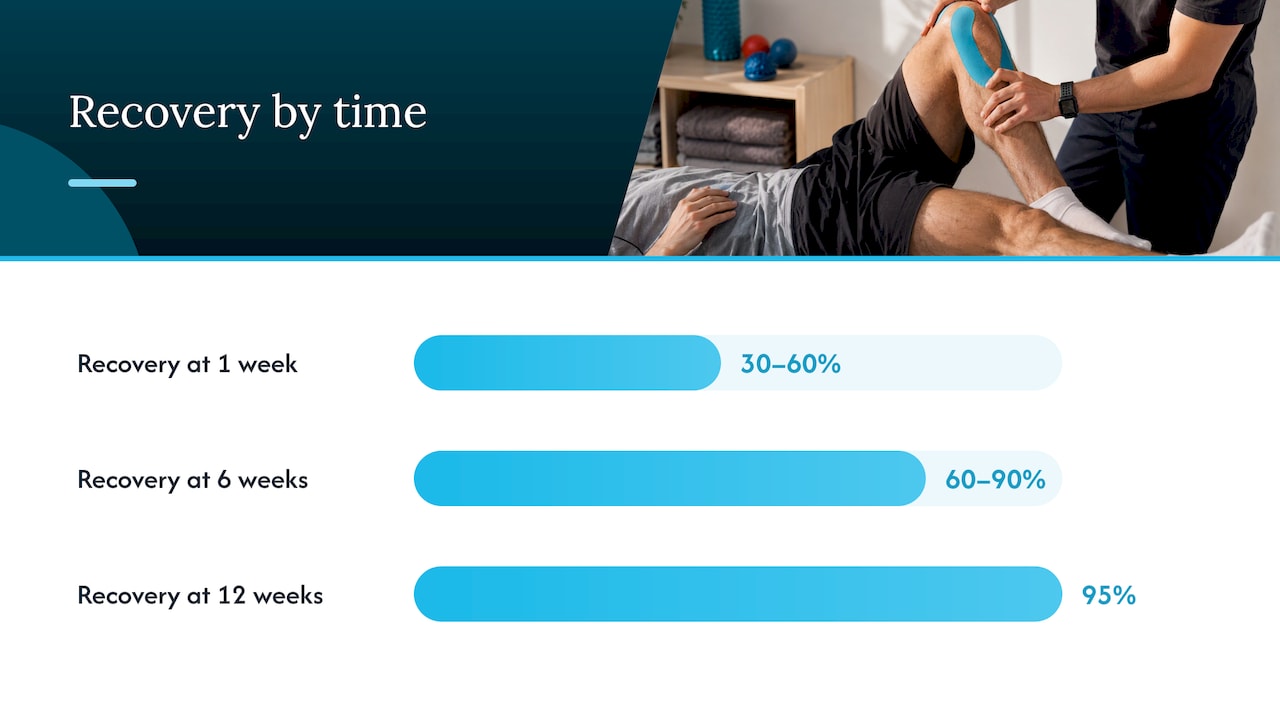
That relapse figure is the reason to treat the pattern and not only the episode. For longer-running shoulder problems, the AAFP says symptoms that persist or worsen after six to 12 weeks of directed treatment should go to an orthopedic specialist. It also notes that rehabilitation works best when the diagnosis is known and the patient takes part daily, and that gradual onset, long-lasting symptoms and severe pain at the start predict slower recovery.
A useful rule: expect a clear direction of improvement within the first few weeks of a well-matched plan, with measurements that change. If nothing moves, the plan or the diagnosis needs another look.
What you do between visits matters most
The movement system impairment review makes a point many people miss: the most important part of the program is learning to perform daily activities correctly and without symptoms. In people with low back pain, sticking with corrected daily activities was associated with more improvement in function and pain than sticking with exercise.
In practice, that means small, repeated changes:
- Change how you get out of a chair, pick things up and carry loads, so the load goes through the muscles meant to take it.
- Break up long sitting with short movement, and keep the same alignment cues you practiced in the clinic.
- Stand with weight even on both feet instead of resting on one hip.
- Warm up the muscles flagged in your assessment before sport, not just generally.
A short, regular routine beats an occasional long one. If you want a model for a brief daily posture routine, this daily posture plan shows how to build one around safety.
Promo: starting in Plano
If you have pain that keeps returning, a sports injury that will not settle or posture-related pain that follows you through the workday, a hands-on assessment of how you move is the place to start. At The Tx Room in Plano, we treat musculoskeletal injuries and biomechanical imbalances with the Fascial Distortion Model, myotherapy and individualized rehabilitation plans. We accept self-pay and insurance.

You can see what we treat and how to book on our main page, or read how the Fascial Distortion Model works before you come in.
Perspective
Most people come to us with a diagnosis name: tendinitis, plantar fasciitis, sciatica, a bad shoulder. The name is where the conversation starts, not where it ends. The better question is why that tissue is overloaded.
Our answer is built on hands-on work. We use the Fascial Distortion Model and myotherapy to find and release the soft tissue that is restricting motion, then build an individualized plan so the body can move the way it should. We believe this is why we do well with people whose problem did not respond to the usual medical or physical therapy routes.
Pain relief is the first milestone, not the last. The goal is that you return to your sport, your job or your kids without the same pattern loading the same spot again.
Chris
FAQ
What is a biomechanical imbalance?
It is a pattern where some muscles, joints or movements do too much while others do too little, so one tissue is repeatedly overloaded. It can come from sustained postures, repeated movements, past injuries or training habits. It often shows up as pain in a different place from where the problem started.
Can a biomechanical imbalance be corrected?
In many cases the pattern can be improved with a combination of manual therapy, targeted exercise and corrected daily movement. Research describes treatment that corrects the impaired alignment, movement patterns and related tissue changes. Your results depend on your diagnosis, how long the problem has been present and how consistently you apply the changes.
When should I see a doctor first?
See a physician or go to the emergency department if you have numbness in the groin or saddle area, loss of bowel or bladder control, progressive leg weakness, fever, unexplained weight loss, pain that wakes you at night, or pain after significant trauma. These are the red flags the AAFP lists for back pain. Mechanical treatment makes sense once they are ruled out.
Is a biomechanical imbalance the same as bad posture?
Posture is one part of it. An imbalance also includes how your joints move and which muscles you use to move them. Someone with good static posture can still load a knee or hip badly when running or lifting, which is why movement is tested as well as standing alignment.
Sources
- Diagnosis and treatment of movement system impairment syndromes (2017)
- Balancing Act: Muscle Imbalance Effects on Musculoskeletal Injury (2022)
- Functional stability re-training: principles and strategy (2001)
- Muscle balance and imbalance, National Primary Care article (2012)
- Sacroiliac Joint Dysfunction: Diagnosis and Treatment, AAFP (2022)
- Hip Pain and Movement Dysfunction Associated With Nonarthritic Hip Joint Pain, JOSPT (2023)
- Evaluation and Treatment of Acute Low Back Pain, AAFP (2007)
- Care of the Active Female, AAFP (2022)
- Chronic Shoulder Pain: Part II. Treatment, AAFP (2008)
- Daily 5–10 Minute Posture Plan for Osteoporosis: Safety First