
Manual Therapy for Sciatica: What It Is and When It Helps
Manual therapy for sciatica means skilled hands-on treatment of the joints, muscles and fascia around an irritated nerve, so the nerve has more room, the tissue around it moves better, and you can get back to walking, sitting and sleeping. It works best as part of a plan that also includes movement and exercise. At The Tx Room in Plano, Texas, we treat sciatica with hands-on methods including the Fascial Distortion Model, and we build the plan around what your exam finds. This guide explains the techniques, what the research says, and which symptoms mean you should see a doctor first.
TL;DR
- Manual therapy covers spinal manipulation, joint mobilization, soft tissue work and nerve mobilization, and each targets a different source of leg pain.
- U.S. and U.K. guidelines support hands-on care for low back pain with leg symptoms, paired with exercise rather than used alone.
- A trial of early physical therapy that included manual therapy found better disability scores at six months and one year than usual care.
- Sudden leg weakness, saddle numbness, or new bladder or bowel changes need emergency care, not a treatment visit.
- Sciatica that has not improved with standard medical or physical therapy is a good reason to book a hands-on evaluation in Plano.
Table of Contents
- What manual therapy for sciatica involves
- Techniques and how they differ
- What the research says
- Manual therapy plus exercise: why the combination wins
- What a first visit looks like
- When to see a doctor before manual therapy
- Why patients in Plano choose us for sciatica
- Our perspective
- FAQ
- Sources
What manual therapy for sciatica involves
Sciatica is leg pain that follows the sciatic nerve, usually from the low back through the buttock and down the back of the leg. Mayo Clinic notes that some people also have numbness, tingling or muscle weakness in the leg or foot. The nerve itself is rarely the whole story. The pain often comes from a combination of a sensitive nerve root, tight muscles such as the piriformis or hamstrings, stiff joints in the low back or pelvis, and restricted fascia that limits how the nerve slides.
Manual therapy goes after those contributors with the practitioner’s hands or a hands-on tool. The main categories are:
- Spinal manipulation: a quick, controlled thrust to a spinal joint, which chiropractors perform daily.
- Joint mobilization: slower, rhythmic movements that restore motion without a thrust.
- Soft tissue techniques: massage, myofascial release and trigger point work on the muscles and fascia that squeeze or tug on the nerve.
- Neural mobilization: movements that help the nerve glide through the tissues around it.
The American College of Physicians 2017 guideline recommends that patients with acute or subacute low back pain, including associated leg symptoms, start with nonpharmacologic options such as heat, massage, acupuncture or spinal manipulation. That puts hands-on care among the first things to try, not a last resort.
Techniques and how they differ
Not every technique suits every sciatica pattern. The right choice depends on where your pain comes from and how irritable the nerve is on the day you come in.
Spinal manipulation and mobilization
These techniques aim at the joints of the lumbar spine and pelvis. A 2024 systematic review of 16 randomized trials in the Brazilian Journal of Physical Therapy found that spinal manipulative therapy was more effective than conventional physical therapy for leg pain, and that for chronic sciatica it performed similarly to microdiscectomy surgery in the short, medium and long term. Manipulation and mobilization are different ways of moving a joint, and a 2020 trial comparing two manual techniques in people with a herniated disc and radiculopathy found both groups improved significantly over 4 and 8 weeks. The practical lesson: skilled hands matter more than a single named method, and a good clinician moves between techniques as your symptoms change.
Soft tissue work and fascial techniques
When a tight piriformis, glute or hamstring is irritating the nerve, soft tissue work is often the quickest way to change how the leg feels. At The Tx Room we use the Fascial Distortion Model, a hands-on approach to soft tissue injuries, along with myofascial release. If you suspect the piriformis is involved, our page on piriformis syndrome treatment walks through what works and when.
Neural mobilization
A 2023 systematic review describes neural mobilization as a manual technique that lengthens a nerve at one joint while shortening it at an adjacent joint, with the aim of helping the nerve move smoothly. It includes slider and tensioner techniques and can reduce mechanical sensitivity of the nerve. A clinician guides these in the office, and you can learn gentle versions for home. Our guide to nerve flossing glides for sciatica covers the safety side.
Needling, shockwave and laser
Some patients need more than hands alone for stubborn muscle knots. We offer dry needling, focused shockwave through MyACT and deep tissue laser therapy as additional tools alongside manual care, chosen after an exam.
What the research says
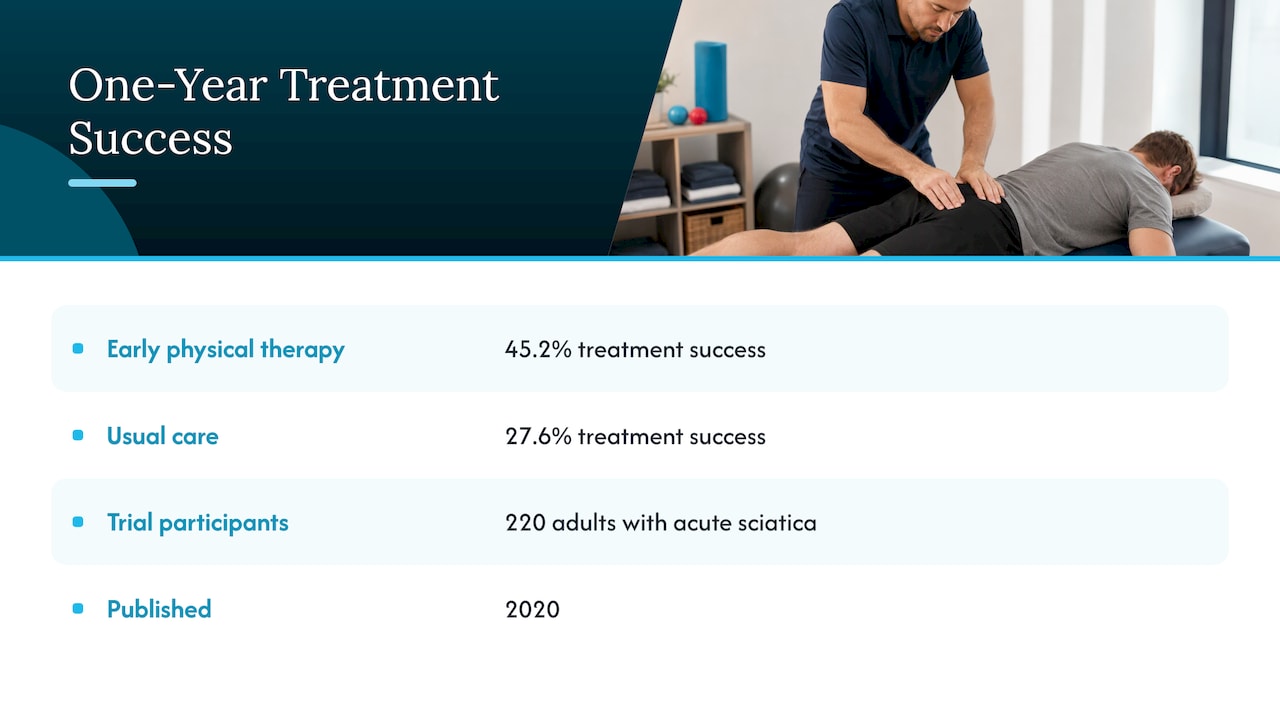
The strongest U.S. evidence for hands-on care in sciatica comes from a randomized trial led by Dr. Julie Fritz and published in Annals of Internal Medicine in 2020. It followed 220 adults with acute sciatica in Salt Lake City. One group received early physical therapy: six to eight sessions over four weeks that combined exercise with manual therapy, which could include mobilization or manipulation of the lumbar spine. The other group received usual care.
The early therapy group had better Oswestry Disability Index scores at six months and at one year, and 45.2% of them reported treatment success at one year, compared with 27.6% of the usual care group. The authors concluded that early physical therapy can be offered as first-line nonpharmacologic care for recent-onset sciatica.
That result mirrors what guidelines say. The U.K.’s NICE guideline, amended in 2026, recommends considering manual therapy such as spinal manipulation, mobilization or soft tissue techniques for low back pain with or without sciatica, as part of a package that includes exercise. A Danish-guideline review of the evidence also suggests clinicians could consider spinal manipulation alongside usual treatment for recent-onset sciatica.
What this means for you
The pattern across these sources is consistent: hands-on care helps most when it starts early, when it is matched to the person, and when it comes with a movement plan. If you have waited months and standard approaches have not worked, that is the situation we built our approach for.
Manual therapy plus exercise: why the combination wins
In the Fritz trial, the protocol used 2 sessions a week for the first two weeks, then 1 to 2 sessions a week in weeks three and four. Participants also got written directions and did their assigned exercises at home every 4 to 5 hours on the days between visits. The hands-on work opened the door and the exercise kept it open.
That is the structure we favor. The visit does the work you cannot do on yourself: releasing restricted tissue, restoring joint motion, calming a sensitive area. The home program then keeps the gains between visits. Useful starting points are our pages on sciatica stretches, bed moves and nerve glides and sciatica at night, which cover the flare-ups that wreck sleep. Living with long-lasting pain also wears on mood and energy, and online therapy for chronic pain is one support some people add alongside physical treatment.

How many visits to expect
There is no universal number. The trial above used six to eight visits over four weeks for recent-onset sciatica. Your plan depends on how long you have had symptoms, what your exam finds and how you respond. We set a plan after the first examination and adjust it as you improve. We accept insurance and self-pay, so ask the front desk about coverage when you book.
What a first visit looks like
A visit for sciatica starts with a conversation and an exam, not a treatment table rush. Expect questions about when the pain began, what makes it worse (sitting, bending, coughing), and whether you have numbness or weakness. The exam looks at how your spine, hips and legs move, which tissues are tender or restricted, and how your nerve responds to specific positions.
From there, the plan is individualized. A runner with a tight hamstring and hip, a parent with a herniated disc pattern, an office worker with a locked-up piriformis and a student with poor posture can all have leg pain called sciatica, and they will not all receive the same treatment. Our pages on herniated discs and bulging discs explain how we think about disc-related leg pain, and our sciatica page outlines the care we offer in Plano.
Possible side effects
Hands-on care can leave you sore for a day or so, much like after a workout. In the Fritz trial, about one third of patients reported side effects from the physical therapy program, and they were transient and mostly mild or moderate. A broader review of 47 trials covering 9,211 participants concluded that most adverse events from spinal manipulation were musculoskeletal, transient and of mild to moderate severity. Tell your clinician how you felt after each visit so the next one can be adjusted.
When to see a doctor before manual therapy
Most sciatica improves with conservative care, but a small number of cases are emergencies. Go to an emergency room or call 911 if you have:
- New loss of bladder or bowel control, or trouble urinating
- Numbness in the groin, genitals or inner thighs (saddle area)
- Leg weakness that is severe or getting worse quickly, or numbness spreading in both legs
These can signal cauda equina syndrome, a rare condition in which the nerve roots at the lower end of the spinal canal are compressed. The American Academy of Orthopaedic Surgeons describes it as a rare disorder that needs urgent attention, and Mayo Clinic advises seeing a doctor for pain that is severe, follows a violent injury such as a car accident, or comes with significant weakness or bladder and bowel changes.
See your physician promptly too if you have a fever with back pain, unexplained weight loss, a history of cancer, or sciatica after significant trauma. If you are pregnant, read our guide to pregnancy sciatica relief and tell your obstetrician about leg pain that is sudden or one-sided with swelling.
Why patients in Plano choose us for sciatica
Our focus is hands-on, results-driven manual therapy for musculoskeletal injuries and biomechanical imbalances. We use the Fascial Distortion Model, myotherapy and individualized rehabilitation plans, and many of our patients come to us after standard medical or physical therapy approaches did not resolve their problem. Testimonials from our patients highlight sciatica and plantar fasciitis among the conditions we have helped resolve.
If your leg pain is limiting work, parenting, training or sleep, a hands-on evaluation is a practical next step. Book an appointment with The Tx Room and we will examine the full chain from your low back to your foot, then explain what we find and how we would treat it.
You can also learn about the specific tools we use, including shockwave treatment for active patients and active release treatment.
Our perspective
Sciatica is a symptom, and treating the symptom alone is why so many people keep coming back to the same pain. When someone walks in with leg pain, we want to know which tissue is actually pulling on or pinching that nerve.
That is why we lean on hands-on work. Fascial restrictions, tight muscles and stiff joints leave a pattern you can feel with your hands, and the Fascial Distortion Model gives us a way to treat soft tissue injuries directly. Dry needling, shockwave and laser are there when a stubborn spot needs more.
Then we hand you a plan: what to do between visits, what to avoid, and what progress should look like. Our job is to get you back to your life, whether that is a long run, a day of lifting kids or a full night of sleep.
Chris
FAQ
Is manual therapy good for sciatica?
Guidelines support it as part of a treatment package. NICE recommends considering manual therapy for low back pain with or without sciatica alongside exercise, and the American College of Physicians lists massage and spinal manipulation among first options for acute and subacute low back pain. A trial of early physical therapy that included manual therapy also showed better disability outcomes than usual care.
How long does it take for manual therapy to relieve sciatica?
It varies with how long you have had symptoms and what is causing them. In the Fritz trial, patients attended six to eight sessions over four weeks, and the difference in disability was clearest at the four-week mark. Your clinician should give you a timeline after your exam and review it as you progress.
Is spinal manipulation safe for sciatica?
For most people, yes, when performed by a trained clinician after an exam. Reported side effects are mostly short-lived soreness that is mild to moderate. Emergency signs such as loss of bladder or bowel control, saddle numbness or rapidly worsening leg weakness require immediate medical care instead.
Should I stretch or get hands-on treatment first?
Gentle movement helps most people, and hands-on treatment can make movement easier by reducing tightness and nerve irritation. If pain is severe, keeps you up at night or has lasted weeks, a hands-on evaluation in Plano can show which stretches fit your case. Our page on stretching and what it can and cannot do explains more.
Sources
- Mayo Clinic: Sciatica symptoms and causes
- American College of Physicians 2017 low back pain guideline
- Bastos et al., spinal manipulative therapy for sciatica, Brazilian Journal of Physical Therapy
- Comparative effectiveness of 2 manual therapy techniques, randomized trial
- Neural mobilization for reducing pain and disability, systematic review
- Fritz et al., physical therapy referral for acute back pain with sciatica, Annals of Internal Medicine
- NICE guideline NG59: low back pain and sciatica in over 16s
- Physiotherapy management of sciatica, topical review
- AAOS OrthoInfo: Cauda equina syndrome