
Scoliosis Pain Management: What Helps and When to Get Help
Scoliosis pain is best managed by finding out where it is coming from and then combining movement, strengthening and hands-on care that fit that source. The size of your curve does not reliably predict how much it hurts. A 2023 peer-reviewed review found no reliable direct link between curve magnitude and back-pain intensity. At The Tx Room in Plano, we treat musculoskeletal pain with hands-on care, including the Fascial Distortion Model, and build individualized plans around the tissues that are actually painful.
TL;DR
- Pain in scoliosis usually comes from joints, muscles, nerves or the sacroiliac area, not simply from the curve’s angle.
- Physical therapy, core and back strengthening, and low-impact cardio are the most consistently recommended starting points for adults.
- Heat, ice and over-the-counter medicine can calm flare-ups if used with the safety limits below.
- Exercise, yoga, Pilates and chiropractic care may ease pain, but none has been shown to reduce a curve. Keep your spine specialist in the loop.
- Pain in a child, or pain that does not settle in a couple of weeks, needs a medical evaluation.
Table of Contents
- Why scoliosis hurts
- Adults, teens and kids: different questions
- Movement and strengthening
- Heat, ice and medicine for flare-ups
- Where hands-on care fits
- A simple week-by-week approach
- When to get checked
- Perspective
- Start with an exam in Plano
- FAQ
- Sources
Why scoliosis hurts
Many people assume a bigger curve means more pain. The research says otherwise. A 2026 review of scoliosis-related low back pain lists plausible pain sources: irritated facet joints (the small joints at the back of the spine), vertebral endplate pain, nerve compression where nerves exit the spine, a forward-or-backward imbalance that overloads the muscles along the spine, and sacroiliac joint overload. It also stresses that imaging alone cannot show which of these is the pain generator. Your history, a hands-on examination and imaging have to be read together.
For you, this means two people with the same X-ray can need very different plans. One has tight, overworked muscles on the long side of the curve. Another has a stiff, irritated joint. A third has a pinched nerve. Treating all three with the same stretch routine misses.
If your back pain has lasted and you also feel stiffness in the upper back, our guide to thoracic spine stiffness walks through common causes. For general patterns, see back pain causes and options.
Adults, teens and kids: different questions
The approach changes with age.
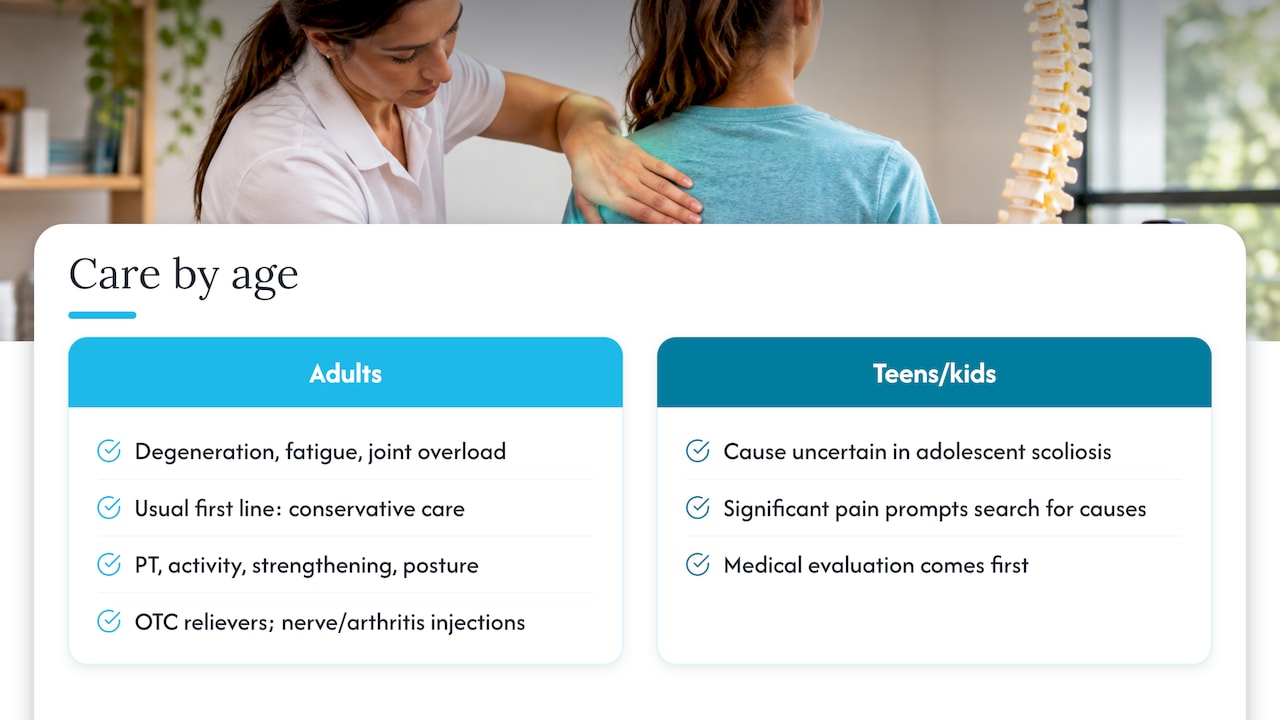
Adults. Pain often comes from degenerative changes, muscle fatigue and joint overload. Conservative care is the usual first line. Mass General Brigham lists physical therapy, activity changes, abdominal and back strengthening, posture work, over-the-counter pain relievers and, for nerve or arthritis pain, injections.
Teens and children. Back pain is common in adolescents generally, and a 2023 review reports that causation in adolescent idiopathic scoliosis is uncertain. The 2023 review above adds that significant pain in a child with apparently typical scoliosis should prompt a search for other causes. That makes a medical evaluation the first step, not a trial of home remedies.
Movement and strengthening
The most consistent advice across major U.S. centers is to keep moving and to strengthen the muscles that support the spine.
- Mayo Clinic says most people with scoliosis do not need activity restrictions, and that physical therapy may strengthen the back, ease pain and improve posture.
- NYU Langone describes a daily routine strengthening the abdominal, thigh, buttock and back muscles, with swimming and cycling as low-impact cardio. Its clinicians may recommend six to eight weeks of physical therapy.
- A 2025 narrative review of nonoperative adult spinal deformity reported that physiotherapy and multidisciplinary rehabilitation reduced pain and disability in the included studies.
Strength work is not just for gym people. Swimming, cycling and a steady core routine suit parents with little time and students who sit all day. If you are building a strength base, exercise guidance for bone health covers similar safe loading principles for the back, thighs and glutes.
What exercise will and will not do
Be clear about the goal. The American Academy of Orthopaedic Surgeons (AAOS) says physical therapy and a home program can help scoliosis-related back pain, but that scoliosis-specific exercises have only low-quality evidence for stopping a curve from worsening. A 2023 meta-analysis summarized by the Chartered Society of Physiotherapy found a small curve-angle difference of 2.82 degrees, in children and adolescents only. Treat exercise as a pain and function tool. That is a worthwhile goal on its own.
Heat, ice and medicine for flare-ups
These are short-term tools for a bad day.
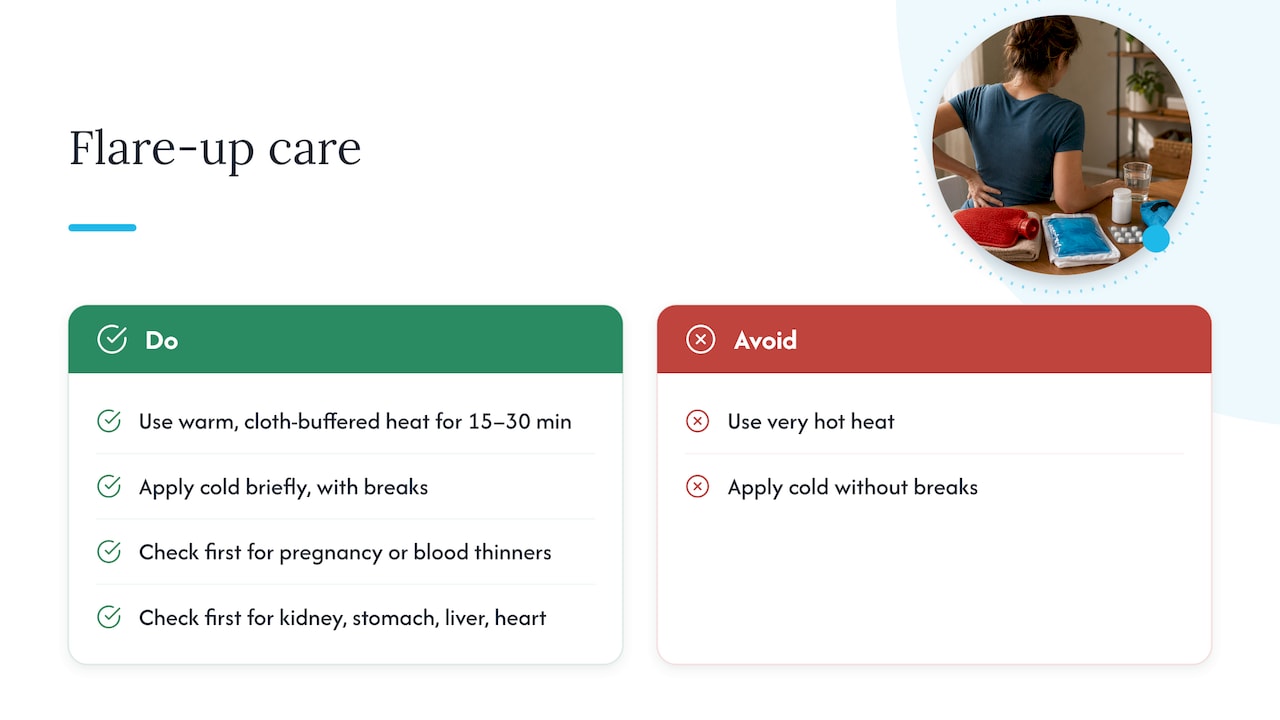
Heat. Pharmacist guidance from the International Pharmaceutical Federation says heat should be warm, not very hot, generally limited to 15 to 30 minutes, with a cloth between the heat source and your skin. People with diabetes or reduced skin sensation need extra care to avoid burns.
Ice. The same guidance says cold should be brief, with breaks, to avoid skin or nerve injury.
Medicine. NYU Langone says adults may use acetaminophen or ibuprofen for moderate back or neck pain, and a physician may prescribe something stronger for a short time after an unusually strenuous flare. Check with your doctor or pharmacist if you have kidney, stomach, liver or heart conditions, take blood thinners, or are pregnant, before using any of these.
Where hands-on care fits
Once you know which tissue is hurting, hands-on work can reduce pain and restore movement so exercise becomes easier. AAOS says yoga and Pilates may improve back pain, and that acupuncture or chiropractic care may help some people. It also says none of them has been shown to reduce or prevent curve progression, and it advises people using chiropractic care to keep being monitored by a spine specialist. We agree with that framing: we aim at pain and function, and your curve is followed by your orthopedic or neurosurgical specialist.
Here is how that looks in our Plano clinic:
- Examination first. We look at how you move, where the muscle and fascial restrictions sit, and how your joints respond, then choose techniques accordingly.
- Fascial Distortion Model (FDM). FDM is a hands-on approach to soft tissue injuries. It suits the muscle and fascia tightness that builds up around a curve.
- Targeted soft tissue options. Depending on what we find, care can include dry needling, focused shockwave or deep tissue laser therapy.
- Home plan. We pair treatment with strengthening so relief lasts. Our page on chiropractors and scoliosis and our scoliosis overview explain more.
This matters for different readers in different ways. An athlete wants to get back to training without guarding one side. A worker with repetitive strain needs the overloaded muscles settled. A student with a slouch needs posture work that does not flare the upper back. Our swayback posture guide and facet joint roadmap cover two common companions of curve pain.
A simple week-by-week approach
Use this as a framework to discuss with your clinician, not a prescription.
| Timeframe | Focus | Notes |
|---|---|---|
| Week 1 | Calm the flare | Warm (not hot) packs for 15 to 30 minutes with a cloth barrier; keep walking; short breaks from long sitting |
| Weeks 2 to 3 | Find the source | Book an exam if pain has not eased; bring any past imaging |
| Weeks 3 to 8 | Build support | Core, glute and back strengthening; swimming or cycling; hands-on care to ease restricted tissue |
| Ongoing | Maintain | Short daily routine, posture habits, periodic spine specialist follow-up |
The six-to-eight-week window echoes the physical therapy course NYU Langone describes.
When to get checked
Rush advises adults to contact a primary-care doctor when back pain is not relieved by rest, ice, heat or over-the-counter medicine within a couple of weeks. Mass General Brigham adds that pain interfering with sitting, walking or stairs is a reason to call your care team. Children with suspected scoliosis should be assessed by a healthcare professional, and Mayo Clinic notes referral to a pediatric orthopedic surgeon may follow. Seek urgent care for new leg weakness, numbness in the groin area, loss of bladder or bowel control, or fever with back pain.
Perspective
Most people come to us after months of being told to stretch and wait. Scoliosis pain is rarely about the angle. It is about which tissues are overloaded, stuck or irritated, and that is something hands-on assessment can find.
We built our approach on the Fascial Distortion Model and individualized plans, with a focus on cases that have not improved with standard medical or physical therapy. We pair that with strengthening, because relief you can keep needs a stronger base.
Your spine specialist follows the curve. We work on the pain and movement around it.
Chris
Start with an exam in Plano
If scoliosis pain is limiting your training, work, parenting or studies, we can examine you and build a plan around what is driving it. Learn about our chiropractic and soft tissue care and book a visit.
FAQ
Does a bigger curve mean more pain?
Not reliably. A 2023 review found no consistent direct relationship between curve size and back-pain intensity. Pain more often reflects joint, muscle or nerve involvement, which is why an exam matters more than the angle alone.
Can chiropractic care help scoliosis pain?
AAOS says chiropractic care may help some people with back pain but has not been shown to reduce or prevent curve progression. We focus on pain and function and encourage you to keep regular monitoring with your spine specialist.
Is exercise safe with scoliosis?
Mayo Clinic says most people with scoliosis do not need activity restrictions. Swimming, cycling and core strengthening are common choices. Have a provider review your program first if you have significant pain or nerve symptoms.
How long should I wait before seeing someone?
If rest, heat, ice and over-the-counter medicine have not helped within a couple of weeks, get evaluated. Do not wait if a child has pain or you notice weakness or numbness.
Sources
- Is scoliosis a source of pain? (2023)
- Imaging and Management of Scoliosis-Related Low Back Pain (2026)
- Back pain in adolescent idiopathic scoliosis (2023)
- Adult Scoliosis Management, Mass General Brigham
- Nonoperative Treatment of Adult Spinal Deformity (2025)
- Scoliosis diagnosis and treatment, Mayo Clinic
- Nonsurgical Treatment Options for Scoliosis, OrthoInfo
- Medical Treatment for Scoliosis and Kyphosis, NYU Langone
- Physiotherapeutic scoliosis-specific exercise review, CSP
- Using heat therapy for musculoskeletal pain, FIP
- Scoliosis Signs and Symptoms, Rush