
Swayback Posture: Signs, Causes and What Actually Helps
Swayback posture is a standing pattern in which your hips drift forward of your ankles, your pelvis tilts, your upper body leans back and your lower back curve looks exaggerated. It is common, it is usually fixable with a mix of strength, mobility and better movement habits, and it is not automatically the reason your back hurts. This guide shows you how to recognize it, how it differs from anterior pelvic tilt and lordosis, what drives it, and when hands-on care makes sense.
TL;DR
- Swayback means the pelvis shifts forward, the rib cage leans back and the lower back curve looks deeper. Anterior pelvic tilt is a related but different pattern.
- The usual drivers are tight hip flexors, weak abdominals and glutes, long sitting, and loose-feeling hips and lower back. Sometimes it is simply how you have learned to stand.
- Posture alone has not been shown to be a sole cause of back pain, so the goal is comfortable, capable movement, not a perfect textbook line.
- Structured exercise is the first-line approach. Hands-on soft tissue work can help you move well enough to do that exercise.
- Numbness in the groin or saddle area, loss of bladder or bowel control, or marked leg weakness needs emergency care, not a posture program.
Table of Contents
- What swayback posture looks like
- Swayback vs. anterior pelvic tilt
- What causes swayback posture
- Does swayback cause back pain?
- How to fix swayback posture
- Where hands-on care fits
- Our perspective on swayback
- When swayback needs a closer look
- Getting help in Plano
- FAQ
- Sources
What swayback posture looks like
Stand sideways to a full-length mirror, or have someone take a photo of you in relaxed standing. Swayback tends to show up as a few things together:
- Your hips sit forward of your ankles.
- Your pelvis looks tilted and your belly pushes forward.
- Your rib cage and upper body lean backward to balance the forward hips.
- Your lower back curve looks deeper than it should, and the buttocks may look more prominent.
Healthline describes it as a posture with exaggerated spinal curves, forward-tilting hips and the look of leaning back when standing. A review of non-structural posture variations lists sway-back as one of four common sagittal-plane patterns, alongside lordotic, kyphotic and flat-back postures.
One helpful way to think of it: the body is balancing itself in space. If the pelvis moves forward, something else has to move backward to keep your center of mass over your feet. That something is usually the rib cage.
Is swayback the same as lordosis?
Not quite. Lordosis is the inward curve of the lumbar spine, and a small degree is normal. MedlinePlus notes that too much curving is called swayback. So swayback is one way an excessive lumbar curve can show up, but the full pattern also includes where the pelvis and rib cage sit.
It is also not scoliosis. Scoliosis is a sideways curve of the spine. Swayback is a front-to-back pattern you see from the side.
Swayback vs. anterior pelvic tilt
People search these two terms together because they look similar and often overlap. The difference is in what the pelvis is doing.
| Swayback | Anterior pelvic tilt | |
|---|---|---|
| Main feature | Whole pelvis shifts forward relative to head and thorax | Front of the pelvis rotates downward |
| Rib cage | Leans backward to compensate | Often unchanged or slightly flared |
| Hip muscles | Gluteals can sit in a shortened state, which may limit hip flexion and internal rotation | Hip flexors typically tight, glutes and abs weak |
| Typical look | Hips ahead of ankles, upper body leaning back | Belly forward, buttocks prominent, deeper arch |
The distinction comes from the posture review above, which describes swayback as an anterior shift of the entire pelvis, while anterior pelvic tilt is mainly a rotation. Banner Health also notes that anterior pelvic tilt creates a lower back curve similar to swayback, which is why the two get confused.
In real life you can have both. If your main issue looks like a forward-rotated pelvis, our page on anterior pelvic tilt goes through it in more detail.
What causes swayback posture
There is rarely one cause. These are the contributors we see most often described, and they stack on top of each other.
Tight hip flexors and hamstrings. Muscles that are short and stiff pull the pelvis out of position. Healthline lists tight hamstrings, a weak core and ligament laxity in the back and pelvis among the common causes.
Weak abdominals and glutes. When the muscles that should hold your trunk over your pelvis are underworking, you lean on passive structures instead: joints and ligaments. Hanging on your hips is the classic lazy standing position.
Long sitting and low activity. A sedentary day teaches the hips to be stiff in front and the trunk to be unsupported. Students at desks, office workers and drivers all fall into this.
Pregnancy, weight changes and recovery periods. The body changes its center of mass, and posture adapts. This is normal, but it can linger.
Habit. Many people simply stand this way because they always have. Leaning back and letting the hips drift forward feels relaxed.
The pattern of tight hip flexors, weak abs and glutes, and compensating back muscles is also called lower crossed syndrome. We cover it in our guide to lower cross syndrome treatment.
Does swayback cause back pain?
Here is the honest answer: maybe, but less often than the internet suggests.
A systematic review of systematic reviews found no consensus that spine postures cause low back pain. A paper on spinal posture assessment makes a similar point: postural alignment is not perfectly symmetrical, and small differences can be normal variation. Posture assessment is useful for spotting risk factors and planning follow-up, not for chasing a perfect line.
What this means for you:
- If you have swayback and no pain, you do not need to panic or overcorrect.
- If you have swayback and your back aches after standing, running or lifting, the pattern may be contributing because it loads certain tissues repeatedly and limits how you move.
- The real target is function: can you stand, walk, squat, hinge and train without pain or stiffness holding you back?
How to fix swayback posture
Skip the quick fixes
Pulling your shoulders back hard or tucking your pelvis under all day feels like correction, but it is often just another form of tension. Healthline notes that forcing posture can backfire when the underlying issue is weakness, and that excessive bracing can contribute to deconditioning of the muscles along the spine. A more useful cue is to stack the rib cage over the pelvis without forcing either one.
Build a base with exercise
Exercise is the first-line approach. A 2025 systematic review and meta-analysis of six exercise interventions for low back pain proposed optimal dosing, finding that sessions of 30 minutes or less, performed more than four times per week, were most effective. A review on adult spinal deformity also supports conservative, exercise-based care as a first step, even in more complex cases. Swayback is far milder than those conditions, so the same principle applies with room to spare.
A simple weekly structure:
- Lengthen what is tight. Hip flexor stretches in a half-kneeling position, hamstring work, and gentle back extensor mobility. Hold 30 to 60 seconds, a few rounds each.
- Wake up what is weak. Dead bugs, side planks, glute bridges and hip thrusts. Aim for slow, controlled reps, not heavy loads at first.
- Practice stacking. Stand with feet hip-width apart, ribs over pelvis, weight evenly through the whole foot, not locked into your heels. Check in a mirror, then forget the mirror and check by feel.
- Move often. Break up sitting every 30 to 45 minutes. Banner Health also recommends regular breaks, general activity and a healthy body weight to reduce strain on the spine.
- Track at 6 to 8 weeks. Take a side photo at the start and again later. Look at how your hips, ribs and back feel too, not only the picture.
Our 8-week lower cross rehab guide lays out a longer progression, and these four hip-opening movements are a gentle starting point if your hips feel locked.
Check how you squat and hinge
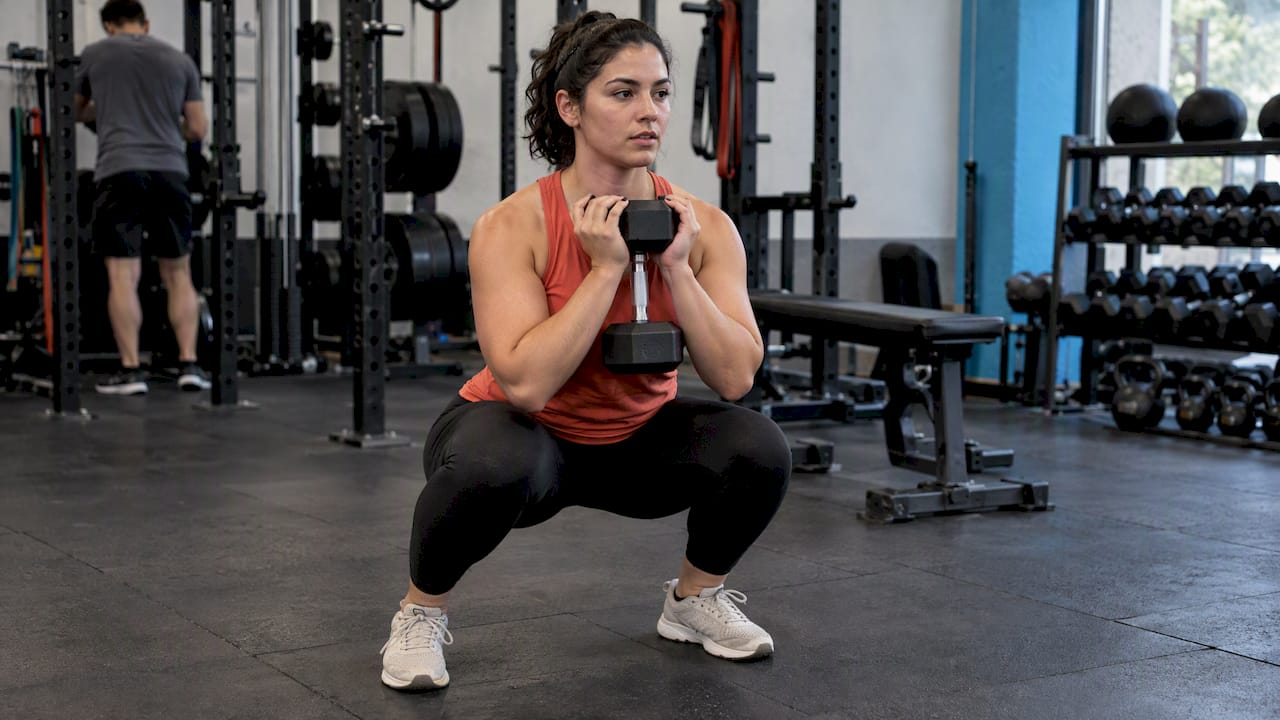
Swayback carries into the gym. If your hips shift or your knees drift when you squat, the same pattern may be showing up under load. Our walk-through on hip shift in the squat shows how to assess before you fix.
Where hands-on care fits
Manual therapy does not bend your skeleton into a new shape. The research on spinal mobilization points to neurophysiological effects, meaning it reduces pain sensitivity and can make movement feel easier. That is exactly why it works best when it opens the door to active rehab instead of replacing it.
In swayback, hands-on work is most useful when:
- Your hip flexors, quads or lower back are so tight or sore that you cannot get into good positions to exercise.
- You have tried a home program for several weeks and it has stalled.
- You have a specific tender area, like a knot in the lower back or a pinching feeling at the front of the hip, that keeps flaring up.
- You are an athlete or active person and the pattern is affecting training.
Types of hands-on approaches include soft tissue work, myofascial release, muscle activation therapy and active release treatment. Each aims at a different part of the same problem: tissue that is stiff, muscles that are not firing, or movement that has become guarded.
Our perspective on swayback
We see a lot of people who arrive believing their posture is “wrong” and needs to be corrected. Our view is different. Posture is a snapshot of how your body has adapted, and it becomes a problem when it stops you from moving comfortably or doing what you love.
That is why we do not start with a plumb line and a lecture. We start with how you move: how you stand, squat, walk, hinge and load. We look at which tissues are overworking and which are not contributing. At The Tx Room we use the Fascial Distortion Model, a hands-on approach to soft tissue injuries, alongside rehabilitation tailored to the person in front of us. Our focus is on cases where standard approaches have not moved the needle, and on getting active people back to their routines.
We also tell people when the answer is mostly exercise. A hands-on session can free up a stubborn hip or back, but the strength and habit changes are what make it last. If you can improve with a good home program, we would rather you do that. If you are stuck, that is when we step in.
— Chris
When swayback needs a closer look
Most swayback is a movement pattern, not a disease. But back pain with certain features needs prompt attention. According to AAOS OrthoInfo on lumbar spinal stenosis, numbness in the groin or saddle area, loss of bladder or bowel control, or significant leg weakness are signs that need emergency evaluation. Go to an emergency department if these appear.
See a physician or a spine-focused clinician soon if you have:
- Severe, persistent lower back pain that does not ease with rest or position changes.
- Pain shooting down a leg, numbness or tingling that is spreading.
- A sense of slipping or catching in the lower back. Vertebral slippage (spondylolisthesis) can look like a deeper arch and needs proper assessment. Our conservative rehab roadmap for spondylolisthesis explains what that process looks like.
If you are pregnant, posture changes are expected, and care should be adapted. See our page on chiropractic care for pregnancy.
Getting help in Plano
If you live or work in Plano and your posture pattern comes with ongoing pain, stiffness or a plateau in training, we can assess how you move and build a plan around it. Our services include chiropractic care, soft tissue therapy, the Fascial Distortion Model, dry needling and MyACT focused shockwave. We accept both self-pay and insurance. You can book as a new patient or start from our main page.
Swayback often travels with other posture patterns. If you also notice your head or shoulders drifting forward, see our guides on forward head posture and rounded shoulders.
FAQ
How do you get rid of a swayback?
For most people, it means lengthening tight hip flexors and hamstrings, strengthening the abdominals and glutes, and practicing a stacked standing position. Aim for short sessions of about 30 minutes or less, more than four days a week, which is what a 2025 meta-analysis found most effective for low back pain. Expect to judge progress over weeks, not days.
What is the difference between swayback and lordosis?
Lordosis is the inward curve of your lower spine, and some of it is normal. Swayback is the pattern in which that curve is exaggerated and the hips shift forward while the upper body leans back. In practice, a deep lordosis is part of what you see in swayback.
Is swayback the same as anterior pelvic tilt?
No, though they overlap. Anterior pelvic tilt is mainly the pelvis rotating forward and down, while swayback involves the whole pelvis shifting forward with the rib cage leaning back. A side-view assessment from a clinician can tell which one you have, or whether it is both.
Is swayback a disease or a sign of something serious?
Usually it is neither. It is a posture pattern. Conditions like spondylolisthesis can mimic or worsen a deep lumbar curve, so persistent severe pain, leg symptoms, or any bladder, bowel or groin-numbness changes should be checked right away.
Will a chiropractor fix my swayback?
Hands-on care can reduce pain and stiffness so you move and exercise better, but it does not reshape your bones. The best results come from combining it with active rehab and habit changes.
Sources
- Non-structural misalignments of body posture in the sagittal plane (PMC)
- Swayback Posture: Causes, Treatment, Exercises (Healthline)
- Lordosis – lumbar (MedlinePlus)
- Swayback Posture and Anterior Pelvic Tilt (Banner Health)
- No consensus on causality of spine postures and low back pain (PubMed)
- Spinal posture assessment and low back pain (PMC)
- Six exercise interventions for low back pain: meta-analysis (PubMed)
- Adult Spinal Deformity: Current Concepts (PMC)
- Spinal mobilization and neurophysiological effects (PubMed)
- Lumbar Spinal Stenosis (AAOS OrthoInfo)