
Relief in 2–6 Visits: Active Release Treatment and How to Start in Plano
Active release treatment (ART) is a hands-on soft-tissue technique that combines practitioner-applied tension with specific patient movements to break up adhesions in muscles, tendons, and fascia. Many patients report meaningful pain relief and better range of motion after several visits, though results vary by injury and tissue involved. ART only works when it’s performed by an ART-certified provider who also holds a valid clinical license, whether that’s a chiropractor, physical therapist, or athletic trainer.
TL;DR:
- ART is most effective for tissue injuries caused by overuse, such as tendinopathies, recurring strains, or nerve restrictions involving adhesions.
- Only licensed providers with current ART certification can legally perform the technique, and they should be able to show their credentials upon request.
- Expect noticeable improvements within two to six visits, especially when combined with prescribed exercises and movement modifications for long-term results.
- The technique involves active patient movement during tension application, targeting specific tissue restrictions informed by thorough palpation.
- Research supporting ART is limited, so treatment should be approached with reasonable expectations and performed by qualified, licensed practitioners.
Table of Contents
- What Is Active Release Technique, and How Is It Different From Massage?
- How Does Active Release Work in a Treatment Session?
- Which Conditions Does Active Release Treatment Help Most?
- What Happens During and After Your First Visit?
- Does Active Release Treatment Actually Work? What the Research Shows
- How Do You Find a Qualified ART Provider?
- How The Tx Room Uses Movement-Based Release in Real Rehab Plans
- When We Recommend Active Release, and When We Don’t
- Ready to Address Your Soft-Tissue Pain? Here’s How to Start
- Sources
What Is Active Release Technique, and How Is It Different From Massage?
Active release technique treats muscles, tendons, ligaments, fascia, and nerves by pinning down a restricted area and guiding the patient through a specific movement while tension is applied. That’s the detail most people miss: it’s not something done to you while you lie still. It’s done with you, while you actively move.
That distinction separates ART from most other manual therapies. Traditional massage relaxes tissue through passive pressure. Myofascial release (MFR) and trigger-point work also rely mostly on sustained, passive pressure at a restriction point. ART layers active patient motion on top of practitioner contact, which is why it’s classified as a movement-based soft-tissue technique rather than a passive one.
Three things define it:
- Movement requirement: the patient actively moves the affected limb or joint through a specific path while under tension.
- Certification standard: ART must be performed by a licensed provider who has completed formal certification in the technique itself, on top of their base clinical license.
- Protocol specificity: hundreds of documented movement protocols exist for different muscles, nerves, and fascial planes, each targeting a particular pattern of restriction.
How Does Active Release Work in a Treatment Session?
The mechanics are straightforward once you’ve watched it happen once. A provider locates a taut band, adhesion, or restricted layer through palpation, essentially feeling for tissue that doesn’t glide the way healthy tissue should. Then, instead of just pressing and waiting, they hold tension on that spot while directing you to move the joint or limb through a specific range.
Here’s the general sequence most sessions follow:
- The provider palpates the area to find the specific restriction, not just the general zone of pain.
- They apply direct tension at that exact point with a thumb, finger, or forearm.
- You actively move the limb from a shortened to a lengthened position while the tension holds.
- The provider adjusts the angle or depth of contact and repeats on adjacent tissue.
- They reassess range of motion and tenderness before moving to the next spot.
Typical target areas include the forearm flexors in carpal tunnel cases, the piriformis and hamstrings in sciatica, and the Achilles or plantar fascia in foot pain. Expect a deep, sometimes uncomfortable pulling sensation during the hold. That’s normal. Sharp, shooting, or numbing pain is not, and it’s a signal to speak up immediately.
Pro Tip: Tell your provider exactly where the sensation travels during the movement, not just where it started. ART protocols often shift target locations based on how a nerve or muscle refers pain during the session.
Which Conditions Does Active Release Treatment Help Most?
ART is most commonly used for strains, sprains, sciatica, repetitive strain injuries, and limited range of motion, largely because these conditions involve tissue that has stiffened or adhered around a nerve or joint. If your pain traces back to overuse rather than trauma, ART tends to have more to work with.
Common candidates include:
- Athletes with hamstring, calf, or rotator cuff strains that keep recurring.
- Desk workers with carpal tunnel symptoms or forearm tightness from repetitive typing.
- Manual laborers with tendinopathy in the elbow, shoulder, or Achilles.
- Anyone dealing with sciatica traced to piriformis or hamstring tightness.
- People with stubborn sprains and strains that haven’t fully resolved with rest alone.
ART isn’t the right starting point for acute fractures, active infections, unstable joints, or deep vein thrombosis. If you have unexplained swelling, a suspected blood clot, or a condition affecting bone integrity, get medical clearance before booking a soft-tissue session of any kind.
What Happens During and After Your First Visit?
A typical ART session runs 15 to 30 minutes, and it functions as both an exam and a treatment at once. The provider tests your range of motion, palpates for restrictions, then works through the protocols matched to what they find, rather than following a fixed script.
Here’s what the course of care usually looks like:
- Initial visit includes movement testing and a first round of treatment focused on the primary restriction.
- Follow-up visits, usually spaced days apart, target secondary compensations that surface as the main issue resolves.
- Most providers report noticeable improvement within two to six visits, though tendinopathy and long-standing nerve issues can take longer than a fresh strain.
- Home exercises get assigned early, often the same day as your first session, to reinforce the new range of motion.
- Sessions get spaced out as symptoms improve, shifting from active treatment to maintenance.
Providers consistently emphasize that combining ART with prescribed exercises and movement modification matters more for lasting results than the manual work alone. Skip the homework, and the same adhesion tends to come back.
Does Active Release Treatment Actually Work? What the Research Shows
Here’s the honest picture: patient-reported outcomes for ART tend to be positive, but the research backing it is thinner than the confidence you’ll hear in a clinic waiting room.
What the evidence actually shows: Small studies and reviews report pain reduction and improved range of motion with ART, but the pool of high-quality randomized trials is limited, and existing studies vary widely in design and rigor.
The same caveat applies to related manual therapies. Systematic reviews of manual treatments for trigger points and myofascial pain point to significant methodological heterogeneity across the literature, meaning results from one study don’t always generalize cleanly to another technique or population. Some of the benefit patients report may involve a placebo component, and that’s not a knock on ART. It’s true of most manual therapies, including standard massage.
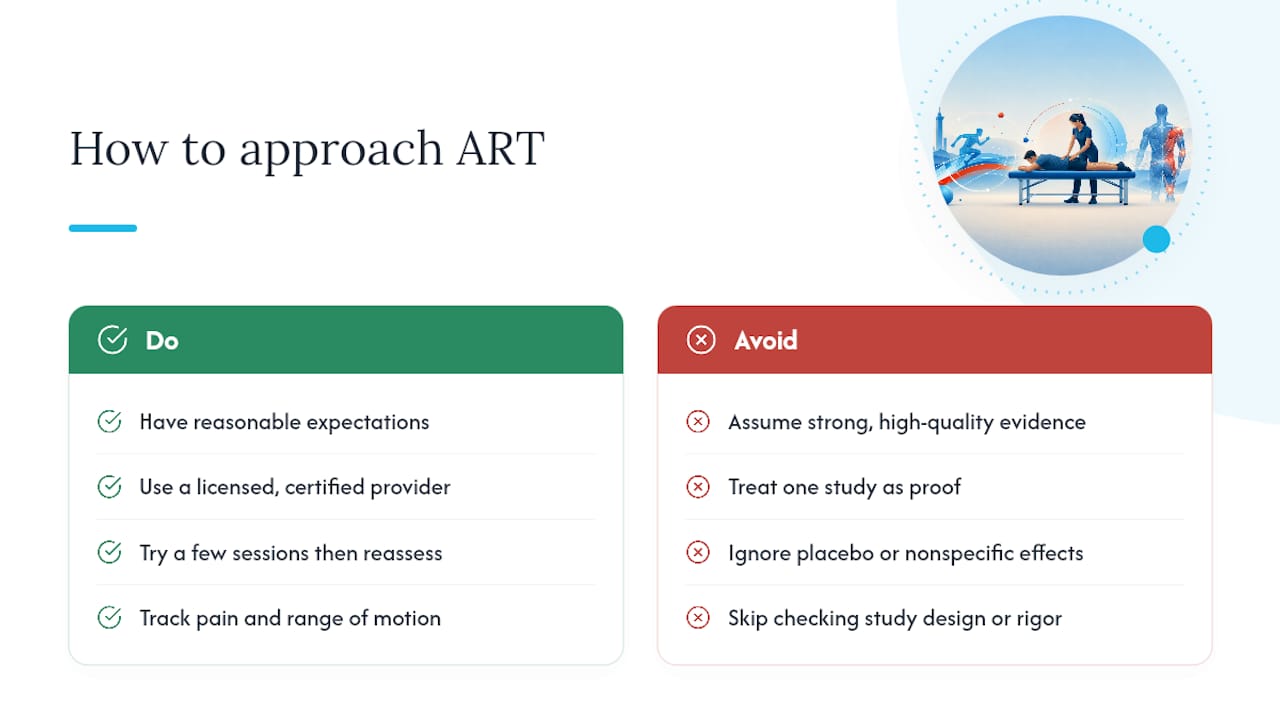
None of this means avoid ART. It means treat it the way you’d treat any manual therapy: reasonable expectations, a licensed and certified provider, and attention to whether your specific symptoms actually improve after a handful of sessions.
How Do You Find a Qualified ART Provider?
Certification is the first filter, not a nice-to-have. ART requires that the provider complete official certification on top of a base license as a chiropractor, physical therapist, or athletic trainer. A provider can’t legally practice ART without a clinical license, and shouldn’t be marketing it without current ART certification either.
Before booking, ask:
- Are you currently ART-certified, and in which body regions or protocols?
- What’s your experience treating my specific condition?
- What timeline should I expect for improvement, and how will we track progress?
- What happens if I don’t respond after four or five sessions?
Walk away from anyone who guarantees a cure, skips a hands-on movement assessment before treating, or can’t clearly explain their credentials when asked directly.
Pro Tip: Ask to see the provider’s ART certification card or number. Legitimate providers keep it current and won’t hesitate to show it.
How The Tx Room Uses Movement-Based Release in Real Rehab Plans
At Thetxroom, movement-based soft-tissue work rarely stands alone. It gets paired with the Fascial Distortion Model and other hands-on techniques to address the layers around a restriction, not just the restriction itself. A sciatica case might start with fascial work on the low back, move into targeted release on the piriformis, then finish with a loading progression to prevent recurrence. Plantar fasciitis and tendinopathy cases follow a similar logic: address the tissue, then rebuild the movement pattern that let it break down in the first place.
When We Recommend Active Release, and When We Don’t
Active release earns its place in a treatment plan when the problem is mechanical and tissue-based, a stuck fascial layer, a nerve caught in scar tissue, a muscle that’s stopped gliding the way it should. It’s less useful as a standalone fix for something structural, like a labral tear or a disc extrusion, where movement-based release might ease symptoms but won’t address the underlying damage. That’s the line we watch for. Self-treating a suspected nerve entrapment with foam rollers and YouTube tutorials usually delays the assessment that would’ve caught the real issue. A proper evaluation, hands-on and specific to your movement pattern, beats guessing every time.
— Chris
Ready to Address Your Soft-Tissue Pain? Here’s How to Start
Thetxroom treats the same soft-tissue problems ART targets, using hands-on techniques including myofascial acoustic compression therapy alongside movement-based release and a rehab plan built around your specific injury, not a generic protocol pulled off a shelf.
Your first visit starts with a real movement assessment, not a cookie-cutter intake form. Bring a list of when your pain flares, what makes it worse, and any imaging or prior treatment notes you have. From there, Thetxroom builds a plan around whatever is actually restricted, whether that’s a stubborn tendinitis case, a lingering strain, or nerve-related pain that hasn’t responded to rest. If sciatica, plantar fasciitis, or a soft-tissue injury has been dragging on longer than it should, book an evaluation at Thetxroom in Plano and get a plan built around your actual injury instead of a guess.
Sources
- Introduction to Active Release Technique
- Systematic review on manual therapy and trigger points (PMC)
This article is general information, not a substitute for advice from a qualified doctor. Consult a qualified healthcare professional about your own circumstances before acting on anything here.