
Stop Relying on Stretching: Muscle Activation Therapy in Plano
Muscle activation therapy is a hands-on manual technique that finds and reactivates muscles the nervous system has effectively shut off, then confirms the change with retesting. Practitioners use it to cut pain, unlock stiff joints, and break through performance plateaus that stretching alone never touched. Results depend heavily on the practitioner’s assessment skill and how well you follow the home program afterward.
TL;DR:
- Muscle activation therapy is most effective for chronic tightness, persistent weakness after healing, or unnoticed performance plateaus, not for acute injuries or fractures.
- Proper assessment and retesting are essential, with trained licensed practitioners holding specialized certifications to ensure safe and accurate treatment.
- Typical sessions involve initial movement comparison, objective muscle testing, targeted activation, retesting, and a home program, with costs varying by region and provider credentials.
- Risks are low and mainly limited to temporary soreness or mild fatigue, but over-aggressive pressure on inflamed areas could worsen symptoms if not performed correctly.
- Combining activation therapy with structured exercise can produce more lasting improvements, as reactivated muscles respond better to functional movement work.
Table of Contents
- What Muscle Activation Therapy Actually Is
- How Does Muscle Activation Work in a Session?
- Who Is a Good Candidate for This Therapy?
- What Happens During a Visit, and What Does It Cost?
- What Does the Research Say About Activation Work?
- What Are the Risks of Muscle Activation Therapy?
- How to Choose a Qualified Practitioner
- How Activation Work Fits Into Care at The Tx Room
- Book a Muscle Activation-Style Assessment at The Tx Room
- Sources
What Muscle Activation Therapy Actually Is
Muscle activation therapy is a clinical, hands-on method, not a set of gym exercises you’d find under a “muscle activation” YouTube tutorial. That distinction trips up a lot of first-time patients. The clinical version involves a trained practitioner testing specific muscles, finding ones that have gone neurologically quiet, and using manual pressure or positioning to bring them back online.
You’ll see it under a few different names. Neuromuscular therapy (NMT) is the broader clinical term covering targeted trigger-point work and precise palpation of dysfunctional muscle fibers, distinct from general deep-tissue massage according to Massage Magazine’s overview of the modality. Muscle Activation Techniques (MAT) is a specific trademarked system built around standardized comparative testing, described in detail by Muscle Activation Techniques itself.
Who provides this work matters. Look for licensed physical therapists, chiropractors, or massage therapists who hold additional manual therapy certification. NMT and MAT both require specialized training beyond a standard license. A generic “sports massage” certificate doesn’t cover the testing protocols this approach depends on.
How Does Muscle Activation Work in a Session?
The process runs on a simple loop: test, treat, retest. It’s what separates this from a relaxing rubdown.
- Baseline movement comparison. The practitioner watches you move, comparing range of motion and strength side to side to spot asymmetries.
- Objective muscle testing. Isometric strength tests on specific muscles reveal which ones fire weakly or inconsistently, a sign of inhibition rather than actual weakness. MAT-style systems use standardized comparative testing to make this less subjective, according to Muscle Activation Techniques’ professional resources.
- Targeted activation. The practitioner applies finger or tendon pressure at specific points, resets joint positioning, or cues isometric contractions. Some sessions borrow from Proprioceptive Neuromuscular Facilitation (PNF), a technique category that pairs contraction and stretch cues to retrain how a muscle responds.
- Immediate retesting. The same muscle gets tested again right away. If strength or range improved, the activation worked. If not, the practitioner adjusts and tries a different point.
Your feedback drives the pressure level throughout. Clinicians rely on you to report what’s tolerable, since the goal is triggering a neuromuscular response, not overwhelming the tissue, a point Spine-Health’s overview of neuromuscular therapy emphasizes as central to safe practice.
Who Is a Good Candidate for This Therapy?
Certain patterns show up again and again in people who respond well to activation work.
- Tightness that never resolves no matter how much you stretch or foam roll it
- Weakness that lingers weeks or months after an injury has otherwise healed
- A performance plateau you can’t explain through training load alone
- Chronic movement complaints, like a hip that “just doesn’t feel right” during a squat
Contraindications exist, and they matter. Acute fractures, uncontrolled systemic conditions, and sudden neurological changes (numbness spreading, loss of bladder control, progressive weakness) all require medical clearance before any manual therapy, activation included.
Pro Tip: If a muscle feels chronically “tight” but stretching gives you only temporary relief that fades within hours, that’s often a sign the muscle is inhibited, not short. Activation work targets the cause; stretching just manages the symptom.
What Happens During a Visit, and What Does It Cost?
A typical visit follows a predictable rhythm, even though every practitioner adds their own touches.
- Intake conversation about your pain history, activity level, and goals.
- Movement and posture comparison to spot the asymmetries worth investigating.
- Isometric testing on suspected muscles to confirm inhibition.
- Targeted activation using pressure, positioning, or PNF-style contractions.
- Immediate retesting to verify the change held.
- A short home program, usually two or three exercises, to reinforce the activated muscle before your next visit.
Expect brief discomfort at trigger points during testing and treatment. It shouldn’t linger, and a good practitioner checks in constantly rather than pushing through silence.
Pricing varies by region, practitioner credentials, and whether the visit is billed as a chiropractic or physical therapy session under insurance. In the United States, session pricing varies widely depending on practitioner credentials and billing methods; initial evaluations with extended testing often cost more than follow-up visits. Ask any prospective clinic for their fee schedule and whether your insurance covers manual therapy codes before booking.
What Does the Research Say About Activation Work?
Peer-reviewed evidence on manual and neuromuscular techniques exists, but it’s still catching up to how widely these methods are used in practice.
Perceived muscle tightness is frequently a protective response from an inhibited or weak muscle rather than a shortened one, and reactivating that muscle can produce longer-lasting relief than repeatedly stretching the tissue around it.
That’s the core clinical insight from Women’s Health’s reporting on muscle activation technique, and it reframes why stretching sometimes feels good for twenty minutes and does nothing by dinner.
Open-access clinical literature backs the general mechanism while flagging a real gap: research on manual and neuromuscular approaches shows growing scholarly interest, but study sizes and methods vary enough that broad claims need caution. A separate clinical review of manual therapy techniques recommends pairing hands-on work with structured rehab exercise for outcomes that actually hold up over months, not just days.
That combination shows up in practice, too. The Tx Room documents pairing fascia-focused manual work with rehab to deliver measurable, if short-term, pain relief and functional gains, which lines up with what the broader research suggests: activation primes the muscle, exercise makes the change stick.
What Are the Risks of Muscle Activation Therapy?
The risk profile here is low compared to most manual therapies, but it’s not zero, and pretending otherwise does readers a disservice.
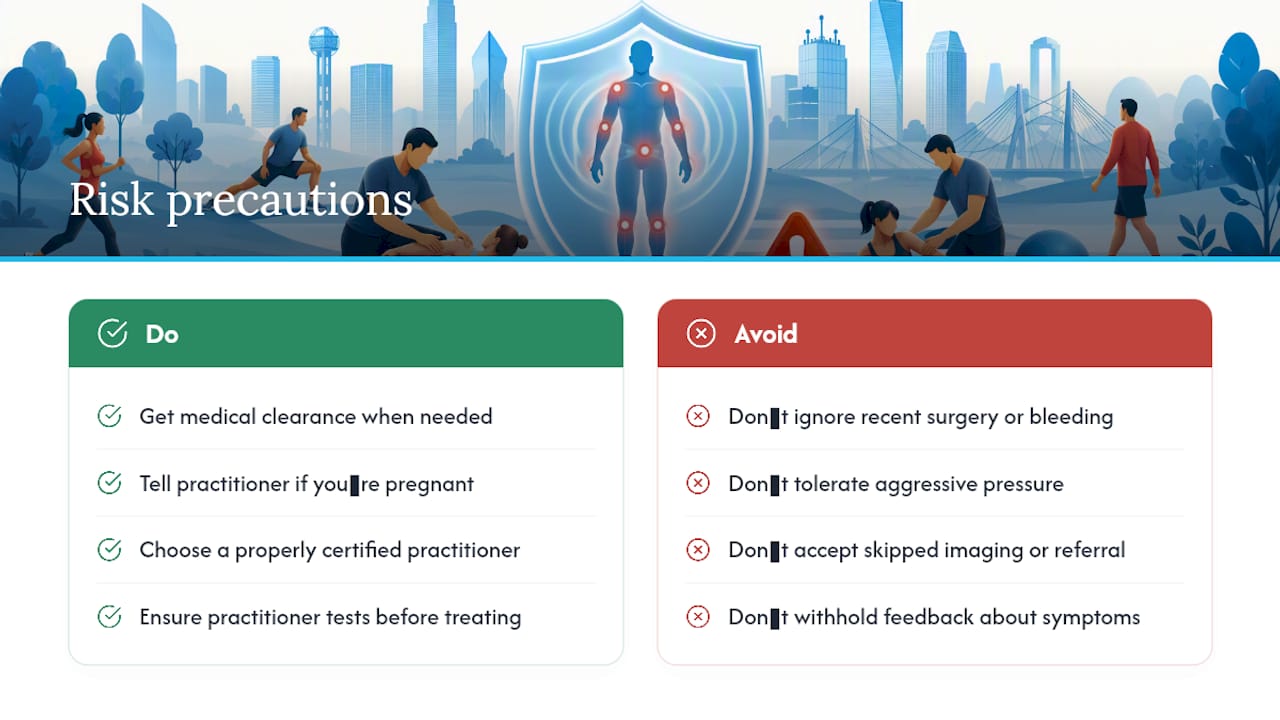
The most common side effect is transient soreness at the treatment site, similar to what you’d feel after an intense workout. It usually fades within a day or two. Occasionally, patients report mild fatigue after a session, since the nervous system did real work reactivating dormant muscle fibers.
More serious risks are rare but worth naming. Overly aggressive pressure on an already inflamed or injured area can aggravate symptoms rather than resolve them, which is exactly why practitioner feedback loops and tolerable-pressure checks matter so much during testing. A practitioner working without proper certification might misread inhibition for a structural injury, delaying appropriate imaging or referral. That’s a credentialing problem more than a technique problem, and it’s avoidable.
Anyone with a bleeding disorder, recent surgery near the treatment area, or an undiagnosed acute injury should get medical clearance first. Pregnant patients generally tolerate gentle manual activation well, but should flag pregnancy to their practitioner so pressure and positioning get adjusted accordingly.
The honest takeaway: activation therapy carries meaningfully less risk than high-velocity spinal manipulation or deep aggressive massage, but it still demands a practitioner who tests before treating and listens to what you report during the session.
How to Choose a Qualified Practitioner
Credentials separate a productive session from a wasted one, so vet before you book rather than after a disappointing visit.
Start with license type. Physical therapists, chiropractors, and licensed massage therapists can all pursue manual therapy certification, but the base license alone doesn’t guarantee activation-specific training. Ask directly whether they hold a recognized certification in neuromuscular therapy or a system like MAT, and how many hours of hands-on training that certification required.
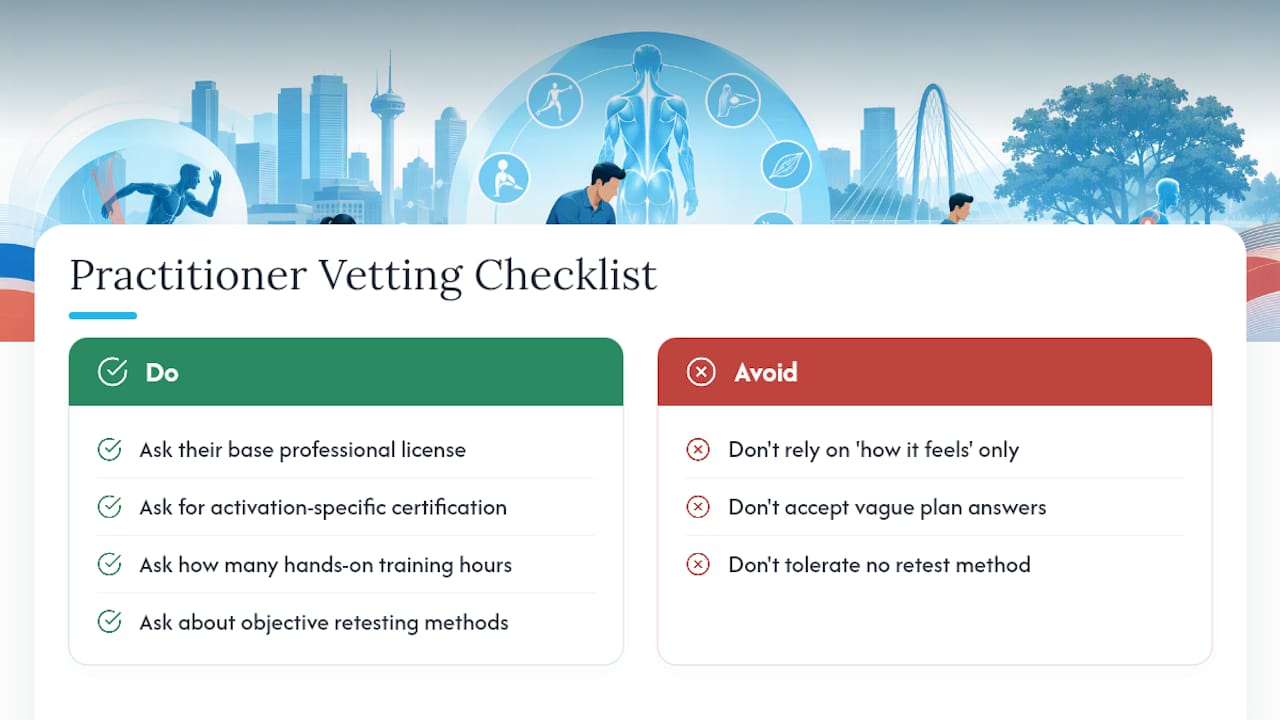
Ask how they measure progress. A qualified practitioner should describe some form of objective testing, comparing strength or range of motion before and after treatment, rather than relying on “how does that feel?” alone. If they can’t explain a retest process, that’s a gap.
Ask about their approach to communication during treatment. You want someone who checks in about pressure tolerance rather than pushing through silence, and who explains what they’re doing and why as they go.
Finally, ask what a typical treatment plan looks like for your specific issue. A vague answer (“we’ll see how it goes”) is a weaker sign than a practitioner who can describe a rough course of care, like a short series of sessions paired with a home program.
How Activation Work Fits Into Care at The Tx Room
At The Tx Room, hands-on activation work runs alongside the Fascial Distortion Model rather than as a separate add-on. If testing shows an inhibited muscle around the ankle or hip, we address the fascial restriction and the activation deficit in the same visit. Patients dealing with posterior tibial tendon dysfunction or nerve irritation from conditions like meralgia paresthetica often need exactly this combination: reactivate the muscle supporting the joint, then correct the fascial pattern feeding the problem.
If you’re dealing with a stubborn ache that stretching hasn’t touched, describe it during a consultation and we’ll test rather than guess.
— Chris
Book a Muscle Activation-Style Assessment at The Tx Room
If stretching, foam rolling, and rest haven’t moved the needle on that stubborn tightness, The Tx Room in Plano offers something those approaches can’t: an actual test of whether the muscle is inhibited before any treatment starts. Our chiropractic care combines the Fascial Distortion Model with hands-on techniques like myofascial acoustic compression to identify what’s actually driving your pain or restricted movement, not just mask it for a few hours.

Your first visit includes a movement assessment and targeted testing so treatment gets aimed at the real problem instead of the sore spot you already know about. We accept both insurance and self-pay, and most patients see measurable change within a handful of visits when activation work pairs with a short home program.
If you’re dealing with a movement limitation that’s outlasted every stretch routine you’ve tried, describe your symptoms and book an assessment focused on restoring range of motion to see whether hands-on activation is the missing piece.
This article is general information, not a substitute for advice from a qualified doctor. Consult a qualified healthcare professional about your own circumstances before acting on anything here.
Sources
- Muscle Activation Technique: What Is It, How To Do … — Women’s Health
- PMC article (relevant manual therapy / neuromuscular research) — PMC8192325
- What is Neuromuscular Therapy (NMT)? — Spine-Health