
Sciatica Stretches: Bed Moves, Nerve Glides, and Red Flags
A handful of gentle hip, glute, and hamstring stretches, paired with slow nerve-gliding movements, can ease sciatica symptoms for many people within days. Try the short routine below, and stop any stretch that sharpens or spreads your radiating pain. If you see no improvement after a few weeks of consistent practice, it’s time to have a clinician take a closer look.
TL;DR:
- Because sciatica can stem from a disc problem, spinal narrowing, or piriformis compression, choose movements by response rather than following a fixed stretch list.
- A daily 10 to 15 minute routine can include knee to chest, seated figure four, hamstring stretches, and pelvic tilts, repeated two to three times.
- Nerve glides should gently move the leg and foot while you tilt your head; they are not deep stretches and should remain symptom free.
- Stop any movement that sharpens or spreads pain or causes new tingling, numbness, or weakness; bladder changes or saddle numbness require same day medical care.
- If pain plateaus despite consistent practice for two to three weeks, seek a physical therapist; symptoms lasting four to six weeks warrant clinician review.
Table of Contents
- The Fastest Stretches to Try First
- What Sciatica Is and Why Stretching Helps
- Step-by-Step Sciatica Stretches You Can Do Today
- Safety Red Flags and When to See a Doctor
- A Simple Routine You Can Repeat Daily
- When Hands-On Therapy Helps Beyond Stretching
- A Practitioner’s Note on Patience and Progress
- How The Tx Room Can Help With Persistent Sciatica
- FAQ
- Sources
The Fastest Stretches to Try First
Before you dig into form cues and routines, here’s what to reach for depending on where you feel the pinch.
- Seated glute stretch / figure-4 (floor or chair): targets deep buttock pain and piriformis tightness.
- Knee-to-opposite-shoulder stretch: opens the outer hip and lower back, good for one-sided pain.
- Knee-to-chest stretch: bed-friendly, eases general lower back tension.
- Standing hamstring stretch (foot elevated): best when pain runs down the back of the thigh.
- Standing piriformis stretch: a standing alternative for buttock-area compression.
- Forward pigeon (gentle version): deeper hip opener for those with more mobility.
- Scissor hamstring stretch: active variation that also warms up the legs.
- Pelvic tilt / cat-cow: gentle spinal mobility work, safe for almost everyone, including in bed.
If floor positions are uncomfortable, the chair and bed versions below cover nearly every stretch on this list.
What Sciatica Is and Why Stretching Helps
Sciatica describes pain that radiates along the path of the sciatic nerve, usually from the lower back through the hip and down one leg. It’s typically caused by a bulging or herniated disc pressing on a nerve root, spinal stenosis narrowing the space around the nerve, or a tight piriformis muscle compressing the nerve as it passes through the hip. The cause matters because the stretch that helps one person can aggravate another, which is why clinicians at Hospital for Special Surgery stress tailoring exercises to each patient’s specific movement limitations rather than following a single fixed plan.
Gentle stretching works by loosening tight muscles around the nerve, improving blood flow to the area, and restoring mobility in the hip and spine. Harvard Health notes that gentle stretches increase flexibility and reduce tension, while aggressive, forceful stretching can strain the lower back and make symptoms worse. Movement also tends to ease pain simply by keeping joints and soft tissue from stiffening up while you recover.
Sciatica is common: an estimated 10% to 40% of people experience it at some point in their lives. Because the underlying cause varies so widely between individuals, no single stretch works for everyone, and paying attention to how your body responds matters more than following a rigid checklist.
Step-by-Step Sciatica Stretches You Can Do Today
Each stretch below includes a floor or standing version plus an easier alternative for days when mobility is limited.
Seated glute stretch / figure-4 (chair version): Sit tall in a sturdy chair, cross your affected ankle over the opposite knee, and gently lean forward from the hips while keeping your back straight. Hold for 15 to 30 seconds, breathing slowly, then switch sides. Repeat two to three times per side. For the floor version, lie on your back, cross one ankle over the opposite knee, and pull the uncrossed leg toward your chest.
Knee-to-opposite-shoulder stretch: Lying on your back, bend both knees. Grab the knee on your painful side and gently pull it across your body toward the opposite shoulder, keeping your shoulders flat on the floor. Hold 15 to 30 seconds, exhale as you deepen the stretch slightly, and repeat two to three times.
Knee-to-chest stretch (bed-friendly): Lying on your back, pull one knee toward your chest with both hands, keeping the other leg bent or flat. Hold 20 to 30 seconds and switch legs. This works well first thing in the morning before you get out of bed.
Standing hamstring stretch (elevated): Place your heel on a low step, chair, or stair, keeping your leg straight but your knee soft. Hinge forward at the hips until you feel a stretch behind the thigh, not the knee. Hold 15 to 30 seconds per side. An easier version: sit on the edge of a chair, extend one leg straight with heel on the floor, and lean forward slightly.
Standing piriformis stretch: Stand facing a wall or chair for balance, cross one ankle over the opposite knee in a figure-4 shape while standing on the other leg, then slowly bend the standing knee and sit back slightly. Hold 15 to 20 seconds.
Forward pigeon (gentle version): From hands and knees, bring one knee forward toward your wrist, angling the shin across your body, and extend the back leg behind you. Lower your chest toward the floor only as far as comfortable. Hold 20 to 30 seconds. Skip this one in the early, more painful stages.
Scissor hamstring stretch: Stand with one foot forward, hinge at the hips with a flat back until you feel a stretch in the back of the front leg, then return upright. Repeat 8 to 10 slow reps per side instead of holding static.
Nerve glides (flossing): Sit tall, straighten the affected leg, and gently flex your foot up and down while slowly tilting your head forward and back, rather than forcing a deep stretch. These moves are meant to glide the nerve gently through surrounding tissue, not stretch it. Our nerve-flossing guide walks through clinic-tested versions and pacing.
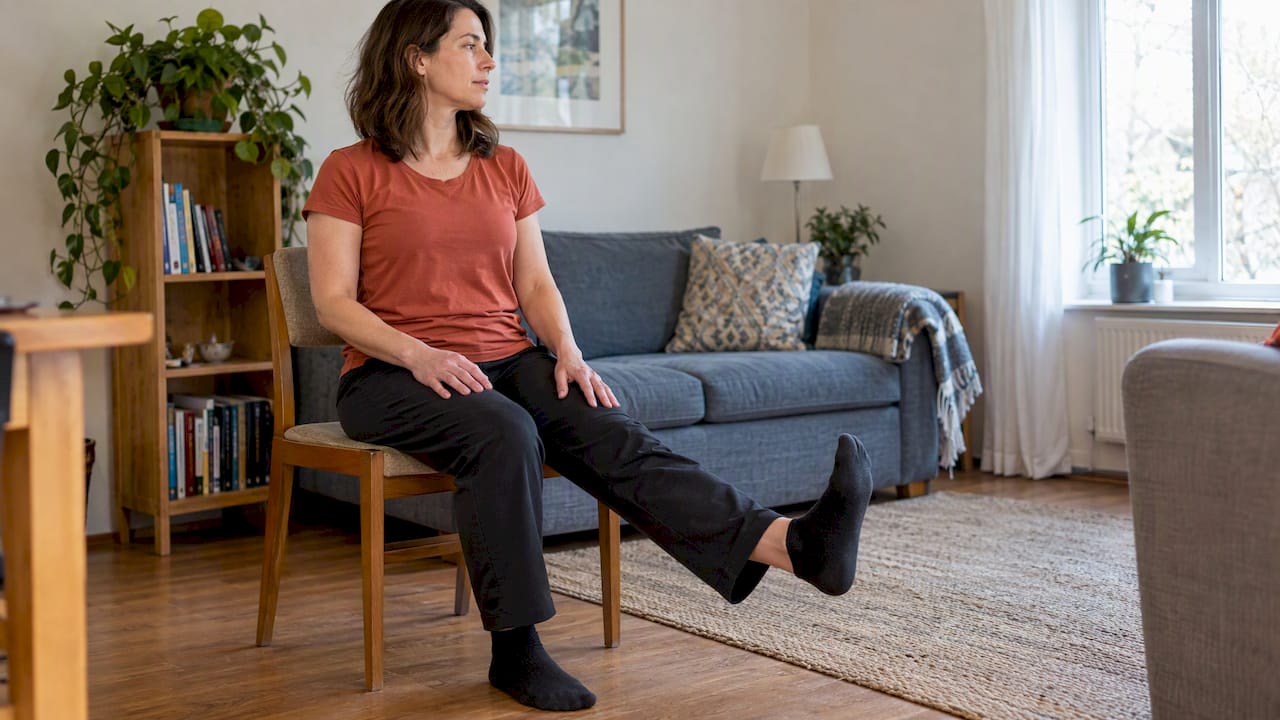
Watch for a sharpening or spreading of pain, new tingling, numbness, or any weakness in your leg or foot during these movements. If any of that happens, stop the stretch, note what triggered it, and ease off intensity next session.
Safety Red Flags and When to See a Doctor
Most sciatica improves with home care, but a few symptoms need prompt medical attention rather than more stretching.
- Sudden loss of bladder or bowel control, or new difficulty urinating.
- Numbness in the saddle area (inner thighs, groin, or genitals).
- Progressive weakness in your leg or foot that worsens over hours or days.
- Fever combined with back pain, or sciatica following major trauma such as a fall or car accident.
- Pain that worsens steadily despite rest and gentle stretching, or new balance and gait problems.
These combinations can point to cauda equina syndrome or another serious condition that needs same-day evaluation. For less urgent but still persistent symptoms, lasting beyond four to six weeks, keep a short log: note which stretches you did, pain intensity before and after, and any new sensations. Bringing that record to a clinician makes diagnosis and treatment planning faster.
A Simple Routine You Can Repeat Daily
A short starter routine beats an occasional long one for consistency and results.
- Starter routine (10 to 15 minutes): knee-to-chest, seated figure-4, standing hamstring, and pelvic tilts, two to three rounds each, held 15 to 30 seconds, done daily.
- Fuller routine (15 to 25 minutes): add forward pigeon, scissor hamstring, and two to three minutes of nerve glides, alternating stretch days with light strengthening work like glute bridges or bird-dogs.
- Progression marker: once stretches feel easy and pain stays flat or improves for a full week, you can add gentle resistance or longer holds.
Pro Tip: Warm up with five minutes of walking or a heating pad before stretching; tissue that’s warm stretches more easily and comfortably than cold, stiff muscle.
If pain plateaus for more than two to three weeks despite consistent practice, that’s a reasonable point to bring in a physical therapist or chiropractor rather than pushing harder on your own.
When Hands-On Therapy Helps Beyond Stretching
Home stretches resolve a lot of sciatica cases, but some respond slowly because the restriction sits in tissue that’s hard to release through stretching alone, think a locked-down piriformis or scarred fascia around the nerve path. That’s where manual assessment adds value: a trained hands-on evaluation can find the specific restriction driving your symptoms rather than guessing from a generic stretch list.
Manual therapy techniques, including the Fascial Distortion Model, are typically delivered alongside an exercise plan. Isolated hands-on work without a home routine is less likely to produce lasting improvement.
Nerve flossing in a clinical setting follows the same gentle, symptom-free principle described earlier, just monitored more closely so progression matches how your nerve responds. Hands-on care works best as a complement to your stretching routine, not a replacement for it.
A Practitioner’s Note on Patience and Progress
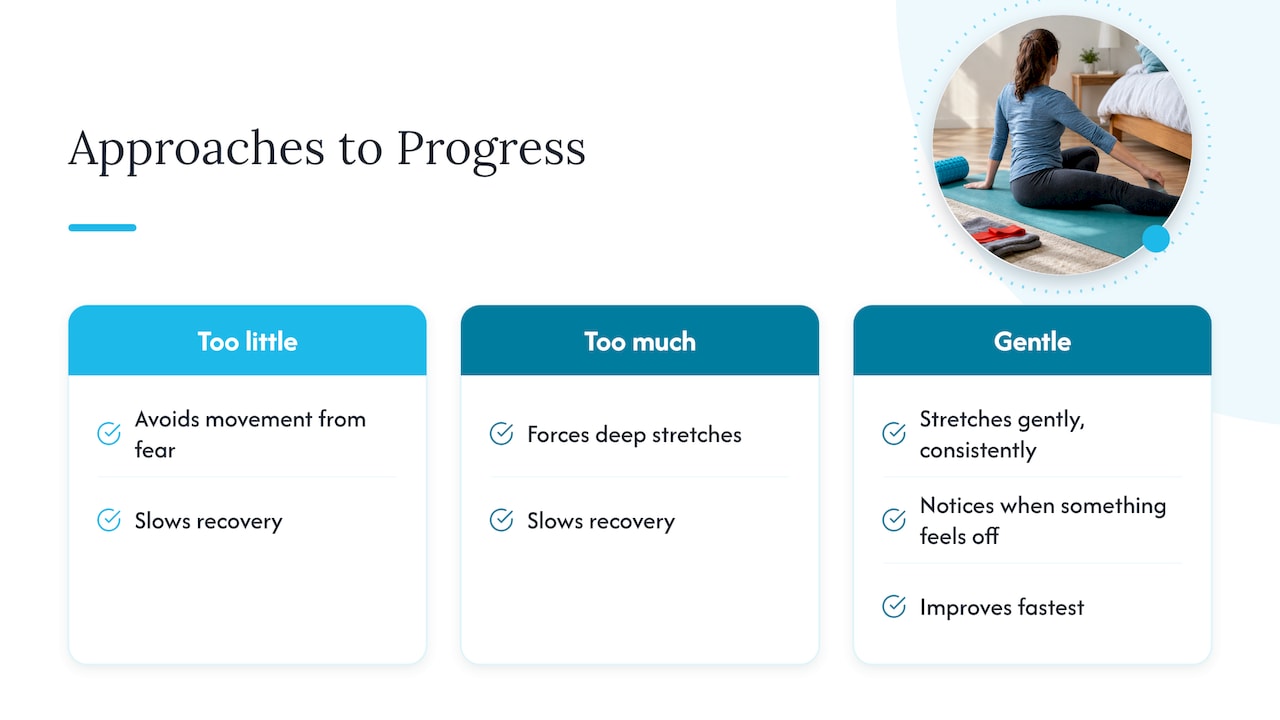
Working through sciatica day to day, the pattern I see most often is people either doing too little (avoiding movement out of fear) or too much (forcing a deep stretch because it feels productive). Both slow recovery. The readers who improve fastest are the ones who stretch gently, consistently, and pay attention when something feels off rather than pushing through it.
Progress with sciatica is rarely linear. Expect some good days and some frustrating ones, and treat a flare-up as information, not failure.
— Chris
How The Tx Room Can Help With Persistent Sciatica
When home stretches plateau, we offer hands-on care built specifically for cases like this. Using the Fascial Distortion Model, we locate and release the specific soft-tissue restrictions that keep irritating the sciatic nerve, work that’s hard to reach through stretching alone. We also offer soft tissue therapy and, for stubborn cases where tissue healing has stalled, MyACT focused shockwave therapy.

At an initial visit, we assess your movement patterns, identify where your restriction sits, and build a treatment plan around your specific case rather than a generic protocol. You can read more on our sciatica care page or visit our main site to check availability. If you’re experiencing any of the red-flag symptoms covered above, seek immediate medical evaluation before booking any appointment, including ours.
Once acute nerve irritation calms down, pairing hands-on release with targeted strengthening, like the progressive approach described in this ankle and lower-limb strengthening guide, helps prevent the same restriction from returning.
This article is general information, not a substitute for advice from a qualified doctor. Consult a qualified healthcare professional about your own circumstances before acting on anything here.
FAQ
Can you fix sciatica by stretching?
Gentle stretching can meaningfully reduce sciatica pain and improve mobility for many people, and clinical guidelines support exercise programs as a key part of care. It isn’t a guaranteed fix for everyone, since the underlying cause, like a disc issue versus piriformis tightness, affects how much stretching alone can resolve.
What is the miracle stretch for sciatica?
There’s no single stretch that works for every case of sciatica. Clinicians at HSS note the best stretch depends on your specific biomechanical pattern, which is why trying a few options like figure-4, knee-to-chest, and standing hamstring stretches and tracking what helps works better than chasing one fix.
What is the one movement for instant sciatica pain relief?
No single movement delivers instant relief for everyone, but many people find quick, temporary ease from a gentle knee-to-chest stretch or a seated figure-4 stretch. If a movement increases rather than eases your pain, stop and try a different one instead of pushing through it.
How do you untrap a sciatic nerve?
Easing nerve compression usually involves a combination of gentle stretching, nerve gliding exercises, and reducing tension in surrounding muscles like the piriformis. When home efforts stall, hands-on techniques such as the Fascial Distortion Model can target the specific soft-tissue restriction contributing to the compression.
Sources
- Sciatica: Gentle stretches to help relieve pain and improve mobility — Harvard Health
- Low back pain and sciatica in over 16s: assessment and management — NCBI Bookshelf (NICE guideline summary)
- Sciatica stretches — Hospital for Special Surgery (HSS)