
Insurance Coverage for Chiropractic Care: A U.S. Guide
Most U.S. health plans cover chiropractic care, but only when it’s classified as medically necessary. Routine or maintenance adjustments almost always get excluded. Coverage typically comes with a visit cap, often somewhere between 20 and 30 visits per year, and the exact number depends entirely on your specific plan.
Here’s what determines whether your insurance pays:
- Whether a licensed chiropractor documents a diagnosed condition, not just general discomfort
- Whether your plan is Medicare, Medicaid, an employer plan, or an ACA marketplace plan
- Whether you’ve hit any visit cap or need prior authorization
Your fastest move: call the member services number on your insurance card, or log into your member portal, and ask directly whether chiropractic manipulation is covered under your plan.
- Locate your member ID number
- Call or log in and ask about chiropractic benefits
- Write down the answer, the rep’s name, and a reference number
Key Takeaways
Insurance coverage for chiropractic care in the U.S. hinges on medical necessity documentation, plan type, and whether you confirm benefits before your first visit.
| Point | Details |
|---|---|
| Coverage isn’t automatic | Most plans require a diagnosed condition and documented medical necessity, not just general pain. |
| Medicare Part B is narrow | It covers spinal manipulation for subluxation only, with 20% coinsurance after the deductible. |
| Visit caps are common | Many plans limit coverage to roughly 20 to 30 chiropractic visits per year. |
| Prior authorization prevents denials | Confirm authorization requirements before treatment starts, since retroactive approval is rare. |
| Verify before you commit | Thetxroom helps Plano patients confirm benefits, submit authorizations, and understand out-of-pocket costs upfront. |
Table of Contents
- Does Insurance Coverage for Chiropractic Care Have Limits?
- Which Insurance Plans Typically Cover Chiropractic Visits?
- What Counts as Medical Necessity for Chiropractic Claims?
- How Do You Verify Your Chiropractic Insurance Benefits?
- How Can You Lower Chiropractic Costs and Appeal a Denial?
- Is Chiropractic Care Safe, and What Should You Expect?
- Do State Laws Affect Your Chiropractic Coverage?
- Why Do Chiropractic Claims Get Denied So Often?
- How Long Do Chiropractic Insurance Claims Take?
- What The Tx Room Sees With Insurance Verification
- Get Help Verifying Your Chiropractic Benefits in Plano
- Where to Learn More About Chiropractic Coverage
- Sources
Does Insurance Coverage for Chiropractic Care Have Limits?
Insurers draw a clear line between spinal manipulation, which they’ll often pay for, and everything else, which they frequently won’t. A licensed chiropractor performing manual adjustment for a diagnosed condition like a herniated disc or acute low back pain usually clears the bar for coverage. A wellness visit with no diagnosis attached usually doesn’t.
Here’s how that split tends to play out in practice:
- Commonly covered: spinal manipulation or manual adjustment tied to a documented diagnosis
- Frequently excluded: massage therapy, acupuncture, and other soft-tissue modalities bundled into a chiropractic visit
- Sometimes excluded: X-rays or diagnostic imaging ordered by the chiropractor, depending on the plan
- Almost never covered: maintenance or “tune-up” visits with no active condition being treated
On top of that, expect a visit cap (commonly 20 to 30 per year), a copay or coinsurance percentage, and possibly a prior-authorization requirement before your insurer approves ongoing treatment. If you’re dealing with a herniated disc injury or a soft-tissue problem like a sprain or strain, that documented diagnosis is exactly what turns a maybe into a yes.
Which Insurance Plans Typically Cover Chiropractic Visits?
Coverage patterns differ sharply depending on who’s paying the bill, and knowing your payer type tells you almost everything about what to expect.
Medicare Part B covers manual manipulation of the spine to correct a vertebral subluxation, full stop. It does not cover other services a chiropractor might order, including X-rays, massage, or acupuncture, and beneficiaries typically pay 20% of the Medicare-approved amount after meeting the Part B deductible. Medicare Advantage plans sometimes expand on this baseline with higher visit allowances or added services, so checking your specific Advantage plan’s documents matters.
Medicaid coverage for chiropractic swings widely by state. Some state Medicaid programs cover it generously; others barely cover it at all.
Commercial employer plans and ACA marketplace plans frequently include chiropractic benefits, but chiropractic care isn’t classified as an essential health benefit under the Affordable Care Act, so nothing forces an insurer to include it.
Many plans that do cover chiropractic care cap visits at 20 to 30 per year and require documented medical necessity for every one of them.
State mandates and individual employer choices create real variability here, which is why the Model Chiropractic Coverage Recommendation from the American Chiropractic Association pushes insurers toward more consistent, evidence-based coverage standards.
What Counts as Medical Necessity for Chiropractic Claims?
Insurers don’t take your word for it. “Medical necessity” means a diagnosed condition, documented functional limitation, and measurable improvement tracked visit over visit by a licensed chiropractor. No diagnosis code, no claim.

Billing runs on two code sets working together: an ICD-10 diagnosis code establishes what’s wrong, while a CPT procedure code documents the manipulation performed. Mismatched or missing codes are one of the most common reasons claims get denied.
Most insurers don’t approve unlimited care upfront. A typical pattern:
- Initial authorization for a fixed block of visits
- Reauthorization required if you need more, backed by progress notes
- An annual cap once you’ve used your allotted visits
Before your first visit, confirm:
- Does my plan require prior authorization for chiropractic care?
- How many visits are pre-approved before reauthorization kicks in?
- What specific documentation does my chiropractor need to submit?
Missing prior authorization is one of the single biggest causes of denied chiropractic claims, and insurers rarely grant it retroactively.
How Do You Verify Your Chiropractic Insurance Benefits?
One phone call or portal session, done right, tells you almost everything you need to know. Here’s the sequence that gets you a real answer instead of a runaround.
- Find your insurance ID card and locate the member services number on the back.
- Check the member portal first. Many insurers now list chiropractic benefits, visit limits, and network status online before you ever pick up the phone.
- Call member services if the portal doesn’t answer your questions, or if you want written confirmation.
- Confirm network status for your specific chiropractor and your specific plan. A provider being “in-network” generally doesn’t guarantee they’re in-network for your plan variant. Confirm directly with the insurer rather than trusting a general directory.
Ask these exact questions during that call:
- “Is spinal manipulation covered under my plan?”
- “Is prior authorization required before my first visit?”
- “How many visits are authorized, and what triggers reauthorization?”
- “What’s my copay, coinsurance, and deductible status for this service?”
Write down the representative’s name, the call’s reference number, and any authorization number issued. Pull up your plan’s Summary of Benefits and Coverage document too. NCCIH recommends asking upfront about expected number of sessions and total out-of-pocket cost before starting care, not after the bills arrive.
Pro Tip: Ask your chiropractor’s office to run a benefit verification and submit any required pre-authorization on your behalf. Most established clinics do this routinely, and it removes the guesswork from your end entirely.
How Can You Lower Chiropractic Costs and Appeal a Denial?
A few practical moves can cut your bill before you even schedule your first appointment.
- Stick with in-network providers whenever possible; out-of-network chiropractic care usually costs meaningfully more
- Ask the clinic about bundled pricing for an initial exam plus first treatment session
- Use HSA or FSA funds to cover copays and coinsurance with pretax dollars
- If you’ve nearly met your deductible, timing elective visits afterward can reduce your share of the cost
If a claim gets denied, you have a path forward, not a dead end:
- Gather your SOAP notes, diagnosis codes, and documented progress measures
- File an internal appeal within your insurer’s stated timeframe, usually printed on the denial letter
- Request an external review if the internal appeal fails and your state allows it
- Ask your clinic about self-pay rates or a payment plan while the appeal is pending
If your injury stems from a car accident or a workplace incident, auto insurance or workers’ compensation may be the party actually responsible for the bill, not your health plan at all.
Is Chiropractic Care Safe, and What Should You Expect?
A 2026 Cochrane review found spinal manipulative therapy provides small improvements in pain and function for chronic low back pain, with benefits more pronounced in the short term than the long term. That’s a real, modest effect, not a cure.
Certain conditions are contraindications your chiropractor needs to know about before treatment starts:
- Severe osteoporosis or significant bone fragility
- Vascular disorders affecting blood vessels near the spine
- Signs of nerve damage, numbness, or progressive weakness
- Recent spinal surgery or hardware
Before your first adjustment, ask your chiropractor how many visits they expect you’ll need, what measurable goals define success, and how they’ll document your progress for insurance purposes. This is exactly the kind of documentation insurers look for when weighing medical necessity, and it’s the same standard that keeps athletes returning to competition faster after soft-tissue injuries.
Do State Laws Affect Your Chiropractic Coverage?
State insurance regulators often layer additional rules on top of federal baselines, and those rules can matter more than most patients realize. A number of states require that health plans sold within their borders include some form of chiropractic benefit, a protection that goes well beyond what Medicaid programs offer on their own. Other states leave the decision entirely up to insurers and employers, which is part of why two people with similar jobs in different states can have wildly different chiropractic benefits.
State mandates typically address one of three things: whether chiropractic must be offered at all, whether patients can see a chiropractor without a physician referral (sometimes called “direct access” laws), and whether insurers must apply the same cost-sharing rules to chiropractic visits that they apply to physical therapy or other specialist care. That third category, often labeled a parity requirement, is precisely what the American Chiropractic Association’s model coverage recommendation pushes insurers to adopt voluntarily where state law doesn’t already require it.
Self-funded employer plans complicate this picture further. Many large employers self-insure, meaning they pay claims directly rather than buying a state-regulated insurance product, and self-funded plans are governed by federal ERISA rules instead of state insurance mandates. If you work for a large employer, your chiropractic benefit may look nothing like the state-mandated coverage your neighbor gets from a small-business plan. The only way to know for certain is to read your plan’s actual benefit language or ask your HR department whether your plan is fully insured or self-funded, since that single distinction determines which set of rules applies.
Why Do Chiropractic Claims Get Denied So Often?
Billing errors, not treatment quality, cause a surprising share of chiropractic claim denials. The most frequent culprit is a mismatch between the ICD-10 diagnosis code and the CPT procedure code submitted for spinal manipulation. If a claim lists a code that doesn’t clearly justify manipulation as medically necessary, an insurer’s automated review often rejects it before a human ever looks at it.
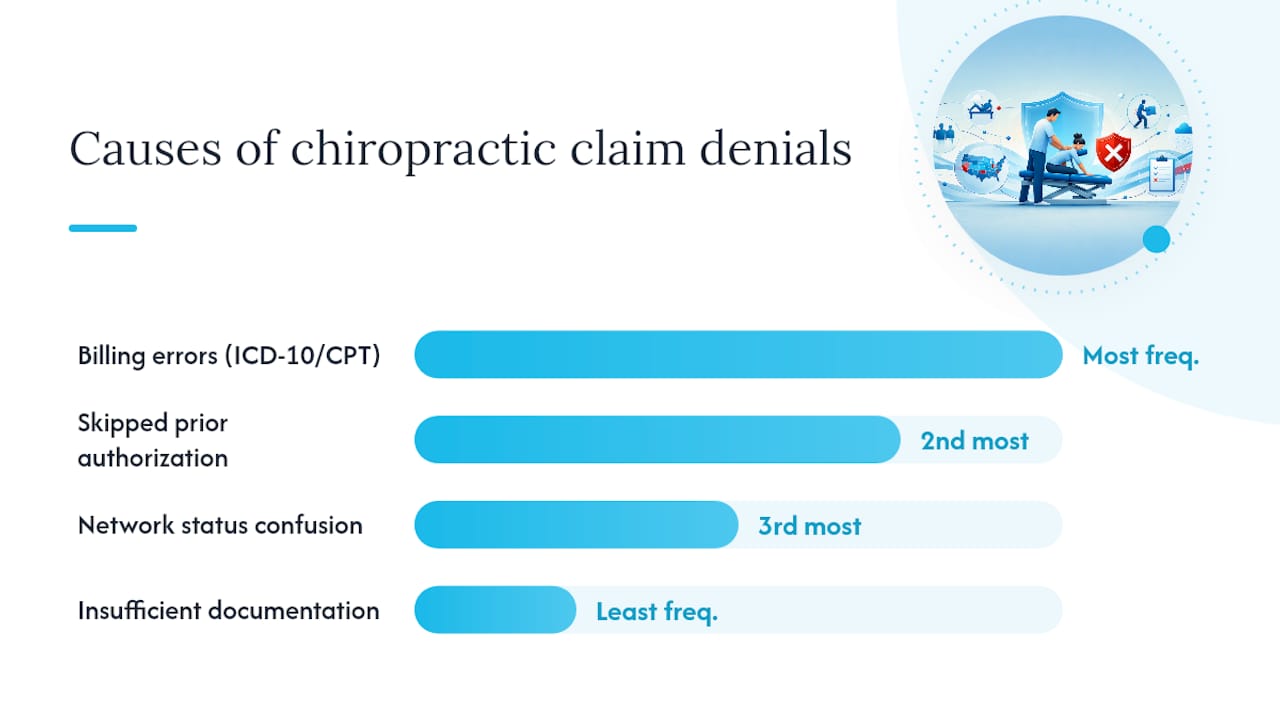
Skipping prior authorization ranks second. Many plans require approval before a course of chiropractic treatment begins, and insurers rarely grant authorization retroactively once services have already been rendered. That means a patient who assumes their plan works like a standard doctor visit, walk in, get treated, submit the bill, can end up owing the full cost out of pocket for visits that would otherwise have been covered.
Network status confusion causes a third wave of denials. A chiropractor listed as in-network in a general provider directory isn’t automatically in-network for every plan variant that insurer sells. Confirming network status against your exact plan ID, not just the insurer’s brand name, prevents a denial that otherwise shows up weeks after your appointment.
Finally, insufficient documentation trips up claims that would otherwise sail through. Insurers want to see functional progress, not just “patient reports feeling better.” A chiropractor’s notes need to tie each visit back to measurable improvement in the diagnosed condition, and gaps in that paper trail give insurers an easy reason to deny an extension of care.
How Long Do Chiropractic Insurance Claims Take?
Most standard chiropractic claims process within two to four weeks once the clinic submits them, assuming the diagnosis codes, procedure codes, and any required prior authorization are all in order. Clean claims with no documentation issues tend to move faster; anything flagged for manual review takes longer.
If a claim is denied, the internal appeal window is usually spelled out directly on your denial letter, commonly 60 to 180 days depending on your plan. Internal appeals themselves typically take 30 to 60 days for a decision, though urgent medical situations can sometimes qualify for an expedited review that moves in days rather than weeks.
If the internal appeal fails, many states allow an external review conducted by an independent third party unaffiliated with your insurer. External reviews generally add another 30 to 45 days to the timeline, though some states offer expedited external review for time-sensitive cases. Throughout this process, keeping copies of every SOAP note, diagnosis code, and progress measurement your chiropractor submits gives you the paper trail you need if a claim stalls or gets kicked back for additional information.
What The Tx Room Sees With Insurance Verification
Patients rarely arrive already knowing their exact chiropractic benefits, and that’s normal. In practice, most confusion traces back to the same two gaps: no prior authorization on file, or documentation that doesn’t clearly tie a diagnosis to the treatment plan. Getting ahead of both, before the first visit, is what keeps a claim moving instead of stalling.
Get Help Verifying Your Chiropractic Benefits in Plano
Reading your Summary of Benefits and Coverage document is one thing. Getting a clear, plan-specific answer about whether your visits will be covered is another, and that’s the gap Thetxroom closes for patients in Plano. Rather than leaving you to decode insurer jargon alone, the clinic verifies benefits, handles prior authorization submissions, and lays out your realistic out-of-pocket costs before you commit to a treatment plan.

If you’re dealing with limited range of motion after an injury, Thetxroom’s team can also help determine whether your specific diagnosis is likely to meet your insurer’s medical necessity standard. That documentation work matters just as much as the hands-on treatment itself. If a previous claim was denied, the clinic can review what went wrong and help you put together a stronger appeal.
Ready to find out where you stand? Schedule an evaluation for range-of-motion or injury-related pain and let The Tx Room handle the benefit verification legwork while you focus on getting back to normal activity.
Where to Learn More About Chiropractic Coverage
For questions specific to your situation, go straight to the source that actually governs your plan.
- Medicare-specific questions: Start with Medicare for Part B rules and cost-sharing details.
- Plan design and benefit questions: Your insurer’s Summary of Benefits and Coverage document, available through your member portal, is the definitive answer for your specific plan.
- Policy standards and coverage advocacy: The American Chiropractic Association’s Model Chiropractic Coverage Recommendation outlines what evidence-based coverage should look like.
- Clinical safety and evidence: NCCIH’s guidance on spinal manipulation and the Cochrane review on spinal manipulative therapy cover what the research actually supports.
- State mandate and ACA questions: Resources like XactInsure’s ACA coverage guidance break down how state-level rules interact with federal law.
This article is general information, not a substitute for advice from a qualified doctor. Consult a qualified healthcare professional about your own circumstances before acting on anything here.
Sources
- Medicare
- Model Chiropractic Coverage Recommendation — American Chiropractic Association
- Spinal manipulative therapy for chronic low back pain — Cochrane
- Does health insurance cover chiropractic? — MoneyGeek
- Spinal manipulation: what you need to know — NCCIH