
Hip Internal Rotation Deficit: Causes, Tests and What Helps
A hip internal rotation deficit means your hip cannot turn inward (toes and knee rotating toward the midline) as far as it should. It is common in people who sit all day, lift, run, golf or play rotational sports, and it often shows up first as a stiff hip, a tight back or a squat that never feels right. The useful question is why the hip is limited: muscle and fascia tightness, a joint problem, or both. Hands-on assessment answers that, and we treat soft tissue restrictions in Plano, Texas, with the Fascial Distortion Model and individualized rehab plans.
TL;DR
- Normal walking needs at least 10° of hip internal rotation, and less than 20° is considered abnormal in a clinical exam.
- Common causes range from soft tissue restriction to femoroacetabular impingement (FAI), where the ball and socket of the hip pinch against each other.
- Reduced hip rotation is linked in research to back and abdominal injuries in athletes and to hip arthritis risk over time.
- Stretching alone often does not hold. Research favors manual therapy first, then exercise to keep the gains.
- Groin pain, locking, catching or worsening symptoms call for a proper exam, not more stretching.
Table of Contents
- What a hip internal rotation deficit actually is
- What causes limited hip internal rotation
- Why it matters for athletes, desk workers and students
- Is it the hip joint or a pulled hip flexor?
- What a positive FADIR test means
- How to improve limited hip internal rotation
- Our perspective
- Hands-on care for a stiff hip in Plano
- FAQ
- Sources
What a hip internal rotation deficit actually is
Your hip is a ball-and-socket joint. Internal rotation is the ball turning inward in the socket. Every step you take uses some of it. According to a clinical review of hip examination, at least 10° is needed at midstance in normal gait, and under 20° is abnormal.
You will also see this called limited hip internal rotation or restricted hip mobility. The terms mean the same thing: less turn than expected, on one side or both. A difference between the left and right hip matters as much as the number itself.
How it is measured
A clinician usually lies you on your back or stomach, bends the hip and knee to 90°, and moves the lower leg outward, which turns the thigh bone inward. Reviewers describe this as the standard method, and supine hip internal rotation tested with excellent agreement between examiners (ICC 0.75) in a study of healthy volunteers.
Two points help you read your own numbers:
- Measurements taken supine, prone and seated can differ, and comparing them helps a clinician judge whether the limit is in soft tissue or bone.
- The 2023 JOSPT hip pain guideline recommends measuring rotation and strength at baseline and again at follow-up, so progress is tracked in degrees rather than by feel.
A phone-app angle at home is a rough guide at best. The structure of your own hip also matters: hip rotation is directly affected by the version (twist) of the upper thigh bone, so two healthy people can have different normal ranges.
What causes limited hip internal rotation
The causes fall into two broad groups.
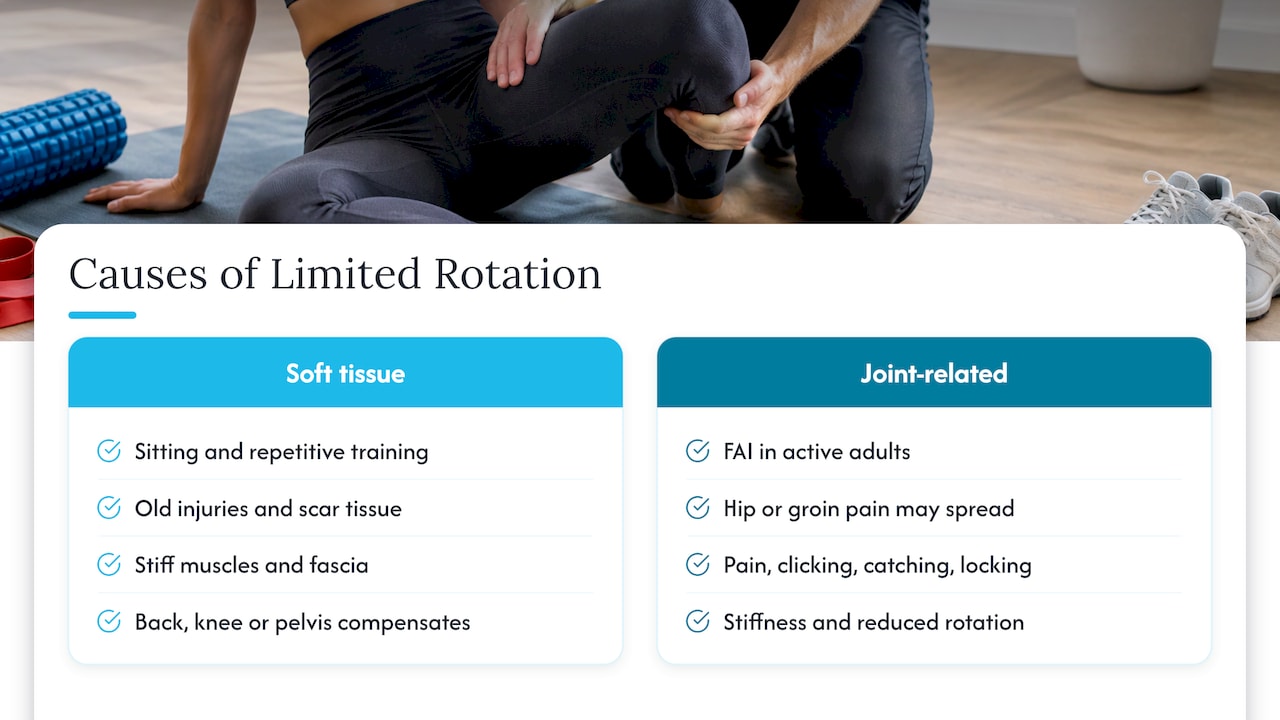
Soft tissue and movement causes. Long hours of sitting, repetitive training, old injuries and scar tissue can leave hip muscles and fascia (the connective tissue wrapped around muscle) stiff and guarded. The hip rotates less, and the lower back, knee or pelvis picks up the slack.
Joint causes. FAI is the main one in active adults. A 2025 review describes motion- or position-related hip or groin pain that may spread to the lower back, thigh and knee, with clicking, catching, locking and stiffness. Reduced internal rotation can also be present in FAI, and reviewers note it has been associated with arthritic changes on imaging in young athletes whose internal rotation measured under 10°.
For adults over 50, the 2025 hip osteoarthritis guideline lists internal rotation under 24°, or 15° less than the pain-free side, among its classification criteria, alongside morning stiffness under an hour and pain with weight-bearing.
Symptoms that come with it
- A pinching feeling at the front of the hip when you squat deeply
- Knees caving or one hip shifting in a squat (see our guide to hip shift in the squat)
- Hip drop or a twisting stride when running (hip drop when running)
- Low back tightness after sitting or after golf, tennis or baseball
- Groin or deep buttock ache with twisting
Why it matters for athletes, desk workers and students
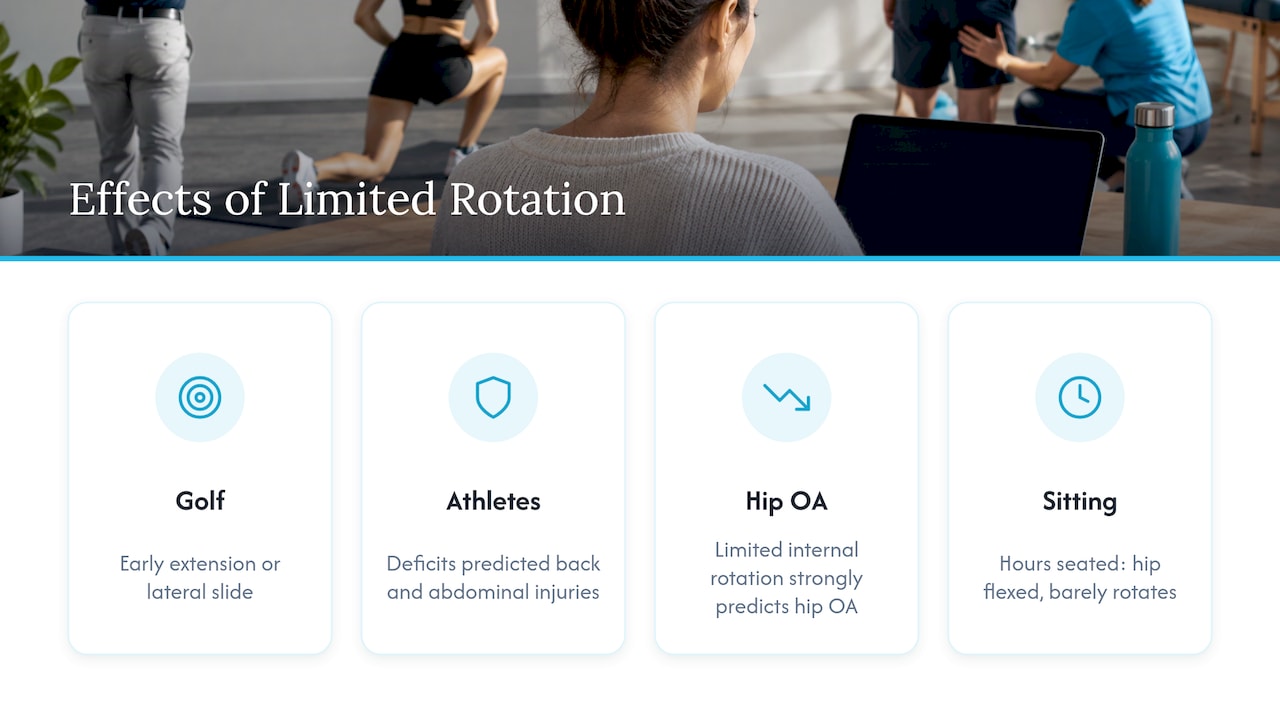
When the hip will not rotate, something else has to. Golf instruction describes the pattern as the body finding range elsewhere, such as early extension or a lateral slide. In the research, a study of athletes found internal rotation deficits predicted back and abdominal injuries, though not shoulder or elbow injuries.
The broader evidence is consistent. Reiman and Matheson report that people with FAI and labral tears tend to have reduced flexion, internal rotation and adduction, that limited internal rotation is a strong predictor of hip osteoarthritis, and that reduced abduction range has been suggested to predict future lower-limb injury.
For desk workers and students who sit for hours, the hip sits in flexion and barely rotates. For parents carrying kids and lifting on one side, asymmetry builds. Either way, the practical point is the same: a stiff hip is worth measuring before it becomes a back, knee or groin problem. Many of those patterns also appear in lower cross syndrome, where tight hip flexors and weak glutes work against each other.
Is it the hip joint or a pulled hip flexor?
They feel similar but behave differently. American Family Physician explains that pain in a muscle when it is stretched points to a strain, while groin pain suggests a problem inside the joint. Groin pain with a positive FABER test (the leg placed in a figure-four position) can mean either an iliopsoas strain or an intra-articular disorder, so the exam has to separate them.
A strained hip flexor usually hurts when you lift the knee against resistance or stretch the front of the hip. A joint-related restriction tends to produce a pinch or block at the end of rotation and may include catching or locking.
What a positive FADIR test means
FADIR stands for flexion, adduction and internal rotation. Lying on your back, the clinician bends your hip to 90°, draws the knee across the body and turns the lower leg outward. A review of FAI calls it positive if that final step reproduces your hip pain.
What it tells you is limited:
- The 2014 JOSPT guideline says FAI can be suspected when FADIR reproduces pain, internal rotation at 90° of flexion is under 20°, flexion and abduction are limited, and mechanical symptoms are present.
- A 2020 study found FADIR had 80% sensitivity but 25% specificity, while a restricted neutral-position internal rotation was better at confirming FAI. In plain terms, a negative FADIR makes FAI unlikely, but a positive one is not a diagnosis.
- There is no consensus on objective diagnostic criteria for FAI, which is why a positive result alone is not enough.
- When FAI is suspected, American Family Physician recommends an anteroposterior pelvis X-ray and a modified Dunn view rather than standard hip films.
See a physician promptly if you have groin pain that is getting worse, locking, a history of fracture or recent surgery, or pain at night or at rest. Those need a medical workup before any manual therapy or stretching.
How to improve limited hip internal rotation
The most common question is how to correct a lack of internal rotation. The evidence points to a sequence, not a single stretch.
- Find out what is limiting the hip. Soft tissue restriction, joint shape and arthritis call for different plans. Measuring both hips and comparing them gives you a baseline.
- Restore motion with hands-on care. The 2025 hip guideline recommends manual therapy, using soft tissue and joint mobilization, to improve range, pain and function in mild-to-moderate hip osteoarthritis with mobility impairment.
- Load the new range. The same guideline pairs manual therapy with an individualized exercise program, with sessions one to five times a week for 30 to 120 minutes over 5 to 16 weeks. Range gains tend not to last without exercise. A practical overview of maintaining joint mobility covers how active adults keep that motion.
- Retest. Measure again at follow-up and at discharge so you know the degrees changed.
Where self-stretching falls short
Self-mobilizations are adjuncts, not substitutes for skilled clinician care, and can be inappropriate when bone shape is the limit. The same source lists fracture history, recent surgery, blood thinners, worsening symptoms, loose ligaments and systemic illness as reasons not to self-treat. It also notes that supervised, prescribed home programs tend to outperform unsupervised exercise. If you are stretching a hip that pinches, the stretch is probably not reaching the problem.
Our perspective
Most people who come to us with a stiff hip have already stretched it for months. The hip is rarely a single-cause problem, so we start with an exam of how the hip, pelvis and low back share the work.
When the restriction sits in soft tissue, we use hands-on methods: the Fascial Distortion Model, myotherapy and individualized rehab plans. Our approach is built for cases that have not improved with standard medical or physical therapy approaches, and the aim is to restore function so you can get back to training, work and family life.
The guideline logic fits how we work: restore motion first, then build strength and control in the new range so it holds. A plan that does both beats either alone.
Chris
Hands-on care for a stiff hip in Plano
If your hip rotation is limited, a hands-on assessment tells you where the restriction sits and what to do about it. At The Tx Room in Plano, Texas, we treat musculoskeletal injuries, biomechanical imbalances and soft tissue injuries with the Fascial Distortion Model, and offer chiropractic care, soft tissue therapy, dry needling, deep tissue laser and MyACT focused shockwave. Insurance and self-pay are both accepted.
To see what care could look like, start with our chiropractic and soft tissue care. For related hip topics, read about chiropractic for hip pain, range of motion care and conservative treatment of hip labral tears.
FAQ
How do I correct a lack of internal hip rotation?
Start by identifying what is limiting the motion, then combine hands-on treatment with an individualized exercise program. Guidelines describe this staged approach, since range gains fade without strengthening. Stretching alone is not enough when the limit is joint-related.
Is limited hip internal rotation a sign of arthritis?
Not always, but it can be. Research lists limited internal rotation as a predictor of hip osteoarthritis, and the 2025 guideline uses a value under 24° as one classification criterion in adults over 50. An exam and, when indicated, imaging confirm what is going on.
What does a positive FADIR test mean?
It means the position reproduced your hip or groin pain. It makes FAI possible but does not diagnose it, since specificity is low. Your clinician combines it with range of motion, symptoms and imaging.
Can a tight hip cause low back pain?
Yes, it can contribute. When the hip rotates less, the spine and pelvis compensate. A study of athletes linked internal rotation deficits to back and abdominal injuries, so it is worth measuring the hips when back pain keeps returning.
Sources
- History and physical examination of the hip: the basics
- JOSPT 2023 nonarthritic hip pain guideline
- Physical Examination of the Hip: Assessment of Range of Motion (PMC)
- Physical Examination of the Hip (Current Reviews in Musculoskeletal Medicine)
- Top ten causes of non-arthritic hip pain
- 2025 hip osteoarthritis guideline, Koc et al.
- 2025 hip osteoarthritis guideline, full text
- Restricted hip mobility: clinical suggestions
- Hip Impingement, American Family Physician
- Nonarthritic Hip Joint Pain, 2014 JOSPT guideline
- Combining hip impingement and range of motion tests
- An Updated Review of Femoroacetabular Impingement Syndrome
- Camp et al., hip internal rotation deficits and injury in athletes