
Spinal Stenosis Pain Relief: What Helps and When to Get Care
Most spinal stenosis pain eases best with a combination of conservative steps: flexion-based movement, pacing your activity, and hands-on treatment that restores how the soft tissue around the spine moves. Surgery is rarely the first step. Recent guidance puts multi-modal conservative care first, and in Plano we build that care around manual therapy such as the Fascial Distortion Model, dry needling and an individualized rehab plan.
TL;DR
- Spinal stenosis is a narrowing of the spaces in the spine that can press on nerves. It often causes burning or cramping pain in the back or legs that is worse standing and walking and better sitting or bending forward.
- Current guidance favors conservative care first: manual therapy, supervised exercise and education ahead of medication.
- Daily habits matter: flexion-based exercise, pacing, a healthy weight and, if you smoke, quitting.
- Numbness or weakness that interferes with walking, or any bowel or bladder change, needs urgent medical care.
- If your pain has not improved with standard care, hands-on treatment in Plano is a logical next step.
Table of Contents
- What spinal stenosis is and why it hurts
- Start with what you can do every day
- What the guidelines say about conservative care
- Where hands-on treatment fits
- Who tends to benefit most
- A practical first-month plan
- Red flags: when to skip the clinic and get medical care
- Perspective
- Ready to get moving again?
- FAQ
- Sources
What spinal stenosis is and why it hurts
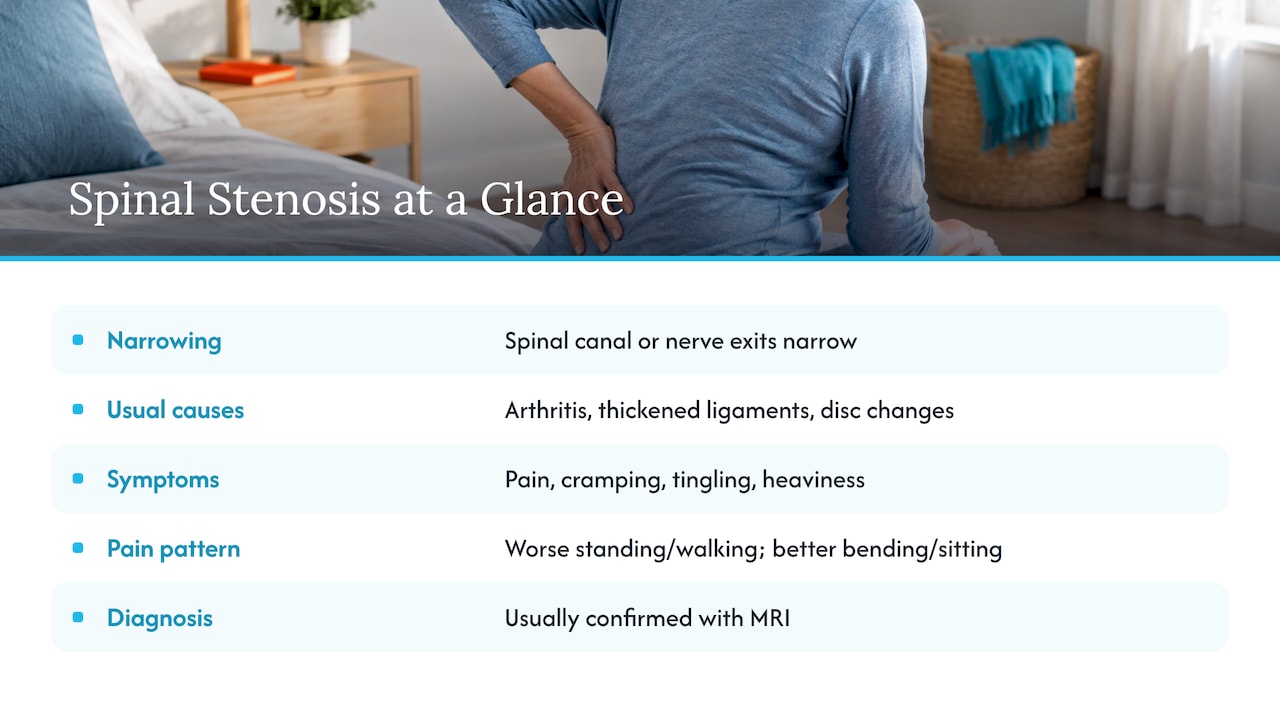
The spine is a stack of bones with a channel running through it for the spinal cord and nerve roots. Stenosis means that channel, or the openings where nerves exit, has narrowed. Arthritis, thickened ligaments and disc changes are the usual causes. When the nerves are squeezed, you feel it as pain, cramping, tingling or heaviness.
The pattern is distinctive. The American Academy of Family Physicians describes the pain of lumbar stenosis as typically burning or cramping, worse with standing and walking, and better with bending forward or sitting. That is why many people notice relief leaning on a shopping cart. Bending forward opens the spinal canal slightly and takes pressure off the nerves.
It is most common in older adults (the same review gives a mean age of 64), but workers with repetitive loading, former athletes with old spine injuries and people with long-standing posture problems also come in with stenosis-like symptoms. A scan, usually an MRI, is how a physician confirms the diagnosis.
Start with what you can do every day
The National Institute of Arthritis and Musculoskeletal and Skin Diseases (NIAMS) lists self-care steps that form the base of any plan:
- Exercise regularly, at least three times a week for 30 minutes.
- Modify or pace activities so you avoid your pain triggers.
- Use assistive devices if you need them for stable walking.
- Flex the spine to open the spaces and take pressure off nerves.
- Maintain a healthy weight and quit smoking.
The American College of Rheumatology adds that stenosis can cause a slow loss of leg strength, so regular exercise matters to keep you mobile. It suggests beginning with flexion-based exercises and slowly adding walking or swimming, while modifying heavy lifting or long walks.
Heat, ice and positions
Cleveland Clinic suggests ice or heat for 20 minutes on and 20 minutes off, with care to avoid burns when using heat. Check with a provider before starting an exercise program.
A note on neck stenosis
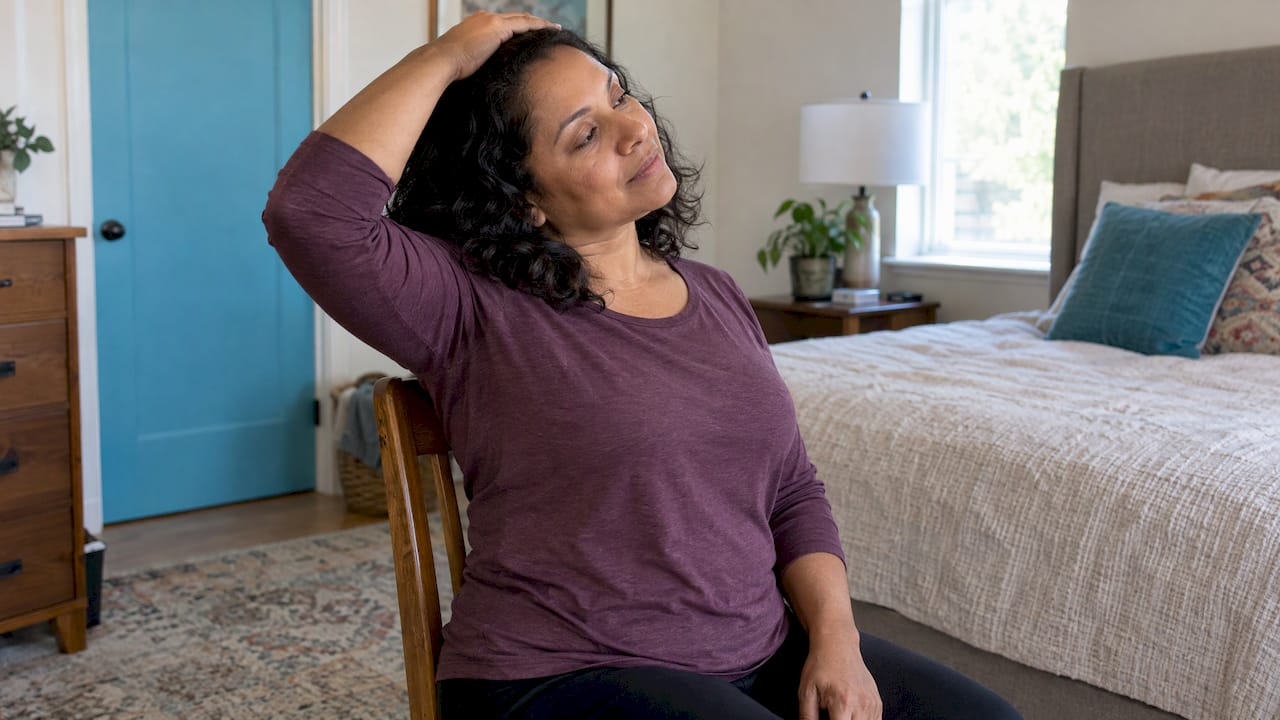
If the narrowing is in your neck, Kaiser Permanente advises changing positions often, supporting the neck with a pillow or towel roll at rest, and doing gentle neck side stretches and rotations held for 15 seconds. Follow your doctor’s instructions about activities that could injure the neck.
Gentle hip and posture work
Tight hips and a stiff trunk change how the lower spine loads. A simple hip mobility routine can be a low-effort daily addition, and a short daily posture plan is useful if you also have bone-density concerns. Keep both within your comfort and stop anything that sends pain or tingling down a leg.
What the guidelines say about conservative care
The AAFP’s 2024 guidance on chronic low back pain calls nonpharmacologic treatment first-line: exercise, physical therapy, massage, heat, acupuncture and spinal manipulation. A July 2025 review of recent clinical practice guidelines reports that multi-modal conservative care is recommended first for lumbar stenosis, combining manual therapy, supervised exercise and education, and that oral medicines are not recommended as first-line because of limited efficacy evidence and side-effect risk in older adults.
That matters for you in practical terms. Pills may take the edge off, but the approach with the strongest guideline support is hands-on work plus structured movement, which is what changes how you function day to day.
Medications, injections and surgery
These exist, and your physician decides on them. NIAMS notes that doctors may recommend surgery right away when numbness or weakness interferes with walking or bowel function is impaired. Epidural steroid injections are an option for short-term relief; the AAFP describes modest pain and function results at up to 3 weeks. Johns Hopkins Medicine notes that outside emergencies such as cauda equina syndrome, surgery is often the last resort.
A Mayo Clinic specialist notes that symptom severity, progression and response to earlier therapy should guide what comes next. If you have already tried standard care and are still limited, that is the point to look at a more focused hands-on approach.
Where hands-on treatment fits
Stenosis itself is a structural narrowing, but much of what you feel day to day comes from the muscles, fascia and joints around it: guarded hip flexors, tight glutes, restricted lumbar joints and irritated soft tissue. Those are the tissues manual therapy works on, and the ones that determine how well you can walk, stand and bend.
At The Tx Room in Plano we offer several hands-on options, and the plan is individualized:
- Fascial Distortion Model: a hands-on approach to soft tissue injuries and biomechanical imbalances.
- Dry needling: used for muscle-related pain and tightness.
- MyACT focused shockwave: a treatment for tissue that has stayed stubborn.
- Deep tissue therapy laser and soft tissue therapy.
- Chiropractic care for joint mobility and alignment.
Pain that radiates down the leg is often mistaken for, or overlaps with, sciatica. Our guides on sciatica stretches and red flags and sciatic leg pain in Plano explain the overlap. If your symptoms come from the small joints of the spine, the facet joint roadmap may also describe you.
Who tends to benefit most
Workers with repetitive strain. Hours of sitting or repeated lifting stiffen the hips and lower back. Hands-on soft tissue work, then activation exercises, addresses the loading pattern.
Athletes. Past injuries leave the trunk and hips compensating. Treatment aims to restore movement so you can return to activity, with a progressive plan rather than rest alone.
Busy parents. Short, targeted visits and a few daily movements fit a crowded week better than a long program you cannot keep up.
People with chronic pain. If you have cycled through medication or generic exercise without lasting change, a different kind of input, hands-on and individualized, is worth trying.
Students with posture problems. Posture-related back and neck pain responds to a mix of manual work and training habits. Our page on muscle activation therapy explains why stretching alone often is not enough.
A practical first-month plan
- Get a diagnosis. Confirm stenosis with your physician, since MRI is the study of choice.
- Rule out red flags (see below).
- Book an evaluation so your movement, joints and soft tissue are assessed and a plan is set.
- Begin hands-on treatment with short sessions focused on the tissues limiting you.
- Walk and flex daily. Short walks you can finish comfortably beat one long walk that flares symptoms.
- Track it. Note how far you can walk and how long you can stand before symptoms start. Those two numbers show progress better than a pain score.
Red flags: when to skip the clinic and get medical care
Get urgent medical care if you notice numbness or weakness that interferes with walking, loss of bowel or bladder control, numbness in the saddle area, or pain and weakness in both legs. These are the signs of cauda equina syndrome, which a peer-reviewed report calls a surgical emergency where delay can cause serious harm. Go to an emergency room. Also see a physician for new back pain with tingling or weakness in your limbs, or if your current treatment is not working, as Cleveland Clinic advises.
Perspective
Many people arrive having been told to rest, take an anti-inflammatory and wait. Stenosis is not something you fix with waiting. What we see as a better path is treating the tissue you can change: the fascia, muscle and joints that decide whether you can walk to the mailbox or finish a grocery run.
That is why we use hands-on methods like the Fascial Distortion Model, dry needling and focused shockwave, and why each plan is individualized. We focus on cases that have not improved with standard medical or physical therapy. The goal is simple: less pain, better function, and a faster return to the life you want to lead.
Chris
Ready to get moving again?
If stenosis symptoms are limiting your walking, work or training, we can evaluate where your pain is coming from and build a plan around it. The Tx Room in Plano offers chiropractic care, soft tissue therapy, dry needling, laser and shockwave under one roof. Start at our main page to book an evaluation.
FAQ
Can spinal stenosis be cured?
The American College of Rheumatology states there is no cure, but exercise, medication and surgery can relieve symptoms. Many people manage well with conservative care and stay active.
What should I avoid with cervical spinal stenosis?
Follow your doctor’s instructions about activities that could injure the neck, and avoid staying in one position for long. Support your neck with a pillow or towel roll at rest and use gentle stretches as Kaiser Permanente describes.
Is walking good for spinal stenosis?
Yes, for most people, built up gradually. The ACR suggests adding walking or swimming slowly after starting flexion-based exercises. Shorter, more frequent walks usually work better than one long one.
How many visits will I need?
It depends on your history and how long symptoms have been present. We set the plan after an evaluation and adjust it as you respond.
Sources
- Spinal Stenosis: Diagnosis, Treatment, and Steps to Take (NIAMS)
- Lumbar Spinal Stenosis: Diagnosis and Management (AAFP, 2024)
- Chronic Low Back Pain in Adults (AAFP, 2024)
- Spinal Stenosis (American College of Rheumatology)
- Spinal Stenosis (Cleveland Clinic)
- Cervical Spinal Stenosis: Care Instructions (Kaiser Permanente)
- Lumbar Spinal Stenosis (Johns Hopkins Medicine)
- Nonsurgical treatment options for lumbar spinal stenosis (Mayo Clinic)
- Multi-modal conservative care review (PMC, 2025)
- Cauda equina compression case report (PMC)