
Trigger Finger Treatment: What Works, and When to Escalate
Most trigger finger starts small and responds to early, consistent care: rest from the gripping that irritates the tendon, a splint, gentle movement, and hands-on soft tissue work. If the finger still catches or locks after a few weeks, a steroid injection or a short procedure usually settles it. The skill is knowing which step you are on. At The Tx Room in Plano, we work with hand and forearm overload every week, and the sooner the tendon is calmed down, the fewer steps you need.
TL;DR
- Trigger finger is a tendon that can’t glide smoothly through its sheath at the base of the finger. It often starts as morning stiffness and a click.
- Early treatment is non-surgical: rest from repetitive gripping, a splint, and gentle stretching, plus over-the-counter anti-inflammatories if your doctor says they are right for you.
- A steroid injection gives lasting relief in roughly 70% to 80% of cases. A finger that stays locked needs a medical evaluation.
- Hands-on soft tissue care aims at the overloaded tissue in the palm and forearm, and activity changes protect the result.
Table of Contents
- What trigger finger actually is
- Step 1: Rest and change what you grip
- Step 2: Splint, ice and over-the-counter relief
- Step 3: Gentle exercises and massage, done carefully
- Where hands-on soft tissue care fits
- When non-surgical care isn’t enough
- A quick guide to timing
- Protecting the result
- Our perspective
- Get a hands-on assessment in Plano
- FAQ
- Sources
What trigger finger actually is
Your finger tendons run through a tunnel-like sheath, held down by bands called pulleys. The first one, the A1 pulley, sits at the base of the finger in your palm. Per the Veterans Affairs health library, trigger finger is inflammation of the tendon and its lining that makes the tendon stick on that A1 pulley.
Mayo Clinic explains it the same way: part of the sheath swells, or a small nodule forms on the tendon, and the tendon can no longer glide. The ring finger and thumb are most often affected.
How it progresses
The symptoms tend to climb a ladder:
- Stiffness in the morning and a popping or clicking when you bend the finger.
- Tenderness or a small bump in the palm at the base of the finger.
- Catching, where the finger snaps straight from a bent position.
- A finger that locks bent and needs your other hand to straighten it.
Cleveland Clinic adds that the palm may feel sore near the base and the lump can be tender and warm.
Where you are on this ladder decides your plan. Stages 1 and 2 are the best time to act. Stages 3 and 4 may call for a medical procedure, covered below.
Who gets it
It is most common in women over 50, and the risk is higher with diabetes, low thyroid function or rheumatoid arthritis, according to Mayo Clinic. Cleveland Clinic lists most affected ages as 40 to 60 and also names osteoarthritis, gout and amyloidosis as risk conditions.
But it is not only a condition of older adults. Repeated forceful gripping, such as heavy tool use, can irritate the tendons, and the VA notes that the cause is often unknown. Desk workers who grip a mouse for hours, parents who carry kids and bags all day, lifters who grip heavy bars, and anyone with a hobby that means repeated hand use can all load the same tissue. Everyday tasks like typing, buttoning a shirt, using a key or gripping a steering wheel can become difficult as it progresses.
Step 1: Rest and change what you grip
The first treatment is also the one people skip. Kaiser Permanente’s patient guide recommends resting the finger for one to two weeks and changing activities so they are pain-free. It also says the problem may come back if the hand is not rested long enough or activities are not changed.
Practical ways to do that:
- Enlarge or soften your grips. Foam tubing on tool handles, a thicker pen, a wider bar or handle all lower the squeeze force your tendon has to pass through.
- Pad your hands. Kaiser suggests padded gloves for driving, biking, gardening and exercise machines. Mayo Clinic says the same when you can’t avoid repeated grasping or vibrating hand-held machinery.
- Break up long grip tasks. Alternate hands, take short pauses and put the phone on a stand.
- Watch the training load. Athletes who climb, row, golf, lift or play racquet sports should lower grip-heavy volume for a stretch rather than push through the catching.
If you are a busy parent, the most realistic change is usually how you carry things: switch to a shoulder or forearm carry for bags and car seats so the fingers aren’t doing the work.
Step 2: Splint, ice and over-the-counter relief
Splinting
A splint keeps the tendon from repeating the catch-and-release cycle. Yale Medicine says splinting, often at night, keeps the finger or thumb straight and limits movement to decrease pain and improve motion. Taping the affected finger to its healthy neighbor can have the same effect. A 2025 review in the Pomeranian Journal of Life Sciences recommends immobilizing the digit for 6 weeks, with 12 more weeks if it hasn’t resolved. Ask your clinician which splint position and schedule fit your finger.
Ice
Kaiser’s guide suggests icing for 10 to 15 minutes, 3 to 5 times a day, with a thin towel between skin and ice.
Anti-inflammatories
Mayo Clinic lists over-the-counter NSAIDs such as ibuprofen (Advil, Motrin IB) or naproxen sodium (Aleve) to relieve pain and inflammation, and notes some come as creams or patches applied where the problem is. If you have kidney disease, stomach ulcers, heart conditions or take blood thinners, check with your doctor or pharmacist before using any NSAID.
Mild cases can also improve on their own, Yale Medicine notes, which is why early rest and splinting are worth the small effort.
Step 3: Gentle exercises and massage, done carefully
The goal of movement is to keep the finger mobile without triggering it. Kaiser’s guide describes two basics:
- Passive wrist stretch. Put your palms together and lower them toward your waistline, holding 10 seconds.
- Finger-tip bending. Bend just the tip joint, then the tip and middle joints together, for 3 to 5 repetitions. Kaiser has people repeat the set 3 to 5 times a day, building toward hourly.
The rule that matters: stay below the point where the finger catches or locks. Forcing it through the snap is the opposite of resting the tendon.
On massage, the people-also-ask question is common. Light massage of the palm and forearm is fine if it is comfortable, but press gently over the tender bump rather than grinding into it. Stop and get evaluated if symptoms increase, or if you develop new numbness, tingling or pain that spreads, as Kaiser advises. Those signs point to something beyond a simple trigger finger, such as nerve involvement in the wrist or forearm.
Where hands-on soft tissue care fits
The finger is the place you feel it, but the tissue load often runs through the palm, forearm and wrist. A tendon that glides poorly can be sitting in a hand and forearm that are tight, overworked and full of sore trigger points. If you want to understand those tender spots, our guide to trigger points and how to treat them explains them in plain terms.
Hands-on care is built for this kind of problem. At The Tx Room, our work centers on the Fascial Distortion Model (FDM), a hands-on approach to soft tissue injuries. We use it alongside other soft tissue methods: myofascial release, dry needling and focused shockwave are among the tools we have. And because repetitive hand use is a common thread, we often look at the whole chain from neck to fingertips, not only the one digit.
Two related conditions are worth ruling out when hand symptoms linger. Numbness and tingling in the fingers can point to carpal tunnel, and a sore, achy tendon without catching may be tendinitis. A proper exam sorts these apart, and the plan differs for each.
When non-surgical care isn’t enough
If the finger keeps locking after a stretch of consistent rest, splinting and activity changes, medical options exist, and they work well. Mayo Clinic describes three:
- Steroid injection near or into the tendon sheath. It is often effective for more than a year, though sometimes more than one injection is needed.
- A needle procedure, where a sturdy needle breaks apart the blocking tissue after the palm is numbed. Ultrasound guidance can improve results.
- Surgery through a small incision near the base of the finger, which opens the narrowed sheath.
Injection numbers
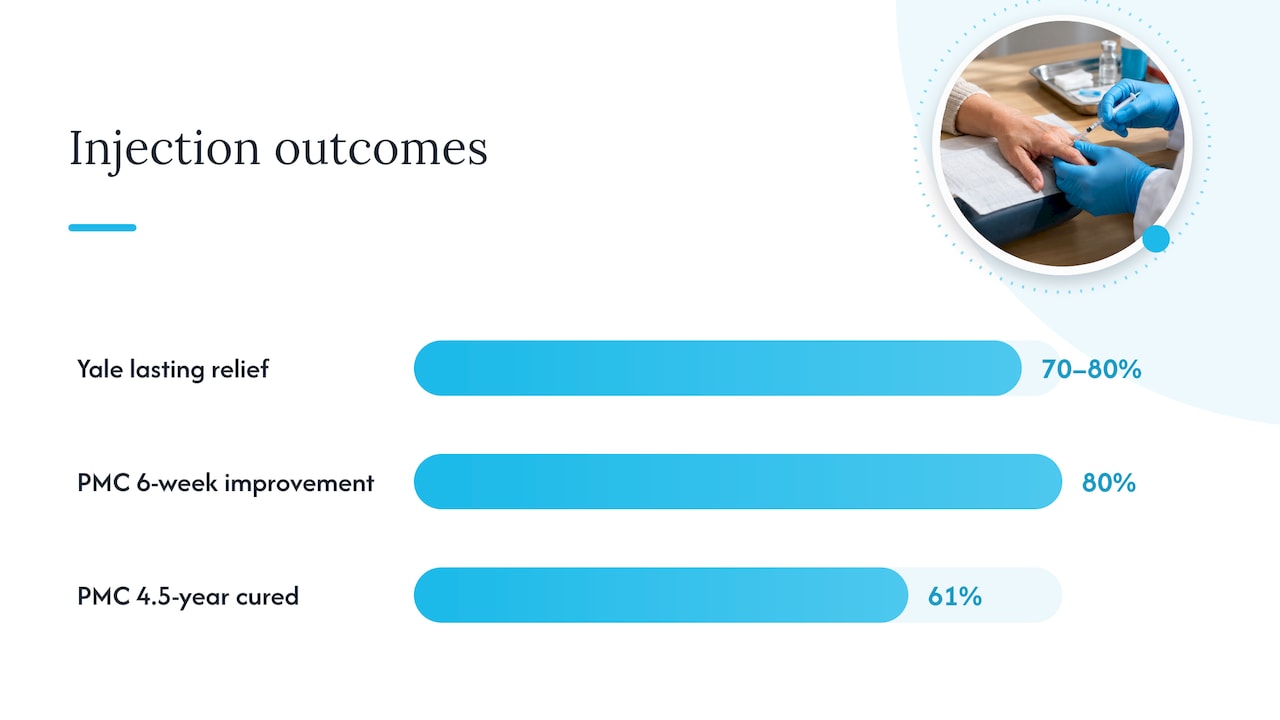
Yale Medicine reports lasting relief without surgery in about 70% to 80% of cases, and says injections may be less effective with diabetes or when several fingers are affected. A 2020 article in PMC followed 77 patients for an average of 4.5 years: 80% had complete or near-complete improvement at 6 weeks, and 61% were still cured at 4.5 years. A second injection is sometimes given if the first doesn’t fully work.
Release procedures
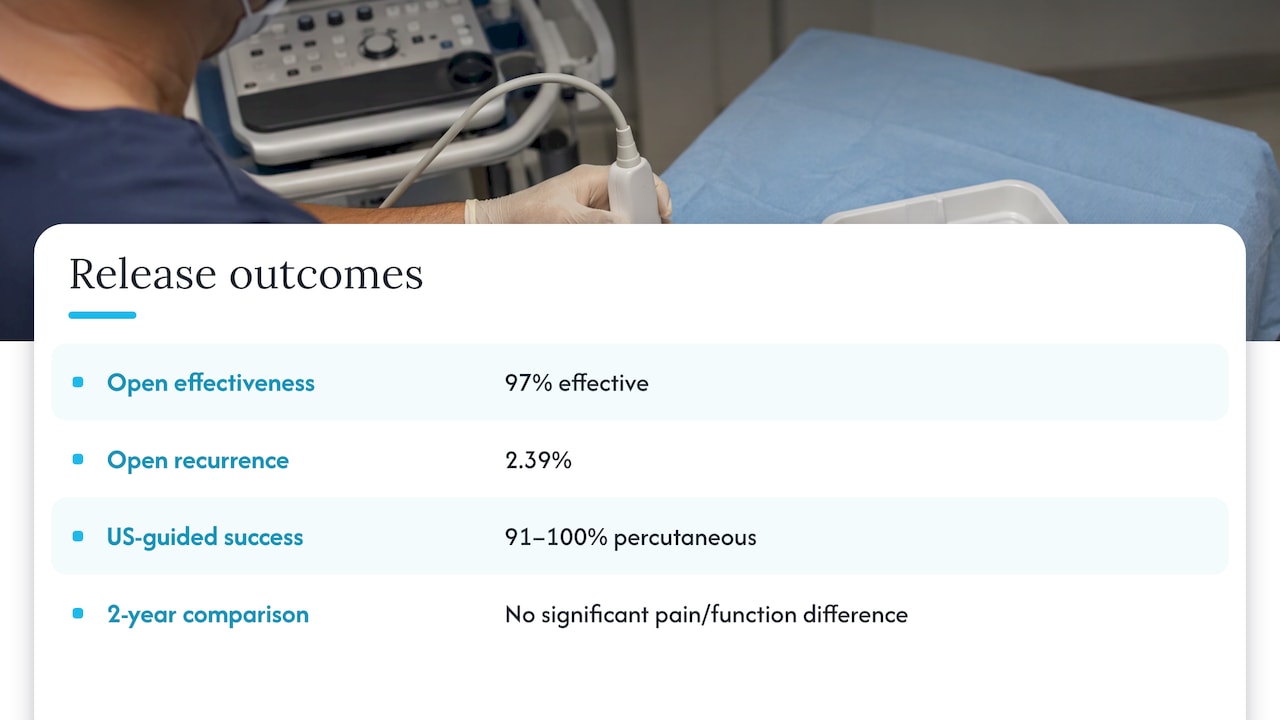
If the finger is locked bent or other treatment has failed, A1 pulley release may be recommended. Yale notes it has a high success rate and is usually done while the patient is awake. Two-year data from a retrospective comparison found no significant difference in pain or hand function scores between percutaneous (needle) and open release, with open surgery reported as 97% effective. A 2025 clinical review puts open release recurrence at 2.39% and notes ultrasound-guided percutaneous release success of 91% to 100%.
See a hand specialist or your physician promptly if the finger is locked bent and won’t straighten, if you have diabetes or rheumatoid arthritis (both change which option is likely to work), or if you notice numbness, spreading pain, redness, heat or swelling that doesn’t fit a simple catch. Those are medical questions, and the right professional is a physician.
A quick guide to timing
| Where you are | What to do |
|---|---|
| Morning stiffness, occasional click | Rest from heavy gripping, pad your grips, start gentle motion, book a hands-on exam |
| Tender bump in the palm, catching now and then | Add a night splint or buddy taping, ice, and soft tissue care for the palm and forearm |
| Frequent catching despite several weeks of care | Ask a physician about injection or a needle procedure |
| Finger locked bent | Get a medical evaluation soon |
| Numbness, tingling, spreading pain | Get evaluated to look for nerve involvement |
Treat the weeks as a guide, not a deadline: Kaiser’s rest period is one to two weeks, and the splinting literature runs six weeks or more. What matters is whether the finger is trending better, not how quickly.
Protecting the result
Recovery doesn’t end when the catching stops. The tendon will keep meeting the same loads you gave it before, so the habits that caused it need adjusting for good. Keep the grip modifications, build forearm and grip strength gradually and avoid sudden jumps in hand-heavy work or training. For a broader approach to returning to activity safely, see this guide on preventing future injuries.
If you have had surgery or an injection, follow your surgeon’s instructions on return to gripping and lifting. Scar tissue around the palm can leave tightness afterward, and our page on hands-on care for scar tissue covers what soft tissue work can do there.
Our perspective
Chronic hand overload is rarely about one finger. When someone comes in with a catching digit, we look at how they grip, how they work, how they train and what the palm and forearm are doing around that tendon.
Our approach is hands-on. We use the Fascial Distortion Model and individualized rehabilitation plans, and we focus on cases that haven’t improved with standard medical or physical therapy approaches. The idea is to get you back to your sport, your job and your kids sooner, with a plan built around your hands and your week.
The most useful thing you can do is start early. A finger that clicks in the morning is far easier to calm than one that locks.
Chris
Get a hands-on assessment in Plano
If your finger is catching, your hand is aching from repetitive work or training, or earlier care hasn’t helped, you can book a visit at The Tx Room. We treat musculoskeletal and soft tissue injuries with hands-on therapy for athletes and non-athletes alike, and we accept self-pay and insurance.

Learn more about the Fascial Distortion Model or visit The Tx Room to start.
FAQ
Can trigger finger go away on its own?
Mild cases can improve without treatment, according to Yale Medicine, and the NHS also notes it can get better on its own. Resting from heavy gripping and using a splint give the tendon the best chance. If it keeps catching or locks, get it evaluated rather than waiting.
How long does trigger finger treatment take?
It depends on the stage. Kaiser Permanente suggests one to two weeks of rest as a start, and a 2025 review recommends splinting for six weeks, and up to 12 more if needed. Injections often work within days to weeks, and the 2020 PMC series saw locking resolve in the first few weeks.
Is massage good for trigger finger?
Gentle massage of the palm and forearm can feel good and fits alongside rest and splinting. Keep pressure light over the tender bump and don’t force the finger through its catch. Stop and get evaluated if pain increases or numbness or tingling develops.
Do I need surgery for trigger finger?
Not usually at first. Surgery is considered when other treatments fail or the finger stays locked bent, and per Yale it has a high success rate. Many people avoid it, since injections give lasting relief in about 70% to 80% of cases.
Sources
- Trigger finger: Symptoms and causes, Mayo Clinic
- Trigger finger: Diagnosis and treatment, Mayo Clinic
- What Is Trigger Finger? Veterans Affairs
- Trigger Finger: Cleveland Clinic
- Trigger Finger: Yale Medicine
- Trigger Finger: Kaiser Permanente patient guide
- Pomeranian Journal of Life Sciences, 2025 review
- Trigger Finger? Just Shoot! PMC, 2020
- A Two-Year Retrospective Comparison of Clinical Outcomes, PMC, 2025
- Clinical Review of Trigger Finger in Pediatric and Adult Patients, PMC, 2025
- Trigger finger: NHS