
Wrist Pain From Typing: Causes, Relief and When to Get Help
Wrist pain from typing is usually an overuse problem: tendons, muscles and sometimes a nerve are being loaded in the same bent position thousands of times a day. Fixing your setup and taking breaks relieves many mild cases. If the pain lasts more than a week, keeps you from normal activity or comes with numbness and tingling, it is time for hands-on care. At The Tx Room in Plano, Texas, we treat soft tissue and repetitive strain problems with the Fascial Distortion Model (FDM), myotherapy and individualized rehabilitation plans.
This guide is for people who type, click and scroll for a living or for school: office workers, students, parents working at the kitchen table and athletes who also spend long hours at a keyboard. It explains what is going on in your wrist, what to change today, and how to tell when home care is no longer enough.
TL;DR
- Typing wrist pain usually comes from sustained awkward positions, tendon overload and too little movement, not from one single event.
- Keep wrists close to neutral, elbows bent about 90 to 120 degrees, and take a short break every hour at minimum.
- Pain, tingling or numbness that lasts more than a week, or that makes you skip activities or work, deserves a professional evaluation.
- Sudden numbness, weakness or loss of grip should be seen by a doctor promptly.
- If standard approaches have not fixed it, hands-on soft tissue care in Plano is the next step we offer.
Table of Contents
- Why typing makes your wrist hurt
- What your symptoms may be telling you
- Fix your setup first
- Relief at home for the first week
- When home care is not enough
- What hands-on care looks like in Plano
- Our perspective
- Book an evaluation
- FAQ
- Sources
Why typing makes your wrist hurt
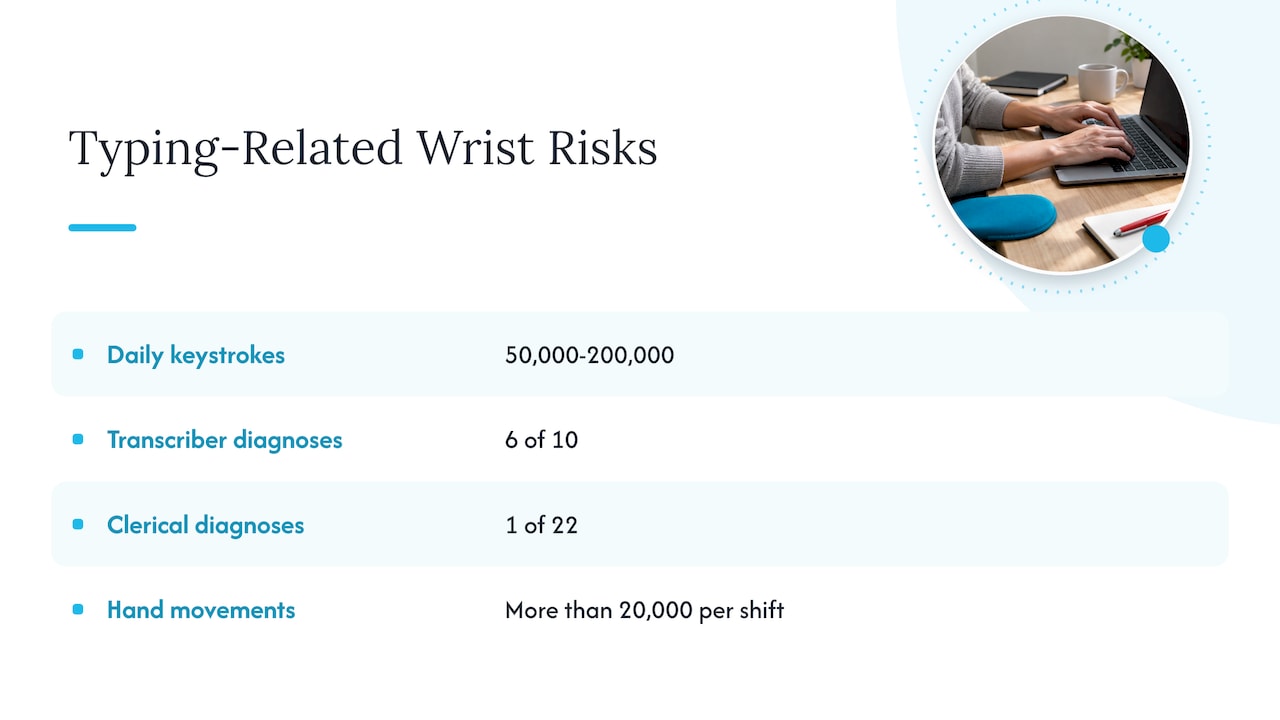
A keyboard worker may make 50,000 to 200,000 keystrokes a day, according to the University of Pittsburgh’s ergonomics office. Small movements repeated at that volume can upset the balance between the muscles, tendons and ligaments of the hand. When a tendon is stressed beyond what it can handle, it develops tiny tears and friction-driven inflammation, which is what tendinitis means.
The U.S. National Library of Medicine lists repetitive wrist motions such as typing among the risk factors for wrist problems. Typical symptoms include pain, swelling, reduced wrist strength and sudden numbness or tingling.
Posture adds to the load. A Tulane University safety fact sheet explains that tendonitis develops when a tendon is overused, especially with the wrist in an awkward position, as in long typing or mouse sessions. The same sheet notes that resting your wrists on a hard desk edge adds contact stress.
A classic federal workplace investigation shows how strongly this can cluster. In a NIOSH health hazard evaluation of police transcribers in the mid-1980s, six of ten transcribers reported a diagnosis of carpal tunnel syndrome or tendonitis, compared with one of 22 other clerical staff. The report linked the problem to more than 20,000 hand and wrist movements per shift and to excessive wrist extension caused by improper chair and keyboard height. Your workload is probably lighter than that, but the mechanism is the same: repetition plus a bent wrist.
What your symptoms may be telling you
Where and how it hurts gives clues. These are general patterns, not a diagnosis.
| What you feel | What it may point to |
|---|---|
| Dull ache or soreness in the wrist or forearm after long sessions, easing with rest | Muscle and tendon fatigue from sustained posture |
| Sharp or burning pain on the thumb side, worse when gripping or moving the thumb | Tendon irritation, such as the thumb-side tendinitis often called mommy thumb |
| Tingling or numbness in the thumb, index, middle and half of the ring finger | Irritation of the median nerve in the carpal tunnel |
| Pain that travels up the arm, or wrist symptoms with neck or elbow pain | Nerve irritation higher up the arm |
| Swelling, warmth or loss of strength | A reason to get examined rather than wait |
The carpal tunnel row deserves a closer look. A peer-reviewed review explains that wrist flexion during nighttime, driving, phone use and typing raises pressure on the median nerve and produces the burning, tingling pattern in those fingers. If that sounds like you, our page on carpal tunnel in Plano explains more.
Does typing actually cause carpal tunnel syndrome?
This is a point where the science has shifted. A 2024 clinical practice guideline summary from the American Academy of Orthopaedic Surgeons and the American Society for Surgery of the Hand states that, without reliable evidence, the workgroup’s opinion is that high keyboard use is not associated with carpal tunnel syndrome. Carpal tunnel syndrome itself is common. The American Family Physician reports it occurs in 1% to 5% of the general population, and women are affected about three times as often as men.
For you, the practical point is simple. Your aching wrist after a long typing day does not need a carpal tunnel diagnosis to be real. Tendon overload, muscle tension and awkward positions can all hurt, and all respond to changing how you work and to treatment.
Pain in the wrist is not always from the wrist
The University of Pittsburgh’s ergonomics office points out that nerve compression can occur anywhere between neck and hand, so pain felt in the elbow, wrist or hand can originate at the neck or elbow. That is why a good evaluation traces the problem along the whole arm instead of looking only at the sore spot. If your neck and shoulders are also tight from desk work, our guide to desk ergonomics for neck pain covers the upstream part of the chain.
Fix your setup first
Setup changes cost little and help whatever else you do. The numbers below come from U.S. federal and university ergonomics programs.
- Keep wrists near neutral. NIOSH, part of the CDC, advises that wrists be as close to neutral as possible with elbows at 90 to 120 degrees, and that forearms and wrists avoid unpadded, cornered edges.
- Keep forearms parallel to the floor. The University of Washington’s workstation guidelines call for elbows bent 90 to 110 degrees, wrists straight or slightly flexed downward, and for resting your palms, not your wrists, on a wrist rest so soft tissue is not compressed.
- Lower the keyboard if your wrists bend up. MedlinePlus advises keeping the keyboard low enough that your wrists do not bend upward, and resting your hands at your sides during breaks.
- Float, do not anchor. Rest the wrist rest only during pauses. While typing, move the whole forearm instead of pivoting from the wrist.
- Mind the mouse. Keep it close to the keyboard so your arm does not reach out, and keep your wrist straight rather than propped on its heel.
- Check your laptop. A laptop on your lap or a low table forces wrists up and necks down. These laptop ergonomic tips show how to raise the screen and bring your hands to a better angle.
Breaks matter as much as position
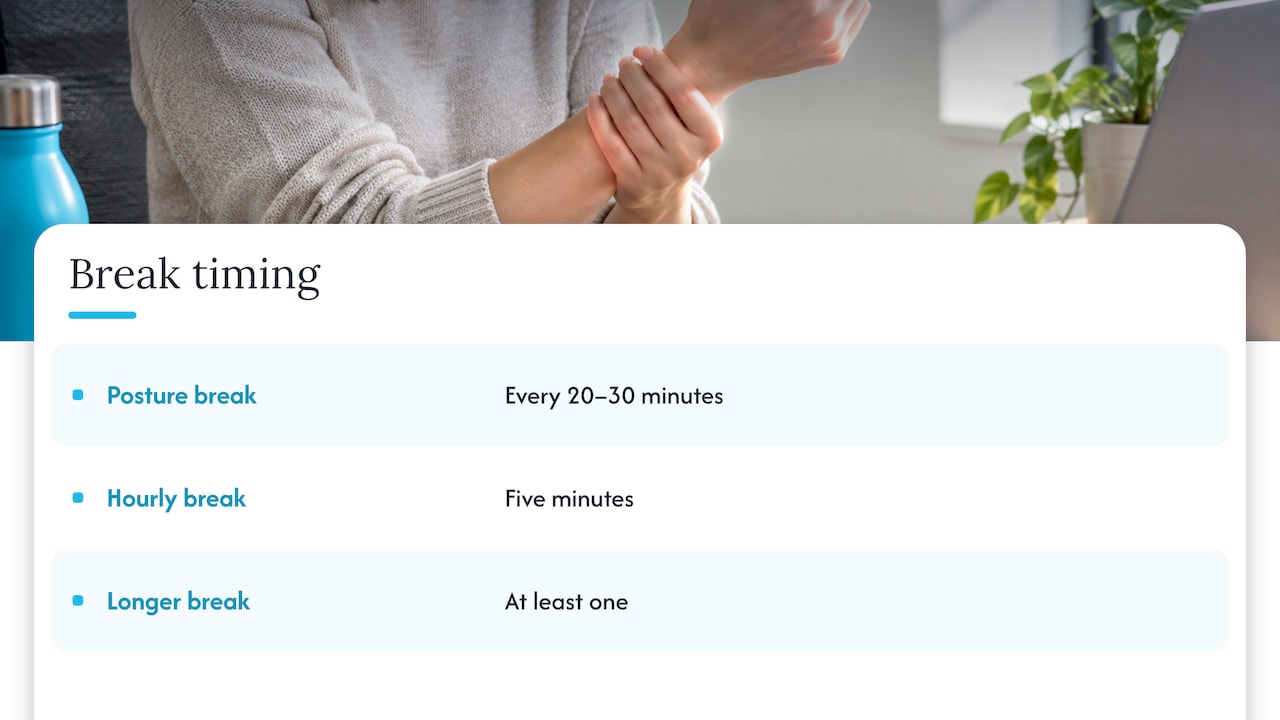
No posture stays comfortable for hours. UCLA’s ergonomics program recommends a break from any sustained posture every 20 to 30 minutes. NIOSH research found that musculoskeletal discomfort dropped significantly when regular rest breaks were supplemented with hourly five-minute breaks and at least one longer break.
A workable routine: set a timer, stand up, shake out your hands, open and close your fists a few times, and walk for a minute or two. Students cramming for exams and parents answering emails between school runs tend to skip this, and that is when symptoms build.
Relief at home for the first week
For mild pain, MedlinePlus suggests frequent breaks, over-the-counter pain relievers such as ibuprofen, naproxen or acetaminophen, and warm or cold compresses a few times a day. It also mentions typing pads, split keyboards and wrist splints. For a recent injury, it advises elevating the wrist above heart level and applying cloth-wrapped ice for 10 to 15 minutes every hour on the first day, then every 3 to 4 hours.
Tulane’s fact sheet gives a similar acute plan: rest from aggravating activities, ice for 15 minutes every 1 to 2 hours, and avoid heat for the first 48 hours of an acute injury. It also advises avoiding wrist extension at night, sleeping on your back and considering a night splint. It says to contact a healthcare provider if symptoms persist after two to three days.
Use pain medicines as labeled, and ask your doctor or pharmacist first if you have kidney, stomach or heart conditions, take blood thinners or are pregnant. A splint should be fitted and used as a doctor or therapist instructs: UCLA recommends splints and wrist supports only after instruction by a physician or therapist.
When home care is not enough
There are two thresholds worth knowing.
Get examined soon. California’s Department of Industrial Relations advises seeking care when musculoskeletal symptoms last more than a week or limit your activities or work, and notes that the longer symptoms go without help, the harder they can be to treat. A week of better posture and breaks that changes nothing is your signal.
See a doctor promptly. Sudden numbness, visible swelling, a hand that feels weak or drops things, pain after a fall or injury, or symptoms alongside fever or a known condition such as rheumatoid arthritis call for a medical evaluation. Diagnosis can involve a history, a physical exam of strength and range of motion, and sometimes x-ray or other imaging. In more severe carpal tunnel cases, such as muscle wasting at the base of the thumb or positive nerve testing, guidelines point toward surgical referral.
Between those two extremes sits a large group: people whose wrist has been sore for weeks or months, who have stretched, bought the ergonomic keyboard and rested, and still feel it every afternoon. That is where hands-on treatment makes sense.
What hands-on care looks like in Plano
The Tx Room is a specialized chiropractic center in Plano focused on musculoskeletal injuries and biomechanical imbalances. We work with athletes and non-athletes, and we place particular focus on cases that have not improved with standard medical or physical therapy approaches. For a typing-related wrist problem, the tools we use include:
- Fascial Distortion Model (FDM): a hands-on approach to soft tissue injuries that aims to relieve pain and restore function.
- Soft tissue therapy and chiropractic care: manual work to address the muscles and joints around the wrist, forearm, neck and shoulder.
- Dry needling: one of the options in our soft tissue toolkit.
- MyACT focused shockwave: a therapy we offer for stubborn soft tissue problems.
- Deep tissue therapy laser: another option within individualized treatment plans.
We do not publish prices, and we accept both self-pay and insurance. The first visit includes an exam, because the treatment depends on where the problem really starts.
If your pain sits in a specific spot, these pages may help: hand pain, tendinitis and tennis elbow, which often shows up alongside wrist and forearm overload.
Our perspective
Most people who come to us with typing-related wrist pain have already done the sensible things. They raised the monitor, bought a wrist rest, and downloaded a stretching routine. The pain is still there because the tissue itself has become irritated and restricted, and no desk accessory changes that.
That is why we work with our hands. In our practice, the Fascial Distortion Model gives us a way to find and treat the specific soft tissue distortions behind a painful wrist, instead of only calming the area down. We build the plan around you: your job, your sport, your kids, your week.
Our advice is to treat the setup and the tissue together. Fix the desk so you stop re-irritating the area, and get the tissue treated so it can recover. If you have waited longer than a week, there is no reason to keep waiting.
Chris
Book an evaluation
If your wrist has been hurting for more than a week, or you have tried the basics and it keeps coming back, our team in Plano can examine the whole arm and build a treatment plan around your daily routine. We use hands-on therapies including the Fascial Distortion Model, and we accept both self-pay and insurance. You can see everything we offer and request a visit on our Plano chiropractic care page.

FAQ
Is it normal for my wrists to ache after typing all day?
Mild soreness after a long session is common and usually reflects sustained posture and tired tendons. It should ease with rest, breaks and a better setup. If it lingers for more than a week, returns every day or comes with tingling or weakness, get it evaluated.
How can I relieve wrist pain from typing right now?
Stop the aggravating activity, keep your wrist neutral, and use cloth-wrapped ice for 10 to 15 minutes if the area is sore or swollen. MedlinePlus also lists over-the-counter pain relievers and splints as options. Take a short break every hour, and book an evaluation if it does not improve within a week.
Why does my wrist hurt when I play on the keyboard?
The cause is the same as with work typing: repetition, a bent or unsupported wrist and long stretches without a break. Gaming and music practice often add fast, forceful finger movements and sessions that run for hours. Adjust the keyboard height, rest your palms between rounds or songs, and take regular breaks. Persistent pain is worth having examined.
Does mouse arm or computer wrist pain go away on its own?
Mild cases often settle once you reduce the load and fix the setup. Pain that continues past a week, or that restricts your activities, is less likely to resolve by waiting, and California’s occupational health guidance notes that symptoms get harder to treat the longer they go without help. Hands-on soft tissue care can address what rest alone does not.
Should I wear a wrist splint while typing?
Splints can help in some cases, particularly at night, but they should be fitted and used as instructed by a physician or therapist. A peer-reviewed review notes that prolonged bracing can contribute to wrist muscle weakness, so how long you wear one matters. Have your wrist examined so the plan matches the cause.
Sources
- MedlinePlus: Wrist Injuries and Disorders
- MedlinePlus Medical Encyclopedia: Wrist pain
- NIOSH Health Hazard Evaluation Report 1984-417-1745
- NIOSH: Working from Home, How to Optimize Your Work Environment
- Tulane University OEHS: Wrist Injuries fact sheet (2023)
- University of Pittsburgh: Musculoskeletal Disorders, Anatomy of an Injury
- UCLA Ergonomics: Preventing Musculoskeletal Disorders and Repetitive Strain Injuries
- University of Washington EHS: Computer Workstation Adjustment Guidelines
- AAOS/ASSH Clinical Practice Guideline Summary on carpal tunnel syndrome (2024)
- American Family Physician: Carpal Tunnel Syndrome (2025)
- Carpal Tunnel Syndrome: Pathophysiology and Comprehensive Management (PMC, 2022)
- California Department of Industrial Relations: Ergonomic Hazards
- Laptop ergonomic tips to prevent and reduce pain