
Sports Injury Chiropractic in Plano: What It Treats and When to Go
Sports injury chiropractic is hands-on care for the sprains, strains, joint pain and soft tissue problems that come from training and competition. It works best when it is matched to a specific injury, delivered by a trained clinician, and paired with active rehabilitation. At The Tx Room in Plano, Texas, we treat athletes and active people with the Fascial Distortion Model (FDM), myotherapy and individualized rehab plans. This guide explains what chiropractic can do for a sports injury, what a course of care looks like, and when you should see a medical doctor first.
TL;DR
- Chiropractic care can help with minor sports injuries and specific problems such as ankle sprains, plantar fasciitis, rotator cuff and shoulder soft tissue issues, and tennis elbow.
- Care works best as part of a plan: hands-on treatment to restore movement, then exercise to rebuild strength and keep the injury from returning.
- Mild soreness after treatment is common and usually passes quickly. Severe pain, numbness, weakness or head and neck trauma call for medical evaluation first.
- Children and teens with back pain should see a medical doctor before any chiropractic treatment.
- We combine FDM, myotherapy, shockwave, dry needling and laser therapy in Plano for injuries that have not improved with standard approaches.
Table of Contents
- Can a chiropractor help with a sports injury?
- Which sports injuries respond best
- What a sports injury visit involves
- How we treat: FDM, myotherapy and focused tools
- Chiropractic in the return-to-sport process
- Do pro athletes use chiropractors?
- Safety: what to know before an adjustment
- Young athletes: see a doctor first
- Perspective
- Book sports injury care in Plano
- FAQ
- Sources
Can a chiropractor help with a sports injury?
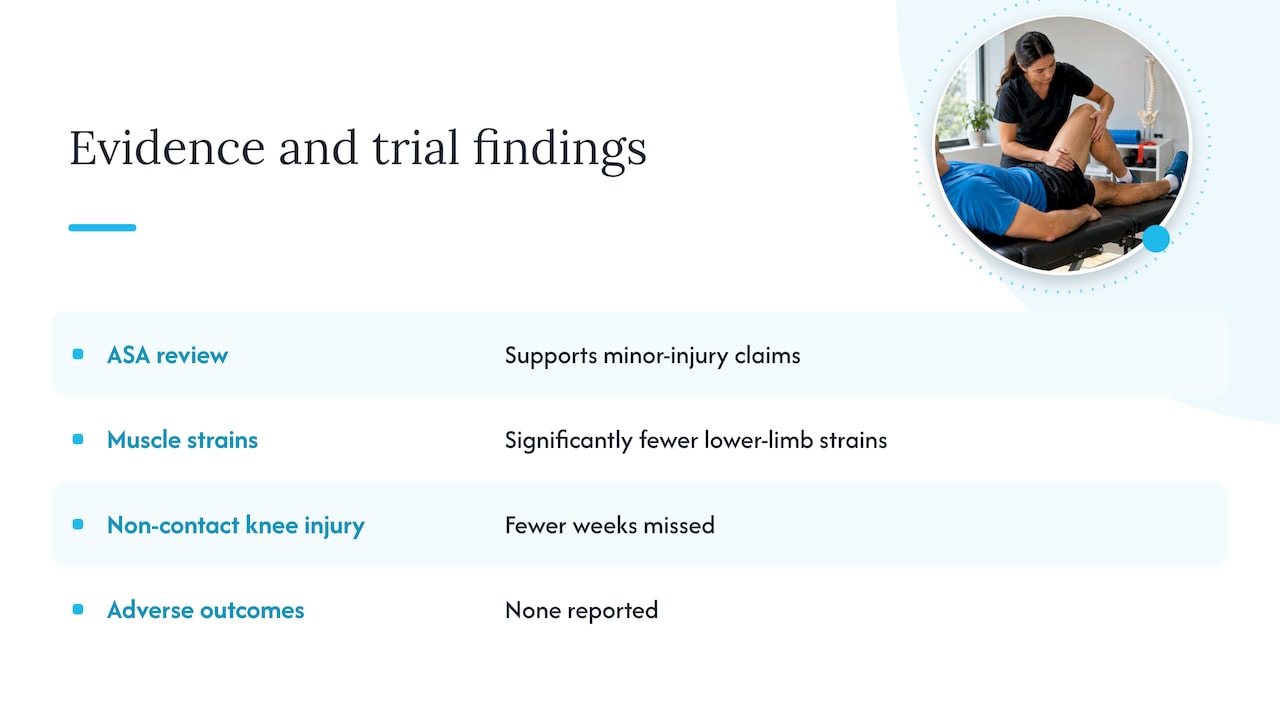
Yes, for the right injuries. The UK’s Advertising Standards Authority reviewed the evidence behind chiropractic marketing claims and found it sufficient to support claims for minor sports injuries and specific conditions. Those include joint pain, muscle spasm and cramp, cervicogenic headache, rotator cuff injuries, soft tissue disorders of the shoulder, short-term management of ankle sprains and plantar fasciitis, and tennis elbow linked to back and neck conditions.
That list matches what we see in an active population. Runners with foot pain, tennis and pickleball players with elbow trouble, lifters with shoulder irritation, and weekend athletes with a rolled ankle all fit the pattern: a soft tissue or joint problem that responds to skilled hands-on work and a targeted rehab plan.
There is also research on athletes themselves. A randomized controlled trial in semi-elite Australian Rules footballers found that a sports chiropractic manual therapy program was linked to significantly fewer lower limb muscle strain injuries and fewer weeks missed from non-contact knee injury, with no adverse outcomes reported.
The practical takeaway: the question to ask is not “Do I have a sports injury?” but “What exactly is injured, and what does it need?” A good clinician starts there.
Which sports injuries respond best
Here is how the common problems we see in Plano line up with the evidence and with the care we provide.
| Injury or complaint | How hands-on care helps | Related care at The Tx Room |
|---|---|---|
| Ankle sprain | Restores joint and soft tissue movement in the short term, then rehab rebuilds stability | High ankle sprain rehab, chronic ankle instability |
| Plantar fasciitis | Addresses foot and lower leg tissue restrictions | Shockwave, FDM |
| Tennis elbow | Treats the elbow and the neck and back contributors | Chiropractic for tennis elbow |
| Shoulder and rotator cuff irritation | Improves joint motion and soft tissue quality | Myotherapy, dry needling |
| Muscle strains, spasm, cramp | Releases tight tissue and restores range of motion | Active release, myofascial release |
| Tendinitis | Reduces load-related irritation in the tendon and surrounding tissue | Tendinitis care |
Sciatica and repetitive strain are also common reasons athletes and desk workers come in. Because back and neck pain after a significant injury can have several causes, we assess first and treat only what the exam supports.
What a sports injury visit involves
A course of care usually follows the same logic whatever the injury.
- History and exam. We ask how the injury happened, what aggravates it, what you do for sport and work, and what you have already tried. We test movement, strength, joint motion and the tissue around the painful area.
- A working diagnosis. If the findings point to something that needs imaging, a medical specialist or an emergency evaluation, we say so and refer you.
- Hands-on treatment. Depending on the injury, this may be a chiropractic adjustment, soft tissue work, FDM, myofascial release or active release technique.
- Added tools when they fit. Focused shockwave, dry needling and deep tissue laser can help stubborn tissue that is slow to settle.
- Rehabilitation. Exercise and movement retraining rebuild the capacity of the injured area, so you return to sport with a stronger base than before.
- Re-evaluation. We re-check at each visit and adjust the plan. If something is not changing, we change the approach.
How many visits you need depends on the injury, how long it has been present and how you respond. We do not publish set prices or fixed visit counts for every case, because a fresh ankle sprain and a two-year-old shoulder problem do not follow the same road. Contact us for current fees and insurance questions.
How we treat: FDM, myotherapy and focused tools
The Tx Room is built around hands-on manual therapy. Our core approach is the Fascial Distortion Model, a method that treats soft tissue injuries by identifying specific fascial distortions and correcting them with targeted manual techniques. We use it for athletes and non-athletes alike, and it is often the piece that moves a case forward when standard medical or physical therapy has stalled.
Around that core we offer:
- Myotherapy for muscle and trigger point problems.
- MyACT focused shockwave for tissue that needs a stronger stimulus, and shockwave treatment for active patients working through tendon and fascia issues.
- Dry needling for tight, painful muscle.
- Deep tissue therapy laser as part of soft tissue care.
- Active release treatment and myofascial release, which pair well with rehab.
We choose among these based on your exam, not a fixed package. Recovery tools outside the clinic are a common question too: if you are curious about compression therapy evidence, it is a reasonable topic to raise at your visit so we can fit it into your plan.
Chiropractic in the return-to-sport process
Returning to sport is a staged process, and manual therapy is one part of it. Case reports show how that can look with a coordinated team. In one elite speed skater with an L5-S1 disc protrusion, conservative chiropractic management inside a multidisciplinary framework led to a full return to competition within 4.8 months, with no recurrence at 12 months. In another case, a master’s-level endurance athlete with a femoral neck stress fracture avoided weight-bearing for 8 weeks, cross-trained, saw her chiropractor weekly, and returned fully to sport one month after discharge.
These are individual cases, not promises, but they show the pattern we follow: protect the injury, keep the rest of the body training, restore movement, then load progressively.
Chiropractors with postgraduate sports training can also take on wider roles. The American Chiropractic Board of Sports Physicians states that doctors with postgraduate education and ACBSP certification are qualified to perform pre-participation examinations and clearance decisions. If you are returning to a team sport, ask about the clinician’s training in sports care.
Do pro athletes use chiropractors?
Many do. Fox News reported that Cleveland Browns cornerback Denzel Ward works with a husband-and-wife chiropractic team who have also treated several other NFL players, and that professional treatment schedules often run two to three times a week, or nearly daily during an in-season injury.
You do not need an NFL schedule to benefit. The lesson from the pros is consistency and integration: regular hands-on care, paired with strength and conditioning, and early attention to small problems before they become missed games. For a recreational athlete in Plano, that often means a short, focused course of visits plus a home exercise plan. Our page on how athletes in Plano do well with chiropractic care goes deeper, and six sports chiropractor benefits explains what to expect without exaggeration.
Safety: what to know before an adjustment
Chiropractic is widely used and, for most patients, well tolerated. Knowing the specifics helps you use it well.
Expect mild, short-lived soreness. A review of the literature found that mild, transient effects such as localized pain are reported by about half of patients. Most people feel a little sore or stiff for a day or so, much like after a new workout.
Tell us about red flags. Go to an emergency room or see a medical doctor first if you have:
- Severe or worsening neck or back pain after a fall, collision or hard tackle
- Numbness, tingling or weakness spreading into an arm or leg
- Loss of bladder or bowel control
- A possible concussion or head injury
- Sudden severe headache, dizziness, trouble speaking or vision changes
Acute disc and nerve injuries need careful assessment. A case report in Frontiers in Neurology noted that manipulative therapy is contraindicated in the acute phase of a disc or nerve root injury, and that risk assessment and re-evaluation at every visit are the safeguard. That is how we work: we screen at the first visit and re-check at each one, and we choose techniques that suit what the exam shows.
Check training. We explain what to look for in our guide on whether chiropractic is safe for Plano patients.
Young athletes: see a doctor first
Parents often ask about care for a teen who plays club soccer, baseball or gymnastics. The American Academy of Pediatrics advises that any child with back pain should be examined by a medical doctor before chiropractic treatment. It also cautions that vigorous spinal manipulation in a young person who may have a hypermobile spine must be done with caution, if at all, and that some cases need specialist input such as imaging or prescription medicine.
We follow that guidance: a medical evaluation first when back pain is involved, then gentle, appropriate soft tissue and rehab care alongside it. For throwing athletes, our approach also respects the growth and workload issues covered in this baseball arm injuries guide for parents and coaches. Read more about chiropractic care for kids in Plano.
Perspective
Most athletes come to us after weeks of rest, stretching or generic therapy that did not fully fix the problem. In our experience, the missing piece is often precise, hands-on work on the tissue that is actually restricted, followed by exercise that fits the sport.
That is why we built the clinic around the Fascial Distortion Model and myotherapy. We want to find the specific distortion or restriction, correct it, and get you moving well again, whether you are a competitive athlete or a parent who wants to keep up with the kids.
Our plans are individualized. We reassess at every visit, we refer out when something needs a medical doctor, and we pair treatment with rehab so the improvement holds.
Chris
Book sports injury care in Plano
If you are dealing with a sprain, strain, tendon problem, sciatica or a stubborn injury that has not improved, we can examine it and build a plan around it. Our care combines chiropractic, soft tissue therapy, FDM, shockwave, dry needling and laser, and we accept both self-pay and insurance.
Visit The Tx Room to schedule an initial exam, or learn about the Fascial Distortion Model first.
FAQ
Can a chiropractor help with sports injuries?
Yes. Evidence supports chiropractic care for minor sports injuries and specific conditions such as ankle sprains, plantar fasciitis, rotator cuff problems and tennis elbow. The best results come when treatment targets a specific diagnosis and is combined with rehabilitation exercise.
When should you not get adjusted by a chiropractor?
See a medical doctor first after significant trauma, or if you have severe pain, numbness, weakness, loss of bladder or bowel control, or symptoms of a head injury. An acute disc or nerve root injury also needs careful assessment before any manipulation. A chiropractor should screen for these at your first visit.
Do NFL players use chiropractors?
Many do. Reports describe NFL players working with chiropractors two to three times a week, and nearly daily during an in-season injury. Their care sits inside a wider recovery team that includes strength and conditioning.
What is the most common side effect of chiropractic treatment?
Mild, temporary soreness or stiffness in the treated area, which affects roughly half of patients and typically settles quickly. Tell your chiropractor about any symptom that is severe, new or lasting so they can re-evaluate before continuing.
Sources
- Chiropractic: ASA review and guidance for marketing claims
- The effect of a sports chiropractic manual therapy intervention on lower limb injuries (BMC Musculoskeletal Disorders, 2010)
- Chiropractic management of L5-S1 disc protrusion in an elite speed skater
- Femoral neck stress fracture in a female athlete: a case report
- The American Chiropractic Board of Sports Physicians position statement
- Chiropractors for Denzel Ward and other professional athletes (Fox News)
- Chiropractic Care: Attempting a Risk-Benefit Analysis
- Upper Trunk Brachial Plexus Palsy Following Chiropractic Manipulation
- Sports Medicine Professionals (American Academy of Pediatrics)
- Baseball Arm Injuries: A Parent and Coach Guide
- Compression Therapy: 4 Medical Uses Backed by Evidence