
Chiropractic for an Ankle Sprain: What Helps and When to Go
Yes, a chiropractor can be a useful part of ankle sprain recovery, as long as the injury is a true sprain and not a fracture or a complete rupture. The best evidence supports hands-on care (gentle joint mobilization and soft-tissue work) combined with exercise, not hands-on care by itself. If you cannot put weight on the foot, or the ankle looks deformed, get it checked by a medical doctor first. This guide covers what the research shows, what a visit involves, the warning signs, and how recovery usually goes.
TL;DR
- Research on manual therapy for sprains is encouraging for short-term pain, motion and function, and it works best alongside rehabilitation exercises.
- Get an X-ray or medical exam first if you cannot bear weight, the ankle looks deformed, or you have bone tenderness at the ankle bones.
- Expect a rehab timeline measured in weeks, not days: a targeted program of 8 to 12 weeks is the standard recommendation for acute sprains.
- At The Tx Room in Plano, we combine hands-on soft-tissue methods such as the Fascial Distortion Model with an individualized rehab plan.
- If an ankle has not improved after 3 to 4 weeks of conservative care, it needs reassessment.
Table of Contents
- What a chiropractor can and cannot do for a sprained ankle
- What the research shows
- Check the basics first: when to see a doctor before a chiropractor
- What to do in the first days
- What chiropractic care for a sprain involves
- How long recovery takes
- Why finishing rehab matters
- Can a chiropractor fix a torn ligament?
- Getting care in Plano
- FAQ
- Sources
What a chiropractor can and cannot do for a sprained ankle
An ankle sprain is an injury to the ligaments that hold the ankle together, most often the ones on the outside of the joint after the foot rolls inward. The injury leaves swelling, bruising and pain. It often leaves stiff joints and muscles that guard the area, and those are the parts hands-on care is aimed at.
A chiropractor can examine the ankle, foot and the chain above it, restore motion in stiff joints, treat the tight or irritated soft tissue around the injury, and build the exercise plan that gets you back to activity. What a chiropractor cannot do is heal a ligament by adjusting it. The ligament needs time and progressive loading. Good hands-on care sets up the conditions for that, by getting the ankle moving, calming the surrounding tissue and keeping you doing the right exercises.
The Canadian Chiropractic Guidelines take the same view. For a recent lateral ankle sprain, they advise soft-tissue techniques and pain-free ankle or foot mobilization paired with exercise for short-term goals like comfortable motion, walking and balance, and not as a stand-alone strategy. That is how we think about it too.
What the research shows
The studies are small, but they point in a consistent direction.
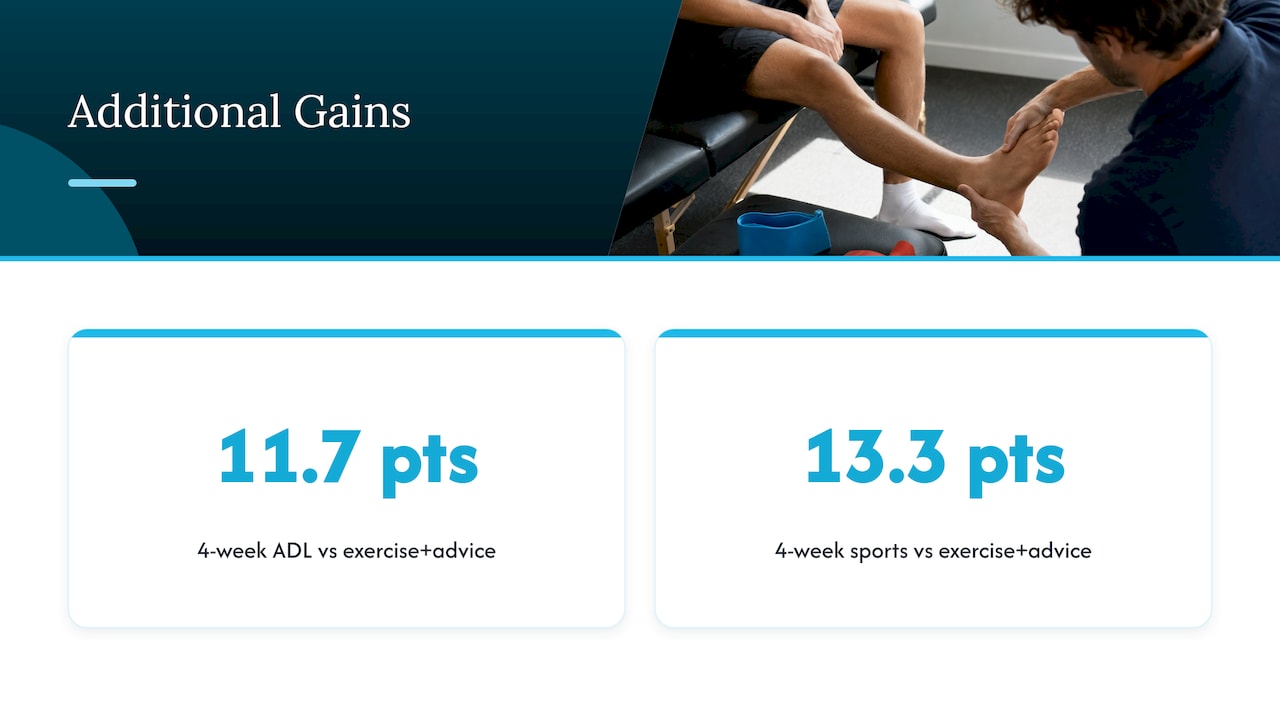
Mobilization plus home exercise. In a randomized trial of adults with grade I and II ankle sprains, lower extremity mobilization added to home exercise and advice produced greater short-term gains in daily activities and sports function than exercise and advice alone. At four weeks the difference was 11.7 points out of 100 on the activities of daily living scale and 13.3 points on the sports scale.
Manipulation for recurrent sprains. A trial of 33 people with recurrent sprains and a feeling of instability compared chiropractic manipulation plus rehabilitation with rehabilitation alone. The group that got manipulation had less short-term pain and fewer joint restrictions, though disability scores did not differ significantly. Improvement in pain and motion without a change in a disability score is a fair summary of what manual therapy does: it helps you move and feel better so you can do the rehab, and the rehab does the long-term work.
A young athlete. A published case report described a pediatric athlete with chronic ankle pain and limited motion after an old ligament sprain. After four treatments with ankle manipulation and a home stretching program, the athlete returned to sport with no pain or functional complaints at five months. A single case is not proof, but it shows the pattern: restore motion, then re-load.
The honest limits. A meta-analysis of 11 studies on chronic ankle sprains found that joint mobilization improved dynamic balance and weight-bearing dorsiflexion in the short term, while pain intensity and static balance did not change significantly. That is why we pair hands-on work with a balance and strength program rather than relying on one tool.
On safety, a large analysis of spinal manipulation reports found that severe adverse events were very rare, about 0.21 per 100,000 sessions, and most minor effects lasted hours or days. That analysis covers spinal manipulation, so the exact figure is not specific to the ankle. Still, it is useful context for what to expect from manual care in general.
Check the basics first: when to see a doctor before a chiropractor
A sprain is the most common explanation for a sore ankle after a roll or a landing, but it is not the only one. Fractures and other injuries can look like sprains. These are the situations where we want you to get medical imaging or an exam first, and we will send you there ourselves.
- You cannot put weight on the foot. The American Medical Association says a deformed foot or ankle, or being unable to bear weight, calls for a doctor, urgent care or emergency visit.
- You have pain near the ankle bones plus any of the Ottawa criteria. The Ottawa Ankle Rules call for an X-ray when there is pain near the malleoli (the bony bumps on either side of the ankle) along with age 55 or older, inability to bear weight right after the injury and take four steps, or bone tenderness at the back edge or tip of either malleolus.
- The pain is at the outside of the foot. Physicians also rule out injuries that get mistaken for sprains, such as a fracture at the base of the fifth metatarsal or of the front of the heel bone.
- The ankle keeps swelling or feels unstable. The American Academy of Orthopaedic Surgeons advises seeing a medical professional if the ankle stays swollen or painful for several weeks despite conservative treatment or you have trouble putting weight on it.
- It is not following the expected course. Family physicians recommend further evaluation with MRI when a sprain does not recover as expected, to look for talar fractures or peroneal tendon injuries.
The Canadian chiropractic guidance also puts suspected fractures, dislocations, Achilles tendon ruptures and unstable syndesmotic (high ankle) injuries outside the conservative chiropractic pathway, meaning they need medical or surgical management first. Once those are cleared, hands-on rehab is the natural next step, and a clear diagnosis makes our job easier.
What to do in the first days
What you do before your appointment matters. Current guidance from family physicians says acute management should include joint protection, pain control, an external ankle support for 5 to 10 days, early functional activity and targeted exercises.
Some specifics from the patient version of that guidance:
- In the first three days, do not use heat. It can increase swelling.
- A stirrup or lace-up brace, or taping, suits mild to moderate sprains. Severe sprains may call for a rigid stirrup brace or walking boot for up to 10 days.
- Anti-inflammatory drugs such as ibuprofen and naproxen may slow normal healing in that acute window, so ask your doctor or pharmacist what suits you.
- Ice for about 20 minutes every 2 to 4 hours, compression and elevation are standard. Children’s Hospital of Philadelphia also advises against heat and massage early on because they increase blood flow and can worsen swelling.
That last point answers a common question: is massage a good idea on a fresh sprain? Not in the first days. Gentle, targeted soft-tissue work after the swelling is controlled is a different matter, and it is what we do once the ankle is ready. If you want a plain-language walkthrough of the first days, this guide on sprained ankle home treatment covers swelling control and early care.
Resting entirely is not the goal either. Washington State’s Department of Labor and Industries notes that current thinking supports rapid incorporation of pain-free activity and motion, and that delays in rehabilitation have been linked to a higher chance of recurrence. Our own plan on starting rehab in the first 48 to 72 hours follows this logic.

What chiropractic care for a sprain involves
A visit for an ankle sprain at our clinic is built around three things: a clear picture of what was injured, hands-on treatment matched to that picture, and a plan for what you do between visits.
Examination
We look at how you walk, how far the ankle moves, where it is tender, how the foot, knee and hip are working, and how well you balance on the injured side. Many ankle problems that linger are not just the ligament. The joints are stiff, the calf is tight, and the muscles around the ankle have stopped firing well. If something on the exam points to a fracture or a serious ligament tear, we refer you for imaging.
Hands-on treatment
Which tools we use depends on what the exam finds and the stage of healing:
- Joint mobilization and chiropractic adjustment for stiff joints in the ankle and foot, kept within what is comfortable.
- The Fascial Distortion Model, a hands-on approach to soft-tissue injury that is the core of our clinic.
- Dry needling for tight, irritable muscle around the ankle and calf.
- Deep tissue laser therapy and focused shockwave where they suit the tissue and the stage of recovery.
Not every patient needs all of these. A grade 1 sprain a few weeks old may need little more than joint work and a good exercise plan. A sprain that has lingered for months usually needs more.
Rehab you can do at home
The exercises are what finish the job. The American Academy of Family Physicians describes a targeted neuromuscular rehabilitation program of 8 to 12 weeks as part of acute sprain management. Typical elements include:
- Motion first. Ankle pumps, alphabet tracing and gentle dorsiflexion stretches once pain allows.
- Strength. Resistance band work in all four directions, calf raises, and work for the muscles on the outside of the ankle that protect against re-rolling.
- Balance. Single-leg standing, progressing to an unstable surface and eyes closed. Guidance on balance training shows how these drills build steadiness and are scaled up gradually.
- Sport or work specific. Hopping, cutting, pivoting or the lifting and standing your job requires.
We write the plan around your life, whether that is a school sport, a job on your feet or chasing kids, and adjust it at each visit.
How long recovery takes
There is no single number. The Canadian Chiropractic Guidelines note that pain and activity often improve over days to weeks after a lateral ankle sprain, but that the course varies with the injury and the person. Giving way and other symptoms can persist at 12 months in some people, so no universal return-to-activity date applies.
These rules of thumb help you plan:
| Stage | What you are doing | What to watch for |
|---|---|---|
| First days | Protect the ankle, control swelling, begin pain-free motion | Inability to bear weight, deformity, bone tenderness |
| Weeks 1 to 4 | Walk normally, restore motion, start strengthening | Swelling that returns, pain that is not easing |
| Weeks 3 to 4 | Reassess if progress is inadequate | Washington State guidance calls for reassessment and a specialist consult if the response to conservative care is inadequate by 3 to 4 weeks |
| Weeks 4 to 12 | Balance, strength and sport-specific rehab | Giving way, fear of cutting or landing |
| After return to sport | Brace or tape for protection | Family physicians suggest a brace during sport for up to 12 months after recovery to prevent recurrence |
For a more detailed look at ligament healing stages, see our guide to ligament sprain recovery milestones. If your injury is higher up, above the ankle joint, our page on high ankle sprain rehab explains why it takes longer.
Why finishing rehab matters
Most people stop doing anything once the pain fades. That is the most common reason a sprain comes back. A narrative review of ankle sprain injuries notes that poor compliance with therapy may predispose to functional instability, and that on a return to sport the athlete should keep supporting the ankle with tape or a brace even after the ligament has regained its original strength.
The same review says that most sprains respond well to nonsurgical care, including care from doctors of chiropractic, and that surgery should be considered for grade 3 syndesmotic injuries or sprains that do not respond to conservative care.
If your ankle keeps rolling or feels unreliable months later, that pattern is covered in our guide to chronic ankle instability. It is also the kind of case where a hands-on, individualized approach tends to matter most.
Can a chiropractor fix a torn ligament?
It depends on the tear. A partial tear (grade 1 or 2) usually heals with conservative care and rehab, and hands-on therapy plus exercise fits well. A complete tear, grade 3, is a more serious injury. Washington State’s guidance says grade 3 sprains may need significant immobilization with a cast or brace for 2 to 3 weeks, and that permanent instability can remain. These need a medical diagnosis first, then structured rehabilitation. We are glad to work with your doctor on that rehab phase.
Our perspective
Most ankle sprains that reach us have a second problem hiding behind the first. The ligament was stretched, but weeks later the calf is tight, the joint is stiff, the foot is not loading evenly and the knee or hip has started to compensate. That is the injury people carry for months.
We specialize in hands-on, results-driven treatment of soft-tissue injuries with the Fascial Distortion Model, and we build an individualized plan around each patient. That matters most for people whose ankles have not improved with standard medical or physical therapy approaches. We aim to restore motion early, treat the tissue that is holding on, and get you doing the strengthening and balance work that makes the ankle trustworthy again.
We also think a good clinician knows when not to treat. If your exam says fracture, we send you for imaging. If it says sprain, we want to get you moving, back to your sport, your job or your kids, as soon as it is safe.
Chris
Getting care in Plano
If you have had your ankle checked, or the injury is a plain sprain with no red flags, we can help you get moving again. The Tx Room in Plano offers chiropractic care and soft-tissue therapy, including the Fascial Distortion Model, dry needling, deep tissue laser and focused shockwave, built around an individualized plan for athletes and non-athletes alike. We accept both self-pay and insurance.

To book an evaluation, visit The Tx Room. If your ankle pain also runs into the heel or arch, our page on chiropractic for plantar fasciitis explains what we do there.
FAQ
Should I see a chiropractor for a sprained ankle?
Yes, once a fracture is ruled out. If you can bear weight, there is no deformity and no tenderness over the ankle bones, a chiropractor can treat the stiffness and soft-tissue problems and design your rehab. If you cannot bear weight, see a doctor or urgent care first.
What is the fastest way to heal a sprained ankle?
There is no shortcut, but the sequence matters. Protect the ankle with a brace or tape, control swelling, and begin pain-free motion within days instead of resting completely. Then follow a progressive strengthening and balance program. Skipping rehab is what most often slows recovery and invites a repeat sprain.
Is it a good idea to massage a sprained ankle?
Not in the first days. Children’s Hospital of Philadelphia advises avoiding heat and massage early because they can increase swelling. A 2020 guideline from the American Academy of Family Physicians and the American College of Physicians found that massage brings short-term pain relief but no other proven benefit, so it works best alongside exercise, not in place of it.
Can a chiropractor fix a torn ligament?
Partial tears generally heal with conservative care, and hands-on therapy plus rehab supports that. A complete tear needs a medical diagnosis and often a period of immobilization first. Rehabilitation then restores strength and balance, and some grade 3 injuries need surgical consultation.
How many visits will I need?
That depends on the grade of the sprain, how long ago it happened and your goals. The research trials used about six treatments over several weeks, and the home program runs much longer, commonly 8 to 12 weeks. We set expectations at your first exam and adjust as you progress.
Sources
- Canadian Chiropractic Guidelines: Ankle Sprain
- Effectiveness of manual therapy for ankle sprains, Chiropractic & Manual Therapies
- Manipulative therapy and rehabilitation for recurrent ankle sprain, PubMed
- Chiropractic management of chronic ankle pain, PMC
- Clinical benefits of joint mobilization on ankle sprains, Medscape
- Severe adverse events after spinal manipulation, Scientific Reports
- AMA: What doctors want patients to know about ankle sprains
- When to X-ray ankle sprains, Cleveland Clinic Journal of Medicine
- AAOS OrthoInfo: Sprained Ankle
- AFP: Management of Acute Ankle Sprains
- AFP: Recovering From an Ankle Sprain
- Children’s Hospital of Philadelphia: Sprained Ankle in Children and Teens
- Washington State L&I: Work-Related Mechanical Foot and Ankle Conditions
- Lateral and syndesmotic ankle sprain injuries: a narrative review, PMC
- AAFP and ACP guideline on acute non-low back musculoskeletal pain