
PPO vs HMO for Chiropractic Care: Which Plan Fits?
If you want the most freedom to choose a chiropractor, a PPO usually gives it to you: no referral, and out-of-network care is allowed at a higher cost. An HMO usually costs less each month, but it expects you to stay in its network and may ask your primary care provider to sign off first. Both plan types can cover chiropractic care. What decides your real cost is the specific plan, so the last step is always to read your own benefits.
This guide walks through how each plan type handles chiropractic visits, what the copay difference can look like, and how to verify coverage before you book. We are The Tx Room, a chiropractic center in Plano, Texas, and we answer these questions from patients every week.
TL;DR
- PPO: more choice. You can see in-network or out-of-network chiropractors without a referral, but you pay more outside the network and premiums tend to be higher.
- HMO: more structure. You pick a primary care provider, stay in the network, and may need a referral before chiropractic visits. Premiums are usually lower.
- Coverage is plan-specific. Most plans cover chiropractic care when it is part of a medically necessary treatment plan, but the Affordable Care Act does not require it.
- Verify before you book. Check the network, visit limits, referral rules and pre-authorization with your insurer, then confirm with the clinic.
Table of Contents
- How HMOs and PPOs differ in plain terms
- Do HMO and PPO plans cover chiropractic care?
- Referrals and pre-authorization
- What a visit can cost under each plan
- Out-of-network chiropractors
- How to check your chiropractic coverage before you book
- Which plan suits which patient
- Our perspective on plan types and hands-on care
- See how we can help in Plano
- Questions to bring to your insurer
- FAQ
- Sources
How HMOs and PPOs differ in plain terms
The two plan types are built on different trade-offs: cost against flexibility.
HealthCare.gov explains that an HMO usually limits coverage to care from doctors who work for or contract with the plan, and generally does not cover out-of-network care except in an emergency. A PPO, by contrast, lets you use out-of-network providers for an additional cost, and you do not need a referral to do it.
MedlinePlus adds the gatekeeper detail. In an HMO you choose a primary care provider who manages your care and refers you to specialists. In a PPO you do not need a primary care provider, and you do not need referrals to see providers inside or outside the network.
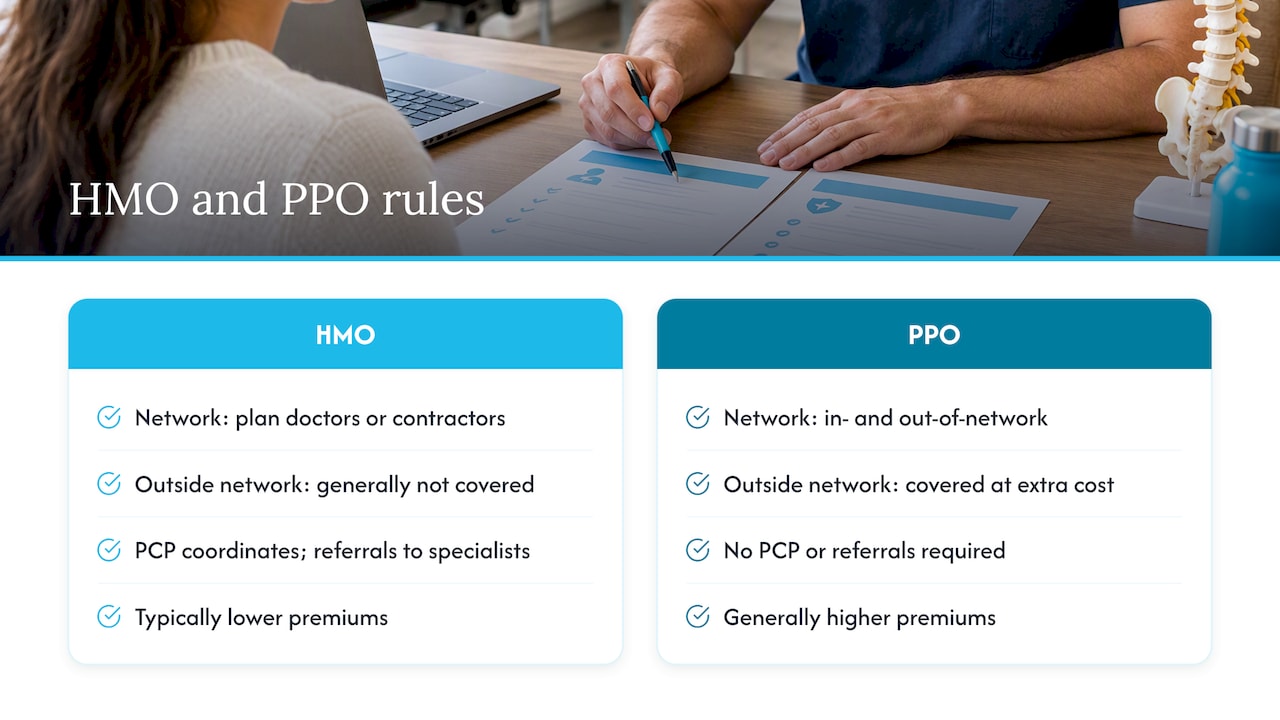
On price, eHealth describes HMOs as emphasizing coordinated care with typically lower premiums, while PPOs generally carry higher premiums in exchange for more provider choice.
The comparison at a glance
| Feature | HMO | PPO |
|---|---|---|
| Monthly premium | Typically lower | Generally higher |
| Primary care provider required | Yes, manages your care | No |
| Referral to a chiropractor | May be required | Not required |
| Out-of-network chiropractor | Generally not covered except emergencies | Allowed, at a higher cost |
| Best fit | You want predictable costs and are fine staying in network | You want to pick your own provider |
Do HMO and PPO plans cover chiropractic care?
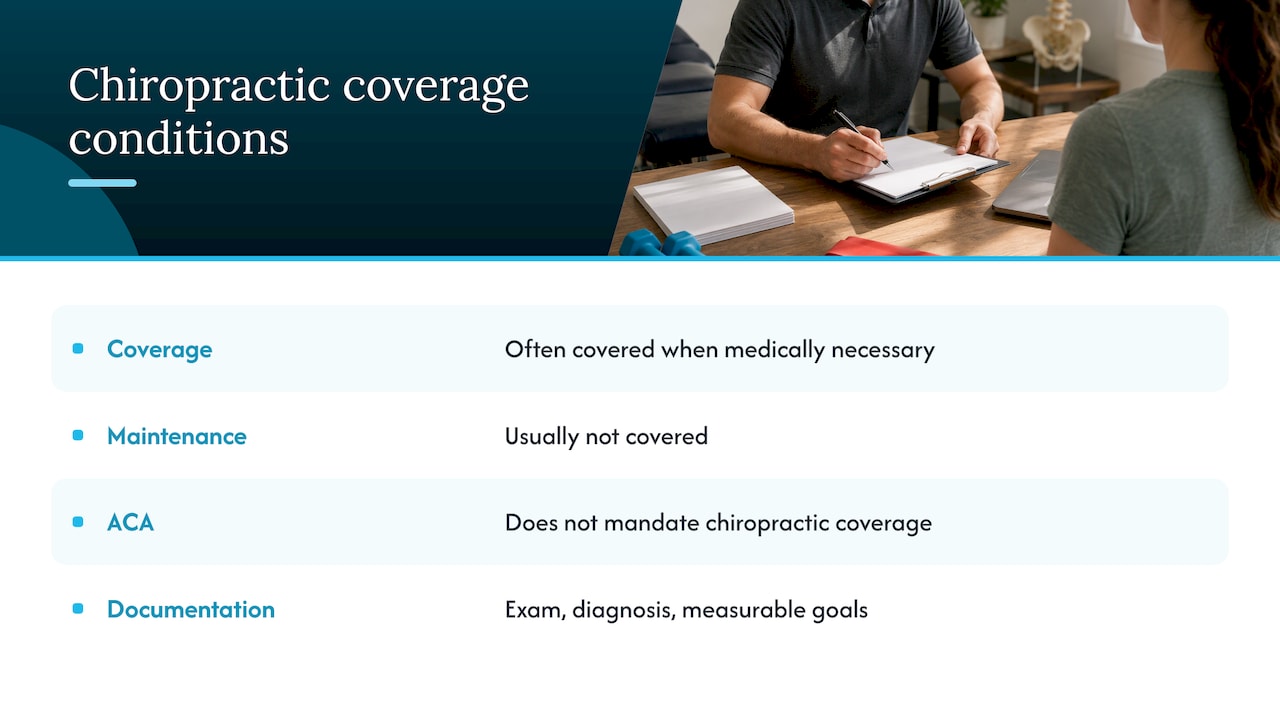
Often yes, with conditions. According to Insurance.com, most health plans provide some chiropractic coverage when it is part of a medically necessary treatment plan. Preventive or maintenance-style care is not usually covered, and the Affordable Care Act does not mandate chiropractic coverage. That means two people with the same plan type can have different benefits.
What “medically necessary” means in practice: your plan wants to see a diagnosed problem, such as a musculoskeletal injury or a pain condition, and a treatment plan aimed at improving it. Documentation matters. A clear exam, a diagnosis and measurable goals make claims easier to process. If you are comparing how paperwork flows with tax-advantaged accounts, our guide on HSA vs FSA chiropractic paperwork covers that side.
The conditions people most often bring to a chiropractor, such as low back pain, sciatica, plantar fasciitis, repetitive strain and sports injuries, are exactly the kind of musculoskeletal problems plans tend to describe in their chiropractic benefits. Your plan document will say which diagnoses and services qualify.
For a broader walk-through of how insurers approach chiropractic care, see our U.S. guide to insurance coverage for chiropractic care.
Referrals and pre-authorization
This is where the plan types feel different day to day.
With an HMO, eHealth notes that the plan may require a primary care referral for chiropractic services. If your plan does, the sequence looks like this:
- Book a visit with your primary care provider and describe the problem.
- Ask whether a chiropractic referral is appropriate and request it.
- Confirm the referral names an in-network chiropractor.
- Book the chiropractic visit.
With a PPO, you can book directly. Even so, eHealth cautions that plans may still require pre-authorization for some services, so check your plan’s rules. Pre-authorization is separate from a referral: it is the insurer approving a service before it happens. Visit caps and additional therapies, such as those beyond a first set of visits, are common places where it comes up.
Some plans route chiropractic benefits through a separate network administrator. For example, Kaiser Foundation Health Plan contracts with ASH Plans for a network of participating chiropractors in California, and members can find providers through the ASH Plans website or customer service, according to the 2026 disclosure amendment. The same document notes that the provider list may change without notice. That is a California example, but the lesson applies everywhere: your plan may not use the same network for chiropractors as for other doctors.
What a visit can cost under each plan
Premiums are only part of the picture. For chiropractic, the numbers that matter are your copay or coinsurance per visit, your deductible and any annual visit limit.
One published example shows the pattern. In a Health Net flyer from 2019, chiropractic visits carried a $10 copayment on the HMO and a $25 copayment on the PPO. The flyer also says the PPO deductible was waived for non-HDHP plans and applied to HDHP plans. That is one California insurer in one year, so treat it as an illustration of how the two designs can differ, not as a price you should expect. Your own summary of benefits has the numbers that apply to you.
A few things to look for in that summary:
- Copay or coinsurance for chiropractic visits, and whether it differs from a regular specialist visit.
- Deductible: does it apply before chiropractic benefits start?
- Visit limits per calendar year.
- Network status of the specific clinic.
- Which services count: an exam, spinal manipulation, soft tissue work, and therapies such as dry needling or shockwave may be treated differently, or not covered at all.
If you plan to pay without insurance for some services, our breakdown of chiropractor cost per visit explains what drives the price.
Out-of-network chiropractors
This is the clearest practical difference. Under an HMO, going out of network generally means paying the whole bill yourself unless it is an emergency or the plan pre-approves it. California’s insurance department describes it the same way: HMO members cannot see out-of-network providers except in an emergency or with plan pre-approval, while PPO members can go out of network but pay more.
Why would anyone go out of network? Common reasons:
- You are already seeing a chiropractor who helps you and your plan changed.
- You need a specific hands-on approach that no in-network office near you offers.
- Appointment times in network do not fit your work or family schedule.
- Your problem has not improved with earlier care and you want a different method.
Under a PPO, that choice is available to you at a higher cost share. Under an HMO, ask your plan whether it will approve an out-of-network provider when there is a good reason. California has rules for one such situation: when there are not enough in-network providers, insurers must arrange out-of-network care at in-network prices under its emergency regulation, as summarized by the American Chiropractic Association. That is a California rule, so do not assume it applies in Texas. Ask your insurer what protections your state and plan provide.
How to check your chiropractic coverage before you book
The American Chiropractic Association’s view, reported by Insurance.com, is that benefit verification is time-consuming but cannot be skipped, and it recommends thorough checks. A five-step routine takes about 20 minutes:
- Find your summary of benefits. Many insurers post it in your member account. Sharp Health Plan, for instance, tells members to log in, open Coverage documents and review the summary of benefits. Your insurer’s portal likely has a similar path.
- Identify your plan type. It is printed on your card: HMO, PPO, or a variation.
- Check the network. Use the insurer’s provider directory, or call the number on your card. Directories can lag behind reality, so confirm the clinic is currently a participating provider under your exact plan.
- Ask four questions on the phone: Is a referral required? Is pre-authorization required? How many visits per year are covered? What is my copay or coinsurance, and does my deductible apply?
- Call the clinic. Give the front desk your plan name and member ID and ask what they can confirm on their side. Write down the date and the name of the person you spoke with.
If you are choosing a clinic at the same time, these guides help you compare offices: how to choose a Plano chiropractor and how to find a chiropractor in Plano.
Which plan suits which patient
There is no universal winner. Match the plan to how you actually use care.
A PPO tends to fit if:
- You have a chiropractor or therapist you trust and want to keep them.
- You are an athlete or active adult who wants direct access without a referral step.
- Your injury is stubborn and you may want a specialist with a particular technique.
- You are willing to pay a higher premium for flexibility.
An HMO tends to fit if:
- You want lower monthly premiums and predictable copays.
- You are comfortable with one primary care provider coordinating everything.
- A good in-network chiropractor is close to home or work.
- You rarely need care outside the network.
If you are already enrolled, the question changes from “which plan” to “how do I use this one well.” For an HMO, get the referral early, because a delay can stretch a short problem into a long one. For a PPO, compare the in-network and out-of-network cost for your specific clinic before you start.
If you are choosing during open enrollment, compare the premium, the deductible, the chiropractic copay and the visit cap across the options you have, then add up what a realistic year looks like. A typical case might be six to ten visits over a couple of months. A plan with a slightly higher premium but a lower per-visit cost can come out ahead, and the reverse is also true.
Our perspective on plan types and hands-on care
We see the same pattern in Plano. People arrive after weeks of pain, often having already been through standard medical or physical therapy, and the first thing they ask is whether their insurance “works here.” It is the right question, and it is easier to answer before the first visit than after the first bill.
Our work centers on hands-on treatment of soft tissue injuries and biomechanical imbalances, using the Fascial Distortion Model, myotherapy and individualized rehabilitation plans. We build each plan around the person in front of us, whether they are a runner with plantar fasciitis, a parent with sciatica or an office worker with repetitive strain. Clear documentation of what we find and what we plan to do helps your insurer understand why care is needed, and it helps you understand it too.
Our advice is simple. Know your plan type, ask about referrals and pre-authorization, and get your benefits in writing. Then choose the clinic that can actually treat your problem. Coverage is a tool for getting the right care, and the right care is what gets you back to your life sooner.
Chris
See how we can help in Plano
If you are in the Plano area and want hands-on care for a musculoskeletal injury, we accept insurance and self-pay patients. Our team can talk through your situation and what to verify with your plan before you commit to a visit. Our approach includes the Fascial Distortion Model, soft tissue therapy and chiropractic care, tailored to your condition. Start at The Tx Room and reach out to book an initial exam.

Not sure what to expect? Read about the first chiropractic visit so you can prepare your questions and paperwork.
Questions to bring to your insurer
A short script keeps the call efficient. Have your member ID ready and ask:
- “Is chiropractic care covered under my plan, and for which diagnoses?”
- “Do I need a referral from my primary care provider?”
- “Does any service require pre-authorization?”
- “How many visits are covered per year, and do they reset on January 1 or on my plan anniversary?”
- “Is this clinic in my network, and what is my cost in and out of network?”
- “Are soft tissue therapies and other add-on services covered, or do I pay for them separately?”
Write down the answers. If a claim is denied later, notes with dates and names make an appeal much easier.
One more habit worth building: keep every explanation of benefits you receive. It shows what the insurer allowed, what it paid and what you owe, and it is the quickest way to spot an error. If your HMO referral has an expiration date or a set number of visits, note that too, so you can ask for a renewal before it runs out in the middle of a treatment plan.
FAQ
Is a PPO better than an HMO for chiropractic care?
A PPO is better if you value choice, because you can see a chiropractor without a referral and can go out of network for a higher cost. An HMO can be better if you want lower premiums and are happy with an in-network option. The right answer depends on your plan’s chiropractic copay, visit limit and network.
Do I need a referral to see a chiropractor with an HMO?
Possibly. HMO plans may require a primary care referral for chiropractic services, and the rules differ by plan. Call the number on your card and ask before booking, so the visit is not denied.
Does insurance cover chiropractic care at all?
Most plans provide some chiropractic coverage when it is part of a medically necessary treatment plan, but preventive care is not usually covered. The Affordable Care Act does not require chiropractic coverage, so check your own benefits.
What if my chiropractor is out of network?
With a PPO, you can usually still go, but you will pay more. With an HMO, out-of-network care is generally not covered except in an emergency, though you can ask the plan about pre-approval. Compare the out-of-network cost with the cost of switching to an in-network provider.
Sources
- HealthCare.gov: Health insurance plan and network types
- MedlinePlus: Understanding health insurance plans
- eHealth: Does health insurance cover chiropractic care?
- Insurance.com: Does health insurance cover chiropractic care?
- Kaiser Permanente: 2026 disclosure form amendment for chiropractic services
- Health Net: Your Chiropractic Care Options
- California Department of Insurance: Compare PPOs, EPOs and HMOs
- American Chiropractic Association: Verification of benefits instructions
- Sharp Health Plan: Find a chiropractor or acupuncturist
- What is a participating provider