
Forward Head Posture: 8+ Weeks of Exercise, Manual Care if It Stalls
Yes: most people can reduce forward head posture with a structured corrective exercise program plus ergonomic changes. Meta-analysis data show therapeutic exercise improves the craniovertebral angle, and programs that combine self-myofascial release, stretching, and strengthening for eight weeks or longer tend to produce the biggest gains. When home care stalls, a hands-on assessment and manual therapy can move things along faster.
TL;DR:
- Repeat side view photos every two to four weeks from the same camera position; a craniovertebral angle below about 50 degrees may indicate forward head posture.
- Practice chin tucks daily, holding each rep for five seconds across two or three sets of ten, and progress gradually as your neck tolerates it.
- Raise your monitor so its top third sits at eye level, pair a laptop with an external keyboard, and pause every 30 to 45 minutes.
- Progressive weakness, spreading arm numbness, or bowel or bladder changes are not typical posture symptoms and call for medical evaluation rather than stretching alone.
- If pain persists beyond eight weeks or mobility stops improving, an in person assessment can identify restrictions and guide a supervised exercise progression.
Table of Contents
- What forward head posture is and how clinicians measure it
- Common causes and contributors
- Symptoms and effects of forward head posture
- How to check your posture at home
- Evidence-backed exercise program to correct forward head posture
- Daily ergonomics and habits to prevent recurrence
- When self-care stalls, what a hands-on evaluation adds
- How The Tx Room treats forward head posture that won’t budge
- FAQ
- Sources
What forward head posture is and how clinicians measure it
Forward head posture describes a forward shift of the head relative to the shoulders, often paired with a rounded upper back and a jutting chin. Clinicians quantify it with the craniovertebral angle, or CVA, measured between a horizontal line at the C7 vertebra and a line drawn to the tragus of the ear.
- A smaller CVA signals more forward head translation; a larger angle reflects a more upright head position.
- Researchers photograph the neck from the side with the shoulder and ear visible, then measure the angle digitally or with a goniometer.
- Many studies treat a CVA below roughly 50 degrees as indicating forward head posture, though exact cutoffs vary by study population.
Photogrammetry methods used in posture research rely on these same landmarks, which is why a photo taken the same way each time makes your own tracking meaningful.
Common causes and contributors
Forward head posture rarely comes from one habit alone. It usually builds from repeated positions held for hours at a time, combined with muscles that adapt to whatever position they spend the most time in.
- Looking down at phones and laptops for extended periods pulls the head forward and keeps the neck in flexion.
- Tight chest and upper trapezius muscles paired with weak deep neck flexors and scapular stabilizers let the head drift forward unchecked.
- Side-sleeping with a too-high pillow, carrying a heavy bag on one shoulder, and old neck or shoulder injuries can all reinforce the same pattern.
Desk-based work and screen time are the biggest daily contributors for most adults, which is why ergonomic changes matter alongside exercise.
Symptoms and effects of forward head posture
Forward head posture shows up differently from person to person, but a few patterns are common enough to expect.
- Neck and upper back pain, along with cervicogenic headaches that start at the base of the skull, are frequent complaints.
- Reduced cervical range of motion, and in some cases subtle effects on breathing mechanics or balance, can follow prolonged forward head positioning.
- Symptoms tend to be more noticeable in older adults, since connective tissue and muscle have less capacity to compensate over time.
A systematic review and meta-analysis found that adults with neck pain show greater forward head posture than those without pain, and that the degree of forward translation correlates with pain intensity and disability. That said, not every symptom traces back to posture alone. Progressive weakness, numbness that spreads down an arm, or any change in bowel or bladder function are not typical forward head posture symptoms and warrant a medical evaluation rather than a stretching routine.
How to check your posture at home
Two simple self-tests give you a baseline before starting any corrective program, and both are worth repeating every few weeks to track change.
- Stand with your heels, buttocks, and shoulder blades against a wall, then try to touch the back of your head to the wall without tilting your chin up; a noticeable gap usually indicates forward head posture.
- Take a photo from the side with your ear and shoulder visible, then draw a line from the base of the neck (roughly C7) through the ear and compare it to a vertical line for future comparisons.
- Repeat both tests under the same conditions (same wall, same camera distance, same time of day) every two to four weeks to see whether your angle is improving.
Pro Tip: Keep your phone on a small tripod or propped at the same height each time you photograph your posture, since small camera angle changes can throw off your comparison.
A one-time wall test gap or a slightly reduced CVA photo doesn’t necessarily mean something is wrong: these measures are most useful as a trend over weeks, not a single verdict.
Evidence-backed exercise program to correct forward head posture
The strongest results in the research come from combined programs, not single exercises done in isolation. A randomized controlled trial comparing postural education alone, self-myofascial release plus stretching, and self-myofascial release plus stretching plus strengthening found that the fullest combination produced the largest CVA increase, with a mean improvement of 4.4 degrees over four weeks.
- Self-myofascial release on the upper trapezius and pec muscles with a foam roller or ball, about one to two minutes per side, before stretching.
- Chin tucks (cranial retraction), holding each rep for five seconds, two to three sets of ten, performed daily.
- Deep neck flexor activation drills, lying on your back and gently nodding the chin while keeping the neck long, building toward longer holds.
- Thoracic extension over a foam roller to counter the rounded upper back that typically accompanies forward head posture.
- Scapular squeezes and a doorway pec stretch to balance the muscles pulling the shoulders forward.
A realistic weekly structure is three to five sessions combining these elements, starting with lighter sets and adding reps or hold time every one to two weeks as the neck tolerates more load.
Meta-analytic data show an average CVA improvement of about 3.38 degrees across therapeutic exercise trials, with programs running eight weeks or longer associated with better outcomes than shorter ones. A separate systematic review on cervical proprioception found that cervical stabilization exercises can improve joint position sense in people with forward head posture, though the nine trials reviewed varied enough in method that no single protocol stands out as definitively best.
Pro Tip: Consistency beats intensity here: doing chin tucks correctly for five minutes daily outperforms an occasional long session done with poor form.
Form matters more than volume. Rushing chin tucks or shrugging the shoulders during deep neck flexor work trains the wrong muscles and slows progress.
Daily ergonomics and habits to prevent recurrence
Exercise corrects the pattern; your daily setup determines whether it sticks. A few changes carry outsized impact.
- Raise your monitor so the top third sits at eye level, and dock your laptop to an external keyboard and screen rather than hunching over it for hours.
- Use a hands-free option or prop your phone higher instead of tilting your head down to read or type.
- Set a timer for a posture check and brief stretch every 30 to 45 minutes during desk work.
- Sleep with a pillow that keeps your neck neutral rather than flexed forward, and switch to a backpack or crossbody bag instead of a heavy one-shoulder load.
A study comparing monitor types found that a moving monitor setup reduced how often forward head posture was observed during prolonged computer use compared with a fixed monitor, which supports the basic principle that screen position changes posture outcomes, not just willpower.
When self-care stalls, what a hands-on evaluation adds
Most people respond to a well-run exercise program, but some get stuck: mobility that won’t budge, pain that persists past eight weeks, or a program that never quite progresses past the basics. That’s when an in-person assessment matters. We pair the Fascial Distortion Model with targeted rehab to address soft tissue restrictions that exercise alone sometimes can’t reach, then build a supervised progression from there.
— Chris
How The Tx Room treats forward head posture that won’t budge
When a corrective exercise program plateaus, we go further with hands-on care built around the Fascial Distortion Model, a treatment approach that targets the fascial restrictions often underlying stubborn posture patterns. We also offer soft tissue therapy and dry needling to address the muscle tightness and trigger points that keep pulling the head forward.

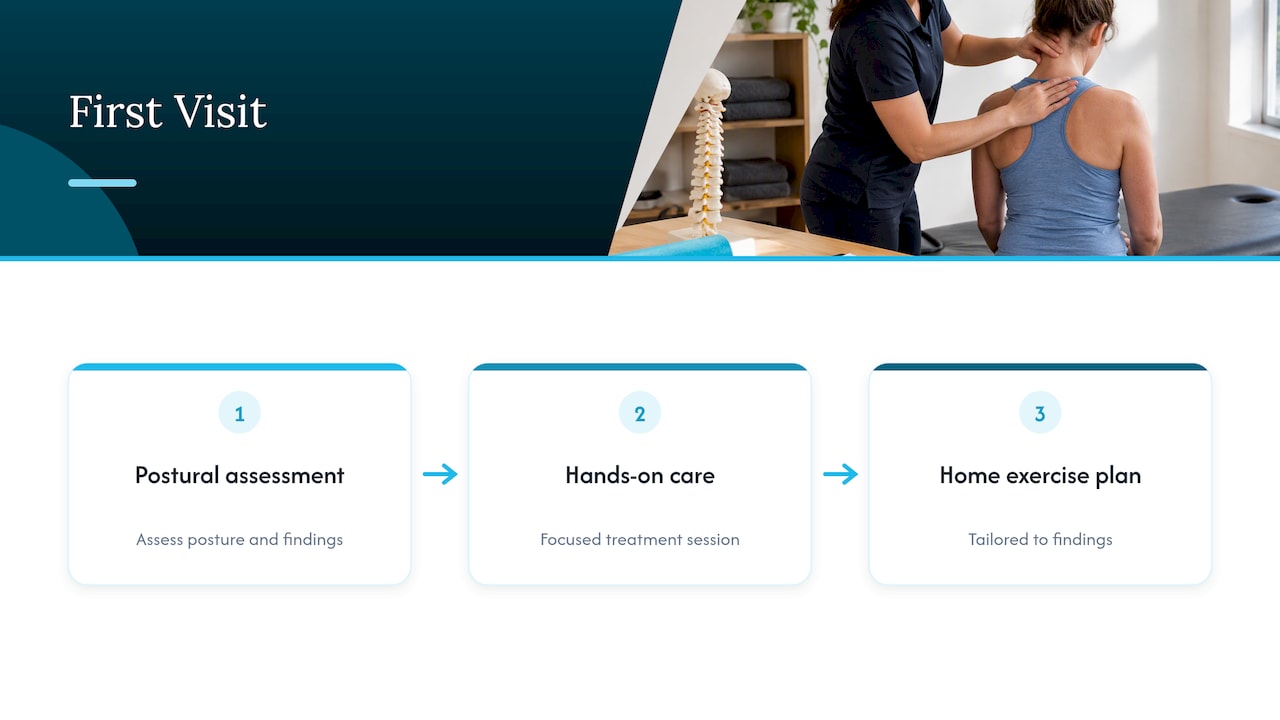
A typical first visit includes a postural assessment, a focused hands-on treatment session, and a home exercise plan tailored to findings, so you leave with both immediate relief and a path forward. For persistent cases, we sometimes layer in MyACT focused shockwave therapy alongside rehab. If chronic pain has resisted other regenerative approaches, PRP therapy for neck pain is another option worth discussing with a provider. If you’re ready for a hands-on plan, visit The Tx Room to schedule an assessment.
This article is general information, not a substitute for advice from a qualified doctor. Consult a qualified healthcare professional about your own circumstances before acting on anything here.
FAQ
How can I check if I have forward head posture?
Stand against a wall with your heels, buttocks, and shoulder blades touching it, then see if the back of your head reaches the wall without tilting your chin. A side-view photo measuring the angle from your shoulder through your ear, compared against a vertical line, gives a more precise read you can track over time.
How does posture affect mood?
Posture and mood interact in ways researchers are still mapping, and forward head posture itself is better documented for its links to pain, headaches, and reduced range of motion than for direct mood effects. If slouched posture is tied to chronic neck pain, addressing the pain and mechanical strain is a reasonable starting point.
How do I fix forward head and rounded shoulders together?
A combined program works best: chin tucks and deep neck flexor activation address the forward head, while thoracic extension, scapular squeezes, and a doorway pec stretch target the rounded shoulders. Trial data show that programs combining self-myofascial release, stretching, and strengthening produce larger improvements than any single exercise type alone.
What neurological symptoms are associated with forward head posture?
Forward head posture on its own typically causes mechanical symptoms like neck pain, headaches, and reduced range of motion rather than true neurological signs. Progressive weakness, numbness spreading into an arm, or changes in bowel or bladder function are not expected with posture alone and should prompt a medical evaluation to rule out other causes.
How long does it take to correct forward head posture?
Research-backed programs generally run at least eight weeks, since longer programs are associated with greater CVA improvement than shorter ones. Some people notice early changes within a few weeks, but measurable, lasting improvement in head position typically takes consistent daily exercise over two months or more.
Sources
- Therapeutic exercise for forward head posture in neck pain patients: systematic review and meta-analysis
- Is forward head posture associated with neck pain? Systematic review and meta-analysis
- Exercise interventions for cervical proprioception in forward head posture (systematic review)