

78% Return Without Surgery: Conservative Labrum Tear Care in Plano
Most shoulder labrum tears respond well to a structured, non-surgical rehabilitation program before anyone considers the operating room. Patients who complete a full course of criterion-based physical therapy return to sport at a 78% rate, compared with 53.7% overall. Surgery becomes the right call mainly when true instability, mechanical catching, or a stalled rehab plan makes conservative care a dead end.
TL;DR:
- Most shoulder labrum tears respond well to a structured non-surgical rehab program, with about 78% of patients returning to sport after completing the full course.
- Success relies on criterion-based progression, where each stage advances only when measurable targets like pain level, range of motion, and strength are achieved.
- Patients with degenerative tears, older age, or lower activity demands tend to do better with conservative treatment, while competitive throwers, dislocators, or those with instability often require surgery.
- The typical rehab timeline spans roughly two to three months, progressing from inflammation control to strengthening and sport-specific loading, with 16 to 24 supervised sessions linked to better outcomes.
- Adjunct therapies like manual soft-tissue work, dry needling, and tissue-irritability reduction can support rehab but do not replace the core exercise program.
Table of Contents
- What Does Shoulder Labrum Tear Conservative Treatment Involve?
- Who Is a Good Candidate for Conservative Care?
- How Long Does Shoulder Labrum Rehab Take?
- What Exercises Help a Torn Labrum Heal?
- Do Injections or PRP Help a Torn Labrum?
- When Should You Consider Surgery Instead?
- Does Conservative Treatment Actually Work for Labrum Tears?
- What Does a Sample Conservative Rehab Program Look Like?
- How Hands-On Clinic Care Supports Conservative Rehab
- Practical Next Steps and Questions to Ask Your Clinician
- The Case for Conservative-First, When the Evidence Supports It
- Get Hands-On Support for Your Shoulder Rehab in Plano
- Sources
- FAQ
What Does Shoulder Labrum Tear Conservative Treatment Involve?
Conservative treatment for a torn labrum is built around one idea: give the joint a fair, structured chance to adapt before cutting into it. That means calming irritated tissue first, then systematically rebuilding the strength and mechanics that let the shoulder tolerate load again.
The goals break down into five specific targets. Pain control comes first, because a joint guarded by muscle spasm cannot be strengthened effectively. Restoring range of motion follows close behind, particularly internal rotation, which tends to tighten up after a labral injury. Correcting biomechanics, especially scapular positioning and posture under load, prevents the shoulder from compensating in ways that reinjure the labrum. Strengthening the rotator cuff and scapular stabilizers builds the dynamic support the torn tissue can no longer provide alone. Finally, the whole program is designed to prevent recurrence, not just resolve the current flare.
The National Athletic Trainers’ Association’s position statement on SLAP injuries recommends nonoperative management, including rehab, NSAIDs, and corticosteroid injections, as first-line treatment for many SLAP tears. That guidance specifically calls out internal rotation deficits, total arc of motion, horizontal adduction, and periscapular strength and endurance as the targets rehab should address, not just generic “stretch and strengthen” advice.
A typical conservative program includes:
- Activity modification, temporarily limiting overhead reaching, lifting, or throwing that provokes symptoms
- Guided physical therapy, supervised sessions that progress through defined phases rather than a fixed calendar
- Analgesia, usually NSAIDs and ice in the early stage to manage inflammation
- Selective injections, corticosteroid used diagnostically or for short-term symptom control in specific cases
- A home exercise program, the daily work between clinic visits that actually drives most of the adaptation
The Hospital for Special Surgery notes that in some cases, the labrum itself can improve with rest and physical therapy, not just the surrounding muscles compensating for it. That’s a meaningful distinction for anyone worried that “conservative” means “just living with it.”
What separates a good program from a mediocre one is criterion-based progression. Instead of moving to the next phase because two weeks have passed, a well-run plan advances when the patient hits specific, measurable targets: a pain threshold, a strength ratio, a motion benchmark. This also requires coordination. A chiropractor, physical therapist, and orthopedic surgeon working from the same playbook catch problems faster than any one provider working in isolation.
Who Is a Good Candidate for Conservative Care?
Age, tear type, and activity level do most of the work in predicting who does well without surgery. Degenerative labral tears in older or recreational athletes, where the fraying happened gradually rather than from a single traumatic dislocation, tend to respond favorably to rehab. So do many Type I and Type III SLAP lesions, which involve fraying or a stable flap rather than a full detachment. StatPearls’ clinical review notes that surgical selection depends heavily on symptoms, tear pattern, age, and functional demands, not on the mere presence of a tear on an MRI.
Certain profiles predict a rockier road with conservative care alone:
- Competitive overhead throwers, especially pitchers, whose sport demands extreme, repetitive shoulder ranges that stress a healing labrum
- Patients with recurrent shoulder dislocations, where the labrum’s job of stabilizing the joint has already failed repeatedly
- Anyone with a concomitant rotator cuff tear, since the shoulder is missing two supporting structures instead of one
- Patients who show frank instability on exam rather than just pain with specific movements
Deciding between rehab and referral is a clinical judgment call, not a formula. A thorough exam checks for apprehension signs, relocation tests, and strength deficits. MRI (often with contrast, called an MR arthrogram) helps characterize the tear pattern, but imaging findings only matter in context. A lot of asymptomatic shoulders show labral fraying on MRI that never causes a problem. The decision to try rehab first usually comes down to a conversation: what does the patient need their shoulder to do, how much instability is actually present, and how does the exam match the imaging? That’s shared decision making, and it should feel like a discussion, not a directive.
How Long Does Shoulder Labrum Rehab Take?
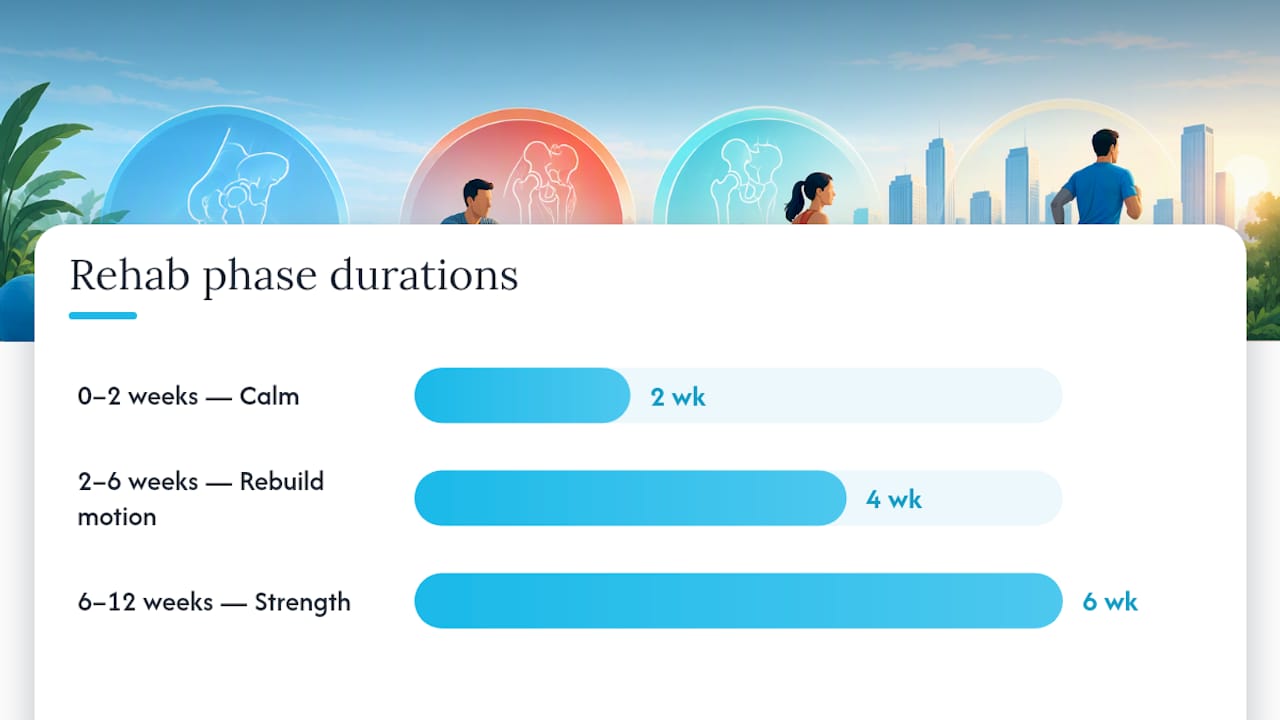
Recovery timelines vary by tear severity and how consistently someone does the work, but most criterion-based programs move through four recognizable stages over roughly two to three months.
- Weeks 0 to 2: Calm things down. The priority is controlling irritability, not building strength. Expect relative rest from provoking positions, ice, NSAIDs as needed, and gentle pendulum or passive range-of-motion work. Aggressive stretching or strengthening this early usually backfires.
- Weeks 2 to 6: Rebuild motion and wake up the stabilizers. As pain settles, therapy shifts toward restoring pain-limited range of motion, especially internal rotation, and introducing scapular activation drills and isometric rotator cuff holds. This is where the role of scapular positioning becomes central, since a poorly controlled shoulder blade forces the labrum to absorb stress it shouldn’t have to.
- Weeks 6 to 12: Build real strength. Isometrics give way to isotonic strengthening with bands or light weights, targeting the rotator cuff, lower trapezius, and serratus anterior. Kinetic-chain work, meaning exercises that connect the legs, core, and shoulder the way real movement does, gets introduced here too.
- Return-to-activity clearance. Advancing past this phase requires objective markers, not just “feeling better.” Clinicians typically look for strength within roughly 85 to 90 percent of the uninjured side, pain-free performance of sport- or work-specific tasks, and a clean clinical exam.
Pro Tip: Track your range of motion and pain levels with simple numbers, not just “good” or “bad” days. Writing “internal rotation reached my mid-back, pain 2 out of 10” gives your clinician something concrete to compare week over week, which speeds up decisions about advancing your program.
The session count during this window matters more than most patients expect. Research on nonoperative SLAP management found that patients who abandoned rehab for surgery had completed an average of only about 8 supervised sessions, while those who succeeded without surgery averaged closer to 20. That gap suggests a lot of “failed” conservative treatment is actually incomplete conservative treatment. Similar phase-based logic applies to other joint injuries, as outlined in this breakdown of ligament sprain recovery milestones, where early, middle, and late-stage benchmarks follow the same criterion-based logic.
What Exercises Help a Torn Labrum Heal?
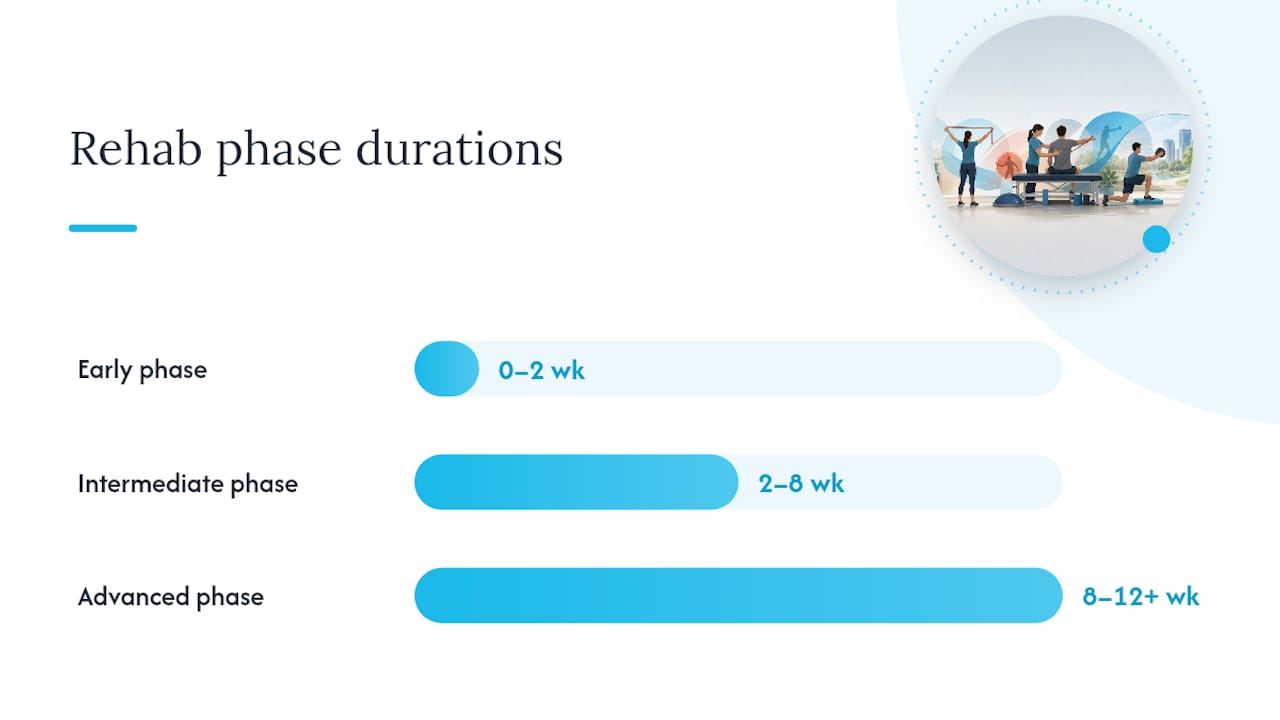
Exercise selection follows the same phase logic as the overall timeline, moving from protective isometrics toward sport-specific loading as tissue tolerance improves.
Early phase (weeks 0 to 2):
- Rhythmic stabilization drills and pain-free isometric holds for the rotator cuff
- Scapular activation work like scapular clocks or wall slides, done without provoking symptoms
- Gentle posterior capsule mobility work, since a tight posterior capsule often drives the internal rotation deficit that stresses the labrum
Intermediate phase (weeks 2 to 8):
- Band or cable external and internal rotation at the side, progressing resistance gradually
- Lower trapezius and serratus anterior strengthening, often through prone Y raises or wall push-ups with a plus
- Horizontal adduction control drills, training the shoulder to decelerate the arm safely, which matters enormously for anyone returning to throwing or racquet sports
Advanced phase (weeks 8 to 12+):
- Muscular endurance work, higher repetitions at lower loads to prepare for sustained activity
- Eccentric loading for the rotator cuff, which builds tissue resilience that concentric-only work misses
- Plyometric and progressive throwing or lifting programs, reintroduced in small, monitored increments
Dosing matters as much as exercise selection. Early isometrics are typically held 5 to 10 seconds for multiple repetitions, several times a day, well within a pain-free range. Intermediate strengthening usually runs 2 to 3 sets of 10 to 15 repetitions, three to four days a week, with load increasing only when the current level feels genuinely easy. Advanced loading, including throwing progressions, should follow a defined interval program with rest days built in, not a “see how it feels” approach.
Watch for regression signals that mean it’s time to back off rather than push through: pain that lingers more than a couple hours after a session, a new pinching or catching sensation, or night pain that wasn’t there before. Any of those is a sign to drop back a phase and flag it for your clinician rather than grinding forward. The NATA guidelines specifically emphasize restoring total arc of motion and periscapular endurance as prerequisites for advancing load, and skipping that step is one of the more common reasons rehab plans stall. If cuff-specific loading feels like the missing piece, this guide to rotator cuff tendinopathy walks through progressive strengthening in more detail, and this resource on return-to-sport progression after conditioning setbacks covers similar pacing principles for rebuilding capacity after time off.
Do Injections or PRP Help a Torn Labrum?
Injections and modalities have a real but limited role here: they buy comfort and window of opportunity, not structural repair.
Short-term pain control usually starts with NSAIDs, cryotherapy, and simply avoiding the positions that provoke symptoms. This isn’t a treatment for the tear itself; it’s what makes the early rehab phase tolerable enough to actually do the exercises.
Corticosteroid injections serve two purposes: diagnosing whether the labrum or a nearby structure like the biceps tendon is the real pain generator, and providing short-term relief that opens a window for more aggressive rehab. The evidence doesn’t support them as a long-term fix. Relief typically fades over weeks to a few months, and repeated injections carry their own tissue risks.
PRP (platelet-rich plasma) and other regenerative injections get a lot of attention, but the evidence for labral tears specifically is still mixed and emerging. Some patients report benefit, but the research base is nowhere near as established as it is for tendon conditions. These are worth a conversation with your clinician on a case-by-case basis, not a default add-on.
Modalities like laser therapy, therapeutic ultrasound, and focused shockwave fall into the same category: useful adjuncts, not replacements for the exercise program.
- NSAIDs and ice: short-term symptom control, not a long-term strategy
- Corticosteroid injection: diagnostic value plus short-term relief; limited durability
- PRP: selectively considered; evidence still developing for labral-specific outcomes
- Laser, ultrasound, and shockwave: reduce irritability and support progression, but don’t substitute for loading the tissue appropriately
The consistent theme across the HSS nonsurgical guidance and other clinical sources is that every adjunct exists to make the rehab work better, not to replace it.
When Should You Consider Surgery Instead?
Give conservative care a real trial before writing it off. Most guidance points to a minimum of 6 to 12 weeks of consistent, criterion-based rehab, meaning actual attendance and actual progression, before concluding it isn’t working. Two or three sporadic sessions over a month isn’t a failed trial; it’s an incomplete one.
Certain signs, though, shouldn’t wait that long:
- Recurrent dislocation or a shoulder that feels like it’s genuinely giving way, not just aching
- Persistent mechanical catching or locking that doesn’t settle with modified activity
- A clear inability to make measurable gains despite honest adherence to the program over several weeks
- New or worsening neurological symptoms like numbness or weakness down the arm
NYU Langone’s guidance on nonsurgical labral treatment notes that persistent pain or instability after a few months of dedicated therapy often triggers a surgical consultation. That consultation typically involves a fresh exam, review of imaging, and an honest assessment of what rehab has already accomplished. Surgeons generally aren’t looking for an excuse to operate. Most prefer nonoperative management when it’s realistically viable, which is exactly why the decision hinges on documented, individualized progress rather than a calendar date.
Does Conservative Treatment Actually Work for Labrum Tears?
The strongest data point in this whole conversation is the gap between people who finish rehab and people who don’t. Athletes who completed a full nonoperative program returned to play at 78%, versus 53.7% for the overall group that included both completers and dropouts, and 72% of completers returned to their previous level of performance. That’s not a subtle difference. It suggests the biggest lever most patients have isn’t which exercise they do, but whether they stick with the plan long enough for it to work.
What predicts nonoperative success:
- Older or recreational athletes, and non-overhead-sport patients generally, tend to do better than competitive throwers
- Degenerative tear patterns respond more favorably than acute, traumatic ones tied to a dislocation event
- Full adherence to a supervised program, roughly 16 to 24 sessions over 8 to 12 weeks in successful cases, correlates strongly with better outcomes
What predicts nonoperative failure:
- Early dropout, patients who discontinued rehab for surgery averaged only about 8 supervised sessions
- Ongoing frank instability rather than isolated pain with specific movements
- High mechanical demand sports, particularly overhead throwing at a competitive level
A comparative review of operative versus nonoperative labral treatment found similar patient-reported function between the two approaches in selected cohorts, though return-to-sport rates varied by group. It’s worth being honest about the evidence quality here: most of this comes from cohort studies and systematic reviews rather than large randomized controlled trials. That’s a real limitation, but it’s also the nature of orthopedic research on a condition where randomizing patients to “get surgery or don’t” raises obvious ethical and practical hurdles.
What Does a Sample Conservative Rehab Program Look Like?
A criterion-based program has a rhythm to it: frequent supervised sessions early, tapering as independence grows, with objective checkpoints deciding when to move forward rather than the clock.
- Weeks 1 to 2: 2 to 3 supervised sessions weekly, focused on pain control and gentle motion, plus a daily home program of pendulum swings and pain-free isometrics.
- Weeks 3 to 6: 2 supervised sessions weekly, adding scapular activation and light resistance work; home program grows to include band-based rotation exercises 4 to 5 days a week.
- Weeks 7 to 10: 1 to 2 supervised sessions weekly, shifting toward isotonic strengthening and kinetic-chain integration; home program includes progressive loading 3 to 4 days a week with built-in rest.
- Weeks 11 to 12+: Sessions taper to 1 weekly or biweekly for monitoring, while sport- or work-specific loading progresses at home under a defined plan.
That adds up to roughly 16 to 24 total supervised sessions for a patient progressing on schedule, which lines up with the session counts tied to successful nonoperative outcomes in the research above.
Checkpoint metrics matter more than the calendar. A reasonable program tracks:
- Range of motion targets, particularly internal rotation compared to the uninjured shoulder
- Strength symmetry, generally aiming for 85 to 90 percent of the uninjured side before returning to demanding activity
- Pain-free sport- or work-specific tasks, meaning the actual movement pattern the patient needs, not just a generic strength test
If any checkpoint isn’t met on schedule, the right move is adjusting the program, not abandoning it. A stalled metric at week 6 might mean more time is needed in that phase, or it might mean an underlying factor, like a coexisting rotator cuff issue, needs a fresh look. This is where working with a clinician who tracks numbers rather than vibes pays off.
How Hands-On Clinic Care Supports Conservative Rehab
Structured exercise is the backbone of labrum rehab, but tissue that’s chronically irritated doesn’t always respond to loading alone; sometimes it needs help calming down first. That’s the gap hands-on manual therapy is meant to fill, and it’s the space Thetxroom operates in.
Thetxroom, a chiropractic clinic in Plano, Texas, uses the Fascial Distortion Model, a hands-on treatment approach, alongside soft-tissue work and dry needling to address the fascial and myofascial irritation that often accompanies a labral injury. The idea isn’t to replace physical therapy. It’s to reduce the tissue restriction and guarding that can make progressive loading harder to tolerate.
Services relevant to a conservative labrum plan include:
- Fascial Distortion Model treatment, addressing fascial restrictions that limit shoulder mechanics
- Soft-tissue therapy, targeting muscle and connective tissue irritability around the joint
- Dry needling, used to address trigger points and muscular guarding that can restrict motion
- MyACT (focused shockwave), a modality aimed at reducing tissue irritability to support progression into loading
Individualized roadmaps can coordinate this hands-on work with the progressive loading and home programs a physical therapist or orthopedic provider may be running rather than working in isolation from the rest of the care team.
Practical Next Steps and Questions to Ask Your Clinician
Getting the most out of a first appointment starts with how you describe the problem. Be ready to explain when the pain started, whether it followed a specific injury or built up gradually, and which positions or movements consistently provoke it. Bring any prior imaging reports or MRI images if you have them; even a written radiology report gives a clinician useful context before they lay hands on the shoulder.
Once you’re in the room, a handful of questions separate a criterion-based plan from a generic one:
- “What’s the expected timeline, and what happens if I’m not progressing on schedule?”
- “What specific milestones tell you I’m ready to move to the next phase?”
- “What exactly should my home program look like, and how often should it change?”
- “What would make you refer me for a surgical opinion?”
Adherence tracking matters more than most patients realize. Keep a simple log of sessions completed, home exercises done, and pain levels day to day. If you hit a setback, a flare after a specific activity, a new catching sensation, report it specifically rather than a vague “it’s worse.” Specific information gets you a faster, better-targeted adjustment to the plan.
The Case for Conservative-First, When the Evidence Supports It
Conservative-first isn’t a consolation prize for people who can’t get surgery. When the evidence lines up, it’s the smarter play. What gets underestimated is how much the outcome depends on the program’s structure, not the patient’s willpower. A vague “do some stretches and see how it goes” plan and a criterion-based, session-tracked program produce very different results from the same starting tear.
Individualized care matters because a competitive pitcher and a recreational golfer with the same MRI finding are not the same clinical problem. Good rehab treats them differently. And the best outcomes I’ve seen described in the research come from teams, not solo providers. A physical therapist, a chiropractor, and a surgeon comparing notes will catch a stalled recovery faster than any one of them working alone.
— Chris
Get Hands-On Support for Your Shoulder Rehab in Plano
Physical therapy and home exercises build the strength your shoulder needs, but tight, irritated soft tissue can quietly cap how far that progress goes. Hands-on Fascial Distortion Model treatment, soft-tissue work, and dry needling can be used to reduce the restrictions that keep a shoulder from tolerating its rehab program.
An assessment at Thetxroom starts with a look at how your shoulder actually moves, not just what the MRI says, identifying fascial restrictions, muscular guarding, and compensation patterns that may be slowing your recovery. From there, treatment is built to complement whatever physical therapy or orthopedic plan you’re already following, not compete with it. If shockwave therapy fits your case, MyACT is available as an additional option for reducing tissue irritability. If you’re stuck at a plateau in your conservative rehab or just want a second set of hands evaluating what’s holding you back, book an assessment at Thetxroom and find out whether hands-on therapy can move your recovery forward.
This article is general information, not a substitute for advice from a qualified doctor. Consult a qualified healthcare professional about your own circumstances before acting on anything here.
Sources
- Return to play following nonsurgical management of superior labrum anterior-posterior tears
- National Athletic Trainers’ Association position statement: Evaluation, management, and outcomes of and return-to-play criteria for overhead athletes with SLAP injuries
- Shoulder labrum tear — Hospital for Special Surgery (HSS)
- Nonsurgical treatment for shoulder labral tears — NYU Langone Health
FAQ
What Is the Conservative Treatment Protocol for a Shoulder Labral Tear?
The typical protocol starts with rest, NSAIDs, and activity modification to calm irritation, then moves into supervised physical therapy targeting range of motion, scapular control, and rotator cuff strength. Athletes who complete this full progression return to sport at a 78% rate, well above the 53.7% rate for the overall group. Corticosteroid injections may be used selectively for short-term relief alongside the exercise program.
What Is Worse, a Torn Rotator Cuff or a Torn Labrum?
Neither injury is universally “worse”; severity depends on the specific tear pattern, size, and the patient’s functional demands. A small labral fraying often responds better to conservative care than a large, retracted rotator cuff tear, but a labral tear paired with instability or a concurrent cuff tear tends to be harder to manage without surgery. Your exam findings and imaging matter far more than the injury’s name alone.
How Long Does It Take for a Shoulder Labrum Tear to Heal Without Surgery?
Most structured conservative programs run 8 to 12 weeks, moving from pain control through strengthening to a return-to-activity phase, though full functional recovery can take a few months longer for higher-demand activities. Patients who complete roughly 16 to 24 supervised sessions during that window tend to have notably better outcomes than those who stop early. Persistent symptoms beyond a few months of consistent effort usually prompt a surgical opinion.
How Bad Does a Shoulder Labrum Tear Have to Be for Surgery?
Surgery becomes the likely path when there’s true instability, recurrent dislocation, persistent mechanical catching, or no measurable progress after a genuine trial of rehab, typically 6 to 12 weeks of consistent, criterion-based therapy. Tear type matters too. Competitive overhead throwers and patients with a coexisting rotator cuff tear are more likely to need surgical evaluation than recreational athletes with degenerative fraying. The decision is always individualized between the patient and their orthopedic surgeon based on exam findings and documented rehab progress.