

Why Night Splints Work 89% for Cubital Tunnel Syndrome Treatment
Most mild to moderate cubital tunnel symptoms improve with nonoperative care: splinting, activity changes, and nerve gliding exercises. Splinting alone shows a pooled improvement rate of 89% in a meta-analysis of conservative treatments, while injections show mixed results. Surgery becomes the right call when weakness, muscle wasting, or nerve instability show up, or when conservative measures fail, and no single surgical technique has proven consistently better than the others.
TL;DR:
- Conservative treatments like splinting have an improvement rate of 89%, outperforming injections in symptom relief for most patients.
- Patients with intermittent symptoms and no weakness or muscle wasting are the best candidates for a 6 to 12-week trial of nonoperative care.
- Surgery is indicated primarily when there is persistent weakness, muscle atrophy, nerve instability, or failure of conservative measures.
- No single surgical technique proves superior; the choice depends on individual anatomy, symptom duration, and surgeon expertise.
- Full nerve recovery can take 3 to 24 months, with worse outcomes in longstanding cases or those with muscle atrophy at diagnosis.
Table of Contents
- Understanding treatment goals and how clinicians decide
- When nonoperative care makes sense and how long to try it
- Nonoperative treatments worth trying first
- Recognizing when surgery becomes the right call
- Comparing the surgical options and what the evidence shows
- What recovery actually looks like
- Questions worth asking at your appointment
- Evidence summary and a practical decision path
- Our take on treating cubital tunnel conservatively
- How The Tx Room supports conservative cubital tunnel care
- Sources
- FAQ
Understanding treatment goals and how clinicians decide
Treating cubital tunnel syndrome means relieving pressure on the ulnar nerve as it passes behind the elbow, then protecting whatever function remains while nerve tissue heals. Clinicians track a few concrete markers to know if a treatment is working: whether tingling and numbness in the ring and little fingers fade, whether grip and pinch strength hold steady or improve, and whether two-point discrimination and sensory testing normalize over time.
The exam itself does a lot of the decision-making. A clinician checks for a positive Tinel’s sign at the elbow, tests elbow flexion provocation, and looks for visible muscle wasting in the hand, particularly in the first dorsal interosseous muscle. When the picture is unclear or symptoms have lasted a while, electrodiagnostic studies (nerve conduction and EMG) measure how much of the nerve’s electrical signal is getting through and whether motor axons have already been lost. Ultrasound or MRI sometimes get added when a clinician suspects the nerve is subluxating out of its groove or when anatomy needs a closer look.
From there, the general algorithm most clinicians follow is straightforward:
- No weakness or atrophy: start with conservative care and reassess in several weeks.
- Weakness or atrophy present: move toward surgical evaluation sooner rather than waiting out a full conservative trial.
- Conservative care fails after an adequate trial: refer for surgical consultation.
- Nerve instability or subluxation confirmed: this often changes the surgical technique chosen, even if surgery wasn’t otherwise imminent.
That said, there isn’t one universal protocol every clinician follows to the letter. Practice varies by specialty, by how a particular surgeon was trained, and by how a patient’s symptoms evolve visit to visit. A review of modern cubital tunnel management notes that patients with intermittent symptoms without measurable axon loss are the clearest candidates for nonoperative treatment, but the exact threshold for escalating care still depends heavily on clinical judgment.
When nonoperative care makes sense and how long to try it
The best candidates for conservative treatment have intermittent symptoms (tingling that comes and goes, often worse at night or with elbow bending) without measurable weakness or muscle wasting. If your grip feels normal and your hand looks the same as it always has, you’re in the group most likely to respond to nonsurgical measures.
The evidence for this approach is fairly strong for a musculoskeletal condition. Older studies referenced in recent cubital tunnel research report success rates for nonoperative approaches ranging from 50% to 88%, and a randomized trial of early-stage disease found 90% of patients improved regardless of which specific nonoperative intervention (education, night splinting, or nerve gliding) they received.
Splinting shows the clearest signal among conservative options.
A meta-analysis pooling data across studies found that 89% of patients using a night splint improved, compared with 54% who improved after a steroid or lidocaine injection.
This gap matters when you’re deciding where to put your effort first: a low-cost, low-risk brace outperforms injections in the pooled data, at least for symptom improvement.
Most clinicians suggest giving conservative care 6 to 12 weeks before judging whether it’s working, though the exact window depends on how severe your symptoms are and how quickly they’re trending. A few warning signs mean it’s time to stop waiting and get reassessed:
- Progressive weakness in grip or finger movements that wasn’t there before.
- Visible muscle wasting, especially between the thumb and index finger or in the hand’s small muscles.
- Severe findings on electrodiagnostic testing, which suggest the nerve is losing function faster than conservative measures can address.
If any of these show up, conservative care has done what it can, and it’s time to talk about surgical options.
Nonoperative treatments worth trying first
Night splinting is usually the first thing clinicians recommend, and for good reason given its pooled success rate. The goal is keeping the elbow at roughly 45 to 60 degrees of flexion overnight, since full flexion stretches and compresses the ulnar nerve at exactly the spot where it’s already irritated. Splints range from soft elbow sleeves with a rigid insert to simple foam wraps; most people notice some benefit within 2 to 4 weeks, though full resolution of nighttime symptoms can take longer.
Activity modification works alongside splinting rather than replacing it. Simple changes include:
- Avoid resting on your elbow on hard surfaces like desks, armrests, or car doors.
- Add elbow padding for jobs or hobbies that involve repeated leaning or pressure on the inner elbow.
- Adjust sleep position to avoid curling the arm tightly under a pillow or your head.
- Take movement breaks during repetitive elbow-bending tasks like typing, phone use, or manual labor.
- Reassess desk and equipment setup if symptoms flare during specific work tasks.
Physical or occupational therapy adds a more active component, usually built around nerve gliding exercises. These involve gently moving the arm through a sequence that slides the ulnar nerve through its available space without stretching it aggressively. A therapist typically teaches two or three specific glides and has patients repeat them several times a day. Hand therapy also helps when grip strength has started to slip, since targeted strengthening can offset some of the weakness that comes with nerve irritation.
Medication and injection options carry more mixed evidence than splinting or therapy. Oral NSAIDs may reduce inflammation-related discomfort but don’t address the underlying compression. Steroid injections, once a common recommendation, don’t have convincing support: a Cochrane review of ulnar neuropathy treatments found corticosteroid injections lacked clear evidence of benefit. Dextrose injections (a form of prolotherapy) showed more promise in small randomized trials, with some patients reporting reduced pain at 4 to 12 months, though the evidence base remains limited.
Adjunct therapies like therapeutic ultrasound, low-level laser, or pulsed electromagnetic signals show up in some treatment plans, but the evidence supporting them for cubital tunnel syndrome specifically is thin. They’re generally used as add-ons rather than standalone treatments, and patients shouldn’t expect them to replace splinting or activity changes.
Pro Tip: Keep a simple symptom log, noting when tingling or numbness happens and what you were doing, so you and your clinician can see whether conservative measures are actually changing the pattern.
Recognizing when surgery becomes the right call
Surgery moves from “an option” to “the recommended path” when a few specific things show up. Persistent, disabling symptoms after a genuine trial of conservative care is the most common reason. Objective motor weakness or visible muscle atrophy is another, since these signs suggest the nerve is already losing fibers rather than just being irritated. Severe findings on electrodiagnostic testing point the same direction, and confirmed nerve instability or subluxation (where the ulnar nerve slips out of its normal groove with elbow movement) often pushes toward a specific surgical technique rather than watchful waiting.
Before surgery, clinicians typically repeat or update the workup:
- Electrodiagnostic studies confirm the degree of nerve involvement, though they have real limits in early or mild cases.
- Ultrasound or MRI gets added when anatomy is unclear or subluxation is suspected.
- Grip and pinch strength testing establishes a baseline to compare against after treatment.
- A symptom history review helps the surgeon judge how long the problem has been building, since duration affects expected recovery.
Age, other health conditions, and surgeon preference all factor into timing and technique choice. Younger patients with recent-onset symptoms and no nerve instability might be steered toward simpler, less invasive procedures, while older patients or those with more complex anatomy might need a different approach. Realistic risk discussion matters here too: infection, wound healing issues, and persistent or recurring symptoms are all possible, and recovery is genuinely variable from one patient to the next.
Comparing the surgical options and what the evidence shows
In situ decompression (simple release) involves cutting the ligament that forms the roof of the cubital tunnel, freeing the nerve without moving it.
Anterior transposition moves the nerve out of its groove and repositions it in front of the elbow’s medial epicondyle, reducing the tension and stretch the nerve experiences with elbow bending. It comes in a few variants:
- Subcutaneous transposition places the nerve just under the skin, which is technically simpler and often used for recurrent or unstable cases.
- Intramuscular transposition places the nerve within the muscle, splitting the difference in tension reduction and invasiveness.
- Submuscular transposition places the nerve beneath the muscle entirely, offering the most protection but carrying a longer recovery and, in some series, a higher complication profile.
Transposition tends to get reserved for patients with confirmed nerve instability, recurrent symptoms after a prior decompression, or anatomy that makes simple decompression less reliable.
Medial epicondylectomy removes part of the bony prominence the nerve runs behind, reducing compression without fully transposing the nerve. It’s used less often than the other two approaches and comes with its own set of typical outcomes and risks, generally falling somewhere between simple decompression and full transposition in terms of invasiveness.
Nerve transfer procedures are reserved for severe or chronic cases where significant axon loss has already occurred. One approach, called supercharged nerve transfer, connects a branch of a healthy nearby nerve to the ulnar nerve’s motor branch to support recovery in cases where the native nerve signal is too weak. According to research on modern cubital tunnel management, selected case series report that more than 75% of advanced cases undergoing this type of nerve transfer showed partial or complete resolution of clawing or muscle wasting. Postsurgical electrical stimulation, used as an adjunct after decompression or transposition, has shown early evidence in a randomized placebo-controlled trial of stronger motor unit recovery and better key pinch strength at long-term follow-up.
The honest summary is that no technique wins across the board.
Randomized trials and meta-analyses comparing simple decompression to transposition, and endoscopic to open decompression, generally find little to no clinically important difference between them.
That’s a real finding, not a shrug: it means the “best” surgery is often the one matched to your specific anatomy, symptom duration, and surgeon experience rather than a single universally superior option.
What recovery actually looks like
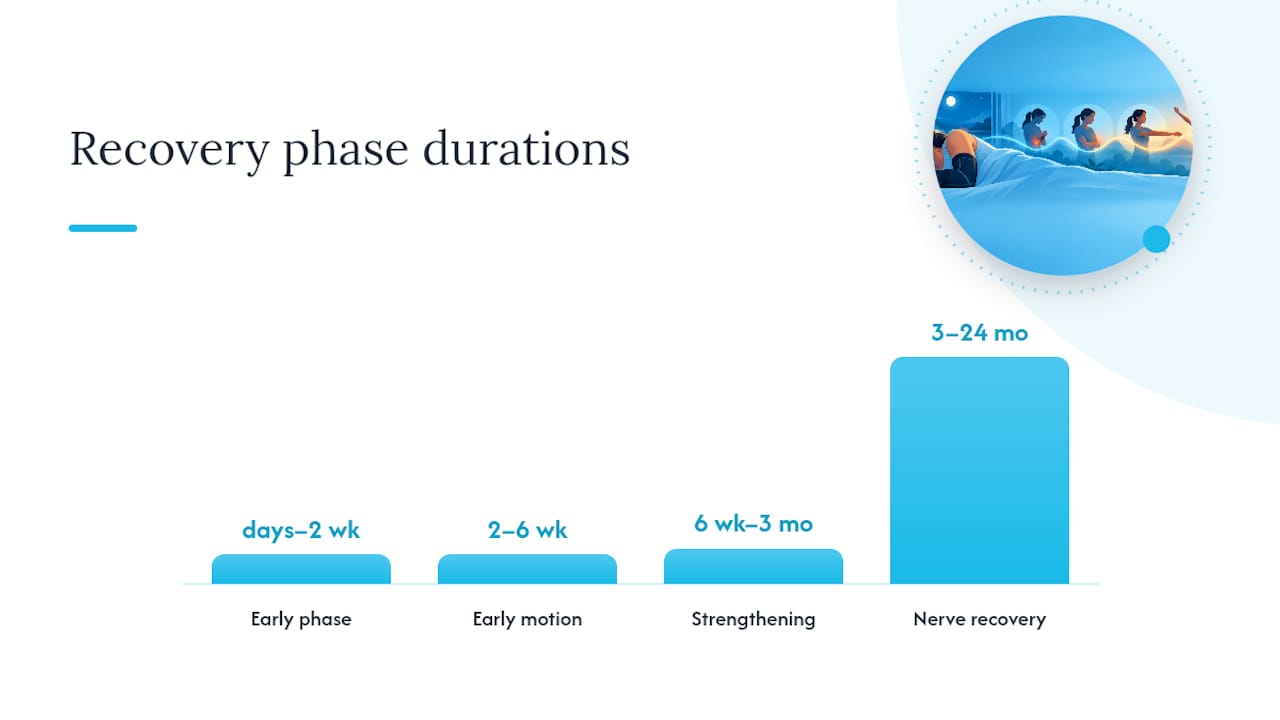
Conservative care that’s working usually shows some improvement within 6 to 12 weeks, which is also the typical window clinicians use before recommending a re-evaluation if symptoms haven’t budged. Surgical recovery follows a different timeline depending on which procedure was done: simple decompression generally allows earlier return to light activity, while submuscular transposition involves a longer period of restricted motion and a more gradual return to full use.
A general recovery sequence looks like this:
- Early phase (days to 2 weeks): wound healing, limited elbow motion, pain management.
- Early motion phase (2 to 6 weeks): gradual reintroduction of elbow range of motion, often guided by a hand therapist.
- Strengthening phase (6 weeks to 3 months): grip and forearm strengthening as tissue heals.
- Nerve recovery phase (3 to 24 months): ongoing improvement in sensation and fine motor control as the nerve itself heals.
That last phase runs on nerve biology, not surgical technique. Remyelination, the process of rebuilding the nerve’s insulating sheath, tends to produce noticeable functional gains starting around 2 to 3 months. Full axonal regeneration, needed when nerve fibers themselves were damaged, is slower and can continue for 12 to 24 months before reaching a plateau. This is why patients with longstanding symptoms before treatment, or visible atrophy at the time of diagnosis, tend to have less complete recovery: the nerve simply has more rebuilding to do, and some residual numbness or weakness can persist even after a technically successful treatment.
Pro Tip: Track grip strength with a simple hand dynamometer if your therapist provides one. Small, steady gains over weeks are a better sign than day-to-day symptom swings.
Call your clinician promptly if you notice worsening numbness, new or increasing weakness, fever, spreading redness, or drainage from a surgical site. These aren’t expected parts of a normal recovery curve.
Questions worth asking at your appointment
Getting clear answers early saves time and helps you understand what’s actually happening with your nerve.
- Do I need electrodiagnostic testing or imaging to confirm how much nerve involvement is present?
- Is there any sign of axon loss, and if so, does that change the recommended timeline?
- How much benefit should I realistically expect from conservative care, and over what timeframe?
- What specific signs would tell us it’s time to move toward surgery?
- Which surgical technique would you recommend for me, and what’s the reasoning?
- What does your typical rehab schedule look like, and what complication rates should I know about?
- Should I try splinting or therapy before considering surgery, even if surgery seems likely eventually?
Bring a written symptom log if you have one. Noting when numbness or weakness happens, how long it lasts, and what activities trigger it gives your clinician far more to work with than a general description at the visit itself.
Evidence summary and a practical decision path
The evidence, taken together, points toward a fairly clear stepwise approach. Splinting produces the strongest pooled results among conservative options at 89% improvement, injections are inconsistent with dextrose showing more promise than steroids, and surgical technique comparisons repeatedly show no consistent winner.
- No weakness, intermittent symptoms: start with splinting, activity changes, and nerve glides for 6 to 12 weeks.
- Symptoms persist despite conservative care: get electrodiagnostic testing and a surgical consultation.
- Weakness, atrophy, or nerve instability present: move to surgical evaluation without waiting out a full conservative trial.
- Surgery is chosen: expect a personalized technique decision, not a fixed “best” procedure.
The biggest limitation across this literature is variability: study designs differ, severity thresholds differ, and surgeon experience shapes outcomes in ways that are hard to standardize in trials. That’s exactly why individualized decision-making matters more than following a single fixed protocol. Clinic-based conservative care, including hands-on soft tissue work and structured rehab, fits naturally into the earliest step of this pathway, giving patients a supervised way to work through splinting and nerve gliding before surgical referral becomes necessary.
Our take on treating cubital tunnel conservatively
Cubital tunnel syndrome gets treated too often as a binary: live with it or get surgery. That framing skips over how much a supervised conservative program, done properly and consistently, can accomplish before either of those becomes the only option. Splinting alone outperforming injections in pooled data should change how patients prioritize their early efforts: cheap, low-risk measures done well beat expensive interventions done halfheartedly.
The bigger issue we see is inconsistency. Patients get handed a splint and told to “wear it at night,” with no follow-up on whether it’s positioned correctly, no reassessment at 6 weeks, and no clear marker for when to escalate. Conservative care fails less often because it doesn’t work and more often because it isn’t actually followed through.
Surgery has its place, clearly, for weakness, atrophy, or nerve instability. But for the intermittent, no-weakness majority, a structured hands-on program with real follow-up deserves a genuine trial before anyone reaches for a scalpel.
— Chris
How The Tx Room supports conservative cubital tunnel care
If you’re in the early, no-weakness stage of cubital tunnel symptoms, a structured hands-on approach can be a real alternative to jumping straight to surgical consultation. At The Tx Room, we use the Fascial Distortion Model to address the soft tissue restrictions around the elbow that often accompany nerve irritation, paired with guidance on splinting position and nerve gliding technique so the conservative program you’re already trying actually gets done correctly.
Services relevant to elbow nerve compression include various manual therapy techniques for soft tissue restriction around the elbow and forearm, therapies to address surrounding muscle tension that can aggravate nerve compression, needling techniques as an option for persistent muscular tension contributing to symptoms, and focused shockwave therapy as an adjunct for soft tissue recovery.
A first visit typically includes a hands-on assessment of the elbow and surrounding soft tissue, followed by a short-term plan built around your specific symptom pattern. If your case shows signs pointing toward surgical evaluation, we say so directly rather than continuing treatment that isn’t likely to help. Schedule a visit with The Tx Room to find out where you stand.
Sources
This article draws on peer-reviewed clinical reviews and major patient guides, including a review of modern cubital tunnel management, a meta-analysis of conservative treatment outcomes, a comparative review of surgical management approaches, the Cochrane systematic review on ulnar neuropathy treatments, and Johns Hopkins Medicine’s patient guide to cubital tunnel syndrome. If you’re also dealing with wrist-level nerve symptoms, our overview of carpal tunnel treatment approaches covers related conservative strategies.
This article is general information, not a substitute for advice from a qualified doctor. Consult a qualified healthcare professional about your own circumstances before acting on anything here.
- Conservative treatment outcomes for ulnar nerve compression at the elbow (systematic review/meta-analysis)
- What are the effects of treatments for ulnar neuropathy at the elbow (UNE)? | Cochrane
FAQ
How to cure cubital tunnel syndrome?
There’s no single cure that works for everyone, since the right approach depends on severity. Most mild to moderate cases improve with splinting, activity changes, and nerve gliding exercises, while persistent weakness or nerve instability typically requires surgical decompression or transposition.
Can cubital tunnel syndrome go away on its own?
Mild, intermittent symptoms can improve without formal treatment if the aggravating activity (like leaning on the elbow or sleeping with it bent) is reduced. Once weakness or muscle wasting develops, though, the condition rarely resolves without conservative or surgical intervention.
Can I work out with cubital tunnel syndrome?
Light activity is usually fine, but exercises that involve sustained elbow flexion or direct pressure on the inner elbow, like certain curls or floor exercises resting on the forearm, tend to aggravate symptoms. Modifying grip position and avoiding prolonged elbow bending during workouts helps most people continue training while symptoms settle.
Can I test for cubital tunnel syndrome at home?
You can watch for the pattern common to this condition: tingling or numbness in your ring and little fingers that worsens with elbow bending, sleeping, or leaning on a hard surface. A home check isn’t a diagnosis, though. Confirming the cause and ruling out weakness or nerve damage requires a clinical exam and, in some cases, electrodiagnostic testing.