

Athletes: 5 Red Flags That Show Soreness Is a Strain, Not DOMS
That ache you’re feeling is almost certainly delayed onset muscle soreness if it built up gradually over a day or two, feels dull and spread across the whole muscle, and eases once you start moving. If instead the pain hit suddenly during the activity, sits in one exact spot, or came with a pop, swelling, or real weakness, treat it as a probable injury and get it looked at rather than pushing through.
TL;DR:
- Soreness that appears 12 to 48 hours after exercise and eases with movement is most likely delayed onset muscle soreness, not injury.
- Pain during activity, sudden sharpness, swelling, or weakness indicates a probable muscle strain or injury requiring professional assessment.
- Overexertion and rapid increases in training volume or intensity frequently cause DOMS, not necessarily indicating poor effort but often overloading recovery limits.
- Self-care favors light activity and gentle stretching for DOMS, while a strain demands rest, ice, compression, and limited movement until pain subsides.
- Persistent pain, swelling, or weakness beyond one week often warrants hands-on evaluation and possibly imaging to confirm diagnosis and guide recovery.
Table of Contents
- DOMS vs Injury: How the Timing and Symptoms Differ
- What’s Actually Happening Inside the Muscle
- When Should You Stop Self-Care and Get Checked?
- Should You Rest or Keep Moving? Self-Care by Type
- How to Train So You Don’t Keep Guessing
- When Hands On Assessment Actually Helps
- A Simple Rule of Thumb Worth Remembering
- Sources
- FAQ
DOMS vs Injury: How the Timing and Symptoms Differ
The clock is your best diagnostic tool here, and it’s more reliable than trying to judge pain “levels.”
Delayed onset muscle soreness shows up 12 to 48 hours after exercise, peaks around the 24 to 72 hour mark, and fades within a few more days, according to Cleveland Clinic. It’s a dull, achy, whole-muscle sensation, often symmetrical if you trained both sides evenly, and it typically loosens up once you start moving. That last part surprises people: soreness that gets better with light activity is a strong point in favor of DOMS, not injury.
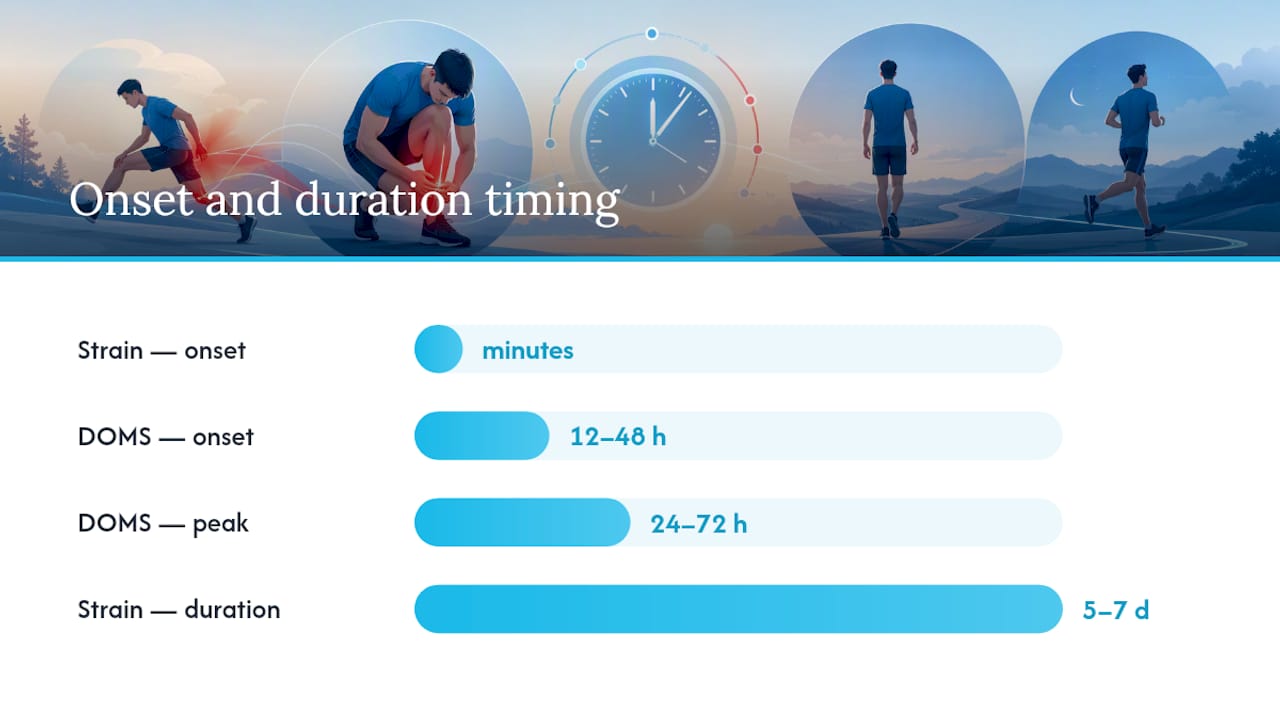
A strain or muscle tear behaves almost the opposite way. The pain shows up during the activity itself or within minutes, not a day later. It’s sharp, it sits in one specific spot, and it usually affects only one side. You might notice an audible pop, a sudden loss of strength, or an immediate need to stop what you were doing.
Two mismatches are worth flagging:
- Soreness that keeps intensifying instead of fading after day 2 or 3
- Any ache still present or worsening beyond 5 to 7 days, which points toward a strain rather than normal recovery
What’s Actually Happening Inside the Muscle
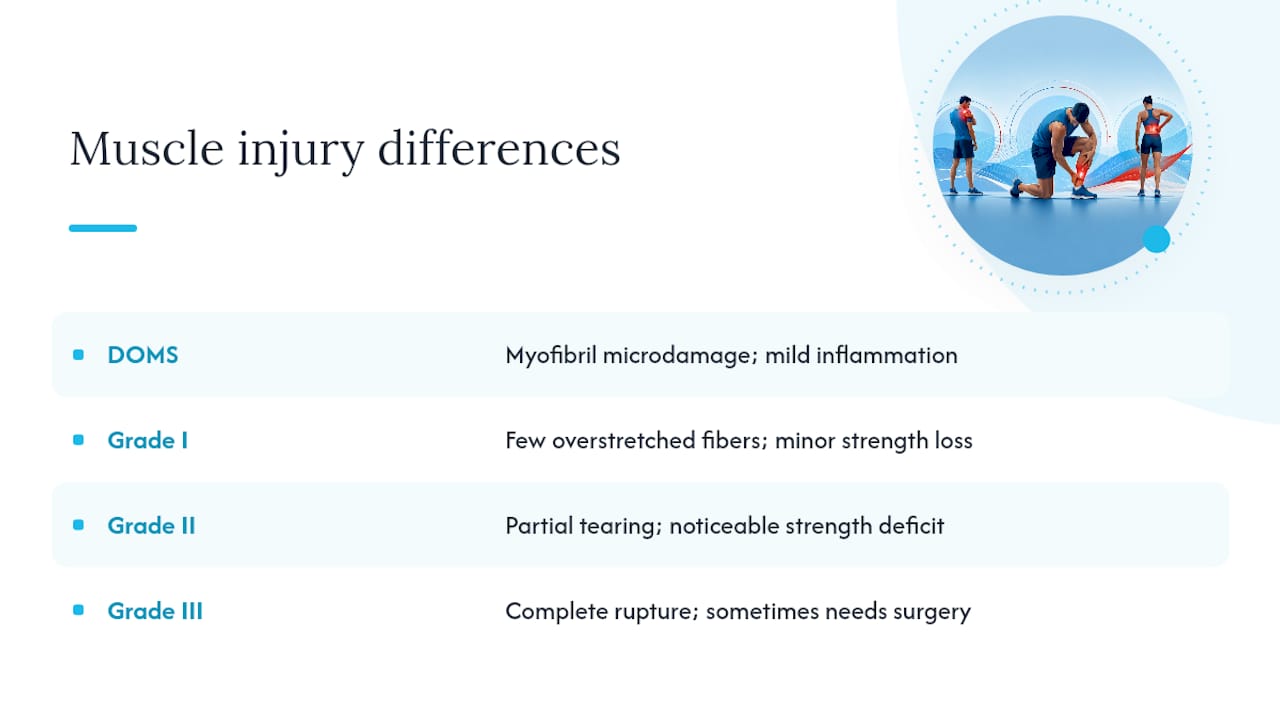
DOMS comes from microscopic damage to myofibrils, the contractile threads inside muscle fibers, triggered by unfamiliar or heavily eccentric movement, think slow lowering phases on a squat, or your first hill run in months. That microtrauma sparks a mild inflammatory response that sensitizes nearby nerve endings, which is why the area feels tender and stiff rather than sharply painful.
A strain is a different kind of damage entirely: fibers or tendon attachments overstretch or tear outright. Clinicians grade strains I through III. Grade I is a few overstretched fibers with minor strength loss. Grade II involves partial tearing and a noticeable strength deficit. Grade III is a complete rupture, sometimes requiring surgical repair, according to Cleveland Clinic’s strain classification.
One rare but serious wrinkle: extreme, unaccustomed exertion (think a first ultra-marathon or an all-out eccentric workout after months off) can occasionally trigger rhabdomyolysis, a breakdown of muscle tissue severe enough to release proteins into the bloodstream. It’s uncommon, but it’s the reason “just sore” claims deserve a second look when the swelling or pain seems out of proportion to the workout.
When Should You Stop Self-Care and Get Checked?
Certain findings should move you from “wait it out” to “call someone” without much deliberation.
- Pain that started during the movement itself, especially if it arrived as a sudden sharp jolt or an audible pop.
- Visible swelling, bruising, or deformity, particularly a dent or gap you can feel at the injury site, a classic sign of a Grade III tear per Harvard Health.
- Focal weakness that doesn’t match general fatigue, like a calf that won’t push off or an arm that can’t lift what it could yesterday.
- Inability to bear weight or use the limb normally.
- Systemic warning signs, dark or cola-colored urine, disproportionate swelling, or pain far beyond what the activity would explain, which can signal rhabdomyolysis and needs emergency evaluation, not a wait-and-see approach.
Sports medicine physicians sometimes frame this as pain you earned versus pain you didn’t earn, according to Houston Methodist. If you know exactly which set or rep caused it, and it improves with gentle movement, that’s usually DOMS. If it just happened to you, that’s the injury pattern.
When a clinician suspects a significant tear, imaging settles it. Ultrasound gives a quick, low-cost look at soft tissue, while MRI offers more detail for grading severity or planning surgery. Blood work, specifically a creatine kinase test, alongside urinalysis is standard when rhabdomyolysis is a concern.
Pro Tip: Test function, not just pain. Try a slow, controlled range of motion, calf raises for a lower leg issue, a light curl for a biceps strain. If strength and range hold up despite discomfort, DOMS is more likely. If either one gives out, that’s your cue to get evaluated.
Should You Rest or Keep Moving? Self-Care by Type
DOMS responds well to staying active, while a real strain needs the opposite approach early on.
For suspected DOMS:
- Keep moving with light activity, walking, easy cycling, or a gentle version of the same movement pattern
- Stretch gently but skip aggressive static holds on tissue that’s already inflamed
- Prioritize sleep and hydration, both measurably speed recovery
- Use NSAIDs sparingly if needed for comfort, and expect noticeable improvement day over day
For a suspected strain, start with RICE, rest, ice, compression, and elevation, in the first 24 to 72 hours, according to Mayo Clinic. Protect the area and avoid loading or stretching it aggressively until pain allows controlled movement. Begin guided rehab once the acute pain settles, and resources on pulled muscle recovery walk through that early progression in more detail.
Escalate to a clinician if pain climbs instead of easing, strength doesn’t return, you feel numbness or tingling, or there’s no real improvement after several days.
How to Train So You Don’t Keep Guessing
Most repeat DOMS cases trace back to one thing: a jump in training demand your tissue wasn’t ready for.
- Increase volume or intensity gradually, especially anything heavy on the eccentric (lowering) phase
- Warm up dynamically before sessions instead of relying on static stretching alone
- Build in scheduled deload weeks rather than waiting for pain to force one
- Add mobility and load-control work for muscles that repeatedly flare up
If soreness shows up after nearly every session, that’s not a badge of effort. It usually means your training load and recovery capacity are mismatched, a pattern worth flagging to a coach or clinician before it turns into a genuine strain. A practical recovery guide from Level Up Gym covers similar ground on separating productive soreness from overreaching.
When Hands On Assessment Actually Helps
Persistent focal pain, an unclear diagnosis, or strength that hasn’t returned after a week or two are the moments to bring in hands-on assessment rather than guessing further. Manual therapy paired with progressive strengthening, once the acute inflammatory window has passed, tends to shorten functional recovery for many soft-tissue injuries.
Common milestones for soft-tissue injuries follow a pattern: reduced pain and improved movement within the first 1 to 3 weeks, followed by a return to normal loading and activity by 3 to 6 weeks, depending on severity and how consistently rehab is followed.
The Tx Room documents staged recovery timelines like this in clinic case notes, and similar milestone frameworks appear in resources on ligament sprain recovery for readers who want the fuller picture. Hands-on work isn’t a replacement for imaging when a tear is suspected. It’s a next step once the diagnosis is reasonably clear.
A Simple Rule of Thumb Worth Remembering
Here’s the shortcut I’d give a friend texting me a photo of their swollen calf: if it started during the move and limits what you can actually do, get checked. If it showed up later and gets better once you’re moving, keep an eye on it and carry on.
Frequent DOMS isn’t proof you’re training hard enough. It’s often proof your volume has outpaced your recovery. Function matters more than soreness. When in doubt, get evaluated early rather than guessing for another week.
— Chris
This article is general information, not a substitute for advice from a qualified doctor. Consult a qualified healthcare professional about your own circumstances before acting on anything here.
Sources
- Delayed Onset Muscle Soreness (DOMS) — Cleveland Clinic
- Muscle strains — Mayo Clinic
- The pain of muscle strains – Harvard Health
- Rhabdomyolysis — Cleveland Clinic
FAQ
Does DOMS Ever Go Away on Its Own?
Yes. DOMS typically resolves within a few days without any specific treatment, following the same 12 to 48 hour onset and 24 to 72 hour peak pattern described by Cleveland Clinic. If soreness lingers past 5 to 7 days or gets worse instead of better, that’s no longer typical DOMS.
How Do I Know if I’m Injured or Just Sore?
Check when the pain started and whether it improves with movement. Pain that hit during the activity, stays sharp and localized, or doesn’t ease with gentle movement points toward a strain rather than ordinary soreness.
What’s the Real Difference Between DOMS and a Strain?
DOMS is diffuse, dull, delayed by a day or two, and improves with light activity, while a strain is sharp, localized, immediate, and often comes with weakness or swelling. Strains are also clinically graded I through III based on how much tissue is torn, per Cleveland Clinic.
Is My Calf Soreness a Strain or Just DOMS?
If the calf ache built up over a day after a hard run or new exercise and loosens up when you walk, it’s likely DOMS. If it hurt sharply the moment it happened, came with a pop, or now limits push off strength, treat it as a possible strain. A guide on calf strain treatment walks through the early recovery steps for that specific case.
If your pain pattern still doesn’t fit clearly into either category, or a week has passed without real improvement, scheduling a hands-on evaluation with Thetxroom can settle the question and get a tailored recovery plan started sooner rather than later.