
Recover in 4–6 Weeks: Low Back Pain Care, Move First in Plano
Low back pain is discomfort or stiffness anywhere between your lower ribs and your buttocks, and it will affect most adults at some point in life. Acute episodes last under several weeks and usually improve on their own with activity and basic self-care; chronic low back pain, defined as lasting several months or more, needs a more structured plan. Stay as active as you can tolerate, try heat and over-the-counter pain relievers if needed, and get urgent care immediately if you notice new bladder or bowel changes, numbness in the groin area, fever, or leg weakness.
TL;DR:
- Most low back pain cases are non-specific, involving a mix of muscle, joint, stress, sleep, and activity factors, making targeted structural treatment less effective initially.
- Red flags such as bowel or bladder dysfunction, fever, or recent trauma require urgent evaluation, while imaging is typically deferred for four to six weeks unless symptoms worsen or neurological deficits develop.
- First-line treatments emphasize activity, physical therapy, spinal manipulation, massage, and behavioral strategies, with medications like NSAIDs used only if necessary after these options.
- Prolonged bed rest can worsen recovery, so gentle movement, heat and ice, and basic lifestyle improvements are recommended to speed healing and prevent chronic pain.
- Opioids are discouraged for most low back pain cases due to limited long-term benefits and high risks, highlighting the importance of structured activity and physical therapy first.
Table of Contents
- What Causes Low Back Pain and How Common Is It
- What Low Back Pain Feels Like and What’s Behind It
- How Doctors Diagnose the Source of Your Pain
- The Right Order of Treatment: Movement First, Medication Second
- Self-Care Steps That Actually Speed Recovery
- What Recovery Actually Looks Like
- When Low Back Pain Needs Immediate Attention
- How The Tx Room Approaches Low Back Pain
- Opioids and Low Back Pain: Why Guidelines Say Avoid Them
- Low Back Pain in Older Adults, Pregnant Patients, and Athletes
- Do Acupuncture, Yoga, and Mindfulness Actually Help?
- How Low Back Pain Disrupts Daily Life
- The Gap Between What Guidelines Say and What Patients Actually Get
- Get Hands-On Care for Low Back Pain in Plano
- Sources
What Causes Low Back Pain and How Common Is It
Low back pain sits in the lumbar region, roughly from the bottom of your rib cage down through the sacrum and into the buttocks. Clinicians classify it by how long it lasts: acute means under six weeks, subacute runs six to twelve weeks, and chronic low back pain means symptoms persisting 12 weeks or longer.
It’s also strikingly common. The World Health Organization reports that low back pain affected hundreds of millions globally in recent years, with projections indicating an increase as populations age and grow. In the United States, roughly 13% of adults live with chronic low back pain, according to the American Academy of Family Physicians.
Here’s the detail that surprises most patients: about 90% of low back pain cases are classified as “non-specific,” meaning no single structural abnormality fully explains the pain. That doesn’t mean the pain isn’t real. It means the cause is usually a mix of muscle mechanics, joint irritation, and factors like stress, sleep, and activity level working together. This is the biopsychosocial model in action, and it’s why treatment that only targets a disc or a muscle often falls short if it ignores how someone moves, sleeps, and copes with pain day to day.
What Low Back Pain Feels Like and What’s Behind It
The pain itself can tell you a lot. A dull, deep ache that worsens with prolonged sitting or bending usually points to a muscle or ligament strain. A sharp, localized pain that flares with specific movements often suggests a facet joint or disc issue. Burning or electric pain that shoots down one leg, sometimes past the knee, is classic sciatica: nerve root irritation from a herniated disc or spinal stenosis pressing on nearby nerves.
Watch for accompanying signs too. Numbness, tingling, or noticeable weakness in a leg or foot suggests nerve involvement, not just muscle soreness. Stiffness that’s worst in the morning and eases with movement points toward something different than pain that worsens throughout an active day.
Common mechanical causes include:
- Muscle or ligament strain from lifting, twisting, or sudden movement.
- Degenerative disc disease, where discs lose height and cushioning with age.
- Herniated disc, where disc material bulges and irritates a nearby nerve root.
- Facet joint arthropathy, arthritis in the small joints connecting each vertebra.
- Spinal stenosis, a narrowing of the spinal canal that often worsens with standing or walking.
Less common but serious causes include vertebral fracture, spinal infection, tumor, and referred pain from organs like the kidneys or pancreas. Pregnancy-related low back pain is also common, driven by weight shifts and ligament laxity. Risk factors that raise your odds of an episode include heavy or repetitive lifting, prolonged sitting, obesity, smoking, poor sleep, and psychological stress.
How Doctors Diagnose the Source of Your Pain
A good evaluation starts with questions, not scans. Your provider will ask about recent trauma, a history of cancer, fever or infection risk, and any new bladder, bowel, or bathroom changes. Progressive leg weakness gets flagged immediately. The physical exam typically checks reflexes, muscle strength in the legs, and a straight-leg raise test, which reproduces sciatic pain when a nerve root is irritated.
Red flags that justify prompt imaging or lab work include:
- Significant trauma or a fall, especially in someone with osteoporosis.
- Unexplained weight loss or a personal history of cancer.
- Fever combined with back pain, raising concern for spinal infection.
- Progressive neurologic deficit, such as worsening leg weakness.
- New bowel or bladder dysfunction, which can signal a spinal emergency.
Absent those signs, routine imaging is usually deferred for four to six weeks. That’s not doctors being cautious with your time. Imaging frequently turns up disc bulges and degenerative changes in people who have no pain at all, so an early MRI can point you toward a structural finding that has nothing to do with why you actually hurt.
Pro Tip: If your provider orders an MRI in week two with no red flags present, ask what specific finding they expect it to change about your treatment. If the answer is “we’re not sure yet,” it’s reasonable to wait.
The Right Order of Treatment: Movement First, Medication Second
Guidelines from the AAFP are blunt about sequencing: nonpharmacologic treatment comes first for chronic low back pain, with medication reserved for cases where movement-based care alone isn’t enough.
First-line options include:
- Staying active rather than resting, since movement keeps supporting muscles engaged.
- Physical therapy and exercise therapy, which build strength and mobility around the affected area.
- Spinal manipulation, appropriate for many mechanical cases of low back pain.
- Massage and myofascial work, which can ease muscle guarding and improve range of motion.
- Cognitive behavioral strategies, which address the stress and fear-avoidance patterns that often prolong pain.
Exercise therapy and cognitive behavioral therapy are specifically recommended as first-line for chronic cases, not as an afterthought once other options run out.
When medication is needed, over-the-counter NSAIDs like ibuprofen or naproxen are typically the first choice, with acetaminophen as an alternative for people who can’t tolerate NSAIDs. Both carry cautions: NSAIDs can affect the stomach and kidneys with prolonged use, and acetaminophen has a firm daily dose ceiling for liver safety.
Injections, such as epidural steroid injections for radicular pain, can offer short-term relief for sciatica, but evidence for lasting benefit is limited. Surgery becomes a consideration mainly when there’s a progressive neurologic deficit, or a confirmed structural lesion causing persistent disability despite months of appropriate nonsurgical care.
Self-Care Steps That Actually Speed Recovery
The instinct to rest completely is usually the wrong one. Prolonged bed rest leads to deconditioning and raises the risk that pain becomes chronic, because your stabilizing muscles weaken exactly when you need them most.
- Move within your limits. Short walks and normal daily tasks, done gently, beat lying flat.
- Alternate heat and ice for comfort. Ice calms acute inflammation; heat loosens tight muscles later.
- Use OTC pain relievers as directed, watching NSAID limits if you have stomach or kidney concerns.
- Add light core stability work once acute pain eases, progressing to guided physical therapy if pain persists past two to three weeks.
- Fix the basics: lift with your legs, adjust your desk chair, manage your weight, prioritize sleep, and quit smoking, since nicotine reduces blood flow to spinal discs.
Pro Tip: Pace your activity in small, consistent doses rather than pushing through a big effort one day and doing nothing the next. That boom-and-bust pattern is one of the most common reasons mild back pain lingers longer than it should.
What Recovery Actually Looks Like
Most acute episodes improve within days to a few weeks, and the majority resolve within four to six weeks with activity and basic self-care. Chronic low back pain, by definition, means symptoms have stuck around for 12 weeks or more, and it affects roughly 13% of U.S. adults.
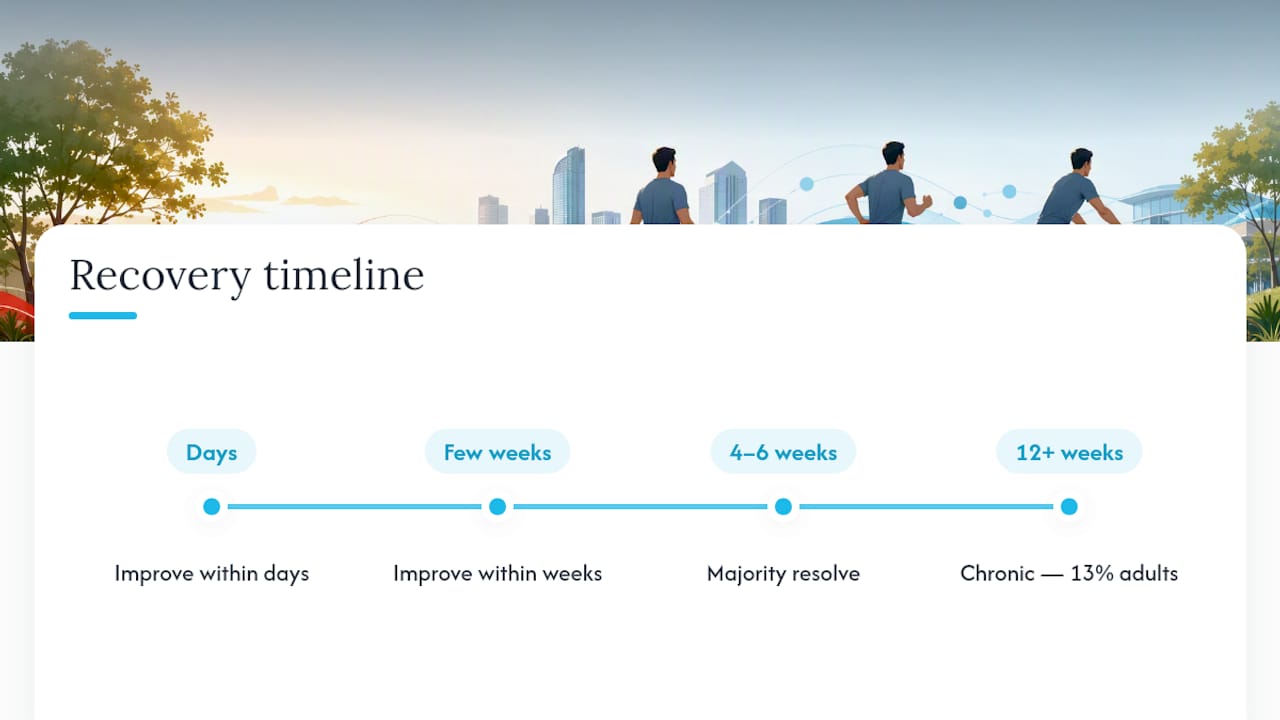
Certain “yellow flags” predict a slower course: depression, high stress, fear of movement, job dissatisfaction, and poor sleep. These aren’t imagined factors. They change how the nervous system processes pain signals, which is exactly why nonpharmacologic and psychologically informed care matters as much for prognosis as it does for symptom relief.
When Low Back Pain Needs Immediate Attention
Some symptoms mean don’t wait, don’t call tomorrow, go now.
- New urinary retention, loss of bladder or bowel control, or numbness in the saddle area (inner thighs, groin) signal possible cauda equina syndrome, a surgical emergency where delay risks permanent nerve damage.
- Fever with back pain, unexplained weight loss, a cancer history, or major recent trauma all warrant same-day evaluation.
- Progressive leg weakness that’s getting worse, not staying the same, needs prompt assessment.
Short of those emergencies, contact your primary care provider if pain persists beyond four weeks, radicular symptoms worsen, or daily function keeps declining despite self-care.
How The Tx Room Approaches Low Back Pain
The Tx Room uses the Fascial Distortion Model, a hands-on method that targets fascial restrictions contributing to pain and restricted movement, paired with individualized rehab. Typical candidates include people with sciatica, disc-related symptoms, or soft-tissue strain who’ve plateaued with rest alone. An initial visit usually involves a focused assessment followed by manual treatment, with home exercise built into the plan so gains hold between sessions.
Patients often come in after weeks of managing pain alone, and the combination of hands-on fascia work with guided movement is what gets them back to normal activity faster than either approach on its own.
| Focus Area | What It Addresses |
|---|---|
| Fascial Distortion Model | Soft-tissue restrictions limiting movement |
| Paired rehab exercises | Long-term strength and recurrence prevention |
| Common conditions treated | Sciatica, disc-related pain, muscle strain |
Opioids and Low Back Pain: Why Guidelines Say Avoid Them
Opioids are not a first-line, second-line, or even reliable third-line option for most low back pain, and current guidance reflects that clearly. The nonpharmacologic-first approach recommended by the AAFP exists partly because opioids show limited evidence of long-term benefit for mechanical back pain, while carrying well-documented risks: tolerance, dependence, constipation, sedation, and overdose potential that climbs with dose and duration.
Short courses may occasionally be considered for severe acute pain that hasn’t responded to other measures, but even then, providers aim for the lowest effective dose over the shortest possible time. Opioids should generally be avoided for chronic non-specific low back pain, where the evidence doesn’t support meaningful long-term functional improvement and the risks compound the longer use continues.
The bigger issue is what opioids don’t do. They dull pain perception temporarily without addressing the muscle deconditioning, movement fear, or mechanical dysfunction actually driving most chronic cases. That’s why exercise therapy, physical therapy, and behavioral approaches consistently outperform medication-only strategies for lasting improvement. If you’ve been offered opioids for garden-variety low back pain without first trying structured physical therapy or activity-based rehab, it’s worth asking your provider directly why nonpharmacologic options weren’t tried first.
Low Back Pain in Older Adults, Pregnant Patients, and Athletes
Age and life stage change both the likely cause and the right response to low back pain.
Older adults face a higher likelihood of compression fractures, spinal stenosis, and degenerative changes, especially with osteoporosis. A fall that seems minor can still cause a fracture, so trauma in this group gets evaluated more readily than it would in a younger adult. Stenosis symptoms, pain that eases with sitting or leaning forward, are also more common with age.
Pregnant patients commonly develop low back pain from shifting posture, loosened pelvic ligaments, and added weight through the lumbar spine, especially in the second and third trimesters. Most cases are mechanical rather than a sign of something serious, but new severe pain, especially with contractions or bleeding, needs prompt evaluation. Gentle, pregnancy-appropriate exercise and posture support tend to help more than rest.
Athletes are more likely to develop pain from repetitive loading, such as extension-based stress in gymnasts and rowers, or acute strain from heavy lifting. A sudden onset of sciatica after deadlifting, for example, often reflects disc irritation rather than a simple muscle pull, and pushing through training too soon can prolong recovery. Athletes generally recover well with a structured return-to-activity plan rather than complete rest, since deconditioning works against performance and pain control alike.
Across all three groups, the safety threshold for red flags stays the same: new bladder or bowel changes, saddle numbness, fever, or progressive weakness require urgent evaluation regardless of age or activity level.
Do Acupuncture, Yoga, and Mindfulness Actually Help?
These approaches sit alongside, not instead of, standard nonpharmacologic care, and the evidence for each varies in strength. Acupuncture has shown modest benefit for some patients with chronic low back pain, likely through effects on pain perception and muscle tension, though results are inconsistent across studies and it works best paired with active rehabilitation rather than used alone.
Yoga has a more consistent evidence base for chronic low back pain specifically, largely because it combines gentle strengthening, flexibility, and controlled breathing, the same ingredients found in formal exercise therapy. Mindfulness-based approaches, meanwhile, target the psychological side of the biopsychosocial picture directly. They don’t reduce a disc bulge or loosen a tight facet joint, but they can reduce the fear, catastrophizing, and stress response that make pain feel more disabling than the tissue damage alone would predict.
None of these replace the core recommendation of staying active and pursuing physical therapy or exercise-based rehab when pain persists. Think of them as legitimate additions for people who want more tools in the kit, particularly those whose pain has a strong stress or anxiety component, rather than a standalone fix for a herniated disc or spinal stenosis.
How Low Back Pain Disrupts Daily Life
Low back pain is one of the leading causes of disability worldwide, and its impact goes well beyond the physical discomfort. Simple tasks, bending to tie shoes, lifting a child, sitting through a workday, become calculated decisions instead of automatic movements. Sleep often suffers first, since finding a comfortable position gets harder, and poor sleep in turn makes pain feel worse the next day, creating a cycle that’s tough to break without intervention.

Work is frequently affected too. People with chronic low back pain report reduced productivity, missed workdays, and in some cases job changes when physical demands can’t be modified. The emotional toll is real: persistent pain is linked to higher rates of anxiety and depression, which then feed back into how the nervous system processes pain signals, making symptoms feel more intense and harder to shake.
The WHO frames this clearly: a biopsychosocial approach paired with rehabilitation can reduce disability and support people’s return to work and community participation, rather than treating pain in isolation from the rest of a person’s life. That’s the practical argument for addressing sleep, mood, and activity pacing alongside any physical treatment. Fixing the muscle without fixing the sleep deprivation, or vice versa, tends to leave people stuck halfway to recovery.
The Gap Between What Guidelines Say and What Patients Actually Get
The guidance is consistent: move first, medicate second, image only when it matters. Yet plenty of patients still leave a first appointment with a prescription and no exercise plan, or get an MRI in week two that finds a disc bulge everyone their age has, with or without pain. That mismatch between evidence and practice is the real problem, not a lack of good research.
What’s underrated is how much psychological framing changes outcomes. Being told your spine is “degenerating” versus being told your back is strong but temporarily irritated leads to measurably different recovery paths, because fear of movement is one of the strongest predictors of pain becoming chronic. Patients deserve language that matches the actual risk, not the scariest possible interpretation of a scan.
What should come first, practically speaking, is a real trial of activity and hands-on rehab before reaching for medication or ordering images that were never going to change treatment anyway. That’s not a lower standard of care. Given what the evidence shows, it’s the higher one.
— Chris
Get Hands-On Care for Low Back Pain in Plano
Specialized chiropractic centers often treat low back pain with hands-on methods first, incorporating rehab into the treatment plan rather than adding it afterward. If you’ve tried rest and it hasn’t worked, or you’re stuck between an OTC pain reliever and a referral you haven’t scheduled yet, that gap is exactly where the Fascial Distortion Model approach fits, addressing the soft-tissue restriction directly instead of just managing symptoms around it.
![CTA Image]
The clinic works with sciatica, disc-related symptoms, and general low back pain, pairing manual treatment with a rehab plan you continue at home. If your pain involves a specific injury pattern, disc-related symptoms are addressed directly in an initial evaluation, where treatment starts the same visit rather than after a separate round of imaging. Call The Tx Room in Plano to schedule an initial exam and find out what’s actually driving your pain.
This article is general information, not a substitute for advice from a qualified doctor. Consult a qualified healthcare professional about your own circumstances before acting on anything here.
Sources
- Low back pain — WHO fact sheet
- Chronic low back pain in adults: Evaluation and management | AAFP
- Low Back Pain: Evaluation and Management — NCBI Bookshelf (StatPearls)
- Low back pain – acute: MedlinePlus Medical Encyclopedia