
1–3 Sessions: Myofascial Release in Plano That Aids Rehab
Myofascial release is a hands-on therapy that uses sustained, gentle pressure on the fascia (the connective webbing around muscles and nerves) to break up restrictions and ease chronic tightness. For many people, it reduces pain and improves range of motion, but mainly when it’s paired with an actual rehab plan, not used as a one-off fix. Certain conditions, like active malignancy or healing fractures, mean you should get medical clearance before trying it.
TL;DR:
- Myofascial release is most effective when combined with a structured rehabilitation plan, especially for long-term pain relief and improved mobility.
- Passive, sustained pressure techniques target fascia restrictions directly, taking longer hold times compared to massage, which rely on rhythmic strokes.
- Outcomes are strongest for chronic conditions like back pain, fibromyalgia, or post-injury rehabilitation, especially when integrated with movement and strengthening exercises.
- People with active malignancy, unhealed fractures, vascular conditions, or infections should seek medical clearance before treatment.
- Expect mild soreness or fatigue after sessions, and consistent work with long-hold stretching and strengthening maximizes benefits over time.
Table of Contents
- What Is Myofascial Release and How Is It Different From Massage?
- Common Myofascial Release Techniques and What They Feel Like
- Who Benefits From Myofascial Release, and What Does the Evidence Show?
- Contraindications and When You Need Medical Clearance First
- What Happens During a Myofascial Release Session
- Integrating Fascia Work Into a Full Rehabilitation Plan
- What I Tell Patients About Setting Realistic Goals
- How Thetxroom Approaches Fascia Work in Plano
- Sources
What Is Myofascial Release and How Is It Different From Massage?
Fascia is the fibrous sheet that wraps every muscle, nerve, and blood vessel in your body. When it gets stuck, dehydrated, or scarred down after injury, it forms adhesions and trigger points, small knots that can refer pain to spots far from where the actual problem lives. A tight hip flexor, for instance, can cause pain that shows up in the low back.
That’s the core difference from a typical Swedish or deep tissue massage. Massage generally uses gliding strokes over the skin to relax muscle and boost circulation. Myofascial release skips the glide. A practitioner locates a restriction and holds sustained, non-moving pressure on it until the tissue changes under their hands.
- Direct MFR applies pressure straight into the restriction and waits for it to soften.
- Indirect MFR guides tissue in the direction it moves most easily, letting it unwind rather than forcing it.
- Both rely on slow, sustained contact rather than rhythmic strokes, since fascia is viscoelastic and responds to time, not speed.
Common Myofascial Release Techniques and What They Feel Like
The hallmark of myofascial therapy techniques is patience. Fascia doesn’t respond to quick pressure the way a muscle knot sometimes does. Practitioners typically hold a spot for a specific window, then reassess.
- Direct technique: The therapist sinks into a restriction and holds, often for a sustained period, waiting for a sensation practitioners describe as slow softening or spreading rather than a sudden pop.
- Indirect technique: Instead of pressing into resistance, the therapist follows the tissue’s natural pull, letting it “unwind” over a minute or more.
- Release-enhancing maneuvers: Therapists often add breathing cues, guided eye or jaw movement, or active limb motion during a hold. These small inputs from the nervous system can speed up the release, and hold times can range anywhere from about 15 seconds to two minutes or more depending on how the tissue responds.
Self-myofascial release exercises, using a foam roller or a firm ball, let you maintain some of this work between visits. They’re genuinely useful for general tightness, but they can’t replicate a trained hand’s ability to feel subtle, systemic patterns across your whole body.
Pro Tip: If a foam roller spot still feels sharp or “stuck” after a few sessions of consistent rolling, that’s usually your cue to get it assessed by a professional instead of grinding on it longer.

Who Benefits From Myofascial Release, and What Does the Evidence Show?
People most commonly try MFR for chronic low back pain, neck tightness, fibromyalgia, post-exercise soreness in athletes, and as an adjunct during post-surgical or injury rehab. It’s also a common complement to treatment for conditions like sciatica and plantar fasciitis, where fascial restriction along the leg or foot can amplify nerve-related pain.
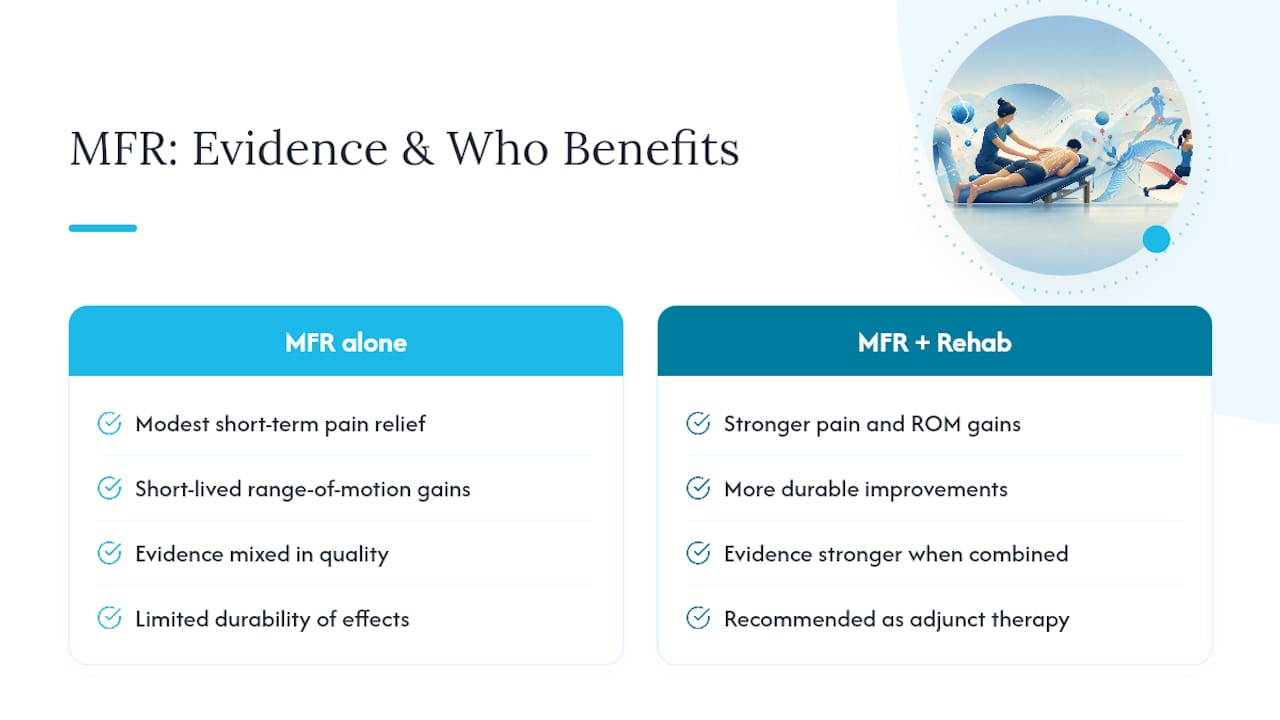
The research picture is encouraging but measured. A systematic review of myofascial release studies found modest short-term improvements in pain and range of motion across a range of conditions, including some fibromyalgia trials showing benefit that held up at six months. The same review is clear about a catch: results were strongest when MFR was folded into a broader program of exercise and progressive rehab, not delivered alone.
That distinction shapes how you should set expectations. If you go in expecting a single session to permanently resolve years of tightness, you’ll likely be disappointed. If you go in expecting a tool that loosens restricted tissue enough to let strength and mobility work actually stick, the evidence lines up much better with reality. Studies caution that techniques, dosing, and patient groups vary widely, so results are far from uniform, which is exactly why pairing MFR with structured rehab, rather than treating it as a standalone therapy, tends to produce more durable results.
Contraindications and When You Need Medical Clearance First
Myofascial release is low risk for most people, but it isn’t appropriate for everyone. Certain conditions call for a doctor’s clearance before you book a session.
- Active malignancy or suspected tumor near the treatment area
- Aneurysm or vascular conditions where pressure could be dangerous
- Healing or unhealed fractures
- Severe osteoporosis, where fragile bone raises injury risk
- Active infection at or near the treatment site
- Uncontrolled systemic disease (unmanaged diabetes, certain autoimmune flares)
These contraindications exist to protect fragile or vulnerable tissue from a therapy that, while gentle in intent, still applies real sustained pressure. Mild side effects like temporary soreness or slight bruising are common and usually resolve within a day or two. If you have any of the conditions above, or you’re not sure, talk to a physician before scheduling.
What Happens During a Myofascial Release Session
A session typically opens with an evaluation, not immediate treatment. The therapist checks your posture, tests movement patterns, and palpates for restricted or tender areas, since trigger points often refer pain to a completely different part of the body than where you feel it.
From there, expect sustained pressure applied by hand, generally without lotions or oils so the practitioner can maintain an accurate feel for tissue changes. Sessions usually run 30 to 90 minutes depending on how many regions need work.
- During treatment: You’ll feel steady pressure, sometimes uncomfortable but rarely sharp, held until the therapist feels a shift in the tissue.
- Right after: Mild soreness, looseness, or fatigue in the treated area is normal. Hydration and light movement help.
- Between visits: Long-hold stretching (90 seconds or more per stretch), consistent foam roller work, and gradual strengthening keep the gains from a session instead of letting them fade.
Integrating Fascia Work Into a Full Rehabilitation Plan
Myofascial therapy techniques work best as one piece of a larger plan, not the whole plan. At Thetxroom, treatment usually pairs the Fascial Distortion Model with adjunct approaches like Myofascial Acoustic Compression Therapy and targeted muscle retraining, aimed at correcting the actual biomechanical dysfunction driving the pain, not just the sore spot.
- Initial assessment maps out movement compensations and identifies where restriction actually originates.
- Short-term, focused fascia work addresses the immediate restriction and reduces guarding.
- Progressive strengthening and activity-specific rehab convert that short-term change into lasting function.
This mirrors what rehabilitation-focused clinics generally recommend: fascia work opens a window, but strength and movement retraining are what keep that window open.
What I Tell Patients About Setting Realistic Goals
Most people notice some looseness within one to three sessions, but real functional change, walking further, sleeping without pain, returning to a sport, usually takes several weeks of consistent work. Track it with something concrete: a 0 to 10 pain scale, a simple range-of-motion check, or a specific activity milestone like climbing stairs without wincing. Treat your clinician as a partner in that tracking, not just a provider you show up for.
— Chris
How Thetxroom Approaches Fascia Work in Plano
Thetxroom treats fascial restriction the way the evidence suggests it works best: as one part of a coordinated plan, not a standalone fix. Using the Fascial Distortion Model alongside Myofascial Acoustic Compression Therapy and progressive rehab, the clinic targets the actual biomechanical cause of pain rather than just the sore spot you can point to.

Initial visits generally include a full postural and movement assessment before any hands-on work begins, so treatment gets built around what’s actually driving your pain, whether that’s sciatica, plantar fasciitis, or general chronic tightness. Wear clothing you can move in and be ready to describe when the pain started and what makes it worse.
If chronic tightness, back pain, or a nagging injury has been slowing you down, book an assessment for fascia-focused care and find out what’s actually causing it.
Sources
- Hss
- Systematic review and applications of myofascial release (PMC)
- D3S1 Myofascial Release intro handout – ATSU (2025) PDF
This article is general information, not a substitute for advice from a qualified doctor. Consult a qualified healthcare professional about your own circumstances before acting on anything here.