
Rehab First Golfer’s Elbow Care: Fascia Work and Eccentric Rehab
Most cases of golfer’s elbow improve with conservative care: activity modification, protective bracing, and a structured rehab program built around eccentric strengthening. Most patients with medial epicondylitis recover without surgery, and rehab is the engine that gets them there. Injections and procedures help select cases that stall out. Surgery comes into play only after months of rehab that hasn’t worked.
TL;DR:
- Activity modification and eccentric strengthening are the foundations of most golfer’s elbow recoveries, with surgery reserved for cases that fail months of rehab.
- First-line treatments include identifying loading patterns, applying ice correctly, using a counterforce strap during aggravating activities, and gradually reintroducing load.
- Rehab progress relies on phased exercises, beginning with pain control and mobility, then moving to isometric, isotonic, and sport-specific strengthening, all guided by soreness levels.
- Injections like corticosteroids offer short-term pain relief but rarely provide lasting healing, while PRP and shockwave therapy show promise in stubborn cases.
- Surgery is the last resort after three to six months of nonoperative care if symptoms persist and function remains limited.
Table of Contents
- How Do You Treat Golfer’s Elbow in the First Few Weeks?
- What Exercises Help Golfer’s Elbow Recover Faster?
- Do Injections or Shockwave Therapy Actually Work?
- When Is Surgery Necessary for Golfer’s Elbow?
- How Is Golfer’s Elbow Diagnosed, and What Are the Red Flags?
- How Long Does Golfer’s Elbow Take to Heal?
- How Does The Tx Room Treat Golfer’s Elbow?
- A Clinician’s Note on Patience and Common Mistakes
- Ready to Get Your Elbow Moving Again?
- Sources
How Do You Treat Golfer’s Elbow in the First Few Weeks?
The first move isn’t ice or medication. It’s figuring out what’s actually loading the tendon and dialing it back. Golfer’s elbow, or medial epicondylitis, flares from repetitive wrist flexion and forearm pronation: the golf swing, sure, but also hammering, typing on a bad wrist angle, or gripping tools all day. You don’t need total rest. You need to identify the specific motion driving the pain and reduce its frequency or force for a few weeks.
Ice earns its place here, but only used correctly. Apply it for about fifteen to twenty minutes several times a day, with a thin cloth barrier between the pack and skin to avoid frostbite or irritation. Mayo Clinic’s guidance on golfer’s elbow recommends starting here alongside short-term NSAID or acetaminophen use for pain control. Keep that NSAID course brief. Medial epicondylitis behaves more like a degenerative tendon problem than a purely inflammatory one, which is part of why anti-inflammatories alone rarely produce a lasting fix. Check with a clinician before using NSAIDs beyond a week or two, especially if you have kidney, stomach, or cardiovascular concerns.
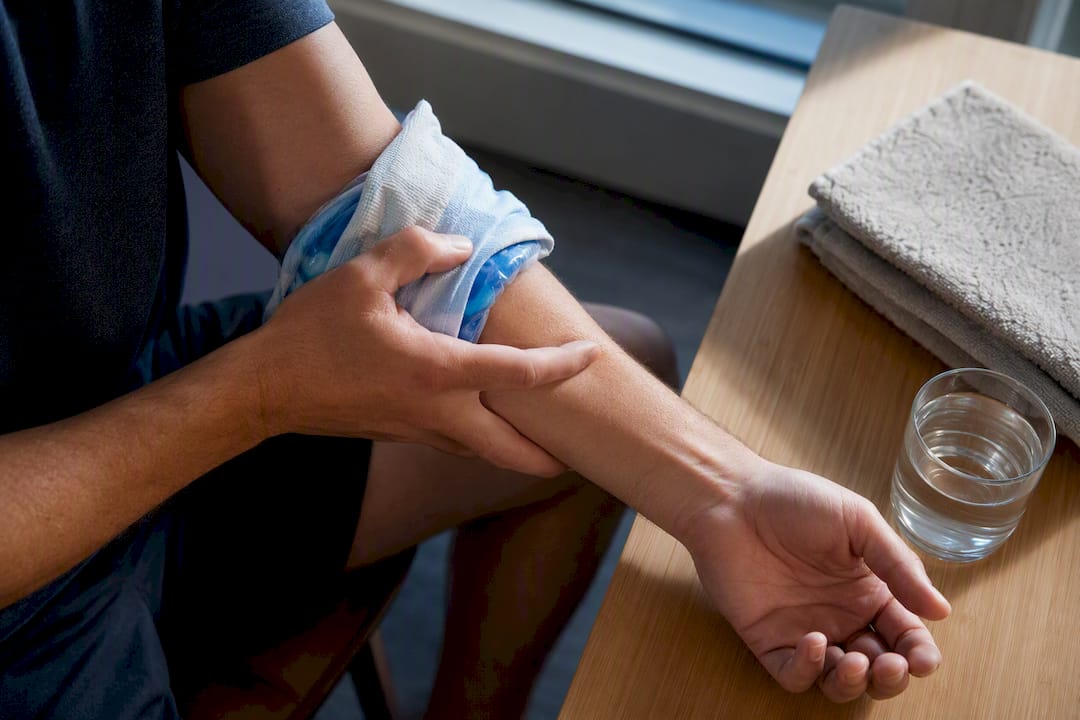
Bracing fills the gap between rest and rehab. A counterforce strap, worn a couple of inches below the elbow crease, redistributes load away from the tendon’s attachment point during the day. A night splint that keeps the wrist in a neutral position can cut down on the ache that wakes people up, since many sleep with the wrist curled into flexion without realizing it.
Here’s how to sequence the first two to three weeks:
- Identify and reduce the specific aggravating motion, without going fully sedentary.
- Ice three to four times daily for 15 to 20 minutes.
- Use a short course of an OTC analgesic if needed, and ask a clinician before extending it.
- Wear a counterforce strap during aggravating activities and consider a night splint if sleep is disrupted.
- Reintroduce load gradually, adding small amounts of grip or lifting work every few days as pain allows.
Pro Tip: Track your pain on a simple 0 to 10 scale before and after activity for a week. If a task pushes you above a 4 and the soreness lingers past the next morning, you’re overloading the tendon. That’s your cue to scale back, not push through.
What Exercises Help Golfer’s Elbow Recover Faster?
Rehab is where the real recovery happens, and it needs to follow a sequence rather than jumping straight to strengthening. Progressive physical therapy centered on eccentric strengthening is the backbone of nearly every evidence-based recovery plan, and skipping ahead to heavy loading before the tissue is ready tends to backfire.
- Phase 1, pain control and mobility. Gentle wrist and elbow range of motion, soft-tissue mobilization, and activity modification. No resisted exercise yet. This typically runs one to two weeks.
- Phase 2, isometric to isotonic loading. Start with pain-free isometric holds of the wrist flexors and forearm pronators, five to ten seconds, several times a day. Once tolerated, progress to isotonic reps, then eccentric-focused work: slowly lowering a light dumbbell through wrist flexion for three sets of 12 to 15 reps, a few times a week.
- Phase 3, kinetic chain and sport-specific work. Add scapular and shoulder strengthening, core and hip stability drills, and movements that mimic your sport or job, whether that’s a golf swing, a hammer strike, or a keyboard-heavy workday.
Eccentric loading isn’t just one option among many. It’s the consistent thread running through successful tendon rehab, and the same principle applies whether you’re rehabbing an elbow or a patellar tendon. Track soreness the same way in every phase: a pain level under 4 that resolves by the next day means you’re progressing correctly. Pain that spikes or lingers is a sign to pull back a stage, not push forward.
Do Injections or Shockwave Therapy Actually Work?
These options sit in the middle ground: not first-line, but not surgery either. They matter most for people who’ve done three to six months of real rehab and still aren’t where they need to be.
- Corticosteroid injections ease pain fast, often within days, but the relief rarely lasts. Benefit typically fades within a few weeks, and repeated shots are linked to higher recurrence rates rather than durable healing.
- Platelet-rich plasma (PRP) shows mixed but promising results in refractory cases, particularly when injected after rehab has stalled rather than as a substitute for it.
- Dry needling and ultrasound-guided percutaneous tenotomy (branded devices include Tenex and TenJet) create controlled micro-trauma to stimulate tendon repair, and clinical series support their use in stubborn cases that haven’t responded to conservative measures.
- Extracorporeal shockwave therapy (ESWT) has evidence behind it for chronic tendinopathy, and clinicians generally reserve it for symptoms persisting past six months despite appropriate rehab.
The pattern across all four: mechanical and biological stimulation tends to outperform anything purely anti-inflammatory when the tendon has been hurting for a while.
When Is Surgery Necessary for Golfer’s Elbow?
Surgery is the last stop, not an early option. It’s typically reserved for symptoms that persist and limit function despite three to six months of properly executed nonoperative care, including rehab and, often, one of the procedures above.
- Open debridement or repair removes degenerated tendon tissue and reattaches healthy fibers to the medial epicondyle.
- Arthroscopic or percutaneous approaches offer a less invasive alternative for some patients, with shorter incisions and often faster initial recovery.
- Ulnar nerve decompression gets added to the procedure when nerve irritation or entrapment is contributing to symptoms.
Postop care starts with a brief immobilization period, then moves into the same phased rehab used for nonoperative cases: range of motion first, strengthening later. Most patients return to daily activity within a few months and sport or heavy labor somewhat later. Surgical outcomes are generally good, but as with any procedure, infection, stiffness, and incomplete relief remain real, if uncommon, risks.
How Is Golfer’s Elbow Diagnosed, and What Are the Red Flags?
- A clinician reproduces your pain with resisted wrist flexion and forearm pronation, and checks for point tenderness right at the medial epicondyle.
- Imaging like ultrasound or MRI is reserved for atypical presentations, cases that aren’t improving as expected, or when another injury is suspected.
- Nerve conduction testing gets ordered if numbness or tingling suggests ulnar nerve involvement rather than tendon pain alone.
- Watch for red flags: progressive numbness or weakness, finger tingling, a sudden severe tearing sensation, or signs of infection like fever and spreading redness. Any of these warrants prompt evaluation rather than a wait-and-see approach.
Most people start with a primary care visit, then get referred to sports medicine or orthopedics if symptoms don’t respond to initial conservative steps.
How Long Does Golfer’s Elbow Take to Heal?
Recovery is measured in weeks to months, not days. Many people notice steady improvement within six to twelve weeks of consistent rehab, and most cases resolve within six to twelve months when treated appropriately. Recovery slows when repetitive loading continues unchecked, rehab starts late, or other health issues complicate healing.
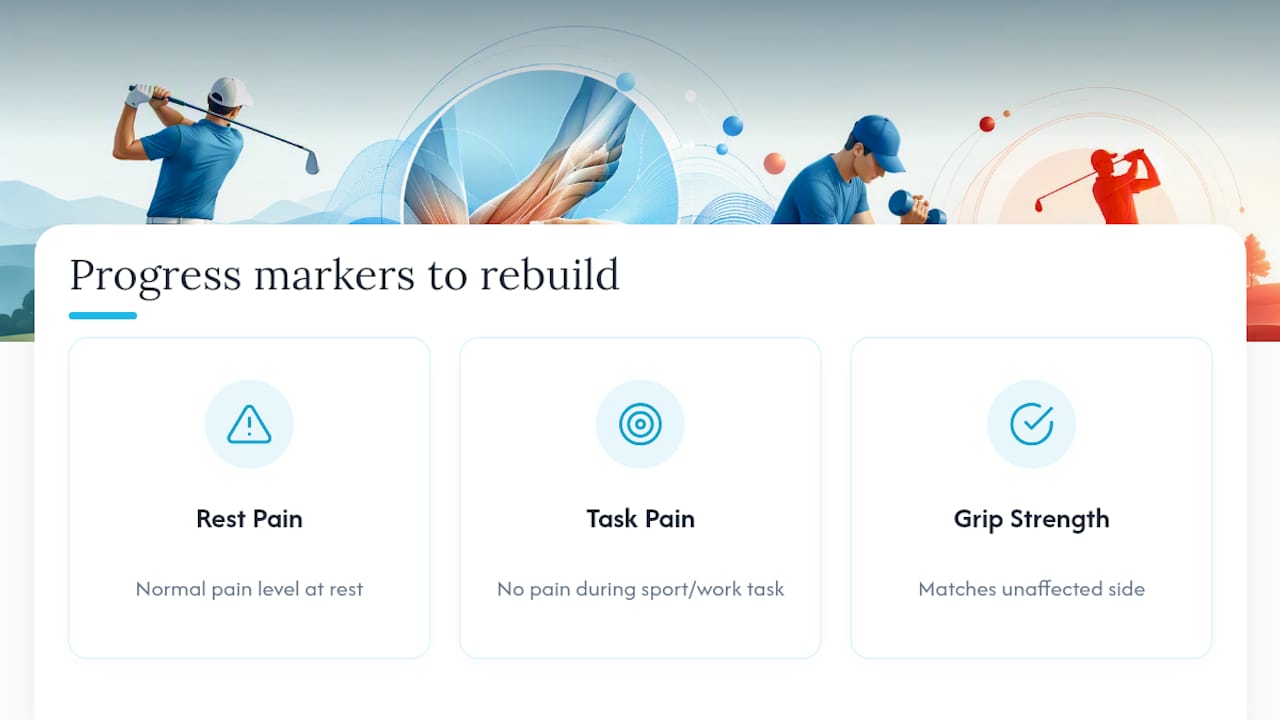
Track your own progress with three simple markers: pain at rest, pain during your specific work or sport task, and grip strength compared to your unaffected side. Once all three normalize, you’re ready to rebuild toward full activity, not before.
How Does The Tx Room Treat Golfer’s Elbow?
A treatment approach combines the Fascial Distortion Model, a hands-on approach to soft-tissue restrictions, with the same progressive rehab principles outlined above. When a case needs imaging or an injection-based procedure, Thetxroom coordinates that referral rather than working around it.
- Initial visits focus on assessing movement, identifying the aggravating pattern, and starting hands-on FDM work alongside early-phase exercises.
- Bring a list of aggravating activities and any prior imaging if you have it.
- Most patients need several visits paired with home exercise to see meaningful change, similar to the approach used for tennis elbow and general tendinitis cases.
A Clinician’s Note on Patience and Common Mistakes
Tendon tissue heals slowly, and graduated loading is the only reliable way to rebuild it. The two mistakes I see most: returning to full swing speed or full grip work too soon, and relying on repeat corticosteroid shots instead of doing the rehab work between them. A hands-on, clinician-guided program earns its value most in that gap, when pain has eased but strength hasn’t caught up yet.
— Chris
Ready to Get Your Elbow Moving Again?
If you’ve been managing golfer’s elbow with ice and a brace but progress has stalled, Specialized care offers what a strap and a rest schedule can’t: hands-on fascial work paired directly with a rehab plan built for your specific aggravating motion, not a generic handout.
An initial visit evaluates how your elbow, wrist, and shoulder are moving together, starts fascia work paired with rehab where appropriate, and builds a phased strengthening plan you actually follow through on. If imaging or an injection makes sense for your case, that gets coordinated rather than left for you to figure out alone. Reach out to schedule an evaluation and get a plan built around your elbow, not a template.
This article is general information, not a substitute for advice from a qualified doctor. Consult a qualified healthcare professional about your own circumstances before acting on anything here.
Sources
- Medial Epicondylitis (Golfer’s Elbow) – StatPearls – NCBI Bookshelf
- Golfer’s elbow (Medial epicondylitis) – Diagnosis and treatment – Mayo Clinic
- Current concepts of natural course and in management of medial epicondylitis: a clinical overview