
Sciatica at Night: Why It Flares and How to Sleep Better
You can usually cut a nighttime sciatica flare down to size tonight by changing how you position your hips and spine in bed, then giving your nervous system ten quiet minutes to settle before you lie down. That’s it, that’s the core move. Side sleepers should try a firm pillow wedged between the knees; back sleepers do better with a pillow under the knees. Neither fixes the underlying nerve irritation, but both take pressure off the nerve roots that flare when your pelvis rotates or your lower back arches during sleep.
Give it a few nights before judging whether it’s working, and don’t expect a pillow to erase pain that’s been building for weeks. If you notice new leg weakness, numbness around the groin or inner thighs, or any change in bladder control, skip the home remedies and get evaluated now.
Try tonight:
- Pillow between the knees (side sleepers) or under the knees (back sleepers)
- A 10 minute wind down: warm shower, slow breathing, gentle hip stretch
- Skip: stomach sleeping, sitting for hours right before bed, ignoring new weakness
Key Takeaways
Sciatica pain intensifies at night due to a combination of pelvic positioning, disc rehydration, muscle guarding from stillness, and a pain sensitivity feedback loop that consistent positioning and a short pre-sleep routine can interrupt.
| Point | Details |
|---|---|
| Match position to cause | Side sleepers use a pillow between the knees; back sleepers use one under the knees; stenosis often prefers a flexed position. |
| Run a wind-down routine | Heat, slow breathing, a short walk, and gentle stretching before bed calm the nervous system before you lie still. |
| Watch the mattress | A sagging or aging mattress can undercut every other fix; medium-firm surfaces support neutral spine alignment best. |
| Know the red flags | Progressive weakness, saddle anesthesia, or bladder changes require same-day medical evaluation, not more home care. |
| Get a mechanical diagnosis | Thetxroom uses hands-on FDM assessment to identify the specific restriction driving night-predominant sciatica. |
Table of Contents
- Why Sciatica Pain Often Gets Worse at Night
- The Best Sleeping Positions and Setup for Sciatica
- A Bedtime Routine to Calm Sciatic Nerve Pain Before Sleep
- When Nighttime Sciatica Needs Medical Attention
- How The Tx Room Approaches Night-Predominant Sciatica
- A Clinical Perspective on Getting Through the Worst Nights
- Getting Hands-On Help for Sciatica in Plano
- Sources
Why Sciatica Pain Often Gets Worse at Night
Nighttime sciatica flares rarely come from one single cause. They’re usually the product of position mechanics, changes inside the spinal discs, hours of stillness, and a nervous system that’s gotten more sensitive to pain, all layered on top of each other, according to ePainAssist’s explanation of nocturnal sciatica.
Start with position. Lying flat can rotate your pelvis and shift how your lumbar spine loads, which changes the amount of tension on the sciatic nerve root depending on which way you’re facing and how your hips sit. A body that was upright and moving all day suddenly stops moving, and that stillness matters more than most people realize.
Your spinal discs also behave differently at night. They rehydrate and slightly expand when you’re lying down and not bearing weight through them, which can increase pressure on a nerve root that’s already irritated. Meanwhile, hours without movement let the muscles around an inflamed nerve tighten up defensively, a protective reflex called guarding that ends up adding its own layer of pain.
Then there’s the feedback loop. Poor sleep doesn’t just leave you tired. It measurably raises your sensitivity to pain, so a rough night makes tomorrow night’s flare more likely, not less.
Sleep isn’t a passive backdrop to sciatica. It’s an active part of the pain cycle. A night of bad sleep can turn tomorrow’s manageable ache into another bad night.
- Position mechanics shift nerve tension depending on how your hips and spine are aligned
- Discs rehydrate at night, which can increase pressure on an already irritated nerve root
- Hours of stillness trigger muscle guarding around the nerve
- Poor sleep heightens pain sensitivity, feeding the next night’s flare
The Best Sleeping Positions and Setup for Sciatica
There’s no universal “best” position, because the right setup depends on what’s driving your sciatica in the first place. If a bulging or herniated disc is the culprit, a neutral spine usually feels best. If spinal stenosis is narrowing space around the nerve, a slightly flexed position often brings more relief, according to Cleveland Clinic’s guidance on sciatica and sleep. That’s worth knowing before you rearrange your whole bed around one pillow trick.
- Side sleeping (pain-free side down): Bend your knees slightly and place a firm pillow between them to keep your hips level. A rolled towel under your waist adds extra support if there’s a gap between your ribs and hip.
- Back sleeping: Slide a pillow under both knees to reduce the arch in your lower back. A small towel roll under the lumbar curve helps some people, though it’s worth testing without it first.
- Modified fetal or reclined position (stenosis-leaning symptoms): A wedge pillow, an adjustable bed base, or even a recliner for part of the night can open up space around the nerve by keeping your spine gently flexed.
On mattresses: Harvard Health’s review of mattress choice and back pain points out that medium-firm surfaces are often recommended for keeping the spine neutral. If your mattress is sagging visibly, if you wake up more sore than you went to bed, or if it’s been in service for many years, that’s a reasonable signal it’s time to replace it rather than layer another pillow on top of the problem.
Avoid stomach sleeping entirely. It forces your neck into rotation and your lower back into extension, both of which tend to aggravate an irritated nerve root. If you need to roll over in the night, log roll: keep your shoulders and hips moving together as one unit instead of twisting your spine.
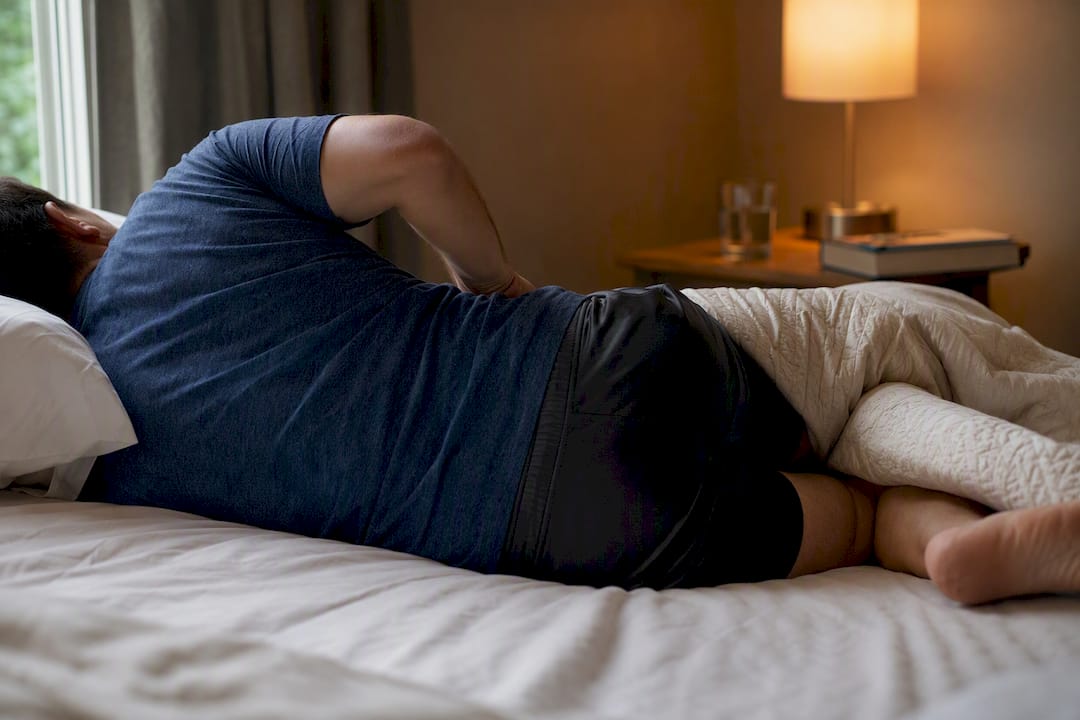
Pro Tip: Keep the “good” pillow for knees within arm’s reach on your nightstand, not buried in the closet. Half the battle with positional fixes is actually using them at 2 a.m. when you’re half asleep and irritated.
A Bedtime Routine to Calm Sciatic Nerve Pain Before Sleep
A short, repeatable wind-down routine gives your nervous system a chance to downshift before you’re lying still for eight hours. This matters more than it sounds like it should.
- Heat first, ten minutes before bed. A warm shower or a heat pack on the lower back and glutes relaxes guarded muscles better than jumping straight into bed cold.
- Slow breathing for two minutes. Long exhales calm the nervous system and can measurably dial down pain perception before you even touch a pillow.
- A short walk if you’re stiff. Even sixty seconds of movement resets circulation and reminds guarded muscles they’re allowed to release.
- Two or three gentle stretches. A piriformis stretch, a knee-to-chest pull, and a slow pelvic tilt, each held around 30 seconds, can ease nerve tension according to Cleveland Clinic’s overview of sciatica management. Stop immediately if leg pain increases; a stretch should never sharpen the pain running down your leg.
Ice can work as well as heat for some people, particularly in the first day or two of a flare, so experiment with both and stick with whichever calms things down faster. A lidocaine patch or an over-the-counter NSAID timed an hour before bed can also take the edge off enough to fall asleep, though neither treats the underlying nerve irritation.
- Don’t lie in bed for hours “resting” if you’re still awake and hurting. Complete bed rest isn’t recommended because prolonged stillness feeds the stiffness cycle.
- Build in a sit-stand break every 30 to 45 minutes during the day if you work at a desk.
- Skip heavy bending or lifting in the evening hours, when muscles are already fatigued and more prone to guarding.
When Nighttime Sciatica Needs Medical Attention
Most sciatica responds to consistent self-care within a matter of weeks, but certain symptoms mean self-care isn’t the right call anymore. Sciatica is technically nerve root irritation, most often somewhere between L4 and S3, and a subset of causes need urgent workup rather than another night of pillow adjustments.
- Progressive leg weakness, especially if you’re now tripping or struggling with stairs
- Numbness around the groin or inner thighs (saddle anesthesia)
- New loss of bladder or bowel control
- Fever, unexplained weight loss, or other systemic symptoms alongside the leg pain
Any of those calls for same-day evaluation, and saddle anesthesia with bladder changes together is an emergency room visit, not a next-week appointment. Short of those red flags, if the pain hasn’t budged after a few weeks of home care, your primary care provider or a chiropractor can order imaging, refer you to physical therapy, or discuss options ranging from targeted injections to a specialist referral, per Mayo Clinic’s sciatica treatment overview.
How The Tx Room Approaches Night-Predominant Sciatica
Sciatica that flares mainly at night usually has a mechanical driver worth finding, not just managing around. At Thetxroom, evaluation starts with a detailed history (when the pain started, what makes it worse, which sleep positions you’ve already tried) followed by a functional exam that looks at hip rotation, pelvic alignment, and where nerve tension actually originates.

Treatment leans on the Fascial Distortion Model, a hands-on method aimed at the soft tissue restrictions and guarding patterns that often keep a nerve irritated long after the original injury. For readers dealing with suspected disc involvement specifically, a disc injury evaluation digs into that mechanism directly rather than treating every sciatica case the same way.
A typical early plan combines hands-on treatment sessions with a simple home program and specific sleep-position coaching based on what’s actually driving your symptoms.
Patients often describe the same pattern: pain that’s tolerable during the day but spikes the moment they lie down. Addressing the mechanical restriction directly, rather than just changing pillows, is often what finally breaks that pattern.
- History and functional exam to identify the mechanical driver
- Hands-on FDM treatment targeting soft tissue restriction and guarding
- A home program paired with sleep-position coaching specific to your case
A Clinical Perspective on Getting Through the Worst Nights
Here’s what gets lost in most sciatica advice: the timeline matters as much as the technique. Most people who stay consistent with positioning, gentle movement, and a real wind-down routine see meaningful improvement within a few weeks, not months. That’s the realistic expectation, and it’s worth holding onto during the nights when nothing seems to help.
What doesn’t get said enough is that persistence matters more than intensity. One good stretch done nightly beats an aggressive stretching session done once. If you’ve been consistent for several weeks and night pain still isn’t budging, or if any red flag symptom shows up, that’s your signal to get a hands-on evaluation rather than trying yet another pillow configuration.
Getting Hands-On Help for Sciatica in Plano
Pillows and pre-sleep routines solve a lot of nighttime sciatica cases, but they don’t fix a mechanical restriction that’s been building for months. That’s where Thetxroom comes in: instead of guessing at which stretch or gadget might help, you get a hands-on assessment that identifies exactly what’s compressing or irritating the nerve, then a treatment plan built around fixing that specific issue rather than managing around it indefinitely.

You’re a good candidate for a clinic visit if your night pain has lasted more than a few weeks despite consistent self-care, if it’s limiting your daily function, or if you’d simply rather have a hands-on diagnosis than keep experimenting alone. A first visit typically includes a full history, a functional movement exam, and an initial round of FDM-based treatment, with most short-course plans aimed at measurable improvement within a handful of visits. For readers with pain radiating specifically down the leg, the sciatica services page walks through what a tailored evaluation involves. If regenerative or injection-based options ever come up down the line, Nortex Tissue Regeneration’s overview of pain relief therapies is a useful primer on what that later-stage path can look like. Ready to stop guessing at pillow angles? Book an evaluation through Thetxroom’s sciatica care options page and get a plan built around your actual cause.
Sources
- How to get better sleep with sciatica pain | Cleveland Clinic
- Sciatica – StatPearls – NCBI Bookshelf
- Sciatica diagnosis & treatment | Mayo Clinic
This article is general information, not a substitute for advice from a qualified doctor. Consult a qualified healthcare professional about your own circumstances before acting on anything here.