
Chiropractor Cost: What You’ll Actually Pay Per Visit
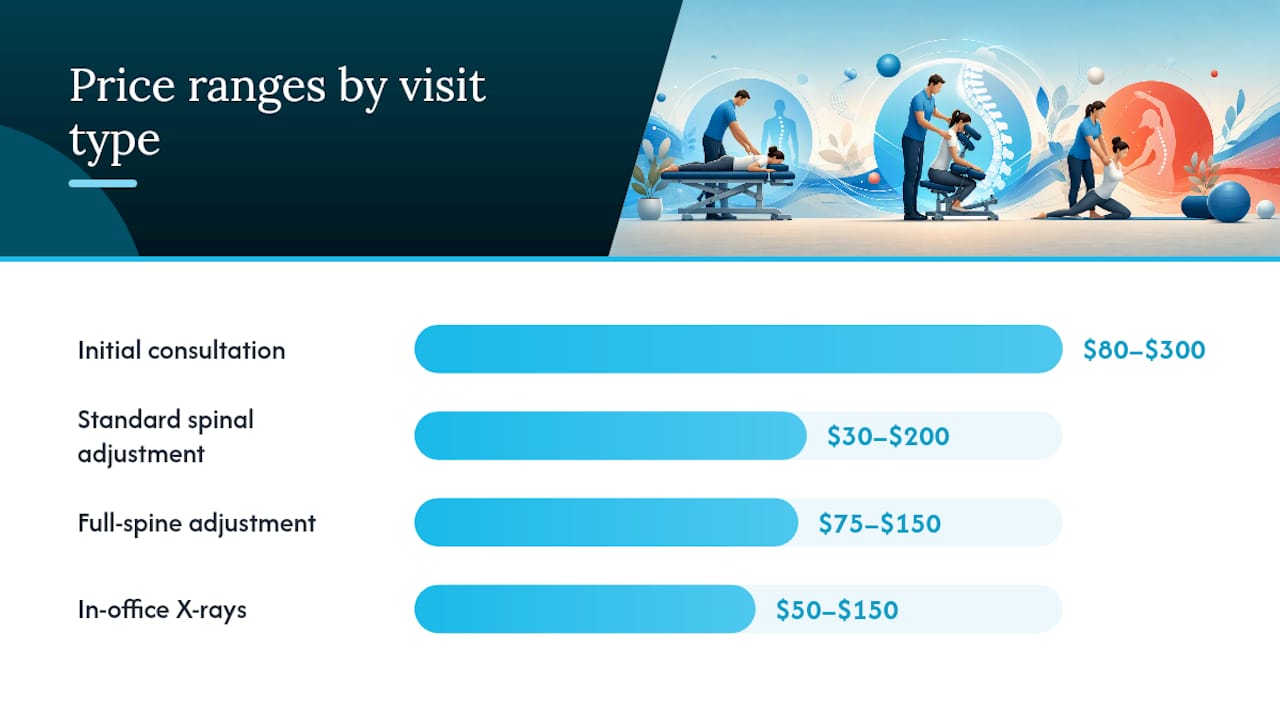
A standard chiropractic adjustment runs $30–$200 out of pocket, with most cash-pay patients landing somewhere in the $60–$100 range. Your first visit costs more, typically higher than follow-up visits, because it includes a health history, physical exam, and sometimes X-rays before any hands-on treatment begins. The total cost for a course of care depends on how many visits you need, which add-on services get layered in, and where you live.
- Standard adjustment (cash pay): $30–$200 per visit; national average near $65
- Initial/new-patient visit: $80–$300, averaging around $120 when imaging is included
- Follow-up visits: $50–$150 per session
- Total episode cost: Anywhere from a few hundred dollars for an acute issue to $1,500+ for a multi-month plan with add-ons
Key Takeaways
A standard chiropractic adjustment costs $30–$200 cash-pay, but your total episode cost depends on visit count, add-ons, and whether you’re treating an acute injury, a chronic condition, or post-accident trauma.
| Point | Details |
|---|---|
| Per-visit cash range | Standard adjustments run $30–$200; the national average is near $65 per visit. |
| Initial visit costs more | New-patient exams average around $120 and can reach $300 when imaging is included. |
| Episode math matters | A 10–15 visit acute plan at mid-range rates totals $770–$1,095 before add-ons. |
| Lower-cost options exist | Packages, memberships, student clinics, and cash-pay discounts can cut per-visit cost to $25–$40. |
| Thetxroom (Plano, TX) | Offers FDM-based hands-on care with insurance and cash-pay options; call for a visit-count estimate before booking. |
Table of Contents
- How much does a chiropractor cost by visit type?
- What actually drives the price you’ll pay
- How to estimate your total cost for a course of care
- How insurance, Medicare, and billing choices affect what you pay
- Practical ways to lower your out-of-pocket cost
- Questions to ask before you book your first appointment
- Red flags that should make you pause
- How Thetxroom structures pricing and what patients can expect
- The case for matching care intensity to clinical need
- Thetxroom is the hands-on option in Plano for patients who need more than a quick adjustment
- Sources
How much does a chiropractor cost by visit type?
Every visit type carries a different price tag, and knowing the breakdown before you walk in prevents sticker shock at checkout.
| Visit Type | Typical Cash Price Range | What’s Usually Included |
|---|---|---|
| Initial consultation/new-patient exam | $80–$300 | Health history, orthopedic/neurological exam, postural assessment, possible imaging |
| Standard spinal adjustment (follow-up) | $30–$200 | Manual manipulation of one or more spinal regions |
| Full-spine or multi-region adjustment | $75–$150 | Adjustment of cervical, thoracic, and lumbar spine in one session |
| X-rays (in-office) | $50–$150 per series | Spinal imaging to rule out fracture, disc pathology, or structural anomaly |
| Spinal decompression (per session) | $50–$200 | Motorized traction table targeting disc herniation or stenosis |
| Electrical stimulation (e-stim) | $15–$50 add-on | Muscle relaxation or pain modulation before/after adjustment |
| Therapeutic massage (in-clinic) | $30–$80 add-on | Soft-tissue prep or post-adjustment muscle work |
| Laser therapy (low-level) | $25–$75 add-on | Photobiomodulation for inflammation or soft-tissue healing |
| Specialized soft-tissue therapy (e.g., FDM, myotherapy) | $100–$200+ | Extended hands-on sessions targeting fascial or myofascial injuries |
Sources: Hotaling Insurance, CostNotes, UseCalcPro
Bundled packages and monthly memberships change the math considerably. Membership plans can reduce effective per-visit cost to roughly $25–$40, which works well if you need frequent maintenance visits. The trade-off: most membership tiers cover quick routine adjustments and exclude extended soft-tissue work or comprehensive diagnostics.
What actually drives the price you’ll pay
Geography is the single biggest variable outside your control. A clinic in Manhattan and a clinic in rural Kansas may both call it a “standard adjustment” — the clinical content is similar, the price is not.
Beyond location, these factors move the number up or down:
- Practice model. Cash-only clinics set their own rates without insurance-contract constraints. Insurance-billing clinics may charge higher list prices but accept lower contracted rates. Franchise membership clinics offer low per-visit pricing but limited service depth. Teaching clinics at chiropractic colleges charge the least, often $20–$40, with students performing care under licensed supervision.
- Visit type and treatment complexity. A 10-minute spinal adjustment costs less than a 45-minute session combining FDM, myofascial release, and rehabilitation exercises. Longer, more specialized sessions require more provider skill and time, and the price reflects that.
- Provider experience and credentials. A chiropractor with advanced postgraduate training in a specialty technique typically charges more than a generalist. That premium often reflects faster resolution of complex injuries, not just a higher hourly rate.
- Imaging and diagnostics. In-office X-rays add $50–$150 to your first visit. Some clinics include them in a new-patient flat fee; others bill them separately.
- Billing choices. Out-of-network billing, balance billing on partially covered services, and auto-injury claims each create different cost structures. Cash-pay patients often get a time-of-service discount that insured patients don’t.
The 2024 Chiropractic Economics fees and reimbursements survey found practitioners receiving reimbursement rates averaging 56–57% of their billed fees. That gap is why so many clinics actively promote cash-pay and membership pricing — it’s more predictable revenue for them, and often a better deal for you.
Pro Tip: Ask one question before booking: “What is your new-patient fee, and does it include imaging?” The answer tells you the all-in cost of visit one and whether you’ll face a separate imaging bill.
How to estimate your total cost for a course of care
Per-visit thinking is how people underestimate chiropractic spending. Episode thinking is how you budget accurately.
Chiropractic care typically follows two phases: an acute/intensive phase with higher visit frequency, followed by a lower-frequency maintenance phase. Here’s how that plays out in dollars for three common scenarios, using mid-range cash rates:
-
Acute injury (e.g., low back strain, neck pain after a minor incident). Expect 2–3 visits per week for 3–4 weeks, then 1 visit per week for 2–3 weeks. That’s roughly 10–15 visits total. At $65 per follow-up adjustment, the adjustment cost alone runs $650–$975. Add the initial exam ($120 average) and you’re looking at $770–$1,095 before any add-ons.
-
Chronic condition (e.g., recurring sciatica, postural dysfunction). A 2–3 month plan at 2 visits per week for the first month, dropping to weekly, totals 16–24 visits. At $65 per visit plus the initial exam, that’s $1,160–$1,680. If decompression or e-stim is added at even $30 per session, the total climbs by $480–$720.
-
Post-accident rehabilitation (e.g., whiplash, soft-tissue trauma). These cases often require 20–30 visits over 8–12 weeks, with imaging, multiple modalities, and possibly co-treatment with physical therapy. Total costs can reach $2,000–$4,000 or more. The key difference: auto-injury cases are typically billed to the at-fault driver’s liability insurance or your own PIP (personal injury protection) coverage, meaning you may pay little or nothing out of pocket while the case is active.
For a broader view of why healthcare pricing works the way it does, this breakdown of healthcare cost dynamics explains the structural pressures that push clinic prices upward regardless of what insurance pays.
How insurance, Medicare, and billing choices affect what you pay
Most commercial health insurance plans cover chiropractic care, but the coverage is almost always capped. Here’s what that typically looks like:
- Copays: $20–$50 per visit after your deductible is met, depending on your plan tier and whether the chiropractor is in-network.
- Visit limits: Most plans cap covered visits at 12–30 per year. Once you hit the cap, you pay the full cash rate for every additional visit.
- Deductible interaction: If you haven’t met your annual deductible, you pay the full contracted rate (not the cash rate) until you do. That contracted rate is often higher than what a cash-pay patient would pay.
- Out-of-network billing: Seeing an out-of-network chiropractor means your plan pays less (or nothing), and the clinic can balance-bill you for the difference up to its full list price.
Medicare specifics deserve a separate paragraph. Medicare Part B covers manual spinal manipulation for subluxation, but it does not cover the initial exam, most imaging ordered by a chiropractor, or maintenance care once your condition has stabilized. If a chiropractor bills for services Medicare doesn’t cover without telling you first, they’re required to give you an Advance Beneficiary Notice (ABN) so you can decide whether to proceed and pay out of pocket.
Additional billing points worth knowing:
- Auto-injury claims are billed to liability or PIP insurance, not your health plan. The clinic typically handles billing directly with the insurer, and you assign your benefits to the provider.
- Assigning benefits means the insurer pays the clinic directly. If you don’t assign benefits, you pay upfront and wait for reimbursement.
- Cash-pay discounts are common and legal. Many clinics offer 10–20% off the list price when you pay at the time of service and skip the insurance billing process entirely.
The Chiropractic Economics survey data showing reimbursement at 56–57% of billed fees makes clear why clinics often prefer cash patients — and why asking for a cash discount is a reasonable request, not an awkward one.
Practical ways to lower your out-of-pocket cost
Not having insurance doesn’t mean paying full list price. These options genuinely reduce what you spend:
Pro Tip: Before starting any package, ask for the per-visit rate in writing and confirm the refund policy for unused sessions. A package that saves you $200 upfront costs you more if the clinic won’t refund unused visits when you move or recover early.
- Time-of-service discount. Pay at the visit, skip the billing process, and ask for a discount. Clinics commonly offer 10–40% off for cash patients who pay same-day.
- Prepaid visit packages. Buying 6–12 visits upfront typically reduces the per-visit rate. BestDosage’s survey data shows package pricing can cut per-visit cost by 20–30% compared to single-visit rates.
- Monthly memberships. Franchise-style membership clinics charge a flat monthly fee for a set number of adjustments. Effective per-visit cost drops to $25–$40, though these plans rarely include specialized soft-tissue therapy or extended intake exams.
- Student clinics at chiropractic colleges. Schools like Parker University (Dallas) and Logan University (St. Louis) operate public clinics where supervised students provide care at significantly reduced rates, often $20–$40 per visit.
- Federally Qualified Health Centers (FQHCs). Some FQHCs offer chiropractic services on a sliding-fee scale based on income. Coverage varies by location, but it’s worth calling your local FQHC to ask.
- Telehealth triage. A telehealth consultation with a chiropractor or musculoskeletal specialist can help you determine whether in-person care is necessary before you commit to a full new-patient exam fee.
The trade-off with cheaper options is real. Membership clinics and student clinics work well for routine spinal adjustments. They’re not the right fit for complex soft-tissue injuries, post-accident rehabilitation, or conditions requiring specialized joint care and individualized treatment plans.
Questions to ask before you book your first appointment
A five-minute phone call before booking can save you hundreds of dollars in surprises. Here’s what to ask:
- What is your new-patient fee, and does it include imaging? Some clinics bundle X-rays into a flat new-patient rate; others bill them separately.
- What is your follow-up adjustment rate? Get the cash-pay rate specifically, not the insurance list price.
- Do you charge separately for add-ons like e-stim, ultrasound, or massage? These can add $15–$75 per visit without being clearly disclosed upfront.
- How many visits do you typically recommend for a condition like mine? Any experienced clinician can give you a range. Refusal to estimate is a red flag.
- Do you offer packages or memberships, and what is your refund policy for unused sessions? Get this in writing before you pay.
- Do you accept my insurance, and will you verify my benefits before my first visit? Verification before the visit prevents billing surprises weeks later.
- Do you bill auto insurance or PIP directly if my injury is accident-related? Relevant if you’re coming in after a car accident.
A sample script that works: “Before I book, can you email me an itemized list of your new-patient fee, follow-up rate, and any add-on charges? I want to understand the full cost before I come in.”
Any clinic that refuses to provide a written estimate or can’t give you a visit-count range for your condition deserves a second look. Knowing how to evaluate a provider before you commit is as important as knowing the price.
Pro Tip: Ask for a written Good Faith Estimate. Under the No Surprises Act, healthcare providers are required to give uninsured patients a written cost estimate before scheduled services. You can request one.
Red flags that should make you pause
Most chiropractors are ethical, transparent practitioners. A small number use pricing and sales tactics that cost patients money without improving outcomes. Watch for these:
- Pressure to sign a long-term contract upfront. A legitimate provider will recommend a treatment plan and reassess progress. Requiring you to pay for 40 visits before treatment begins is a sales tactic, not a clinical protocol.
- Guarantees of a cure. No provider can guarantee a cure for a musculoskeletal condition. Promises of complete resolution are a marketing claim, not a clinical one.
- No documentation of diagnosis or treatment goals. Every visit should generate a progress note. If a clinic can’t produce documentation of your diagnosis and treatment rationale, that’s a billing and clinical problem.
- Opaque add-on pricing. If you’re being charged for modalities you didn’t discuss or consent to, ask for an itemized bill immediately.
- Aggressive collections on unused package sessions. If you stop care and the clinic refuses to refund unused prepaid visits without a clear contractual basis, escalate to your state chiropractic board.
- No reassessment milestones. A responsible treatment plan includes checkpoints where progress is measured against goals. Indefinite care with no endpoint discussion is a financial and clinical concern.
If you encounter any of these, ask for an itemized bill, get a second opinion from another provider, and file a complaint with your state’s chiropractic licensing board if billing misconduct is involved.
How Thetxroom structures pricing and what patients can expect
Thetxroom operates on a direct-fee-for-service model in Plano, Texas, meaning patients pay for the services they receive rather than navigating a complex bundled billing structure. The clinic accepts insurance and also works with cash-pay patients, which gives patients flexibility in how they manage costs.
The new-patient intake at Thetxroom is more thorough than a standard adjustment clinic. The initial visit includes a detailed health history, movement and biomechanical assessment, and a clinical conversation about your specific injury or condition. That depth takes time, and the fee reflects it. Follow-up visits focus on hands-on treatment using the Fascial Distortion Model, a technique that addresses soft-tissue injuries at the fascial level rather than relying solely on spinal manipulation.
Specialized therapies like myofascial acoustic compression therapy are available for patients with stubborn soft-tissue injuries, repetitive strain, or conditions like plantar fasciitis and sciatica. These sessions are longer and more technique-intensive than a standard adjustment, which is reflected in the per-visit cost. The trade-off is that patients with complex injuries typically need fewer total visits when the root cause is addressed directly.
- Insurance accepted: Yes, with benefits verification available before your first visit.
- Cash-pay options: Available; ask about current rates when you call.
- Treatment phases: Acute/intensive phase followed by reassessment and a transition to lower-frequency care as the condition improves.
- Conditions commonly treated: Sciatica, plantar fasciitis, whiplash, disc injuries, sports injuries, postural dysfunction, and repetitive strain.
Pro Tip: When you call Thetxroom, mention your specific condition and ask for an estimate of the typical visit count for that presentation. That one question gives you a realistic episode budget before you commit to anything.
The case for matching care intensity to clinical need
There’s a version of cost-conscious chiropractic shopping that backfires: choosing the cheapest per-visit rate regardless of whether that clinic can actually address your condition. A $35 membership adjustment is a good deal for someone who needs routine spinal maintenance. It’s a poor investment for someone with a fascial adhesion, a disc injury, or a post-accident soft-tissue injury that requires a skilled clinician and a structured treatment plan.
The real economic argument for appropriate-intensity care is this: resolving a condition in 8–10 targeted visits at $100 each costs $800–$1,000. Managing the same condition indefinitely at $40 per visit because the treatment never fully addresses the root cause costs far more over a year, and the patient stays in pain longer. Documented treatment goals and regular progress reassessment are what separate a finite course of care from an open-ended expense.

Cost matters. So does getting better.
Thetxroom is the hands-on option in Plano for patients who need more than a quick adjustment
If you’re in the Plano, TX area and dealing with a soft-tissue injury, post-accident pain, or a condition that hasn’t responded to standard adjustments elsewhere, Thetxroom offers something most membership clinics don’t: a clinician who takes the time to identify what’s actually wrong and treat it directly.

The clinic uses the Fascial Distortion Model and myofascial acoustic compression therapy to address the underlying tissue dysfunction, not just the symptom. Patients with sciatica, plantar fasciitis, whiplash, and sports injuries regularly come in after trying other options. The intake process is thorough, the treatment is hands-on, and the goal is resolution, not indefinite maintenance.
To get a clear picture of what care will cost for your specific situation, call Thetxroom before your first visit and ask for a visit-count estimate and a breakdown of fees. Book your first appointment and come in with your questions ready.
Sources
- How Much Does a Chiropractor Cost Without Insurance in 2026? – Hotaling Insurance Services
- How Much Does a Chiropractor Cost in 2026? (With &… | BestDosage
- Chiropractor Cost Calculator — 2026 Visit & Adjustment Pricing | UseCalcPro
- Equilibrium achieved, what’s next? Results of the 28th annual fees and reimbursements survey (Chiropractic Economics)
This article is general information, not a substitute for advice from a qualified doctor. Consult a qualified healthcare professional about your own circumstances before acting on anything here.