
Shin Splints Treatment: A Practical Guide for Athletes
Most shin splints improve with relative rest, targeted rehab exercises, and a smarter return to training. The clinical term is medial tibial stress syndrome (MTSS), and the good news is that the majority of cases respond well to conservative care without surgery or prolonged downtime. Here is what to do right now, and when to escalate.
Start today with these steps:
- Cut high-impact activity (running, jumping, plyometrics) immediately.
- Apply ice for 15–20 minutes, two to three times daily, to the tender area along the inner shin.
- Switch to low-impact cross-training: swimming, cycling, or the elliptical to maintain fitness.
- Take OTC anti-inflammatories (ibuprofen, naproxen) or acetaminophen as directed if pain is significant, but do not use them to mask pain and keep training.
Stop self-care and see a clinician if you notice:
- Pain that persists at rest or wakes you at night.
- A single, sharply localized tender spot rather than a diffuse ache along the shin.
- Swelling, visible bruising, or pain that gets worse despite a week of rest.
These are red flags for a stress fracture or another condition that needs imaging. Do not push through them.
Key Takeaways
Effective shin splints treatment combines relative rest, progressive strength work, and a structured return to running, with clinic-level hands-on care when conservative measures stall.
| Point | Details |
|---|---|
| Start with relative rest | Stop high-impact activity immediately; switch to swimming, cycling, or the elliptical to maintain fitness. |
| Ice and monitor pain | Apply ice 15–20 minutes, two to three times daily; use a 0–10 pain diary to track progress objectively. |
| Rehab requires strength, not just stretching | Eccentric calf raises, dorsiflexor work, and hip strengthening build tibial load tolerance and prevent recurrence. |
| Know the red flags | Focal point tenderness, rest pain, or worsening despite rest means stop training and get imaging to rule out stress fracture. |
| Thetxroom for persistent cases | Thetxroom in Plano, Texas, offers FDM, myotherapy, and biomechanical assessment when home care is not resolving the problem. |
Table of Contents
- What are shin splints, and how do they differ from stress fractures?
- How do shin splints actually feel?
- What causes shin splints, and who is most at risk?
- What do clinicians check, and when is imaging needed?
- Immediate self-care you can safely start this week
- Rehabilitation: stretches, strengthening, and progressive loading
- Recovery timeline and a staged return to running
- How to prevent shin splints from coming back
- Red flags: when shin pain may be more serious
- What to expect from hands-on specialist care
- The mistake most athletes make that keeps shin splints coming back
- Thetxroom offers hands-on shin splints care in Plano, Texas
- Sources
What are shin splints, and how do they differ from stress fractures?
Medial tibial stress syndrome is an overuse injury involving irritation of the periosteum (the connective tissue layer covering the bone) and the surrounding muscles along the inner, lower two-thirds of the tibia. The pain is diffuse, typically spread over at least 5 centimeters of the shin, and it comes from cumulative mechanical stress rather than a single traumatic event.
MTSS sits on a spectrum of bone stress injuries, with stress reactions and stress fractures at the more serious end. The key distinction matters because the treatment path diverges sharply:
- MTSS: Periosteal and soft-tissue irritation. Pain is diffuse, improves with warm-up early in the condition, and responds to relative rest plus rehab.
- Stress reaction: Early bone-level stress without a visible fracture line. Pain is more persistent and often present during low-intensity activity.
- Stress fracture: An actual crack in the bone. Pain is focal, often present at rest, and may require immobilization and non-weight-bearing for 2–6 weeks or longer.
According to NCBI Bookshelf’s chapter on bone stress injuries, the tibia is the most commonly fractured bone in stress-fracture cases, accounting for a significant proportion of stress fractures in athletes. Recurrence rates for bone stress injuries can be high in some athlete cohorts without proper prevention. That number is a reason to take even “mild” shin pain seriously from the start.
How do shin splints actually feel?
The pain pattern is one of the most reliable diagnostic clues. MTSS typically presents as a dull, aching soreness along the inner border of the lower leg, roughly the bottom half of the tibia. Early on, it hurts at the start of a run, eases once you warm up, and returns after you stop. As the condition progresses, pain starts earlier in activity and lingers longer afterward.
Common signs that point to MTSS:
- Diffuse tenderness when you press along a 5-centimeter or longer stretch of the inner shin.
- Pain that increases with repeated impact loading (hopping on one leg, for example).
- Aching or stiffness the morning after a hard training session.
- Bilateral presentation (both legs) is common, especially in new runners.
Signs that suggest something more serious:
- A single, pinpoint spot that is exquisitely tender to touch.
- Pain that does not ease with warm-up and instead worsens through the run.
- Nighttime pain or pain at rest, even after several days off.
- Numbness, severe tightness, or weakness in the foot during exercise (possible compartment syndrome).
If your pain fits the first list, the self-care and rehab guidance below applies. If it fits the second, skip ahead to the red flags section and get evaluated.
What causes shin splints, and who is most at risk?
Shin splints are primarily an overuse condition triggered by a mismatch between training load and the tissue’s capacity to absorb it. The most common culprits fall into three categories.
Training errors:
- Increasing weekly mileage or intensity too quickly (more than roughly 10% per week is a widely cited threshold).
- Adding hills, downhill running, or speed work before building a solid base.
- Training on hard surfaces like concrete without adequate recovery.
- Returning to full training too soon after a break.
Biomechanical factors:
- Overpronation (excessive inward rolling of the foot during the gait cycle).
- Weak foot intrinsic muscles and limited ankle dorsiflexion.
- Hip abductor and glute weakness, which shifts load down the kinetic chain to the lower leg.
- High or rigid arch, which reduces the foot’s shock-absorbing capacity.
Equipment and surface:
- Worn-out running shoes (most shoes lose meaningful cushioning well before they look worn out).
- Footwear that does not match your foot mechanics.
- Abrupt surface changes (treadmill to road, track to trail).
Pro Tip: Check your shoes’ midsole by pressing your thumb firmly into the foam. If it compresses easily with little resistance, the cushioning is likely depleted regardless of the outsole’s appearance. Most running shoes need replacement every 300–500 miles.
For tactical athletes and military personnel, the injury prevention principles around load management apply directly here: progressive overload, adequate recovery, and surface variety are the three levers that prevent most overuse lower-leg injuries.
What do clinicians check, and when is imaging needed?
A clinical evaluation for suspected MTSS typically starts with a detailed history: when the pain began, how training volume changed in the weeks before, whether pain is present at rest, and whether it is getting better or worse with activity. From there, the physical exam focuses on a few key maneuvers.
What clinicians assess:
- Palpation along the posteromedial tibial border to map the pain’s distribution (diffuse vs. focal).
- Single-leg hop test: three hops on the affected leg. Focal pain with hopping raises concern for stress fracture.
- Ankle range of motion and foot arch assessment.
- Hip strength testing, particularly abductors and external rotators.
- Gait observation, ideally during walking and, when safe, jogging.
When imaging is warranted:
- Plain X-rays are a reasonable first step but often appear normal in early stress fractures. They are most useful for ruling out other bony pathology.
- MRI is the gold standard for distinguishing MTSS from a stress reaction or fracture. It shows periosteal edema, bone marrow changes, and fracture lines.
- Bone scan is an older alternative with high sensitivity but lower specificity.
Clinical experts recommend imaging for persistent localized or rest pain to exclude stress fracture, because MTSS can progress to a fracture if training continues unchecked. Dr. Joshua Goldman at UCLA emphasizes that the two conditions are distinct, and ignoring MTSS can allow the bone to weaken into a fracture requiring immobilization.
Other diagnoses to rule out: chronic exertional compartment syndrome (pain with exercise, relief at rest, possible numbness or weakness), periosteal tendonitis, and, less commonly, nerve entrapment or vascular claudication.
Immediate self-care you can safely start this week
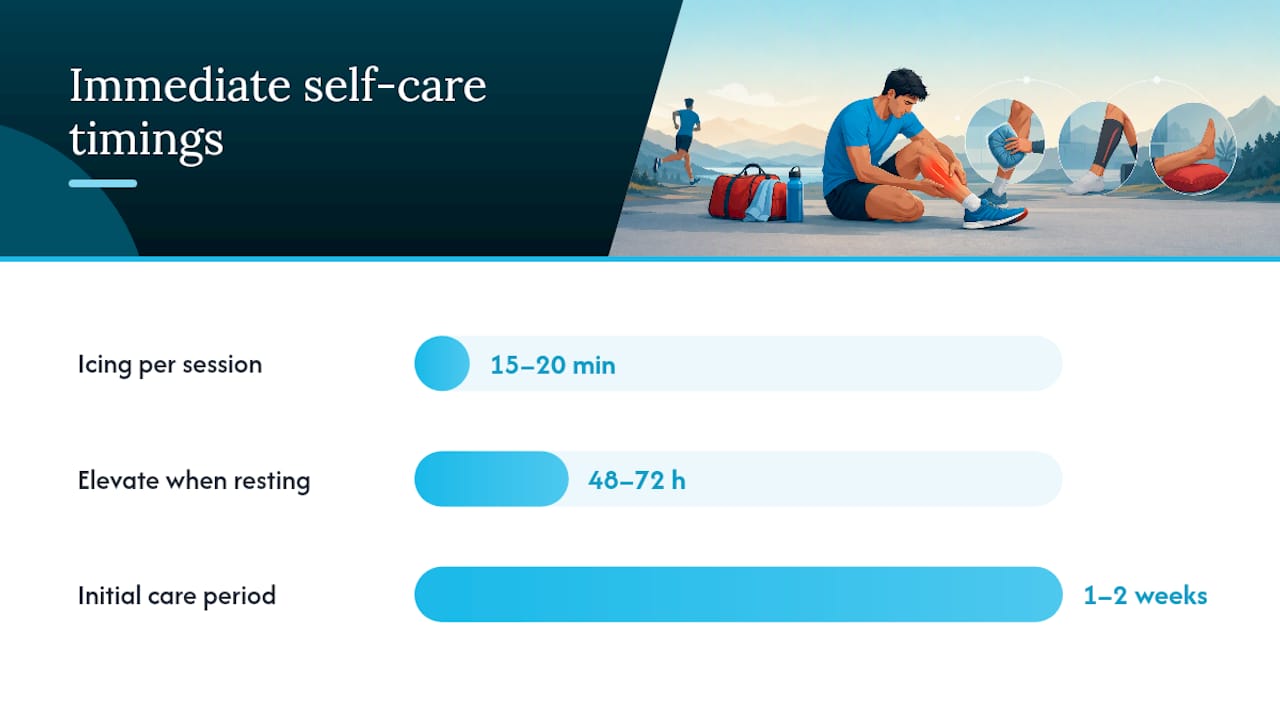
Most shin splints respond well to short-term self-care: relative rest, icing for 15–20 minutes several times daily, and a gradual return to activity once pain-free. The goal in the first one to two weeks is to reduce tissue irritation without losing all fitness.
Relative rest strategy:
- Stop running, jumping, and any activity that reproduces the shin pain.
- Replace with swimming, pool running, cycling, or the elliptical. These maintain cardiovascular fitness with minimal tibial loading.
- Walking is generally fine if it is pain-free. If walking hurts, reduce that too.
Ice, compression, and elevation:
- Ice the shin for 15–20 minutes, two to three times daily. Wrap in a thin cloth to protect skin.
- Compression sleeves can reduce swelling and provide mild comfort during low-impact activity.
- Elevate the leg when resting, particularly in the first 48–72 hours of a flare.
OTC medications:
- NSAIDs (ibuprofen, naproxen) reduce inflammation and pain. Follow label dosing and avoid using them to mask pain so you can keep training. People with kidney issues, GI sensitivity, or blood-thinning medications should check with a physician first.
- Acetaminophen addresses pain without anti-inflammatory effects, which is useful if NSAIDs are contraindicated.
Supportive measures:
- Temporarily switch to a more cushioned or supportive shoe, even just for daily walking.
- Over-the-counter arch supports or semi-rigid orthotics can reduce pronation-related stress. Custom orthotics may be worth discussing with a clinician if recurrence is a pattern.
- Kinesiology taping (KT Tape applied along the shin) provides some proprioceptive feedback and mild support, though evidence for pain reduction is modest.
Pro Tip: Keep a simple activity-pain diary. Rate your shin pain on a 0–10 scale before, during, and after every session. If your pain during cross-training exceeds 3/10 or does not return to baseline within 24 hours, that activity is too much. This gives you an objective signal rather than guesswork.
Rehabilitation: stretches, strengthening, and progressive loading
Stretching alone will not fix shin splints. The research is clear that progressive loading and eccentric strengthening are central components of effective MTSS rehabilitation. The goal is to build the tissue’s capacity to handle impact, not just reduce soreness temporarily.
Acute phase: mobility and activation
Start these when pain is below 3/10 at rest:
- Calf stretches (gastrocnemius and soleus): Straight-leg and bent-knee versions against a wall, 3 sets of 30 seconds each. The soleus stretch (bent knee) is often overlooked and directly relevant to tibial stress.
- Ankle dorsiflexor activation: Seated toe raises, 3 sets of 15–20 reps. Strengthening the tibialis anterior reduces the eccentric load on the periosteum during foot strike.
- Foot intrinsic activation: Towel scrunches, short-foot exercise, and marble pickups. These build the arch’s active support system.
Strength progression
Once pain is consistently below 2/10 during daily activity:
- Single-leg calf raises: Progress from bilateral to single-leg, then add load (hold a dumbbell or use a step for full range). Aim for 3 sets of 15, with a slow 3-second lowering phase. The eccentric component is where the adaptation happens.
- Glute and hip strengthening: Side-lying hip abduction, clamshells, single-leg deadlifts, and lateral band walks. Weak hips increase tibial loading with every stride.
- Step-down exercise: Controls knee valgus and trains the entire lower-limb kinetic chain under load.
Targeted rehab including calf flexibility, dorsiflexor strengthening, foot-intrinsic training, and graded return-to-running is central to long-term recovery and prevention of recurrence. Discuss this list with your clinician or physical therapist before starting if you are still in the acute pain phase.
For a practical mobility checklist to complement this program, the mobility restoration guide for athletes covers the full lower-limb mobility sequence in a format you can work through systematically.
Recovery timeline and a staged return to running
Realistic expectations matter here. Mild MTSS with a clear training-error cause typically resolves in 2–6 weeks of relative rest plus rehab. Moderate cases, where pain was present during most runs and the athlete continued training, often take 6–12 weeks. Persistent or recurrent MTSS can require 3–6 months of structured management, particularly when biomechanical contributors have not been addressed.
Staged return-to-running criteria:
Before starting any run-walk intervals, you should be able to check all of these:
- No pain at rest for at least one week.
- Walking briskly for 30 minutes produces no pain during or within 24 hours afterward.
- Single-leg calf raises (20 reps) are pain-free.
- Single-leg hopping on the affected side is pain-free.
A sample return-to-running progression (adjust based on your pain response):
- Week 1: Walk 1 minute, jog 1 minute, repeat 10 times. Three sessions, every other day.
- Week 2: Walk 1 minute, jog 2 minutes, repeat 8 times. Three sessions.
- Week 3: Walk 1 minute, jog 5 minutes, repeat 5 times.
- Week 4: Continuous jog 20–25 minutes at easy pace.
- Week 5+: Gradually reintroduce normal training volume, adding no more than 10% per week.
Stop and rest an extra day if pain exceeds 3/10 during a session or does not return to baseline within 24 hours. Advancing too quickly is the single most common reason athletes end up back at square one.
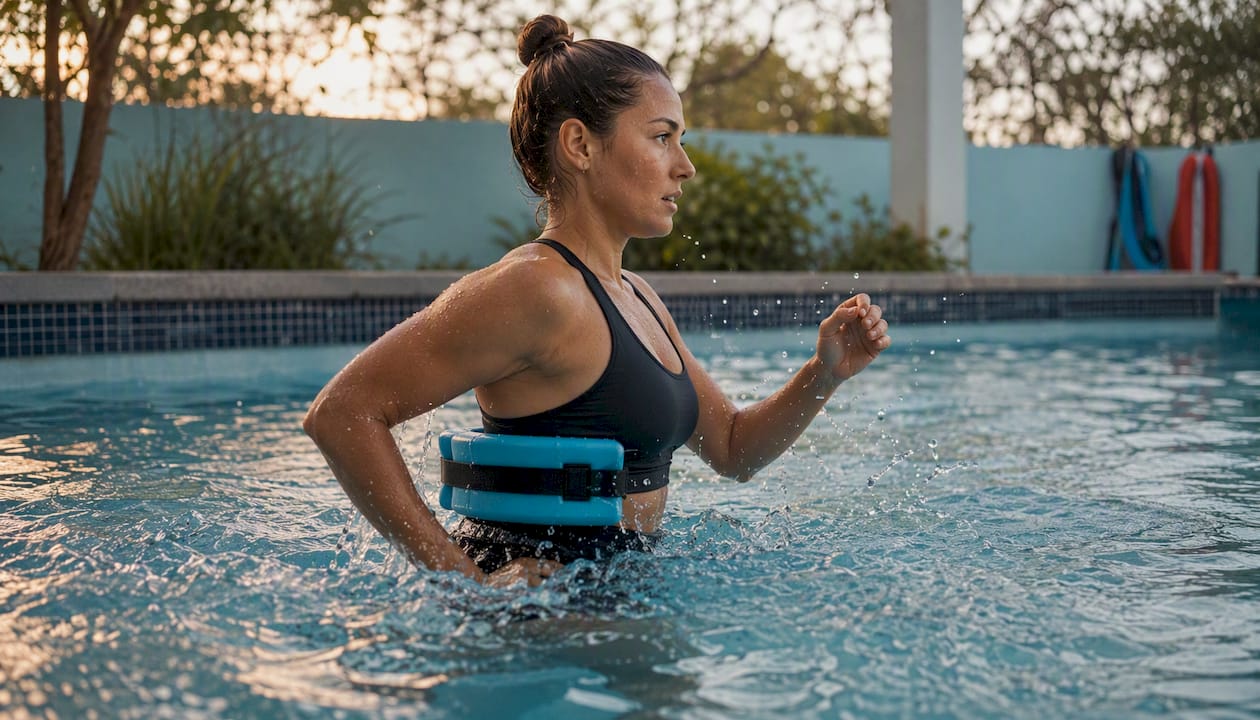
Cross-training during recovery: Pool running (aqua jogging with a flotation belt) is the closest cardiovascular substitute for running. Cycling and swimming maintain aerobic base effectively. Strength training for the upper body and non-affected lower-limb muscles can continue throughout.
How to prevent shin splints from coming back
Prevention is mostly about training discipline and a few equipment decisions. Structured relative rest and correction of training errors are the foundation, but long-term prevention requires ongoing attention to load, mechanics, and maintenance.
Training guidelines:
- Follow the 10% rule: increase weekly mileage by no more than 10% from one week to the next.
- Build in one rest day per week and one lower-volume week every three to four weeks.
- Rotate between surfaces (grass, trail, track) rather than running exclusively on concrete.
- Cross-train regularly. Substituting one or two runs per week with cycling or swimming reduces cumulative tibial stress without sacrificing fitness.
Footwear and equipment:
- Replace running shoes every 300–500 miles. Mark the date you started using them.
- If overpronation is a documented issue, stability shoes or motion-control footwear can reduce medial tibial stress. A specialty running store can assess your gait for free.
- Consider semi-rigid orthotics if recurrence is a pattern despite good training habits.
Ongoing maintenance:
- Keep the calf and dorsiflexor strengthening program going even after you are symptom-free. Two sessions per week is enough.
- Periodic gait analysis (every 12–18 months, or after any significant change in training) catches mechanical drift before it becomes an injury.
- Prioritize sleep and nutrition, particularly calcium and vitamin D intake, which directly affect bone density and stress-fracture risk.
Avoiding common training errors like sudden volume spikes and inadequate recovery is the most reliable prevention strategy across all athlete types.
Red flags: when shin pain may be more serious
Some presentations of lower-leg pain are not MTSS and need prompt clinical evaluation. Continuing to train through these signs risks a stress fracture, compartment syndrome, or a longer recovery.
Seek evaluation promptly if you have:
- Pain at rest, especially nighttime pain that wakes you.
- A single, sharply localized tender spot (the size of a fingertip) rather than a diffuse ache.
- Visible swelling or bruising over the shin without a clear traumatic cause.
- Pain that worsens despite one to two weeks of rest.
- A history of low bone density, disordered eating, or menstrual irregularity (female athlete triad increases stress-fracture risk significantly).
Signs of exertional compartment syndrome:
- Severe tightness or cramping in the lower leg that begins predictably after a set distance or time.
- Numbness or tingling in the foot during exercise.
- Foot drop or weakness that resolves within minutes of stopping.
- Compartment syndrome does not improve with rest alone. It requires clinical evaluation and, in some cases, surgical fasciotomy.
What to tell your clinician: Describe exactly when the pain starts (before, during, or after activity), whether it is getting better or worse, where it is most tender, and whether you have any of the above symptoms. This history guides whether imaging is ordered and how urgently.
What to expect from hands-on specialist care
When conservative self-care stalls after two to four weeks, or when biomechanical contributors are clearly driving the problem, clinic-level intervention addresses what home routines cannot. Professional assessment that targets gait imbalance and myofascial restrictions is the logical next step when pain is not resolving on its expected timeline.
Hands-on options clinicians use for MTSS:
- Manual therapy and soft-tissue mobilization: Reduces muscle tension, improves tissue extensibility, and addresses restrictions in the calf, tibialis posterior, and surrounding fascia.
- Fascial Distortion Model (FDM): A hands-on approach that identifies and treats specific patterns of fascial distortion. Thetxroom applies FDM techniques to address fascial restrictions and gait imbalances that generic online routines often miss.
- Myofascial acoustic compression therapy: A clinic-level modality that uses targeted acoustic waves to reduce soft-tissue restrictions and promote tissue recovery. Thetxroom offers myofascial acoustic compression therapy as part of its MTSS management approach.
- Gait analysis and orthotic prescription: Identifies the mechanical drivers of tibial overload and provides corrective footwear or custom orthotic recommendations.
What a typical clinic visit looks like:
The first visit involves a detailed history, movement screening, and hands-on assessment of the lower leg, ankle, and hip. Treatment follows immediately in most cases, combining manual work with a home exercise prescription. Measurable improvement in pain and function is typically expected within two to four sessions, though the full rehab course depends on severity and how long the condition has been present.
Pro Tip: When evaluating a clinic, ask three questions: What specific outcome are we targeting in the next four weeks? How will we measure progress? What is the plan if I am not improving? A clinician who answers these clearly is running a progressive, goal-oriented program. One who cannot is not.
The mistake most athletes make that keeps shin splints coming back
The pattern is predictable: pain eases after a week of rest, the athlete feels good, and they jump back into full training. Two weeks later, the shin hurts again. Repeat.
Returning too early is the most common reason MTSS becomes a chronic, recurring problem. But the second mistake is almost as damaging: treating shin splints as purely a stretching problem. Calf stretches feel productive, and they are part of the picture, but they do not build the tibial load tolerance that actually prevents recurrence. Strength work does. Specifically, eccentric calf loading, hip strengthening, and foot-intrinsic training change the mechanics of how force is distributed through the lower leg with every stride.
The third overlooked factor is systemic: bone health. Athletes who are under-fueling, sleeping poorly, or deficient in calcium and vitamin D are at higher risk for stress injuries regardless of how well-designed their training program is. In recurrent cases, these contributors deserve as much attention as footwear and mileage. A clinician who screens for the female athlete triad or relative energy deficiency in sport (RED-S) is doing the full job. One who only adjusts your training schedule is not.
Thetxroom offers hands-on shin splints care in Plano, Texas
If two to four weeks of conservative care have not moved the needle, or if your shin pain keeps coming back despite doing everything right, the missing piece is usually a biomechanical assessment that goes deeper than a generic exercise list.
Thetxroom is a specialized chiropractic clinic in Plano, Texas, built around hands-on treatment of exactly these kinds of persistent soft-tissue and bone-stress injuries. Using the Fascial Distortion Model, myotherapy, and myofascial acoustic compression, the clinic identifies the specific fascial restrictions and gait imbalances driving your MTSS, then builds a progressive rehab plan around them. That is a different starting point than rest-and-stretch advice. Bring your training log, your current shoes, and a clear description of when and where the pain occurs. The first visit includes a full biomechanical assessment and hands-on treatment. Book your evaluation at Thetxroom and get a plan built around your mechanics, not a template.
Sources
- Shin splints – Diagnosis & treatment — Mayo Clinic
- Chapter on stress injuries and stress fractures — NCBI Bookshelf
- Shin splints vs. stress fractures — UCLA Health
- Shin splints vs stress fracture — Hospital for Special Surgery (HSS)
- Relevant PMC clinical review article
This article provides general information for educational purposes and is not a substitute for professional medical advice. If you are experiencing significant pain, rest pain, or symptoms that are worsening, consult a qualified clinician before continuing activity.