
Achilles Tendinopathy Treatment: What Works and When to Get Help
The core of Achilles tendinopathy treatment is progressive loading of the tendon, combined with sensible activity changes and fixing whatever overloaded it in the first place. Rest, ice and shoe changes calm the pain. Structured strengthening rebuilds the tendon’s ability to tolerate load. Hands-on care, shockwave and dry needling can support that rehab when progress stalls. Most mild to moderate cases take months, not days, so a clear plan matters more than a quick fix.
This guide walks through each stage in order, from the first two weeks to return to running, and flags the symptoms that need a doctor right away.
TL;DR
- Cut back the activities that provoke pain (running, jumping, hills), but keep moving with low-strain options like swimming or cycling.
- Exercise rehabilitation has the strongest evidence. Expect to commit to at least three months of consistent loading.
- Heel lifts, supportive shoes, ice and over-the-counter anti-inflammatories can ease symptoms while you rebuild.
- Sudden severe pain, a pop in the heel or trouble pushing off the foot may be a rupture. Get medical care immediately.
- If self-care has not helped in about two weeks, or pain keeps returning, a hands-on evaluation can find the cause.
Table of Contents
- What Achilles tendinopathy actually is
- The first two weeks: calm it down
- Load management: how much is too much
- Strengthening: the backbone of treatment
- Heel lifts, boots and shoes
- Medicines and injections
- Where hands-on care, shockwave and dry needling fit
- Our perspective
- How long recovery takes
- Red flags: when to stop and get care
- Starting treatment in Plano
- FAQ
- Sources
What Achilles tendinopathy actually is
The Achilles tendon connects your calf muscles to your heel bone. Tendinopathy is the umbrella term for a painful, overloaded tendon, often called tendonitis or tendinosis in everyday conversation. Pain, stiffness and tenderness are usual, and mornings or the first steps after sitting are often the worst.
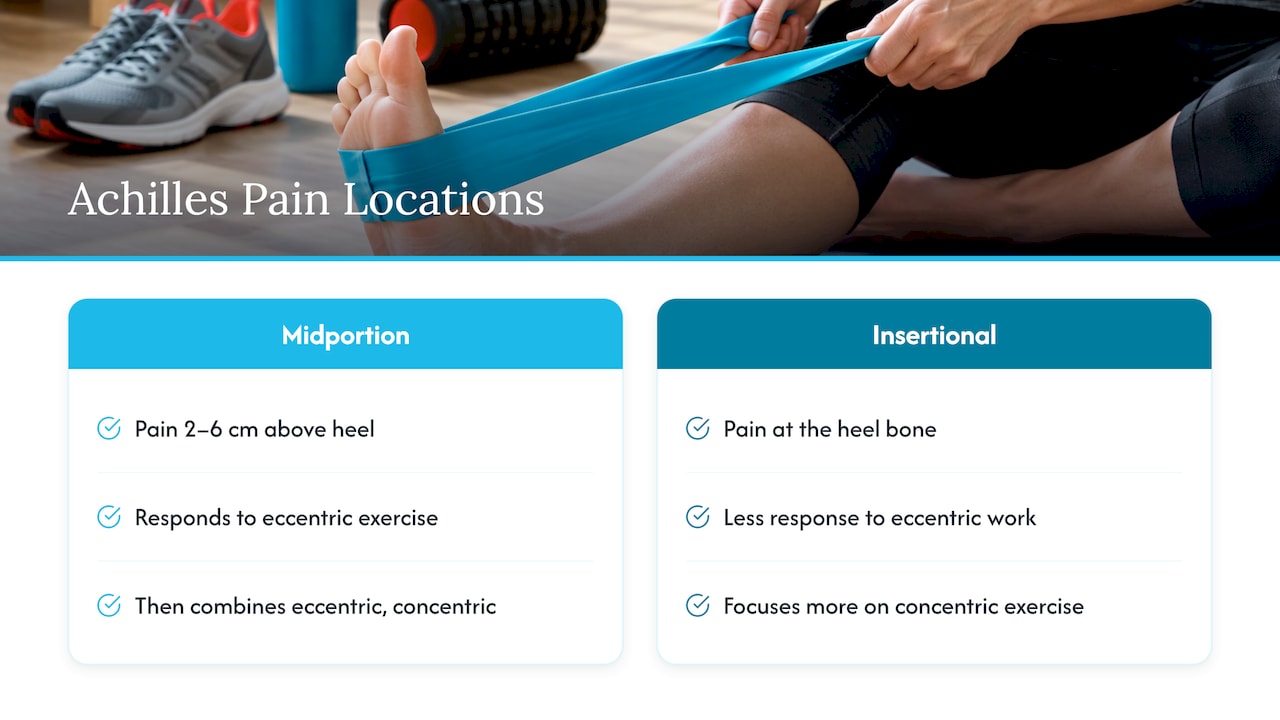
Where it hurts changes the plan. The American Academy of Family Physicians explains that midportion tendinopathy responds to eccentric and then combined eccentric and concentric exercise, while insertional tendinopathy, at the heel bone, responds less well to eccentric work and focuses more on concentric exercise. In plain terms, pain two to six centimeters above the heel and pain right at the back of the heel are not treated identically.
Common contributors include a sudden jump in running or jumping volume, tight or weak calves, worn or unsuitable shoes, hard surfaces and biomechanical imbalances further up the chain, such as how the foot, knee and hip share load. Treatment works best when it addresses those drivers rather than only the sore spot.
The first two weeks: calm it down
Early on, the goal is to settle irritation without letting the leg go deconditioned.
- Reduce provoking activity. MedlinePlus advises stopping or decreasing activities that cause pain, such as running or jumping, and doing activities that do not strain the tendon, such as swimming or cycling.
- Pick forgiving terrain. The same guidance recommends soft, smooth surfaces for walking or running, avoiding hills, and increasing activity gradually.
- Ice. MedlinePlus suggests ice over the tendon for 15 to 20 minutes, two to three times a day. Mayo Clinic’s self-care advice also includes compression and elevation.
- Give it a deadline. MedlinePlus recommends seeing a provider if symptoms do not improve with self-care within two weeks.
Complete rest is not the aim. A 2020 clinical review in a sports physical therapy journal notes that complete rest from all activity in the early phase may not be necessary when activity is adjusted to symptoms. That is good news if you are an athlete, a parent who is always on your feet or a worker who cannot simply stop.
If you want to add cold recovery to your routine, home cold plunge and recovery guides can help you compare equipment. Ordinary ice over the tendon is enough to start.
Load management: how much is too much
A tendon heals when it is loaded in the right dose. Too little and it stays weak. Too much and it flares. The practical question is how to tell the difference.
A patient guide from St George’s NHS in the UK suggests a traffic light system for pacing:
- Green: pain is settled, so you can increase activity.
- Amber: pain is borderline, so stay at your current level.
- Red: pain is climbing, so reduce activity.
The same guide says that if pain increases for more than 24 hours after exercise, do fewer exercises next time. It also stresses that a flare does not mean the tendon has been damaged. It is a warning that you did more than the tendon could tolerate at that moment.
A Danish pilot study of a four-stage loading program uses a similar gate. Progression to the next stage requires that pain after loading stays at or below 3 out of 10 and settles within a few hours. That is a simple rule you can use at home: mild, brief soreness is acceptable, while sharp pain or a next-morning flare means step back.
Strengthening: the backbone of treatment
The clinical review mentioned above states that exercise rehabilitation has the highest level of evidence for Achilles tendinopathy. It adds that the tendon responds better to higher loads over longer durations than to lighter, shorter ones. Any type of contraction can load the tendon (isometric, concentric or eccentric), and the choice should be progressive and based on how you respond.
A four-phase roadmap
The same review describes four phases for athletes:
- Symptom management and load reduction. Exercise to promote tendon recovery starts right away, not after the pain is gone.
- Recovery. Daily exercises progressed by adding repetitions, range of motion and speed.
- Rebuilding. Heavier, more demanding strength work.
- Return to sport. Sport-specific loading is introduced.
The Danish program frames it as stages too. Stage 1 uses isometric holds for pain control, stage 2 builds calf strength, stage 3 adds impact and energy storage, and stage 4 covers push-off and a gradual return to running.
Which exercises for which pain
For midportion pain, Mayo Clinic’s physician-facing review says either the eccentric (Alfredson) protocol or heavy slow resistance can help, while insertional pain tends to do better with a modified eccentric protocol. Mayo Clinic also notes that a physical therapist may prescribe heavy resistance such as weighted heel raises for chronic cases.
As you progress in the recovery phase, the clinical review describes moving heel raises to an incline or with the heel off a step for midportion symptoms. Quick, rebounding heel raises then prepare the tendon for fast loads like plyometrics. Body-weight-supported treadmill or deep-water running is an excellent way to resume running while controlling the load.
If you want ideas for building calf strength with sets, reps and weekly structure, this guide to calf exercises for strength covers options that fit both midportion and insertional tendon symptoms. Dosage matters, so pair any plan with feedback from someone who has examined your tendon.
Be patient
The St George’s guide is blunt on timing: completing your prescribed exercises for at least three months is the key to getting better. It also says other treatments may promise faster recovery but have not been shown to beat exercise in the long term. That is why the best use of any add-on therapy is to help you tolerate and complete the loading program.
Heel lifts, boots and shoes
A simple heel raise in your shoe reduces how far the tendon stretches with each step. Mayo Clinic says a shoe insert or wedge that slightly raises the heel can relieve strain on the tendon, and a heel pad can cushion a sore area. MedlinePlus likewise mentions heel lifts or a walking boot if your provider recommends them.
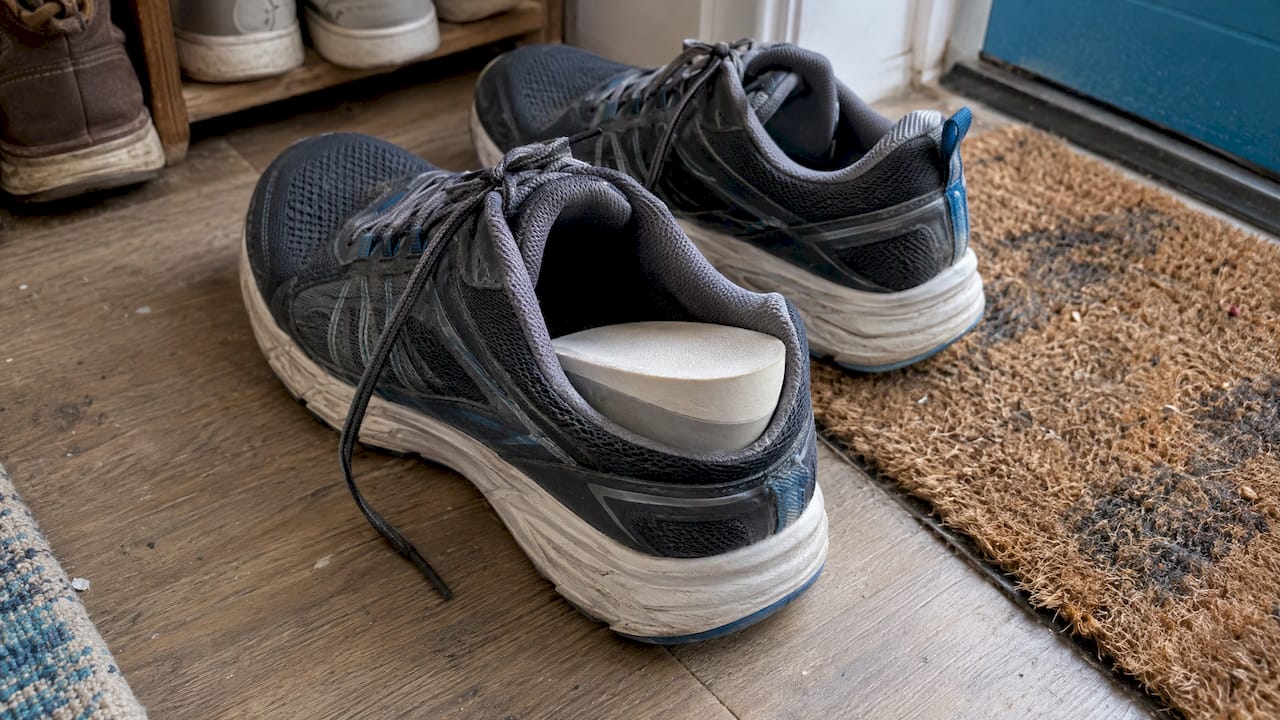
A boot is for severe cases. Mayo Clinic notes that severe tendinitis may need a walking boot and crutches. For most people, a boot is a short-term measure under guidance, not a long-term answer, because the tendon still needs to be loaded to recover. Use lifts as a bridge while the strength work takes hold, and choose cushioned, supportive footwear for daily wear.
Medicines and injections
Over-the-counter pain relievers. Mayo Clinic says ibuprofen or naproxen may help. MedlinePlus adds a safety point: talk with your provider before using pain medicines if you have heart disease, high blood pressure, kidney disease, or a history of stomach ulcers or internal bleeding. If any of those apply to you, ask your doctor or pharmacist first.
Topical nitroglycerin. Mayo Clinic lists a nitroglycerin patch applied to the sore tendon daily for two to three months as a prescription option. This is a physician decision, not an over-the-counter one.
Corticosteroid injections. This one deserves caution. The American Academy of Family Physicians says intratendinous corticosteroid injection into weight-bearing tendons such as the Achilles is not recommended because of the risk of tendon rupture. If someone offers you a steroid injection into the tendon itself, ask your physician about that rupture risk first.
The evidence on other injections is mixed. A 2026 AAFP letter reports that a Cochrane review found no clinically relevant functional improvement from injection therapies and insufficient evidence for routine use, while high-volume injections, particularly ultrasound-guided, have shown short- to medium-term benefit in some patients.
Where hands-on care, shockwave and dry needling fit
The same AAFP letter lists the current non-surgical toolbox: topical nitroglycerin, heel lifts, structured physical therapy, progressive high-load strength training, short-term immobilization when indicated, extracorporeal shock wave therapy and pain psychology. The St George’s guide says shockwave can be considered alongside rehabilitation if symptoms are not improving.
That is where a specialized clinic earns its place: not replacing the loading program, but removing what stands in its way. In practice that can mean:
- Focused shockwave. Our MyACT focused shockwave and shockwave treatment for active patients are designed to work on stubborn soft tissue so you can keep training through rehab.
- Fascial work. The Fascial Distortion Model is a hands-on approach to soft tissue injuries that we use to address the distortions in the calf and heel region that can keep a tendon irritated.
- Dry needling and laser. Dry needling and deep tissue laser therapy are options we use for tight, painful calf tissue.
- Chain assessment. Tight calves, ankle stiffness and foot mechanics often feed into heel pain. Our guide to tight calves and heel pain explains the connection, and our tendinitis page covers how we approach overloaded tendons in general.
If your pain sits closer to the arch than the back of the heel, see our guide to chiropractic for plantar fasciitis. Other tendons near the ankle have their own pages, including peroneal tendonitis and patellar tendinopathy.
Our perspective
Many people come to us after weeks of stretching, rest and anti-inflammatories that did not change much. The tendon was never the whole story. We find that calf tissue, the ankle and the way the foot loads the ground are often part of the problem.
Our approach is hands-on. We use the Fascial Distortion Model, myotherapy and focused shockwave to restore how the tissue moves, then build an individualized rehab plan so the tendon can be loaded progressively. Our treatment is designed to get you back to your active lifestyle sooner, and we focus on cases that have not improved with standard medical or physical therapy approaches.
The loading program is still the engine of recovery. Our job is to make it possible to do it well: less guarding, better movement, a plan matched to your sport or your workday.
Chris
How long recovery takes
Hospital for Special Surgery states that mild to moderate Achilles tendinosis may resolve within three to six months with appropriate treatment, and that patients should expect at least three months of physical therapy before seeing improvement. If surgery is needed or the tendon ruptures, recovery can take nine to twelve months or longer.
Three months of work before improvement sounds long, so set milestones that are not just pain-based:
- Morning stiffness shortens.
- You can do single-leg heel raises with more repetitions or added weight.
- Walking and stairs stop provoking pain.
- You tolerate short jogging intervals on soft surfaces, with pain staying within your acceptable range and settling within hours.
Return to running should be graded. Start with walk-run intervals, avoid hills and speed work at first, and add volume only when the tendon has been in the green zone for several sessions. Our guide to return to sport timelines shows how clinicians think about milestones rather than calendar dates, and the same logic applies to the Achilles.
Red flags: when to stop and get care
Most tendon pain is not an emergency. A rupture is. Mayo Clinic says that if the pain is suddenly severe or keeps you from moving, you may have torn your Achilles tendon and should seek medical help right away. It describes an Achilles rupture as a serious injury that often needs surgery.
Mayo Clinic lists these rupture symptoms:
- A feeling of being kicked in the calf
- Sharp pain and swelling near the heel
- Difficulty bending the foot downward or pushing off when walking
- Difficulty standing on the toes of the injured foot
- A popping or snapping sound at the time of injury
If you hear a pop in your heel, especially if walking is hard afterward, contact a healthcare professional the same day. Also call your provider if pain around the tendon simply does not go away.
Starting treatment in Plano
If you are in Plano and have been stuck in a cycle of rest, flare and restart, we can examine the whole kinetic chain, treat the tissue that is limiting you and build a loading plan around your sport, job or family schedule. We accept self-pay and insurance. Visit The Tx Room to book an initial exam.
Bring your current shoes, a note of what aggravates the pain and any imaging or medication history. That helps us decide where to begin. If we see signs of a rupture or something outside our scope, we will tell you and point you to the right medical care.
FAQ
How can I relieve pain caused by Achilles tendonitis?
Reduce running, jumping and hills, and use ice for 15 to 20 minutes a couple of times a day. A heel lift can reduce strain, and over-the-counter ibuprofen or naproxen may help if your doctor says they are safe for you. Start gentle loading exercises rather than resting completely.
Does wearing a boot help Achilles tendonitis?
A walking boot, sometimes with crutches, is generally used for severe cases and for a short time. For most people a heel lift in a supportive shoe is the first step, because the tendon still needs progressive loading to recover.
How long does Achilles tendinopathy take to heal?
Mild to moderate cases often resolve within three to six months with appropriate treatment, and at least three months of consistent rehab is usual before clear improvement. Severe cases, or a rupture needing surgery, can take nine to twelve months or longer.
Is a cortisone shot a good idea for Achilles tendon pain?
Injecting a corticosteroid into the Achilles tendon itself is not recommended because it raises the risk of rupture. Talk with your physician about safer options, including loading programs and other non-surgical therapies.
Sources
- Management of Chronic Tendon Injuries, AAFP (2019)
- Heel pain and Achilles tendonitis aftercare, MedlinePlus
- Achilles tendinitis diagnosis and treatment, Mayo Clinic
- Achilles Tendinopathy patient guide, St George’s NHS
- Conservative management of Achilles tendinopathy, PMC
- Isometric and functionally based 4-stage progressive loading program
- Treatment of Achilles tendinopathy, Mayo Clinic
- Injections of the Foot and Ankle, AAFP (2026)
- Nonoperative Interventions for Achilles Pathology, AAFP (2026)
- Achilles Tendon Pain, HSS
- Achilles tendinitis symptoms and causes, Mayo Clinic
- Achilles tendon rupture symptoms and causes, Mayo Clinic
- Calf exercises for strength
- Recovery and ice bath guides