
Clinic Tested Rehab Roadmap for Spondylolisthesis: Four Phases
Conservative treatment is the first-line approach for most people with low-grade spondylolisthesis, and it typically works when you follow a phased, criterion-based rehab program rather than generic rest and stretching. Most patients attempt non-surgical care for 6 weeks to 3 months before surgery is even discussed, and many improve within that window. The exception is anyone with progressive weakness, new bowel or bladder changes, or worsening nerve symptoms: that combination needs urgent medical evaluation, not a home exercise program.
TL;DR:
- Conservative treatment typically lasts 6 weeks to 3 months, with progression based on functional benchmarks rather than time alone; failure to improve may require reevaluation.
- Phased rehab involves four stages focused on active rest, early and advanced strengthening, and gradual return to activity, with specific tests guiding progression.
- Symptom management includes short-term medications, injections, and non-drug therapies, timed to support and not replace rehabilitation efforts.
- Bracing is used selectively, mainly for younger patients or those with instability, and activity restrictions focus on avoiding extension and high-impact loading.
- Red flags such as worsening weakness or bladder changes necessitate urgent medical evaluation, and most low-grade cases improve without surgery after a proper conservative approach.
Table of Contents
- What conservative treatment includes: modalities and goals
- A phased rehab plan that actually progresses you forward
- Symptom management: medications, injections, and non-exercise interventions
- Bracing and activity modification: practical guidance
- When to consider surgical referral and red flags
- Prognosis and realistic timeline for improvement
- Potential complications and how to monitor your progress
- How grade and symptom severity change the approach
- Clinic perspective: pairing hands-on therapy with structured rehab
- How to start conservative care with The Tx Room
- FAQ
- Sources
What conservative treatment includes: modalities and goals
Non-surgical care for spondylolisthesis is not one thing. It is a set of tools, each aimed at a different piece of the problem: pain, instability, weak support muscles, or poor movement habits that keep loading the stressed segment of your spine.
- Physical therapy and exercise: core and hip strengthening, hamstring flexibility work, and neutral-spine training from the backbone of recovery for most patients.
- Activity modification: reducing or pausing extension-heavy or high-impact activities (gymnastics, football, diving) gives the affected vertebra a chance to settle.
- Bracing: a rigid or semi-rigid brace can help some patients, particularly younger athletes with pars defects, though evidence on its added benefit over activity restriction alone is mixed.
- Medications: short courses of NSAIDs or acetaminophen manage flares without the risks that come with long-term opioid use.
- Interventional options: epidural steroid injections can calm radicular pain temporarily within an otherwise conservative pathway, though they are not a stand-alone fix.
- Manual therapy and adjunct modalities: hands-on soft-tissue work and other adjuncts can ease pain and improve mobility enough to make active rehab tolerable, but they work best paired with an exercise-centered program, not instead of one.
The guiding principle, according to the NASS clinical guideline, is that there is no single standard of care: treatment should be built around your functional status and neurologic findings, not around how your imaging looks.
A phased rehab plan that actually progresses you forward
Calendar-based rehab (just wait six weeks and see) is weaker than criterion-based rehab, where you move to the next phase only after hitting specific functional markers. Protocols published by Mass General Brigham and Sanford Health both structure recovery into four phases, and the logic holds whether you are a teenage athlete with a pars defect or an adult with degenerative slippage.
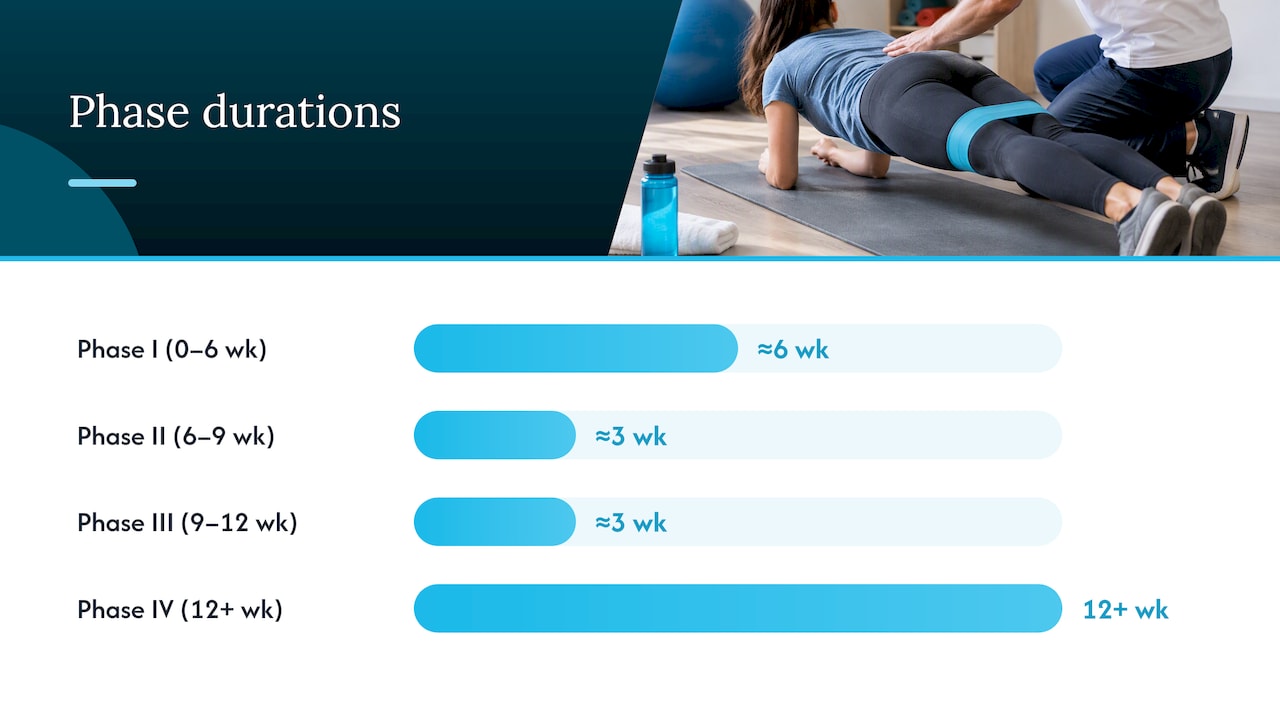
- Phase I (roughly weeks 0 to 6): active rest, pain control, and protected mobility. You avoid repetitive lumbar extension and rotation while starting low-load core activation like pelvic tilts and gentle bracing drills.
- Phase II (roughly weeks 6 to 9): early strengthening begins. The focus shifts to neutral-spine control under light load, along with hip and glute activation to offload the lumbar segment.
- Phase III (roughly weeks 9 to 12): advanced loading and anti-rotation work. Closed-chain exercises, controlled lunges, and sport-prep drills replace the basic stabilization moves from Phase II.
- Phase IV (12 or more weeks): graded return to sport or full activity, with sport-specific drills layered back in gradually rather than all at once.
Progression between phases depends on objective benchmarks rather than the calendar alone. Clinicians commonly use tests like a 60-second plank hold, pain-free range of motion, and supine double-leg lowering under 70 degrees as gatekeepers before advancing someone to heavier loading, and this criterion-based approach is associated with lower re-injury risk than simply counting weeks.
Visit frequency and protocol details vary by diagnosis type. Younger patients with isthmic spondylolisthesis (a stress fracture in the pars) tend to need stricter extension avoidance early on, since the priority is letting the fracture heal rather than adding corrective exercise on top of the same loading pattern. Adults with degenerative spondylolisthesis, where age-related disc and joint changes cause the slip, often tolerate earlier light strengthening but may need a longer Phase III given stiffer joints and slower tissue adaptation, as outlined in degenerative condition treatment options: a practical guide.
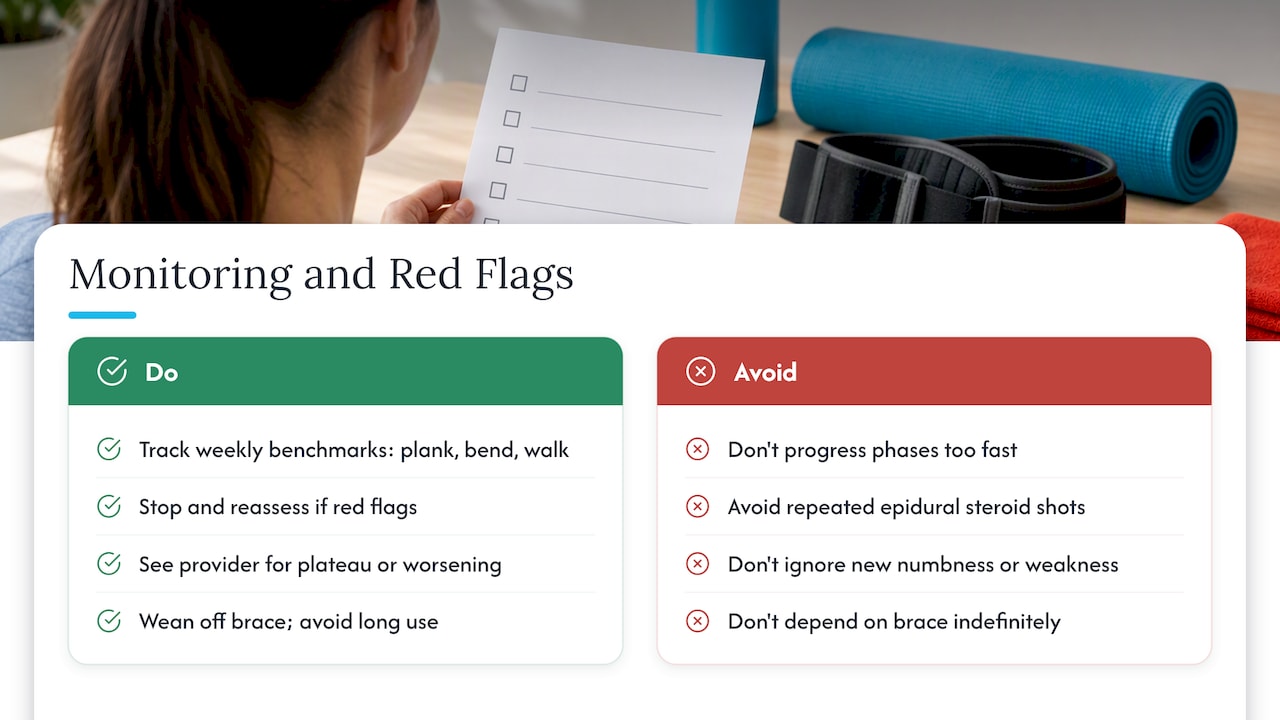
Pro Tip: Track your plank hold time and pain-free bending range weekly. If you are not inching closer to the next phase’s benchmark after two to three weeks, that is a signal to adjust the program rather than push through it.
Symptom management: medications, injections, and non-exercise interventions
Pain control supports rehab, it does not replace it. Short courses of NSAIDs or acetaminophen handle flares reasonably well, and prolonged opioid use is best avoided when alternatives exist. When pain radiates down the leg, gabapentin or a tricyclic antidepressant sometimes helps calm nerve-related pain, used under medical guidance.
- Epidural steroid injections can ease radicular leg pain temporarily, but evidence on their long-term benefit is limited and repeated injections carry their own risks.
- Medial branch blocks and radiofrequency ablation target facet-related pain specifically, with evidence that is thinner still but occasionally useful for the right patient.
- Heat and cold therapy offer low-risk symptom relief during flares, useful alongside exercise rather than in place of it.
- TENS units give some patients a non-drug option for managing breakthrough pain during the day.
Any injection or procedure should be discussed in terms of timing relative to your rehab plan. An injection that buys you two pain-free weeks is most valuable when those weeks get spent progressing through your strengthening phases, not sitting on the couch.
Bracing and activity modification: practical guidance
Bracing is not automatic. It tends to make the most sense for younger patients with confirmed pars defects or for anyone with symptomatic instability that limits daily function, and the supporting evidence remains mixed enough that it is considered selective rather than universal.
- Activity rules: avoid repeated spinal extension and high-impact loading, and for athletes, a graded pause from sport of at least three months is common in symptomatic cases.
- Daily movement: practice neutral spine positioning and hip-hinge mechanics when bending or lifting, which keeps load off the stressed segment during ordinary tasks.
- Weaning off a brace: reintroduce activity gradually as pain settles and core control improves, rather than removing the brace and resuming sport on the same day.
Posture habits matter outside the gym too. Reviewing your posture and pelvic mechanics can clarify why certain everyday positions aggravate symptoms more than others.
Pro Tip: If a brace is part of your plan, treat it as a short-term training wheel for your core, not a permanent fix. The goal is for your own muscles to take over that stabilizing job.
When to consider surgical referral and red flags
Some signs mean you should skip the conservative trial and get evaluated right away: progressive motor weakness, new bowel or bladder dysfunction, or rapidly worsening neurologic symptoms. These point to a problem conservative care will not resolve on its own.
Short of those red flags, surgical evaluation becomes reasonable when someone fails to improve after an adequate trial, commonly 6 to 12 weeks of properly executed rehab, or when neurologic signs worsen despite treatment. Imaging and objective slip progression help inform that decision, but imaging severity alone should not drive it: function and neurologic status matter more than how a scan looks.
Even when surgery is on the table, it is a shared decision. A network meta-analysis of interventions for degenerative lumbar spondylolisthesis found that surgical treatment often improves pain and disability more than nonoperative care in some trials, but it also carries higher complication rates. For patients without neurologic compromise, that tradeoff often favors sticking with a well-run conservative program before escalating.
Prognosis and realistic timeline for improvement
Most low-grade cases do well with conservative care, and older outcome data backs that up. A 2009 meta-analysis found that about 84% of adolescent patients with spondylolysis or grade 1 spondylolisthesis had successful outcomes at one year with nonoperative treatment, a figure still commonly cited to set expectations for low-grade cases today.
Improvement tends to be gradual rather than sudden. You should expect measurable gains in plank hold time, pain-free range of motion, and daily function over the first six to twelve weeks, with activity tolerance building from there. Poorer outcomes tend to cluster around spinal instability, older age, and more severe stenosis, and those patients may need longer rehab courses or earlier reconsideration of other options. Adherence to the phased program, not just the diagnosis itself, is one of the stronger predictors of how quickly someone gets back to normal activity.
Potential complications and how to monitor your progress
Conservative treatment is low-risk compared with surgery, but it is not risk-free. Progressing through strengthening phases too fast can aggravate pain or, in rare cases, worsen the slip if extension-heavy loading resumes before the segment has stabilized. Repeated epidural steroid injections carry their own cumulative risks and offer diminishing returns, which is why they are used selectively rather than as a routine repeat prescription.
The more important risk is missing a red flag because symptoms have been labeled “just the usual back pain.” New numbness, weakness in a leg, changes in bladder or bowel control, or pain that keeps escalating despite a properly run program are reasons to stop self-managing and get reassessed promptly. Monitoring is simple in practice: track your functional benchmarks weekly (plank hold, pain-free bending, walking tolerance), and treat a plateau or regression as a prompt to revisit your plan with a provider rather than push through on your own. People managing a brace should also watch for skin irritation or deconditioning from overreliance on external support, since the point is to transition off it, not depend on it indefinitely.
How grade and symptom severity change the approach
Not every spondylolisthesis case gets the same conservative plan.
Higher-grade slips or cases with mechanical instability often call for closer monitoring and sometimes a brace earlier in the process, since the margin for error with extension-based loading is smaller. Symptom pattern matters as much as grade: someone with purely axial back pain usually progresses through strengthening phases faster than someone with radiating leg pain or neurologic tingling, who may need the injection and medication options discussed earlier layered into the plan before heavier loading becomes tolerable. Degenerative spondylolisthesis in older adults frequently coexists with spinal stenosis, and neuromuscular re-education focused on neutral spine and pelvic positioning becomes a bigger piece of the program than in younger, isthmic cases. The common thread across grades and severities is the same criterion-based progression framework, just with different starting points and paces.
Clinic perspective: pairing hands-on therapy with structured rehab
A phased rehab plan works better when the stiffness and guarding around the affected segment get addressed early, not just the strength deficits. At The Tx Room, we use the Fascial Distortion Model, a hands-on therapy approach, as an adjunct to the kind of structured, criterion-based rehab described throughout this guide, not a replacement for it.
A typical care flow starts with an assessment of movement patterns and tissue restriction, followed by manual therapy to reduce guarding and improve pain-free range of motion, then supervised exercise progression through the phases, and finally a home program the patient can sustain independently. This mirrors the approach we use for related conditions, including our stepwise conservative plan for hip labral tears, where manual work and progressive loading are sequenced rather than treated as competing options. The goal is always the same: reduce the barriers that keep someone from doing their rehab well, then let the rehab do the heavy lifting.
— Chris
How to start conservative care with The Tx Room
If you are in the Plano area and want hands-on support alongside a structured rehab plan, The Tx Room offers Chiropractic Care and Soft Tissue Therapy built around the Fascial Distortion Model, along with Dry Needling and MyACT Focused Shockwave therapy as adjuncts for stubborn pain and restricted tissue.
Your first visit typically includes a movement assessment and a discussion of your imaging and symptom history, followed by a short-term plan covering the next several weeks of care. If you notice progressive weakness, new bladder or bowel changes, or worsening nerve symptoms, seek urgent medical attention before scheduling a routine visit. Otherwise, you can book an appointment to get started.
This article is general information, not a substitute for advice from a qualified doctor. Consult a qualified healthcare professional about your own circumstances before acting on anything here.
FAQ
What happens if you don’t fix spondylolisthesis?
Many low-grade cases stay stable and manageable for years with ongoing core strengthening and activity awareness, without ever needing surgery. Some people experience intermittent flares tied to activity level, and a smaller group sees gradual slip progression or nerve symptoms that eventually need closer medical evaluation.
Is it possible to fix spondylolisthesis without surgery?
Yes, for most low-grade cases without neurologic compromise: conservative care is the first-line approach, and a large share of adolescent patients with grade 1 slips see successful outcomes with nonoperative treatment within a year. Surgery becomes a more serious consideration mainly when conservative care fails after an adequate trial or red flags appear.
What is the newest treatment for spondylolisthesis?
There is no single new standard replacing conservative care. Current guidance still centers on phased, criterion-based rehabilitation with progression tied to functional benchmarks rather than a specific new device or procedure, and interventional options like injections remain adjuncts rather than primary treatment.
What causes spondylolisthesis to flare up?
Flares commonly follow repeated spinal extension or high-impact loading, such as gymnastics, running, or heavy lifting with poor mechanics. Prolonged poor posture or a sudden jump in activity level after a period of rest can also trigger symptoms, which is why gradual, criterion-based progression matters.
Sources
- Surgical and non-surgical management of spondylolisthesis
- NASS guideline: spondylolisthesis
- Rehabilitation guidelines for conservative management of spondylolysis/spondylolisthesis in the young athlete
- Sanford Health: spondylolysis non-operative rehabilitation guideline