

Exercise First Peroneal Tendonitis Treatment With Clear Escalation
Peroneal tendonitis is usually treated without surgery: start with pain-guided activity modification, bracing if needed, and progressive tendon-loading exercises under a physical therapist’s guidance. Most people see steady improvement over several weeks to a few months of consistent, structured loading. If pain persists past that window, or you notice mechanical catching, instability, or real weakness along the outer ankle, it’s time for imaging and a specialist evaluation rather than more waiting.
TL;DR:
- Most cases improve with activity modification, bracing, and progressive tendon-loading exercises over several weeks to months, without surgery.
- Persistent mechanical symptoms like catching or weakness suggest the need for imaging and specialist evaluation rather than continued waiting.
- Proper rehab involves gradual increases in resisted eversion, eccentric calf raises, and balance training, with setbacks indicating the need to regress.
- Injections and shockwave therapy are supportive tools reserved for cases that plateau despite structured loading, not first-line treatments.
- Surgery is only considered for structural tears or instability that do not respond to conservative management after extended trial.
Table of Contents
- Symptoms, Causes, and Why It Gets Mistaken for a Sprain
- How Is Peroneal Tendonitis Diagnosed?
- Conservative Treatment: The First-Line Plan
- Exercises and Progression: From Isometrics to Sport
- When Do Injections or Shockwave Therapy Help?
- Surgical Options for Tears and Chronic Instability
- How Long Does Recovery Take?
- Preventing Peroneal Tendonitis From Coming Back
- How Hands-On Care Fits Into a Conservative Recovery Plan
- Ready to Move Past the Plateau? Here’s How to Start
- Sources
- FAQ
Symptoms, Causes, and Why It Gets Mistaken for a Sprain
The hallmark is pain along the outside of the ankle, just behind or below the bony bump (the lateral malleolus), often with swelling, a clicking sensation, or discomfort that spikes when you turn your foot outward against resistance or walk on uneven ground.
Several factors set the stage for this injury:
- A prior ankle sprain that never fully rehabbed, leaving the tendons doing extra stabilizing work
- A high-arched (cavus) foot, which shifts more load onto the outer ankle structures
- A sudden jump in running mileage, hiking terrain, or court sport volume
- Repeated time on cambered roads, trails, or slanted surfaces
Here’s the problem: most people assume lateral ankle pain means a sprain, ice it for a week, and move on. Persistent clicking or pain with resisted eversion points to tendon involvement, not ligament damage, and treating it like a sprain (brief rest, then back to normal activity) often lets the irritation simmer for months.
How Is Peroneal Tendonitis Diagnosed?
A clinician typically starts with a hands-on exam: palpating the tendon path behind the outer ankle bone, testing resisted eversion strength, and checking for pain or subluxation (the tendon slipping out of its groove) during ankle circles.
Expect these steps in a thorough workup:
- History focused on onset, activity changes, and prior ankle injuries
- Provocative tests for tendon subluxation and resisted eversion pain
- Ultrasound for dynamic assessment of tendon movement, or MRI if a tear or persistent symptoms are suspected
- Screening for red flags: mechanical catching, sudden weakness, or no improvement after a genuine conservative trial
If subluxation or a suspected tear shows up on exam, imaging moves from optional to necessary. That distinction changes the entire treatment path.
Conservative Treatment: The First-Line Plan
Conservative care resolves most cases, and treatment centers on activity modification, RICE, short-term NSAIDs, and physical therapy built around progressive tendon loading. Here’s how that plays out in practice:
- Immediate phase: Cut back (not eliminate) aggravating activity, apply ice after activity, use compression as needed, and consider a short course of NSAIDs for acute inflammation.
- Support and offloading: For higher pain levels, a controlled ankle motion (CAM) boot or ankle brace limits aggravating motion. Lateral heel wedges can offload the peroneal tendons in the short term, and some patients benefit from orthotic adjustments once acute pain settles.
- Guided rehab: A physical therapist builds a progressive loading program, adds manual therapy for surrounding soft tissue, and corrects gait or footwear issues contributing to the strain.
- Reassessment: Nonoperative treatment is typically given several months before considering other options, with checkpoints along the way to confirm you’re actually progressing, not just resting.
Pro Tip: Total rest feels productive but usually backfires. Clinical guidance cautions against prolonged complete rest because tendons need controlled loading to remodel and strengthen. Complete immobilization for weeks often means starting rehab from a weaker baseline than if you’d kept moving within a pain-guided range.
For people managing this alongside a recent ankle sprain, the two injuries often need coordinated rehab timing rather than treating one and ignoring the other.
Exercises and Progression: From Isometrics to Sport
Loading the tendon correctly, in the right order, is what actually drives recovery. Trying to jump straight to running or agility work is the single most common mistake.
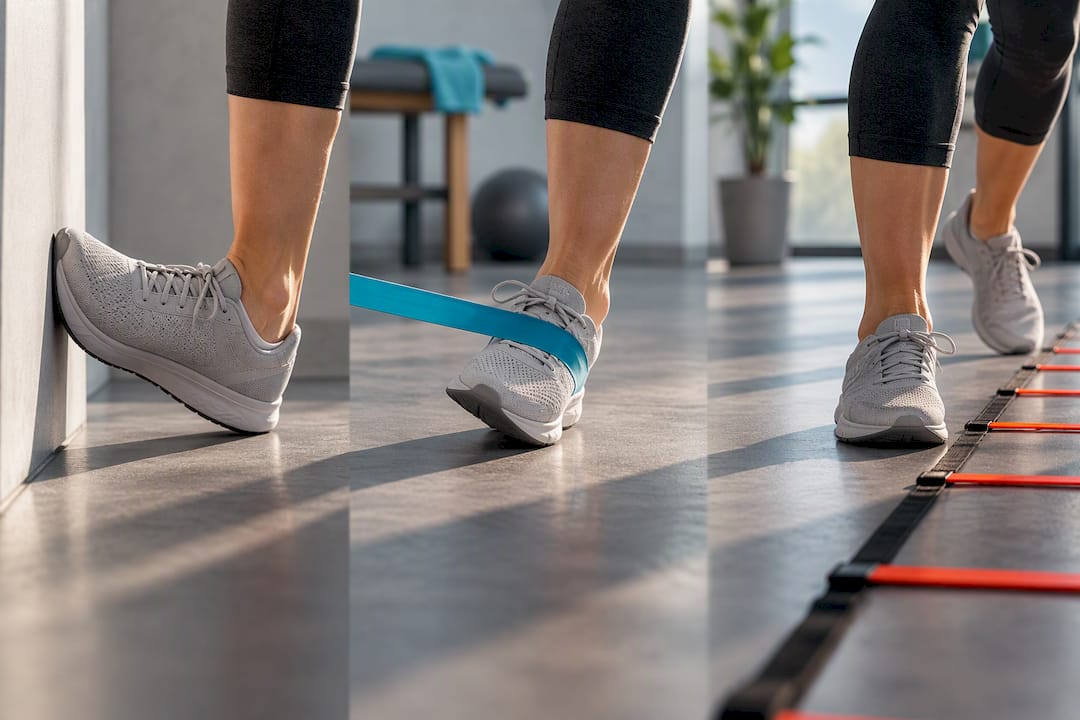
Weeks 0 to 3 (early phase): Gentle range-of-motion work and isometric peroneal holds, done daily. Push the foot outward against a wall or immovable object and hold for 30 to 45 seconds, several times a day. Pain during exercise should stay mild and settle within an hour.
Weeks 3 to 8 (loading phase): Add resisted eversion with a resistance band, slow eccentric lowering movements, and calf raises. A typical structure is 3 sets of 10 to 15 reps, increasing resistance or reps roughly every one to two weeks as pain allows.
Proprioception and return-to-sport phase: Single-leg balance work, wobble board drills, and lateral agility patterns (side shuffles, cutting drills) prepare the ankle for unpredictable surfaces and sport demands.
Targeted exercises like calf raises, resisted eversion, single-leg balance, and tibialis anterior raises reduce pain and restore function when done consistently and progressed appropriately.
Watch for these warning signs to pull back:
- Sharp, stabbing pain (different from the dull ache of muscle fatigue)
- Increased swelling the next morning
- New clicking or a sense of instability during the exercise
If any of those show up, regress to the previous stage for a few days before trying to advance again.
When Do Injections or Shockwave Therapy Help?
Injections and biologic therapies play a supporting role, not a starting one, in most cases.
- Corticosteroid injections can calm peri-tendinous inflammation and sometimes serve a diagnostic purpose, but clinicians generally avoid injecting directly into tendon tissue because it can weaken the fibers; ultrasound guidance improves accuracy and reduces that risk.
- PRP (platelet-rich plasma) shows promise in small studies, but overall evidence remains inconsistent, and many guideline panels stop short of recommending it as routine therapy.
- Shockwave therapy sometimes enters the picture after months of failed conservative care. Some panels support it as a second-line option for recalcitrant cases, even though the evidence base is mixed.
None of these replace a structured loading program. They’re tools to unstick a recovery that has genuinely plateaued, not a shortcut around the exercise work described above.
Surgical Options for Tears and Chronic Instability
Surgery enters the conversation when structural damage or mechanical instability doesn’t respond to sustained conservative effort. Indications include high-grade tendon tears, recurrent tendon subluxation, bony irritants rubbing against the tendon, or a genuine conservative trial that simply hasn’t worked.
Common procedures include:
- Debridement or synovectomy to clean up damaged or inflamed tissue
- Tendon repair or tubularization for split or frayed tendons
- Groove deepening surgery when the bony groove behind the ankle is too shallow, allowing the tendon to slip
- Retinacular repair to stabilize the tendons in place, sometimes with tenodesis or grafting for more extensive damage
Post-op protocols vary by procedure. When the superior peroneal retinaculum is repaired, patients typically spend about two weeks non-weight-bearing in a cast before transitioning to a boot with progressive weight-bearing. The first 12 weeks focus on protecting the repair, then gradually reintroducing motion and load under close supervision.
How Long Does Recovery Take?
Recovery timelines depend heavily on severity and whether surgery was involved, but there’s a general pattern most patients follow.
- Early weeks: Walking and low-impact cardio (swimming, cycling) as tolerated, with lateral ankle pain gradually easing.
- 6 to 12 weeks: Progressive strength and balance work continues; jogging or sport-specific drills begin once strength and gait mechanics are adequate.
- 3 to 6 months and beyond: Many patients return to full activity in this window. Rehab protocols following surgical repair extend loading and return-to-sport timelines out to 8 to 12 weeks or longer, depending on the specific procedure performed.
Progress rarely moves in a straight line. A good week followed by a flare after a longer run doesn’t mean you’re back to square one. It usually means the load increased faster than the tendon could adapt.
Preventing Peroneal Tendonitis From Coming Back
Footwear matters more than most people think. Choose shoes with real lateral stability and cushioning matched to your activity, and be cautious with generic high-arch inserts unless a clinician has actually prescribed them.
For cavus (high-arched) feet specifically, standard arch-support orthotics can actually worsen peroneal loading; a recessed first-metatarsal design or lateral wedging often rebalances hindfoot forces more effectively. Over-the-counter insoles can help milder cases, but persistent symptoms usually call for a custom fit.
Beyond footwear, prevention comes down to load management: increase mileage or training intensity gradually, cross-train to reduce repetitive strain, rotate running surfaces, and keep up maintenance strengthening even after symptoms resolve.
Pro Tip: If you’ve had one bout of peroneal tendonitis, your risk of a repeat episode goes up if you skip the strengthening phase once pain disappears. Pain-free doesn’t mean fully rehabbed.
How Hands-On Care Fits Into a Conservative Recovery Plan
Exercise and activity modification do most of the work in peroneal tendon recovery, but some patients hit a wall: pain that limits how much loading they can tolerate, or tissue restrictions from scar formation and prior injury that make progress feel stuck no matter how consistent the home program is.
That’s where hands-on therapy earns its place. Specialized treatment built around the Fascial Distortion Model and targeted soft-tissue work can address restrictions around the peroneal tendons and surrounding fascia, which can make loading exercises more tolerable and effective. This kind of care isn’t a replacement for progressive exercise. It’s a complement, used to reduce pain enough that rehab can actually progress, and coordinated with imaging or referral if mechanical symptoms like subluxation or catching don’t resolve. For patients managing broader tendon issues, the same approach applies to tendon pain generally, not just the peroneal tendons specifically.
Ready to Move Past the Plateau? Here’s How to Start
If home exercises and activity changes haven’t moved the needle after several weeks, or you’re dealing with mechanical symptoms like clicking, catching, or a sense of ankle instability, a hands-on evaluation can identify what’s actually limiting your progress instead of guessing at another round of rest and ice.
The Tx Room in Plano offers a direct alternative to bouncing between rest, generic stretches, and hoping symptoms fade on their own. Care here combines Fascial Distortion Model therapy with soft-tissue work, dry needling, and MyACT focused shockwave for cases that haven’t responded to standard conservative measures, all built around an individualized rehab plan rather than a one-size-fits-all protocol. If you’ve been stuck at the same pain level for weeks despite doing “everything right,” or you’re trying to get back to running or sport with a clear timeline instead of vague reassurance, that’s exactly the kind of case this clinic is built to handle. Book an initial evaluation through the Chiropractic Care and Soft Tissue Therapy page to get a hands-on assessment and a plan tailored to what’s actually driving your symptoms.
This article is general information, not a substitute for advice from a qualified doctor. Consult a qualified healthcare professional about your own circumstances before acting on anything here.
Sources
- Peroneal Tendonitis: Causes, Treatment and Prevention — Cleveland Clinic
- Peroneal Tendon Syndromes – StatPearls / NCBI Bookshelf
- Peroneal repair rehabilitation guidelines — Mass General (PT protocol PDF)
- International consensus and treatment algorithms for peroneal tendon pathology (journal DOI summary)
FAQ
Is Walking Good for Peroneal Tendonitis?
Yes, walking within a pain-guided range is generally encouraged rather than avoided. Prolonged complete rest can slow tendon adaptation, so gentle, tolerable walking supports recovery better than strict immobilization in most cases.
Why Won’t My Peroneal Tendonitis Go Away?
Persistent symptoms usually mean the tendon isn’t getting the right progressive loading, activity was resumed too fast, or an underlying issue like a cavus foot or tendon subluxation was never addressed. If pain hasn’t improved after several months of consistent conservative treatment, imaging and a specialist evaluation are the next step.
What Triggers Peroneal Tendonitis?
Common triggers include a sudden increase in running or training volume, a prior ankle sprain that wasn’t fully rehabbed, and high-arched feet that shift extra load onto the outer ankle tendons. Running on cambered surfaces or uneven trails repeatedly also raises risk.
How Do You Heal Tendonitis Quickly?
There’s no true shortcut, but the fastest realistic path combines activity modification, short-term bracing if pain is high, and a progressive tendon-loading program guided by a physical therapist. When home rehab stalls, hands-on treatment such as the Fascial Distortion Model work offered at The Tx Room can reduce pain enough to let loading exercises move forward again.
How Is Peroneal Tendonitis Different From an Ankle Sprain?
A sprain involves ligament damage, usually from a specific twisting incident, while tendonitis involves irritation of the peroneal tendons themselves, often from overuse or a poorly rehabbed prior sprain. Clicking or pain with resisted eversion points toward tendon involvement rather than a simple ligament sprain.