

3–4 Weeks to Fix Upper Crossed Syndrome with a Clinic First Sequence
The best-evidenced approach for upper crossed syndrome pairs corrective exercise with manual therapy and ergonomic change, not exercise alone. Exercise reliably straightens forward head posture and rounded shoulders, but pain and function improve more consistently when hands-on treatment and workstation fixes join the program. Start today with a short daily routine, then get assessed if pain, weakness, or stiffness persist past a few weeks.
TL;DR:
- Effective treatment combines manual therapy and ergonomic adjustments with corrective exercises, not exercise alone, especially when tissue is tight or sensitive.
- Assessment should precede exercise, focusing on head position, shoulder posture, and scapular control to avoid chasing the wrong muscles.
- Sequencing exercises from tissue inhibition and lengthening to activation and integration improves outcomes and prevents reinforcing imbalances.
- Manual therapy techniques like myofascial release, dry needling, and shockwave therapy support the exercise program by easing guarded tissue.
- Sustaining improvements requires ergonomic changes such as monitor height and frequent posture breaks, preventing the re-creation of muscle imbalances.
Table of Contents
- What Does Upper Crossed Syndrome Treatment Actually Involve?
- How Do You Know If You Actually Have Upper Crossed Syndrome?
- The Corrective Exercise Sequence: Inhibit, Lengthen, Activate, Integrate
- Manual Therapy Options That Support the Exercise Program
- Ergonomics: The Habit Changes That Keep Results From Reversing
- What to Expect From Clinic-Based Care at The Tx Room
- What the Research Actually Tells You to Prioritize
- Ready for Hands-On Help With Your Posture?
- Selected Evidence and Clinical Resources
- Sources
- FAQ
What Does Upper Crossed Syndrome Treatment Actually Involve?
A real upper crossed syndrome treatment plan isn’t just a stretching sheet. It follows a specific order, and skipping steps is why so many people stretch for months without feeling different.
Here’s what a program should include, roughly in this sequence:
- Assessment first. Measure head position, shoulder rounding, and scapular tracking before picking exercises.
- Inhibit and lengthen overactive tissue: self-myofascial release on the chest and upper traps, followed by static stretching.
- Activate and strengthen the muscles that went quiet: deep neck flexors, middle and lower trapezius, serratus anterior.
- Integrate the pattern into real movement: posture endurance drills, functional lifting mechanics, walking posture.
- Manual therapy when tissue is too tight or irritable for exercise alone to make headway.
- Ergonomic and behavior changes so the gains don’t erode the moment you sit back down at a desk.
Miss the ergonomics piece and the other four steps fight an uphill battle every single workday.
How Do You Know If You Actually Have Upper Crossed Syndrome?
Forward head and rounded shoulders show up in a lot of postural complaints, so confirming the pattern before you treat it saves time and avoids chasing the wrong muscles.
- Check your head position against a wall. Stand with your heels, glutes, and shoulder blades touching a wall. If your head doesn’t touch without straining, or it juts forward at rest, that’s forward head posture.
- Look at your shoulders in a side photo. Rounded shoulders sit visibly forward of the ear line; ask someone to snap a relaxed side profile for an honest read.
- Run the scapular retraction test. Squeeze your shoulder blades together and hold for 10 seconds. Shaking, early fatigue, or the shoulders creeping back up toward your ears signals weak middle and lower trapezius.
- Time your deep neck flexor endurance. Tuck your chin and lift your head slightly off the floor while lying down. Holding under 20 seconds with visible strain suggests underactive deep flexors.
- Watch for red flags. Numbness, tingling down an arm, progressive weakness, or pain that worsens despite rest means you need a clinician’s eyes on it, not another week of home stretching.
The Corrective Exercise Sequence: Inhibit, Lengthen, Activate, Integrate
The logic behind this order isn’t arbitrary. Overactive muscles like the upper trapezius and pectorals tend to dominate movement patterns, so strengthening the weak side first often just reinforces the imbalance. Releasing tight tissue before you load new muscle groups gives those groups a fair shot at actually firing, a sequencing approach NASM’s corrective exercise guidance lays out clearly.
Here’s a practical progression, built around exercises with actual sets and reps rather than vague “do some stretches” advice:
- Pec self-myofascial release — foam roller or lacrosse ball on the chest, 30 to 60 seconds per side.
- Doorway pec stretch — arm at 90 degrees against the frame, lean forward, 3 sets of 30 seconds.
- Levator scapulae and upper trap stretch — tilt the head away and slightly down, 3 sets of 30 seconds per side.
- Craniocervical flexion (deep neck flexor activation) — gentle chin nod, not a chin tuck jam, held 3 sets of 10 to 15 seconds.
- Scapular retraction rows or resistance band rows — 3 sets of 8 to 12 reps, squeezing the blades down and back.
- Prone Ys or lower trap raises — face down, arms in a Y shape, lift and hold, 3 sets of 8 to 12.
- Serratus wall slides or push up plus — 3 sets of 8 to 12, focusing on the shoulder blade wrapping around the ribcage.
Progress this over roughly three phases: daily release and deep neck flexor work in week one, adding resistance training two to three times weekly by week two, then folding the corrected posture into real tasks like desk work and lifting by week three or four.
Pro Tip: If your chest and neck tissue feels sharp or “stuck” rather than just tight, back off the strengthening moves for a few days and lean harder on manual release first. Loading an angry, guarded muscle rarely improves it and often backfires into more spasm.
Watch for the most common form error: shrugging the shoulders up toward the ears during rows instead of pulling the blades down and back. This just recruits more upper trap, which is the opposite of the goal.
A meta-analysis of 28 randomized controlled trials covering 901 participants found that corrective exercise programs produce statistically significant improvements in postural angles, but effects on pain and function were inconsistent across studies. Posture changes fast. Pain relief needs backup from other tools.
Manual Therapy Options That Support the Exercise Program
Hands-on treatment isn’t a replacement for corrective exercise, it’s what makes the exercise stick when tissue is too tight or too sensitive to respond to stretching alone.
- Myofascial release works through restricted fascia and muscle to reduce guarding, often the first move when tissue is highly reactive to touch.
- Muscle energy technique (MET) uses gentle isometric contractions against resistance to lengthen shortened muscles like the pectorals and upper traps.
- Instrument-assisted soft-tissue mobilization applies targeted pressure through a tool to break up adhesions that resist manual pressure alone.
- Dry needling targets trigger points directly, often easing acute muscle guarding within a session or two.
- Focused shockwave therapy delivers acoustic energy into stubborn fascial restrictions that haven’t responded to standard soft-tissue work.
A four-week trial testing MET combined with cervical and scapular stabilization and postural training found larger improvements in pain, disability, and postural angles than MET by itself. Most patients see this paired approach run one to two sessions weekly alongside their home routine, with hands-on work easing tissue enough for the exercises to actually progress.
Ergonomics: The Habit Changes That Keep Results From Reversing
Corrective exercise fixes the muscle imbalance. Ergonomics stops you from rebuilding the same imbalance eight hours a day at a desk.
- Raise your monitor to eye level so the top of the screen sits at or just below eye height, eliminating the forward head lean.
- Set your keyboard so elbows rest near 90 degrees, with shoulders relaxed rather than reaching forward.
- Support your lower back with a cushion or chair lumbar support, and keep frequently used items within arm’s reach to avoid repeated forward reaching.
- Take a 60 to 90 second posture break every 20 to 30 minutes, a doorway stretch or a few scapular squeezes, not a full workout.
- Consider a sit-stand desk if you’re sedentary most of the day, but treat it as one tool among several, since standing with the same rounded posture just moves the problem, it doesn’t fix it.
Workplace-focused clinical guidance consistently finds that ergonomic changes paired with exercise hold gains longer than exercise alone, and a furniture and layout guide can help translate these principles into an actual desk setup.
What to Expect From Clinic-Based Care at The Tx Room
Clinic care for upper crossed syndrome at The Tx Room usually starts with a structured assessment of head position, shoulder mechanics, and scapular control, followed by hands-on fascial work using the Fascial Distortion Model to calm irritated tissue before loading it. Once guarding eases, treatment shifts toward targeted activation and a progressive home program.
Hands-on care makes the most sense when a home routine has stalled for several weeks, when tissue is too sensitive to tolerate stretching, or when pain keeps interrupting sleep or daily tasks. Most patients notice measurable change in postural comfort and range of motion within a handful of visits, though full pattern correction takes longer given how long the imbalance usually took to develop.

What the Research Actually Tells You to Prioritize
Most posture advice treats stretching and strengthening as the whole story. It isn’t. The research is fairly consistent that exercise alone reshapes the angles on an X-ray or a photo, forward head measurement improves, shoulders roll back, but pain and disability scores often lag behind those visual gains. That gap matters more than most guides admit.
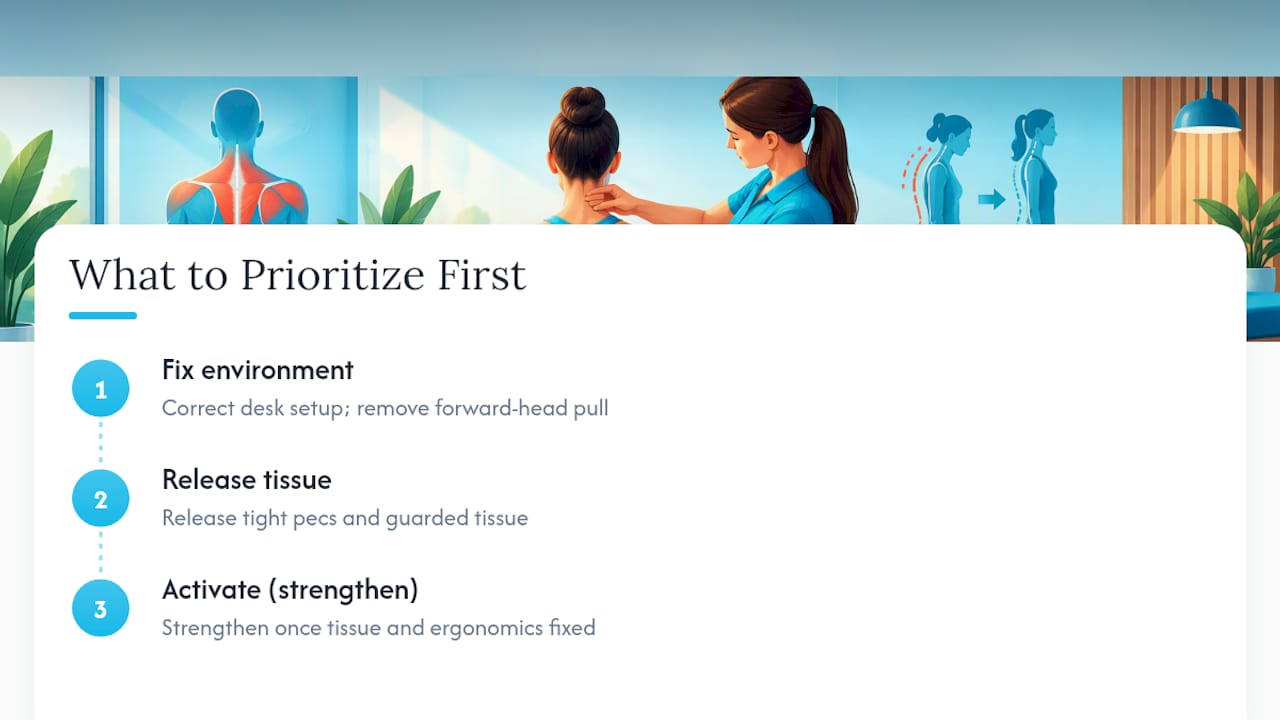
Where conventional advice falls short is sequencing. Handing someone a strengthening sheet without addressing tight, guarded tissue first is like trying to build on a foundation that’s still shifting. The inhibit-then-activate order isn’t a nice-to-have, it’s the difference between exercises that hold and exercises that get abandoned after two frustrating weeks.
If you take one thing from this, prioritize the release and ergonomics pieces before you obsess over rep counts. A tight pec that never gets released will out-tighten hundreds of trapezius rows over the month, and a desk setup that pulls your head forward all day will erode any home program run through it. Fix the environment and the tissue guarding first. The strengthening finally has a chance to hold once those pieces are in place.
— Chris
Ready for Hands-On Help With Your Posture?
If you’ve been consistent with a home routine for a few weeks and the tightness or pain hasn’t budged, that’s usually the signal to bring in hands-on care rather than adding more sets. A clinic specializing in this field treats upper crossed syndrome using hands-on therapy to release guarded chest and neck tissue, paired with tailored rehab plans that pick up exactly where your home exercises stall.

A first visit typically includes a movement and posture assessment, targeted fascial work where tissue is restricted, and a plan for progressive strengthening you can build on at home. Depending on how irritated the tissue is, some patients feel looser within a session or two, while full postural correction runs several weeks alongside consistent home exercise. Beyond manual release, the clinic also offers dry needling and focused shockwave therapy for tissue that hasn’t responded to standard soft-tissue work. If your neck and shoulders have plateaued on their own, book an evaluation with Thetxroom and get a plan built around what your specific assessment shows.
Selected Evidence and Clinical Resources
The claims above draw on a meta-analysis of corrective exercise trials, a multimodal treatment RCT, a narrative systematic review of combined treatment approaches, and workplace ergonomics recommendations for sustaining results.
This article is general information, not a substitute for advice from a qualified doctor. Consult a qualified healthcare professional about your own circumstances before acting on anything here.
FAQ
How long does it take to correct upper crossed syndrome?
Postural angles often start improving within a few weeks of consistent daily practice, but full correction, especially of pain and function, tends to take longer since the multimodal trial measured meaningful change over four weeks with a combined program. Chronic cases with high tissue irritability usually need clinic support to move faster than home exercise alone allows.
How long does it take to fix a related lower crossed pattern?
Lower crossed syndrome, which affects the hips and lower back rather than the neck and shoulders, generally follows a similar inhibit-then-activate timeline, with initial mobility gains in a few weeks and fuller correction over a couple of months. Consistency with both the exercise and the postural habit changes matters more than the exact timeframe.
What is the best exercise for neck and shoulder pain from poor posture?
Craniocervical flexion, the gentle chin nod that activates the deep neck flexors, is one of the most consistently recommended exercises for neck-related postural pain because it directly targets the muscle group that goes weak in upper crossed syndrome. Pairing it with scapular retraction rows for the mid-back tends to produce better results than either exercise alone.
What exercises help with upper crossed syndrome specifically?
The core exercises are pec stretching and self-release, levator scapulae and upper trap stretching, deep neck flexor activation, scapular retraction rows, prone Ys, and serratus wall slides, done in that release-then-activate order. Skipping the release phase and jumping straight to strengthening is the most common reason people don’t see results.
When should I see a chiropractor instead of just doing exercises at home?
See a clinician if pain persists past several weeks of consistent home exercise, if tissue feels too tight or sensitive to stretch without pain, or if you notice numbness, tingling, or weakness down an arm. Chiropractic care that combines manual therapy with a progressive exercise plan tends to move faster than home exercise alone in these harder cases.